




Pengfei Li
@pengfeili.bsky.social
Assistant professor at Nanjing University. Humboldt fellow previously @AIP. Work on dynamics of galaxies and galaxy clusters.
Pinned
Pengfei Li
@pengfeili.bsky.social
· Nov 27
A (dark matter) Space Oddity:
We have an exciting new paper led by @pengfeili.bsky.social: arxiv.org/abs/2511.17705
He used the best data on the Milky Way rotation curve from Gaia to infer not the current, but the *primordial* dark-matter halo of the Galaxy.
And it is quite odd. 🧪🔭☄️
1/6
We have an exciting new paper led by @pengfeili.bsky.social: arxiv.org/abs/2511.17705
He used the best data on the Milky Way rotation curve from Gaia to infer not the current, but the *primordial* dark-matter halo of the Galaxy.
And it is quite odd. 🧪🔭☄️
1/6

The odd primordial halo of the Milky Way implied by Gaia. A shallow core, but a steep decline
Primordial dark matter halos are well understood from cold dark matter-only simulations. Since they can contract significantly as baryons settle into their centers, direct comparisons with observed ga...
arxiv.org
Please check the great summary of our new paper, inferring the primordial dark matter halos from observations.
An interesting post for our new paper.
The primordial dark matter halo of the Milky Way had a mass distribution nothing like what we expect in LCDM.
tritonstation.com/2025/12/01/t...
tritonstation.com/2025/12/01/t...
tritonstation.com
December 3, 2025 at 12:06 PM
An interesting post for our new paper.
Reposted by Pengfei Li

We infer the initial density profile of the dark matter halo of the Galaxy from the Gaia rotation curve, assessing the adiabatic compression that would be induced by plausible baryonic mass models. The data want a primordial halo with a core & rapid outer fall-off, unlike NFW as expected in LCDM.

The odd primordial halo of the Milky Way implied by Gaia. A shallow core, but a steep decline. Pengfei Li et. al. https://arxiv.org/abs/2511.17705
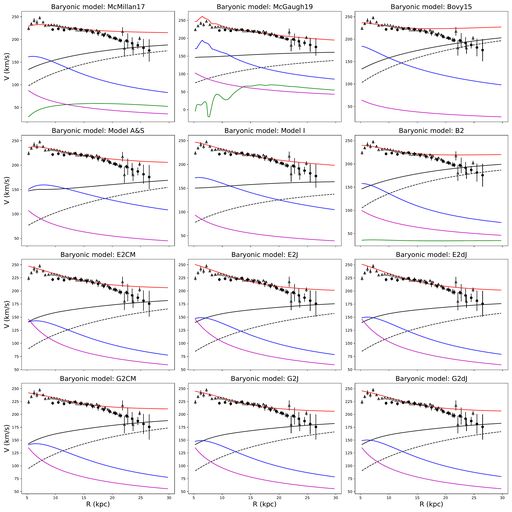


November 25, 2025 at 9:50 AM
We infer the initial density profile of the dark matter halo of the Galaxy from the Gaia rotation curve, assessing the adiabatic compression that would be induced by plausible baryonic mass models. The data want a primordial halo with a core & rapid outer fall-off, unlike NFW as expected in LCDM.
Here is the press release.

Nanjing Univ. press release: Our Galaxy’s Primordial Dark Matter Halo is a Major Oddity
astronomy.nju.edu.cn/EN/NewsEvent...
Article by Li et al.: www.aanda.org/10.1051/0004...
astronomy.nju.edu.cn/EN/NewsEvent...
Article by Li et al.: www.aanda.org/10.1051/0004...
天文与空间科学学院 News & Events
Scientists reverse-engineer our Galaxy’s primordial dark matter halo for the first time, and it is nothing like cold dark matter halos.
astronomy.nju.edu.cn
November 27, 2025 at 3:37 AM
Here is the press release.
Please check the great summary of our new paper, inferring the primordial dark matter halos from observations.
A (dark matter) Space Oddity:
We have an exciting new paper led by @pengfeili.bsky.social: arxiv.org/abs/2511.17705
He used the best data on the Milky Way rotation curve from Gaia to infer not the current, but the *primordial* dark-matter halo of the Galaxy.
And it is quite odd. 🧪🔭☄️
1/6
We have an exciting new paper led by @pengfeili.bsky.social: arxiv.org/abs/2511.17705
He used the best data on the Milky Way rotation curve from Gaia to infer not the current, but the *primordial* dark-matter halo of the Galaxy.
And it is quite odd. 🧪🔭☄️
1/6
The odd primordial halo of the Milky Way implied by Gaia. A shallow core, but a steep decline
Primordial dark matter halos are well understood from cold dark matter-only simulations. Since they can contract significantly as baryons settle into their centers, direct comparisons with observed ga...
arxiv.org
November 27, 2025 at 3:32 AM
Please check the great summary of our new paper, inferring the primordial dark matter halos from observations.
Reposted by Pengfei Li

New press release about our new paper led by my PhD student Mariana Pouseiro Júlio! 🔭🧪☄️
English version here: www.aip.de/en/news/dark...
English version here: www.aip.de/en/news/dark...
October 27, 2025 at 10:45 AM
New press release about our new paper led by my PhD student Mariana Pouseiro Júlio! 🔭🧪☄️
English version here: www.aip.de/en/news/dark...
English version here: www.aip.de/en/news/dark...
Reposted by Pengfei Li
Paper day! My PhD student Mariana Júlio, with @readdark.bsky.social, @pengfeili.bsky.social and others, studies the internal dynamics of dwarf galaxies and finds they don't agree with the Radial Acceleration Relation, challenging the dark matter alternative MOND.
arxiv.org/abs/2510.06905
🔭☄️🧪
1/7
arxiv.org/abs/2510.06905
🔭☄️🧪
1/7
The radial acceleration relation at the EDGE of galaxy formation: testing its universality in low-mass dwarf galaxies
A tight correlation between the baryonic and observed acceleration of galaxies has been reported over a wide range of mass ($10^8 < M_{\rm bar}/{\rm M}_\odot < 10^{11}$) - the Radial Acceleration Rela...
arxiv.org
October 9, 2025 at 8:55 AM
Paper day! My PhD student Mariana Júlio, with @readdark.bsky.social, @pengfeili.bsky.social and others, studies the internal dynamics of dwarf galaxies and finds they don't agree with the Radial Acceleration Relation, challenging the dark matter alternative MOND.
arxiv.org/abs/2510.06905
🔭☄️🧪
1/7
arxiv.org/abs/2510.06905
🔭☄️🧪
1/7
Reposted by Pengfei Li
Jamie‘s new Nature Astronomy paper on how M31‘s satellite galaxy system is much more asymmetric than typically expected from cosmological simulations is now out on the arXiv, too. 🔭
arxiv.org/abs/2504.08047
arxiv.org/abs/2504.08047

Andromeda's asymmetric satellite system as a challenge to cold dark matter cosmology
The Andromeda galaxy is surrounded by a strikingly asymmetrical distribution of satellite dwarf galaxies aligned towards the Milky Way. The standard model of cosmology predicts that most satellite gal...
arxiv.org
April 14, 2025 at 6:55 AM
Jamie‘s new Nature Astronomy paper on how M31‘s satellite galaxy system is much more asymmetric than typically expected from cosmological simulations is now out on the arXiv, too. 🔭
arxiv.org/abs/2504.08047
arxiv.org/abs/2504.08047
This project is in collaboration with the great eROSITA cluster team led by @esrabulbul.bsky.social and many excellent collaborators including @8minutesold.bsky.social.
November 18, 2024 at 2:56 PM
This project is in collaboration with the great eROSITA cluster team led by @esrabulbul.bsky.social and many excellent collaborators including @8minutesold.bsky.social.
Finally, we check the radial acceleration relation established in galaxies. The three independent mass proxies consistently lead to higher total accelerations than predicted by the RAR. So the discrepancy in clusters seems to be a true problem for the universality of the RAR.

November 18, 2024 at 2:56 PM
Finally, we check the radial acceleration relation established in galaxies. The three independent mass proxies consistently lead to higher total accelerations than predicted by the RAR. So the discrepancy in clusters seems to be a true problem for the universality of the RAR.
Still, the wl-inferred mass is higher than hydrostatic mass by 110% on average. This might be the reason why the latest eRASS1 measurements of sigma_8 present a much higher value than previous estimates. Certainly, we need to run the full cosmological pipeline to confirm.
November 18, 2024 at 2:56 PM
Still, the wl-inferred mass is higher than hydrostatic mass by 110% on average. This might be the reason why the latest eRASS1 measurements of sigma_8 present a much higher value than previous estimates. Certainly, we need to run the full cosmological pipeline to confirm.
However, this is not the right comparison for cosmological purpose. Because when measuring sigma_8 using different cluster mass proxies, one would use their own total mass within their own R500. So here is the right comparison.

November 18, 2024 at 2:56 PM
However, this is not the right comparison for cosmological purpose. Because when measuring sigma_8 using different cluster mass proxies, one would use their own total mass within their own R500. So here is the right comparison.
We also compared our mass estimates with that inferred from weak lensing in Ghirardini et al. (2024). To be fair, we calculated the hydrostatic mass within the same radius as that for weak lensing. We found that weak lensing inferred masses are significantly higher.

November 18, 2024 at 2:56 PM
We also compared our mass estimates with that inferred from weak lensing in Ghirardini et al. (2024). To be fair, we calculated the hydrostatic mass within the same radius as that for weak lensing. We found that weak lensing inferred masses are significantly higher.
There seems to be a trend that the dynamical-to-hydrostatic mass ratio decreases with increasing radius, which might be evidence that galaxies in the outskirts are accreting toward the centers of clusters. But we need more statistics to confirm.

November 18, 2024 at 2:56 PM
There seems to be a trend that the dynamical-to-hydrostatic mass ratio decreases with increasing radius, which might be evidence that galaxies in the outskirts are accreting toward the centers of clusters. But we need more statistics to confirm.
We then compared these two mass proxies. Statistically, there is no significant difference. But at small radii, cluster galaxies provide higher mass estimates than X-ray emitting gas, while at large radii the difference becomes smaller.

November 18, 2024 at 2:56 PM
We then compared these two mass proxies. Statistically, there is no significant difference. But at small radii, cluster galaxies provide higher mass estimates than X-ray emitting gas, while at large radii the difference becomes smaller.
Notice that the slope is 1.296 instead of 1, because there is a radial evolution. The rms scatter is only 0.14 dex. This relation can be viewed as a simplified Jeans equation. It can be used to quickly estimate the total enclosed mass.
November 18, 2024 at 2:56 PM
Notice that the slope is 1.296 instead of 1, because there is a radial evolution. The rms scatter is only 0.14 dex. This relation can be viewed as a simplified Jeans equation. It can be used to quickly estimate the total enclosed mass.
By numerically solving the Jeans equation for the kinematics of member galaxies, we derived their cumulative dynamical masses at some discrete radii. We determined the spatially resolved mass-velocity dispersion relation: log(M_dyn) = 1.296 * log(sigma_los^2 * r_proj/G) - 3.87.

November 18, 2024 at 2:56 PM
By numerically solving the Jeans equation for the kinematics of member galaxies, we derived their cumulative dynamical masses at some discrete radii. We determined the spatially resolved mass-velocity dispersion relation: log(M_dyn) = 1.296 * log(sigma_los^2 * r_proj/G) - 3.87.
From the eROSITA X-ray data, we derived electron number density profiles, temperature profiles, gas mass profiles, and hydrostatic mass profiles. These data are all made public and the link is shared in the paper.

November 18, 2024 at 2:56 PM
From the eROSITA X-ray data, we derived electron number density profiles, temperature profiles, gas mass profiles, and hydrostatic mass profiles. These data are all made public and the link is shared in the paper.
The cluster galaxies are from Kluge et al. (2024), which compiled many different catalogs from the literature. Eventually, we retain 22 clusters that have sufficient number of galaxy spectra for robust statistics.

November 18, 2024 at 2:56 PM
The cluster galaxies are from Kluge et al. (2024), which compiled many different catalogs from the literature. Eventually, we retain 22 clusters that have sufficient number of galaxy spectra for robust statistics.
In this paper, we aim to compare two mass proxies for galaxy clusters: cluster galaxies and intracluster medium. So we need both X-ray data and sufficient number of galaxy spectra. We selected clusters from the latest eRASS1 cluster catalog by Bulbul et al. (2024).

November 18, 2024 at 2:56 PM
In this paper, we aim to compare two mass proxies for galaxy clusters: cluster galaxies and intracluster medium. So we need both X-ray data and sufficient number of galaxy spectra. We selected clusters from the latest eRASS1 cluster catalog by Bulbul et al. (2024).
#Paperday New paper accepted by A&A on the mass measurements and comparisons for eROSITA clusters is available at arxiv.org/abs/2411.09735. One result that might be particularly useful is the spatially resolved mass-velocity dispersion relation. A thread summarizes the paper.
November 18, 2024 at 2:56 PM
#Paperday New paper accepted by A&A on the mass measurements and comparisons for eROSITA clusters is available at arxiv.org/abs/2411.09735. One result that might be particularly useful is the spatially resolved mass-velocity dispersion relation. A thread summarizes the paper.
Reposted by Pengfei Li
Now out: Episode 3 of the dwarf galaxies and cosmology video series produced by AIP PhD students Mariana P. Júlio and Jamie K. Kanehisa. This one interviews Paris Observatory's Yanbin Yang and AIP's Humboldt Fellow @pengfeili.bsky.social on the topic of Dark Matter.
www.youtube.com/watch?v=Z6IU...
www.youtube.com/watch?v=Z6IU...

Dark Matter • IAUS379 | Dr. Pengfei Li & Dr. Yanbin Yang
Dr. Pengfei Li, postdoctoral researcher at the Leibniz Institute for Astrophysics Potsdam (AIP), Germany, and Dr. Yanbin Yang from the Paris Observatory, Fra...
www.youtube.com
February 6, 2024 at 2:28 PM
Now out: Episode 3 of the dwarf galaxies and cosmology video series produced by AIP PhD students Mariana P. Júlio and Jamie K. Kanehisa. This one interviews Paris Observatory's Yanbin Yang and AIP's Humboldt Fellow @pengfeili.bsky.social on the topic of Dark Matter.
www.youtube.com/watch?v=Z6IU...
www.youtube.com/watch?v=Z6IU...
Reposted by Pengfei Li
Check out Ep2 of the interview series on dwarf galaxies, the Local Group & cosmology, shot at our IAU symposium. 🔭🧪 This one interviews the fantastic Tony Sohn about measuring the motion of galaxies. Produced by AIP PhD students J.K. Kanehisa & M.P. Júlio +@pengfeili.bsky.social youtu.be/vTAbQw78GIE

Measuring the motion of galaxies • IAUS379 | Dr. Tony Sohn
Dr. Tony Sohn from the Space Telescope Science Institute, USA, talks about measuring the motion of galaxies that are millions of light years away and of star...
youtu.be
January 11, 2024 at 11:59 AM
Check out Ep2 of the interview series on dwarf galaxies, the Local Group & cosmology, shot at our IAU symposium. 🔭🧪 This one interviews the fantastic Tony Sohn about measuring the motion of galaxies. Produced by AIP PhD students J.K. Kanehisa & M.P. Júlio +@pengfeili.bsky.social youtu.be/vTAbQw78GIE
Reposted by Pengfei Li
Want to learn about astrophysics from international experts? 🔭🧪 Check out this new series of interviews shot at our IAU Symposium #IAUS379. The first video on "Dwarf Galaxies" featuring the fantastic @runningastronomer.bsky.social is online now (next one in January):
www.youtube.com/watch?v=iQJI...
www.youtube.com/watch?v=iQJI...

The smallest galaxies in the Universe • IAUS379 | Dr. Michelle Collins
Dr. Michelle Collins, University of Surrey, UK, answers questions on dwarf galaxies, the smallest and most abundant galaxies in the Universe. Discover what t...
www.youtube.com
December 13, 2023 at 1:12 PM
Want to learn about astrophysics from international experts? 🔭🧪 Check out this new series of interviews shot at our IAU Symposium #IAUS379. The first video on "Dwarf Galaxies" featuring the fantastic @runningastronomer.bsky.social is online now (next one in January):
www.youtube.com/watch?v=iQJI...
www.youtube.com/watch?v=iQJI...
Yeah. Would Iike to enjoy the blue and sunny sky.
December 1, 2023 at 10:38 AM
Yeah. Would Iike to enjoy the blue and sunny sky.