


Isabelle Rosenthal
@neurosenthali.bsky.social
neural engineer working on brain-computer interfaces for motor and sensory function
Caltech Phd ‘23
she/her
Caltech Phd ‘23
she/her
Reviving this account to say that the last paper from my PhD is out in final form!
Here, we look at how the timing of artificial tactile sensations (delivered via intracortical microstimulation/ICMS) is perceived relative to visual cues in two participants with spinal cord injuries. 🧠✋👀
Here, we look at how the timing of artificial tactile sensations (delivered via intracortical microstimulation/ICMS) is perceived relative to visual cues in two participants with spinal cord injuries. 🧠✋👀

Visual context affects the perceived timing of tactile sensations elicited through intracortical microstimulation: a case study of two participants | Journal of Neurophysiology | American Physiologica...
Intracortical microstimulation (ICMS) is a technique to provide tactile sensations for a somatosensory brain-machine interface (BMI). A viable BMI must function within the rich, multisensory environme...
journals.physiology.org
November 24, 2025 at 8:21 PM
Reviving this account to say that the last paper from my PhD is out in final form!
Here, we look at how the timing of artificial tactile sensations (delivered via intracortical microstimulation/ICMS) is perceived relative to visual cues in two participants with spinal cord injuries. 🧠✋👀
Here, we look at how the timing of artificial tactile sensations (delivered via intracortical microstimulation/ICMS) is perceived relative to visual cues in two participants with spinal cord injuries. 🧠✋👀
Reposted by Isabelle Rosenthal
🧠Excited to share our latest ultrasound & neurotech paper @natureportfolio.nature.com
🦾 Our previous papers demonstrated the HOW of an ultrasonic brain-machine interface in monkeys and humans. This paper highlights WHY it works.
🦾 Our previous papers demonstrated the HOW of an ultrasonic brain-machine interface in monkeys and humans. This paper highlights WHY it works.
October 4, 2025 at 3:28 PM
🧠Excited to share our latest ultrasound & neurotech paper @natureportfolio.nature.com
🦾 Our previous papers demonstrated the HOW of an ultrasonic brain-machine interface in monkeys and humans. This paper highlights WHY it works.
🦾 Our previous papers demonstrated the HOW of an ultrasonic brain-machine interface in monkeys and humans. This paper highlights WHY it works.
Reposted by Isabelle Rosenthal

Reposted by Isabelle Rosenthal

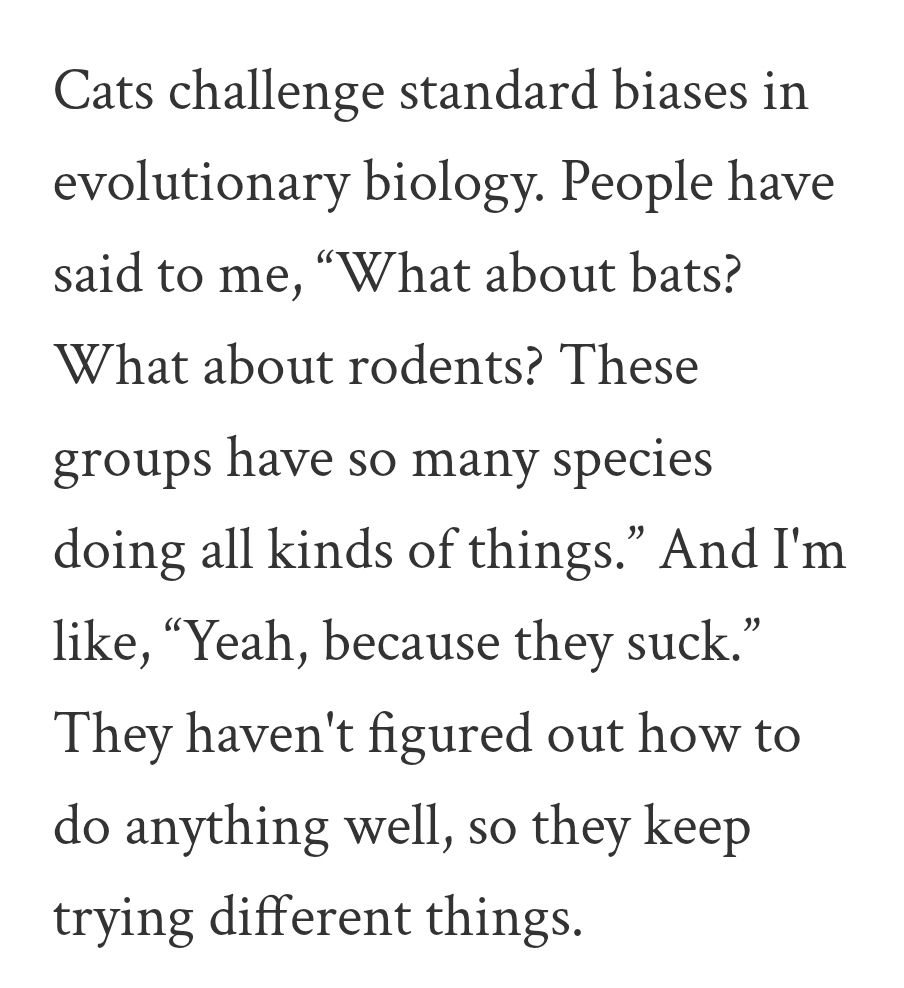
This is the funniest science writeup I've seen in a long time. It's about why cats are so perfectly evolved 🧪
Apparently lots of other animals have "tried to be cats" and the fact that other species have so much more variation is "because they suck" 😆
www.scientificamerican.com/article/cats...
Apparently lots of other animals have "tried to be cats" and the fact that other species have so much more variation is "because they suck" 😆
www.scientificamerican.com/article/cats...
May 18, 2025 at 11:26 PM
This is the funniest science writeup I've seen in a long time. It's about why cats are so perfectly evolved 🧪
Apparently lots of other animals have "tried to be cats" and the fact that other species have so much more variation is "because they suck" 😆
www.scientificamerican.com/article/cats...
Apparently lots of other animals have "tried to be cats" and the fact that other species have so much more variation is "because they suck" 😆
www.scientificamerican.com/article/cats...
Reposted by Isabelle Rosenthal
Congrats to two of the Forest Neurotech team, Tyson Aflalo and Charles Guan on publishing their work from Caltech in Nature Biomedical Engineering!
"Improving Brain–Machine Interfaces with Machine Learning" 🧠⚡️
www.caltech.edu/about/news/i...
"Improving Brain–Machine Interfaces with Machine Learning" 🧠⚡️
www.caltech.edu/about/news/i...
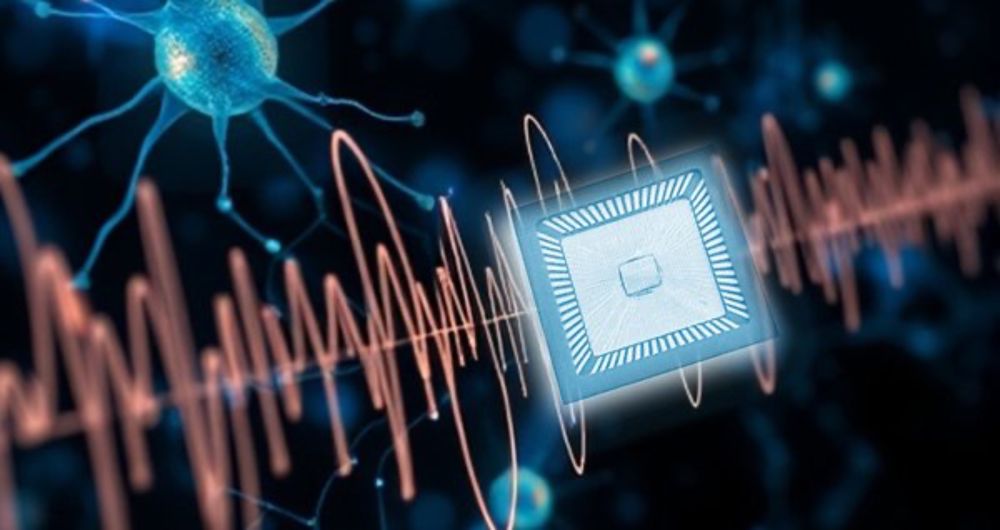
Improving Brain–Machine Interfaces with Machine Learning
Through machine learning, Caltech researchers have improved the performance and lifetime of implants for brain–machine interfaces.
www.caltech.edu
December 9, 2024 at 8:05 PM
Congrats to two of the Forest Neurotech team, Tyson Aflalo and Charles Guan on publishing their work from Caltech in Nature Biomedical Engineering!
"Improving Brain–Machine Interfaces with Machine Learning" 🧠⚡️
www.caltech.edu/about/news/i...
"Improving Brain–Machine Interfaces with Machine Learning" 🧠⚡️
www.caltech.edu/about/news/i...
Reposted by Isabelle Rosenthal

Just a reminder that you can add '-ai' to your google search and it will not show you any AI-generated overviews!
December 3, 2024 at 2:41 AM
Just a reminder that you can add '-ai' to your google search and it will not show you any AI-generated overviews!
Quick introduction since things are taking off around here - I’m Isabelle, a researcher in sensorimotor neural prosthetics. My interests include brain computer interfaces, tactile sensation (real and artificial), neurostimulation, and motor intention 🧠🤖
November 26, 2024 at 6:55 PM
Quick introduction since things are taking off around here - I’m Isabelle, a researcher in sensorimotor neural prosthetics. My interests include brain computer interfaces, tactile sensation (real and artificial), neurostimulation, and motor intention 🧠🤖
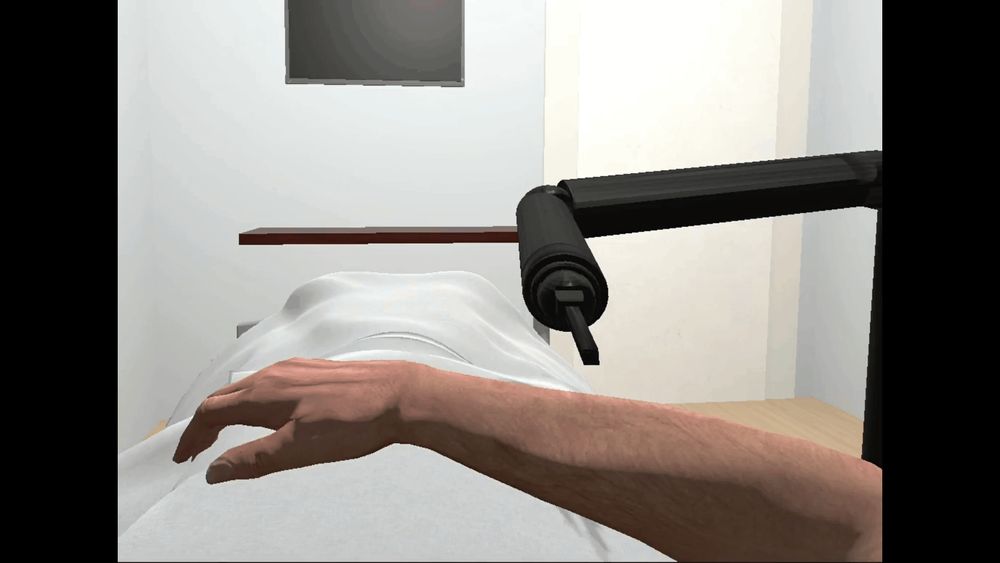
New preprint alert! Interested in human brain-machine interfaces, but wondering how they might work in the real world? We examine how artificial touch sensations are integrated with visual information for a cohesive conscious experience. 1/4
www.biorxiv.org/content/10.1...
www.biorxiv.org/content/10.1...
May 15, 2024 at 2:35 PM
New preprint alert! Interested in human brain-machine interfaces, but wondering how they might work in the real world? We examine how artificial touch sensations are integrated with visual information for a cohesive conscious experience. 1/4
www.biorxiv.org/content/10.1...
www.biorxiv.org/content/10.1...
Happy to have finally made the migration over here! I’m a brain-machine interface researcher working on the neuroscience of tactile sensations 🧠✨ Looking for relevant accounts to follow 👀
November 25, 2023 at 11:34 PM
Happy to have finally made the migration over here! I’m a brain-machine interface researcher working on the neuroscience of tactile sensations 🧠✨ Looking for relevant accounts to follow 👀