




Michael Prinzing
@mprinzing.bsky.social
That would be awesome! Though, could the effect of higher ed on such students be different from the effect on students with more options? E.g., the latter are probably stronger students, which could moderate the effect (consistent with our SAT findings).
February 8, 2026 at 2:26 PM
That would be awesome! Though, could the effect of higher ed on such students be different from the effect on students with more options? E.g., the latter are probably stronger students, which could moderate the effect (consistent with our SAT findings).
Check out the full paper, coauthored with @mvazquez.bsky.social, now in JPSP! psycnet.apa.org/record/2027-...
Or on OSF: osf.io/preprints/ps...
Or on OSF: osf.io/preprints/ps...
APA PsycNet
psycnet.apa.org
January 24, 2026 at 8:35 PM
Check out the full paper, coauthored with @mvazquez.bsky.social, now in JPSP! psycnet.apa.org/record/2027-...
Or on OSF: osf.io/preprints/ps...
Or on OSF: osf.io/preprints/ps...
That said, there are major differences in these within-person changes across majors (e.g., English & arts move most to the left, while business and engineering actually shift right), as well as demographics (e.g., women move leftward more than men), and other individual characteristics

January 24, 2026 at 8:35 PM
That said, there are major differences in these within-person changes across majors (e.g., English & arts move most to the left, while business and engineering actually shift right), as well as demographics (e.g., women move leftward more than men), and other individual characteristics
Since around 2012, grads have increasingly identified as liberal, while non-grads remained steady. And this diploma divide in political ID emerges during college. In the mid-1990s, students did not change their ID during college, but they increasingly have done so since.

January 24, 2026 at 8:35 PM
Since around 2012, grads have increasingly identified as liberal, while non-grads remained steady. And this diploma divide in political ID emerges during college. In the mid-1990s, students did not change their ID during college, but they increasingly have done so since.
Does going to college make people more liberal? Probably yes, but it’s complicated… For decades, US adults with degrees have held more left-leaning views on social issues, but not on economic ones. And, until the 2010s, grads did not *identify* as more liberal than non-grads.
January 24, 2026 at 8:35 PM
Does going to college make people more liberal? Probably yes, but it’s complicated… For decades, US adults with degrees have held more left-leaning views on social issues, but not on economic ones. And, until the 2010s, grads did not *identify* as more liberal than non-grads.
The GOAT of journal submission sites...
December 23, 2025 at 1:22 AM
The GOAT of journal submission sites...
Full paper is open access at Journal of Personality: doi.org/10.1111/jopy...

Is Virtue Good for You?
Introduction Does virtue benefit its possessor, or is it beneficial for others but not the self? We tested two highly influential theories that offer contradictory answers. In particular, we focused...
doi.org
December 19, 2025 at 11:42 PM
Full paper is open access at Journal of Personality: doi.org/10.1111/jopy...
Indeed, we found situations affording opportunities for these virtues are unpleasant. But virtues seem to buffer these situational influences. Compassion, patience, and self-control all showed positive within- and between-person links with (especially eudaimonic aspects of) well-being.

December 19, 2025 at 11:42 PM
Indeed, we found situations affording opportunities for these virtues are unpleasant. But virtues seem to buffer these situational influences. Compassion, patience, and self-control all showed positive within- and between-person links with (especially eudaimonic aspects of) well-being.
Prior studies have found that kindness and generosity increase well-being. But other virtues seem less enjoyable. E.g., compassion is like kindness but involves awareness of suffering/misfortune. Patience requires barriers or frustrations. Self-control involves foregoing present desires.
December 19, 2025 at 11:42 PM
Prior studies have found that kindness and generosity increase well-being. But other virtues seem less enjoyable. E.g., compassion is like kindness but involves awareness of suffering/misfortune. Patience requires barriers or frustrations. Self-control involves foregoing present desires.
Is virtue good for you? Or is it just good for others or society at large? Theories as old as Plato make opposing claims. My coauthors and I tested their predictions in two intensive, longitudinal studies (N = 43,164 obs. from 1,218 participants), focusing on 3 seemingly unpleasant virtues.
December 19, 2025 at 11:42 PM
Is virtue good for you? Or is it just good for others or society at large? Theories as old as Plato make opposing claims. My coauthors and I tested their predictions in two intensive, longitudinal studies (N = 43,164 obs. from 1,218 participants), focusing on 3 seemingly unpleasant virtues.
Hilarious! How about "God be with you"?
December 17, 2025 at 3:06 PM
Hilarious! How about "God be with you"?
I've seen many criticisms of "silicon samples," but always thought it was a bogeyman—like, nobody actually thinks AI participants are a good idea. But now Qualtrics offers "synthetic samples," so at least some people must think this is a reasonable approach. What are the arguments in its favor?
December 17, 2025 at 2:57 PM
I've seen many criticisms of "silicon samples," but always thought it was a bogeyman—like, nobody actually thinks AI participants are a good idea. But now Qualtrics offers "synthetic samples," so at least some people must think this is a reasonable approach. What are the arguments in its favor?
I had a great chat about how studying philosophy can make people better thinkers with @mvazquez.bsky.social, @markalfano.bsky.social, Deborah Mower, and Heather Battaly. Thanks to @apaphilosophy.bsky.social for hosting and making the recording available!
www.apaonline.org/mpage/benefi...
www.apaonline.org/mpage/benefi...

Benefits of Studying Philosophy | APA On DemandAPA Mission - The American Philosophical Association
To activate captions, click on the CC icon at the bottom of the video, then select English from the menu.
www.apaonline.org
August 29, 2025 at 3:40 PM
I had a great chat about how studying philosophy can make people better thinkers with @mvazquez.bsky.social, @markalfano.bsky.social, Deborah Mower, and Heather Battaly. Thanks to @apaphilosophy.bsky.social for hosting and making the recording available!
www.apaonline.org/mpage/benefi...
www.apaonline.org/mpage/benefi...
Reposted by Michael Prinzing

Turns out studying philosophy is actually valuable. Philosophy majors don’t just argue well, they actually become better thinkers and do better on tests.
Data from 600k students shows they outscore every other major on reasoning, curiosity and open-mindedness.
Data from 600k students shows they outscore every other major on reasoning, curiosity and open-mindedness.

Studying philosophy does make people better thinkers, according to new research on more than 600,000 college grads
Philosophers are fond of saying that their field boosts critical thinking. Two of them decided to put that claim to the test.
buff.ly
August 21, 2025 at 8:26 PM
Turns out studying philosophy is actually valuable. Philosophy majors don’t just argue well, they actually become better thinkers and do better on tests.
Data from 600k students shows they outscore every other major on reasoning, curiosity and open-mindedness.
Data from 600k students shows they outscore every other major on reasoning, curiosity and open-mindedness.
I don't know of any, but that's a great question! There's tons of data on college students because institutions collect them. Maybe there's a philosophy for fun organization that could be persuaded to collect data? That would be awesome!
August 9, 2025 at 12:10 PM
I don't know of any, but that's a great question! There's tons of data on college students because institutions collect them. Maybe there's a philosophy for fun organization that could be persuaded to collect data? That would be awesome!
Experiments find effects on PEB on well-being too! They may reflect low impact behaviors, though. That's a nice contribution, consistent with other work on well-being (major life events matter less than daily lifestyle)
journals.sagepub.com/doi/abs/10.1...
onlinelibrary.wiley.com/doi/10.1111/...
journals.sagepub.com/doi/abs/10.1...
onlinelibrary.wiley.com/doi/10.1111/...
August 7, 2025 at 11:20 AM
Experiments find effects on PEB on well-being too! They may reflect low impact behaviors, though. That's a nice contribution, consistent with other work on well-being (major life events matter less than daily lifestyle)
journals.sagepub.com/doi/abs/10.1...
onlinelibrary.wiley.com/doi/10.1111/...
journals.sagepub.com/doi/abs/10.1...
onlinelibrary.wiley.com/doi/10.1111/...
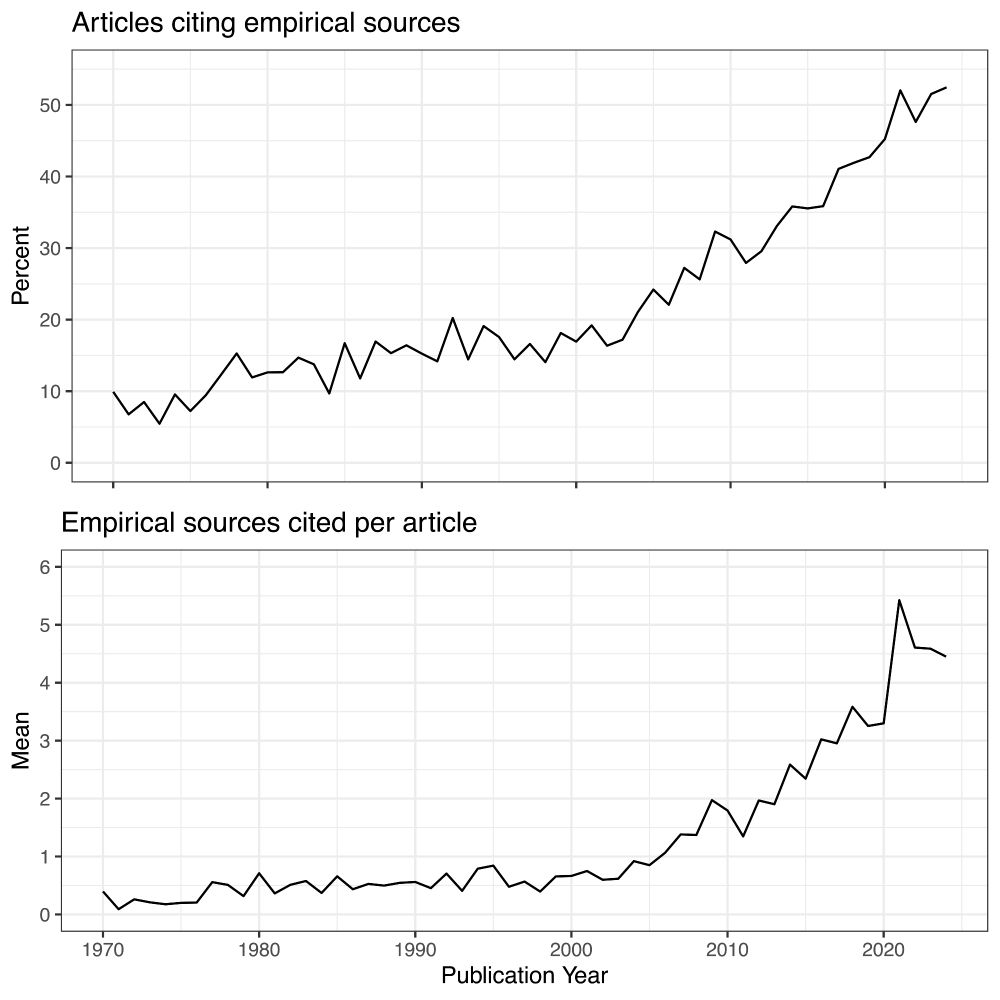
I think you're right! Check it out! In "Leiterific" journals there's been really dramatic growth in citations of empirical sources and references to empirical data, evidence, research, etc. Also, articles citing more empirical sources receive more citations (i.e., are more influential).

July 29, 2025 at 4:18 PM
I think you're right! Check it out! In "Leiterific" journals there's been really dramatic growth in citations of empirical sources and references to empirical data, evidence, research, etc. Also, articles citing more empirical sources receive more citations (i.e., are more influential).
Reposted by Michael Prinzing

Join us for an APA Live event:
The Benefits of Studying Philosophy
Wednesday, August 27, 2025
6 p.m Eastern / 3 p.m. Pacific
Register here: tinyurl.com/4773k45a
The Benefits of Studying Philosophy
Wednesday, August 27, 2025
6 p.m Eastern / 3 p.m. Pacific
Register here: tinyurl.com/4773k45a
American Philosophical Association
The panelists for this event are as follows:
www.apaonline.org
July 14, 2025 at 9:22 AM
Join us for an APA Live event:
The Benefits of Studying Philosophy
Wednesday, August 27, 2025
6 p.m Eastern / 3 p.m. Pacific
Register here: tinyurl.com/4773k45a
The Benefits of Studying Philosophy
Wednesday, August 27, 2025
6 p.m Eastern / 3 p.m. Pacific
Register here: tinyurl.com/4773k45a
Thanks for the suggestions! I'll take a look at the Nisbett chapter. @mvazquez.bsky.social and I reviewed a bunch of older work (going back to the 70s) in another paper, but we may have missed some of this stuff.
July 13, 2025 at 1:43 PM
Thanks for the suggestions! I'll take a look at the Nisbett chapter. @mvazquez.bsky.social and I reviewed a bunch of older work (going back to the 70s) in another paper, but we may have missed some of this stuff.
Same here! In fact, in a prior paper we concluded that there was basically no evidence for anything but self-selection. But these results totally changed my mind!
July 13, 2025 at 1:35 PM
Same here! In fact, in a prior paper we concluded that there was basically no evidence for anything but self-selection. But these results totally changed my mind!
Of course it's not as strong as a randomized experiment, but we think this is really striking evidence that philosophy does make people better thinkers!
The open-access paper is now available in the @apa-journal.bsky.social
doi.org/10.1017/apa....
4/4
The open-access paper is now available in the @apa-journal.bsky.social
doi.org/10.1017/apa....
4/4
Studying Philosophy Does Make People Better Thinkers | Journal of the American Philosophical Association | Cambridge Core
Studying Philosophy Does Make People Better Thinkers
doi.org
July 12, 2025 at 1:21 PM
Of course it's not as strong as a randomized experiment, but we think this is really striking evidence that philosophy does make people better thinkers!
The open-access paper is now available in the @apa-journal.bsky.social
doi.org/10.1017/apa....
4/4
The open-access paper is now available in the @apa-journal.bsky.social
doi.org/10.1017/apa....
4/4
We found that philosophy students outperformed all others on verbal and logical reasoning as well as habits of mind, when controlling for baseline differences (i.e., when students were freshman).
3/4
3/4
Studying Philosophy Does Make People Better Thinkers | Journal of the American Philosophical Association | Cambridge Core
Studying Philosophy Does Make People Better Thinkers
doi.org
July 12, 2025 at 1:21 PM
We found that philosophy students outperformed all others on verbal and logical reasoning as well as habits of mind, when controlling for baseline differences (i.e., when students were freshman).
3/4
3/4
@mvazquez.bsky.social and I analyzed data from over half a million college students, looking at tests of verbal, logical, and mathematical reasoning, plus self-report measures of valuable habits of mind (a mix of curiosity, open-mindedness, intellectual rigor, etc.)
2/4
2/4
Studying Philosophy Does Make People Better Thinkers | Journal of the American Philosophical Association | Cambridge Core
Studying Philosophy Does Make People Better Thinkers
doi.org
July 12, 2025 at 1:21 PM
@mvazquez.bsky.social and I analyzed data from over half a million college students, looking at tests of verbal, logical, and mathematical reasoning, plus self-report measures of valuable habits of mind (a mix of curiosity, open-mindedness, intellectual rigor, etc.)
2/4
2/4
A popular and very old argument for the value of philosophy claims that studying philosophy cultivates important intellectual abilities and dispositions. But empirical evidence for that claim has been hard to come by. Until now!
1/4
1/4
Studying Philosophy Does Make People Better Thinkers | Journal of the American Philosophical Association | Cambridge Core
Studying Philosophy Does Make People Better Thinkers
doi.org
July 12, 2025 at 1:21 PM
A popular and very old argument for the value of philosophy claims that studying philosophy cultivates important intellectual abilities and dispositions. But empirical evidence for that claim has been hard to come by. Until now!
1/4
1/4