



Mike Goodwin
@massspecpro.bsky.social
Senior Scientist @ Thermo (San Jose)




My contribution to the family Christmas sugar cookie designs #teammassspec

December 24, 2025 at 10:18 PM
My contribution to the family Christmas sugar cookie designs #teammassspec
There has recently been another flare up of people bashing quads and saying we should replace them with mobility analysis. I still have a hard time with this argument. The quad has plenty of utility in an instrument with high res mobility. If nothing else it can knock out unwanted charge states.
December 18, 2025 at 1:28 AM
There has recently been another flare up of people bashing quads and saying we should replace them with mobility analysis. I still have a hard time with this argument. The quad has plenty of utility in an instrument with high res mobility. If nothing else it can knock out unwanted charge states.


Reposted by Mike Goodwin

High‐Resolution Ion Mobility as an Alternative to Quadrupole‐Based Precursor Isolation for Reducing Chimeric Fragmentation Spectra in Bottom‐Up Proteomics analyticalsciencejou...
---
#proteomics #prot-paper
---
#proteomics #prot-paper

December 5, 2025 at 8:20 PM
High‐Resolution Ion Mobility as an Alternative to Quadrupole‐Based Precursor Isolation for Reducing Chimeric Fragmentation Spectra in Bottom‐Up Proteomics analyticalsciencejou...
---
#proteomics #prot-paper
---
#proteomics #prot-paper


This has been my exact experience/impression of AI tools in science
Physics and Physicists: ChatGPT and Gemini Can't Do Real Physics Research physicsandphysicists.blogspot.com/2025/11/chat...
Physics and Physicists: ChatGPT and Gemini Can't Do Real Physics Research physicsandphysicists.blogspot.com/2025/11/chat...
ChatGPT and Gemini Can't Do Real Physics Research
A rather interesting post on AI's ability to actually do real physics research that beginning graduate students are expected to do. More th...
physicsandphysicists.blogspot.com
November 26, 2025 at 5:23 AM
This has been my exact experience/impression of AI tools in science
Physics and Physicists: ChatGPT and Gemini Can't Do Real Physics Research physicsandphysicists.blogspot.com/2025/11/chat...
Physics and Physicists: ChatGPT and Gemini Can't Do Real Physics Research physicsandphysicists.blogspot.com/2025/11/chat...


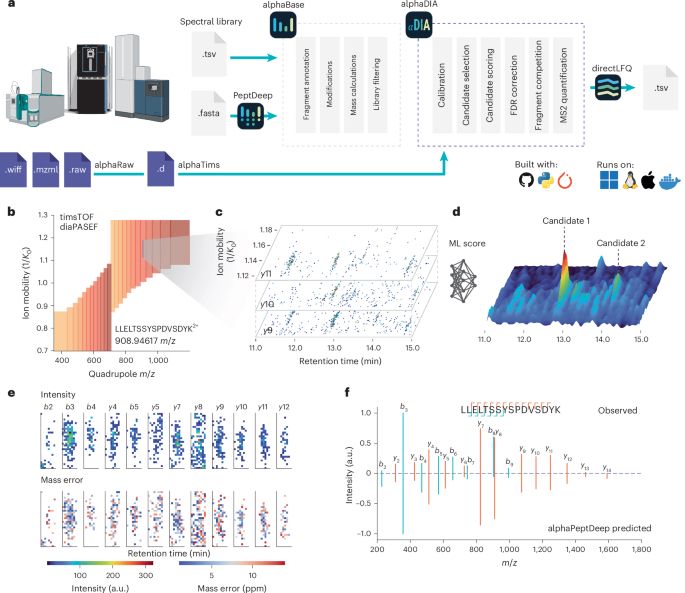
Isn't this the same idea as "boxcar"?
High Dynamic Range Peptide Mass Spectrometry Using Segmented Precursor Ion Accumulation | Analytical Chemistry pubs.acs.org/doi/10.1021/...
High Dynamic Range Peptide Mass Spectrometry Using Segmented Precursor Ion Accumulation | Analytical Chemistry pubs.acs.org/doi/10.1021/...

High Dynamic Range Peptide Mass Spectrometry Using Segmented Precursor Ion Accumulation
Limited sensitivity and depth of proteome sampling in experiments using data-dependent acquisition (DDA) mass spectrometry are usually attributed to an insufficient rate of fragmentation spectra acquisition relative to the number of coeluting potential targets. Here, we demonstrated that limited sensitivity and dynamic range of MS1 scans reduce detection of low-intensity ions and thus their selection for fragmentation. As abundant ions occupy a large fraction of the ion accumulation capacity, we sought to improve MS1 detection of rare analytes by an easily implementable strategy based on gas-phase segmentation of the MS1 scan range, followed by coaccumulation and detection of all ions. The quadrupolar isolation windows used to segment the MS1 scan range are designed to transmit, on average, an equal number of charges, consistent with the parameter used by many recent mass spectrometers to regulate ion trap filling. This strategy, which we named high dynamic range MS1 (HDR-MS1), reduces the contribution of abundant ions to reaching the maximum ion capacity. As a result, HDR MS1 showed improved dynamic range and sensitivity compared to conventional full-range scans, resulting in a higher number of peptides and protein identifications under identical MS2 parameters, less redundant precursor ion sampling, and a higher rate of quantified precursor ions. HDR MS1 scans are compatible with any DDA precursor selection filter and MS2 parameter, and the generated files can be analyzed using any software for peptide-spectral matching and quantification.
pubs.acs.org
October 16, 2025 at 2:17 PM
Isn't this the same idea as "boxcar"?
High Dynamic Range Peptide Mass Spectrometry Using Segmented Precursor Ion Accumulation | Analytical Chemistry pubs.acs.org/doi/10.1021/...
High Dynamic Range Peptide Mass Spectrometry Using Segmented Precursor Ion Accumulation | Analytical Chemistry pubs.acs.org/doi/10.1021/...
