


Dr. Elizabeth Santos
@lizmillermacroevo.bsky.social
Assistant Professor @ The Ohio State University.
Phylogenetics, biogeography, ichthyology, anglerfish toucher.
https://elizabethcmiller.weebly.com/
Phylogenetics, biogeography, ichthyology, anglerfish toucher.
https://elizabethcmiller.weebly.com/
Pinned
Ohio State news piece on our deep-sea fish body shape study:
news.osu.edu/how-fishes-o...
news.osu.edu/how-fishes-o...
Reposted by Dr. Elizabeth Santos

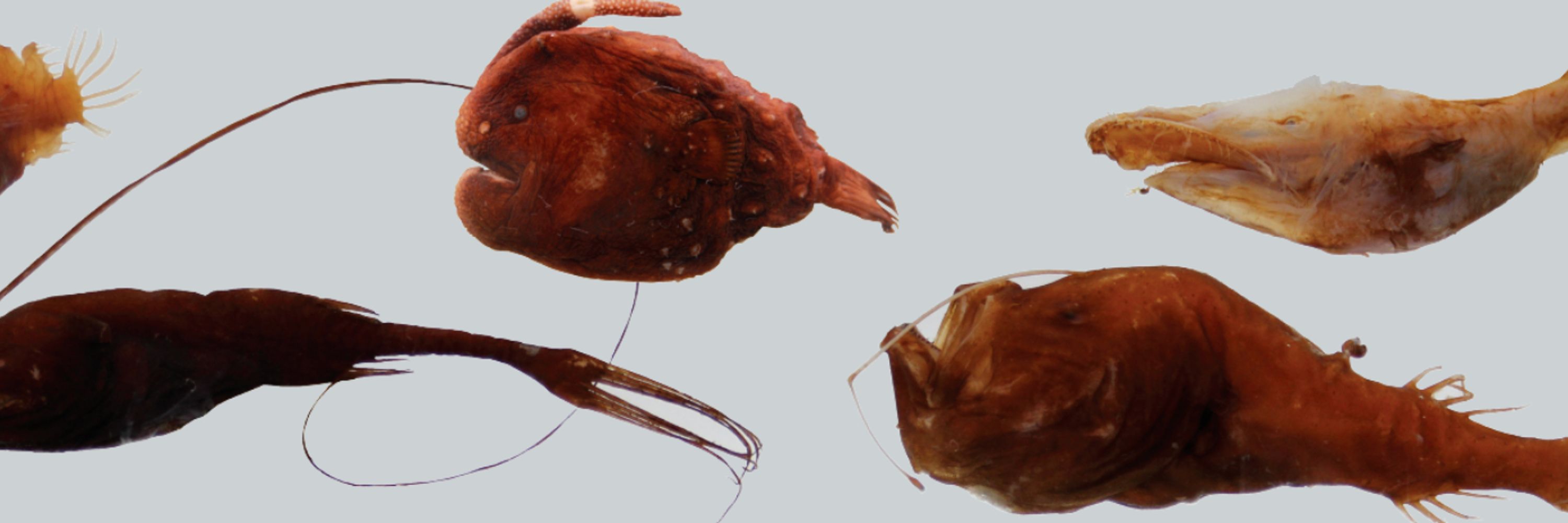
We haven't seen much in the fish department during the current expedition so here's a Sladenia with its dingle dangle sticking up from @schmidtocean.bsky.social dive 389 when they were exploring Osprey Reef, Australia in 2020. #visioningcoralsea #ozoceans2020
February 13, 2026 at 10:51 PM
We haven't seen much in the fish department during the current expedition so here's a Sladenia with its dingle dangle sticking up from @schmidtocean.bsky.social dive 389 when they were exploring Osprey Reef, Australia in 2020. #visioningcoralsea #ozoceans2020
Reposted by Dr. Elizabeth Santos
[New Paper] @currentbiology.bsky.social presents our population genomics study of the iconic Scaly-foot Snail: 125 genomes from 8 Indian Ocean hot vents! Deep currents drive South→North gene flow, while transform faults act as dispersal barriers.
READ FOR FREE: authors.elsevier.com/c/1mbW73QW8S...
READ FOR FREE: authors.elsevier.com/c/1mbW73QW8S...

February 11, 2026 at 11:48 PM
[New Paper] @currentbiology.bsky.social presents our population genomics study of the iconic Scaly-foot Snail: 125 genomes from 8 Indian Ocean hot vents! Deep currents drive South→North gene flow, while transform faults act as dispersal barriers.
READ FOR FREE: authors.elsevier.com/c/1mbW73QW8S...
READ FOR FREE: authors.elsevier.com/c/1mbW73QW8S...
Reposted by Dr. Elizabeth Santos
🚨 Hot off the press: Our look into of the palaeontological database landscape and its sustainability into the future.
Palaeo databases are invaluable and continue to transform our research field - but they are vulnerable... (1/6) 🧪 ⛏️
www.nature.com/articles/s41...
Palaeo databases are invaluable and continue to transform our research field - but they are vulnerable... (1/6) 🧪 ⛏️
www.nature.com/articles/s41...

The billion-dollar case for sustaining palaeontology’s digital databases - Nature Ecology & Evolution
The authors survey community palaeontological databases, documenting their contributions to science as well as their vulnerabilities, and provide recommendations for the future of open science databas...
www.nature.com
February 11, 2026 at 2:10 PM
🚨 Hot off the press: Our look into of the palaeontological database landscape and its sustainability into the future.
Palaeo databases are invaluable and continue to transform our research field - but they are vulnerable... (1/6) 🧪 ⛏️
www.nature.com/articles/s41...
Palaeo databases are invaluable and continue to transform our research field - but they are vulnerable... (1/6) 🧪 ⛏️
www.nature.com/articles/s41...
Reposted by Dr. Elizabeth Santos
When I started my PhD ~10 years ago, only 2/5 echinoderm groups (the star-shaped sea stars and brittle stars) had genome-scale phylogenetic datasets. I am proud to say that the quest to complete the clade is now over
doi.org/10.1098/rsos...
doi.org/10.1098/rsos...

Phylogenomics of extant Crinoidea (Echinodermata) reveals extensive morphological homoplasies and a Permian origin
Abstract. Crinoids have Ordovician origins and are unique among living echinoderms in their attachment to the substrate. Most diversity is within Comatulid
doi.org
February 11, 2026 at 10:58 AM
When I started my PhD ~10 years ago, only 2/5 echinoderm groups (the star-shaped sea stars and brittle stars) had genome-scale phylogenetic datasets. I am proud to say that the quest to complete the clade is now over
doi.org/10.1098/rsos...
doi.org/10.1098/rsos...
Reposted by Dr. Elizabeth Santos
The Church Evolution Lab (CEL@NYU) is hiring a postdoc! We have several new projects to study the genomic basis of biodiversity in model clades – especially Hawaiian Drosophila. apply.interfolio.com/179354
Come join our new group, you can study bugs and live in NYC! Feel free to share widely!
Come join our new group, you can study bugs and live in NYC! Feel free to share widely!

December 22, 2025 at 2:30 PM
The Church Evolution Lab (CEL@NYU) is hiring a postdoc! We have several new projects to study the genomic basis of biodiversity in model clades – especially Hawaiian Drosophila. apply.interfolio.com/179354
Come join our new group, you can study bugs and live in NYC! Feel free to share widely!
Come join our new group, you can study bugs and live in NYC! Feel free to share widely!
Reposted by Dr. Elizabeth Santos

Deep sea folks. Hope you like! doi.org/10.1098/rstb... @deepstewardship.bsky.social @dsbsoc.bsky.social

Delayed Anthropocene in the deep-sea biosphere: a last paradise soon lost?
Abstract. The deep sea remains a last paradise and the place of minimal human impacts compared with other ecosystems. However, this pristine status is rapi
doi.org
February 6, 2026 at 3:58 AM
Deep sea folks. Hope you like! doi.org/10.1098/rstb... @deepstewardship.bsky.social @dsbsoc.bsky.social
Reposted by Dr. Elizabeth Santos
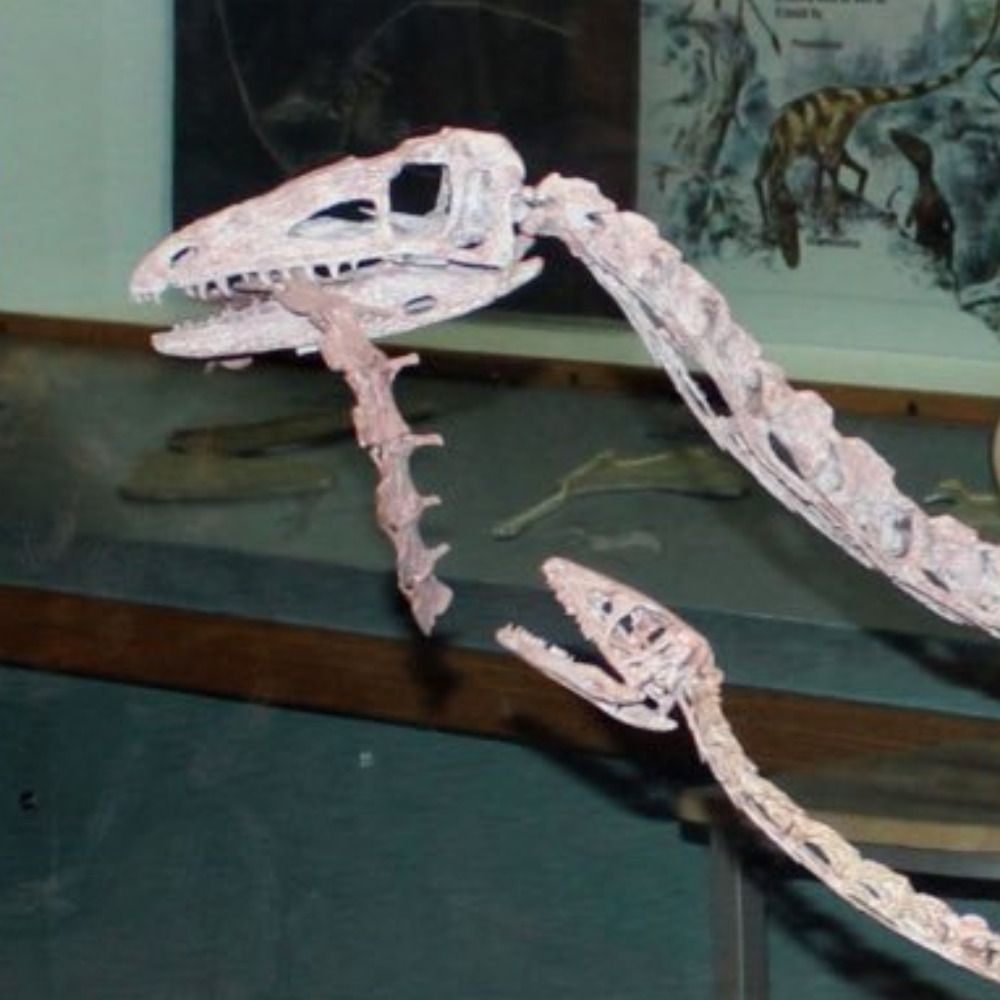
The Rite of Spring is such a spectacular sequence, easily the highpoint of Fantasia even if I put aside my biases. It's a comprehensive, spellbinding look into an imagining of the past that never was. Anyone interested in the history of palaeontology simply must watch it.

The Rite of Spring segment from Fantasia goes so hard for being 86 years old.

February 6, 2026 at 7:17 PM
The Rite of Spring is such a spectacular sequence, easily the highpoint of Fantasia even if I put aside my biases. It's a comprehensive, spellbinding look into an imagining of the past that never was. Anyone interested in the history of palaeontology simply must watch it.
Reposted by Dr. Elizabeth Santos
guess who's back, back again. NSF PRFB!
if you want to address interesting problems in global change biology and the ever thorny problem of what limits species' elevational ranges, and are interested in a postdoc, please do reach out.
www.nsf.gov/funding/oppo...
if you want to address interesting problems in global change biology and the ever thorny problem of what limits species' elevational ranges, and are interested in a postdoc, please do reach out.
www.nsf.gov/funding/oppo...

Postdoctoral Research Fellowships in Biology (PRFB)
www.nsf.gov
February 6, 2026 at 1:31 AM
guess who's back, back again. NSF PRFB!
if you want to address interesting problems in global change biology and the ever thorny problem of what limits species' elevational ranges, and are interested in a postdoc, please do reach out.
www.nsf.gov/funding/oppo...
if you want to address interesting problems in global change biology and the ever thorny problem of what limits species' elevational ranges, and are interested in a postdoc, please do reach out.
www.nsf.gov/funding/oppo...
Reposted by Dr. Elizabeth Santos
Not emphasized in this story: OSU has seen more (and more competitive) undergraduate & graduate applicants, better retention and graduation rates, increased research output and federal funding, and higher ranking concomitant with this more diverse faculty.

One professor described being on a committee that had decided to hire a white male finalist over a white female finalist. “Oh, the department is gonna be angry about this. How are we going to justify the fact that we’re picking the white man, as opposed to the white woman?” https://chroni.cl/4r5utNu

How Colleges’ Pursuit of a Diverse Professoriate Came Back to Bite Them
What was once an urgent imperative has become a legal and political liability. One university’s experience shows how.
www.chronicle.com
February 5, 2026 at 10:54 PM
Not emphasized in this story: OSU has seen more (and more competitive) undergraduate & graduate applicants, better retention and graduation rates, increased research output and federal funding, and higher ranking concomitant with this more diverse faculty.
Reposted by Dr. Elizabeth Santos
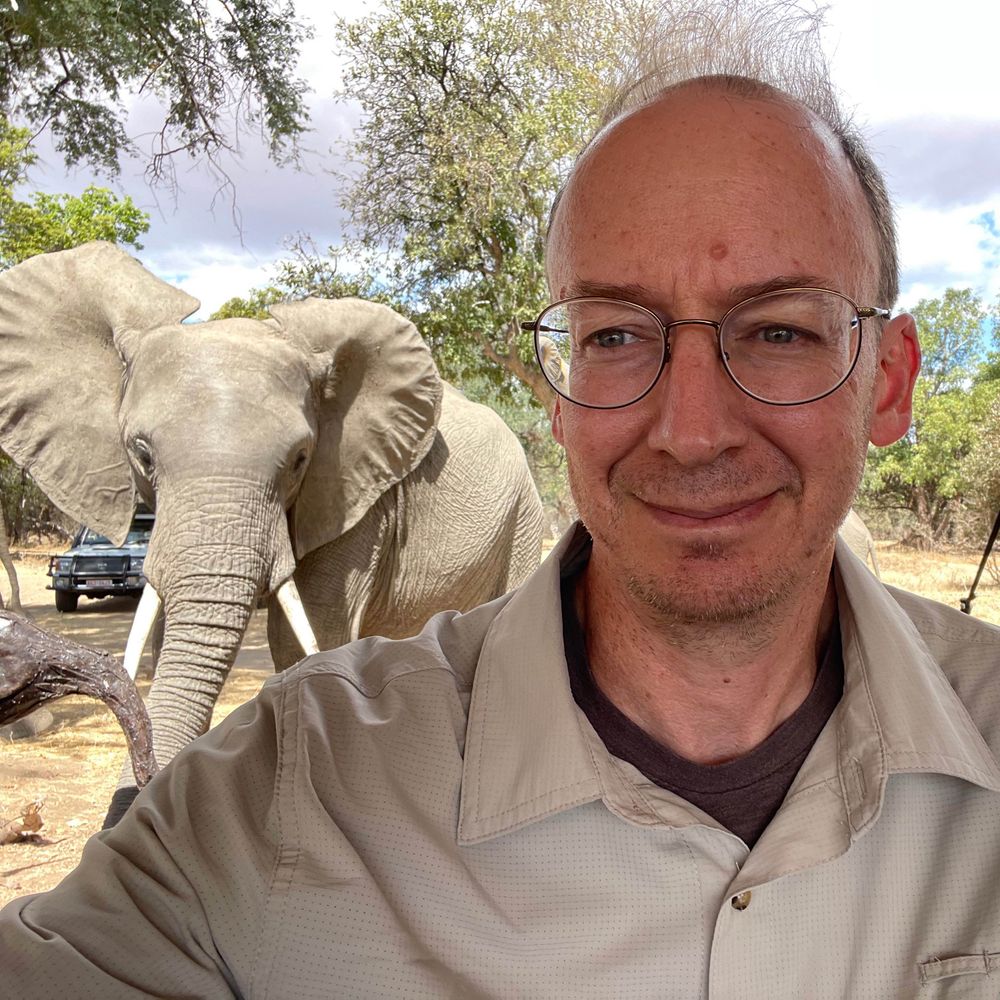
New preprint from our big collaborative evolution experiment in 9 whole lakes in Alaska, written by McGill grad student @lucaseckert.bsky.social
www.biorxiv.org/content/10.6...
What happens if you put a mixture of multiple source populations together to complete & evolve in multiple new lakes?
www.biorxiv.org/content/10.6...
What happens if you put a mixture of multiple source populations together to complete & evolve in multiple new lakes?

February 5, 2026 at 8:41 PM
New preprint from our big collaborative evolution experiment in 9 whole lakes in Alaska, written by McGill grad student @lucaseckert.bsky.social
www.biorxiv.org/content/10.6...
What happens if you put a mixture of multiple source populations together to complete & evolve in multiple new lakes?
www.biorxiv.org/content/10.6...
What happens if you put a mixture of multiple source populations together to complete & evolve in multiple new lakes?
Reposted by Dr. Elizabeth Santos
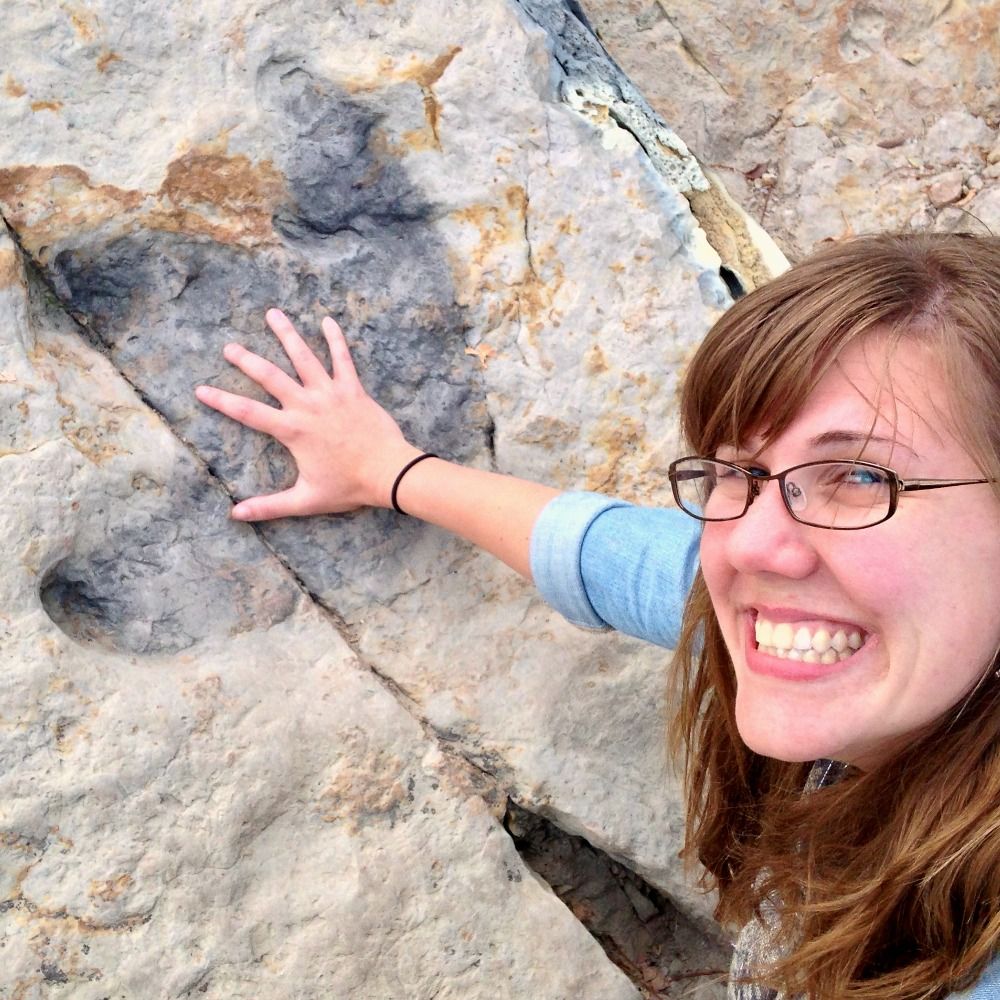
New paper with @peterjwagner3.bsky.social, @wrightam.bsky.social, Jen Bauer, and Maggie Limbeck!
www.cambridge.org/core/journal...
www.cambridge.org/core/journal...
Exploring rates of change and modes of evolution in blastozoan echinoderms | Paleobiology | Cambridge Core
Exploring rates of change and modes of evolution in blastozoan echinoderms
www.cambridge.org
February 2, 2026 at 3:17 PM
New paper with @peterjwagner3.bsky.social, @wrightam.bsky.social, Jen Bauer, and Maggie Limbeck!
www.cambridge.org/core/journal...
www.cambridge.org/core/journal...
Reposted by Dr. Elizabeth Santos
From 1,750–2,000 m deep, we collected one of the rarest deepsea fishes out there: a one-jaw eel (family Monognathidae). Only ~100 specimens of this group are known worldwide and we hold the largest collection (~46), most just a few inches long… The one we collected though, 6 inches or 154 mm!

February 2, 2026 at 12:39 PM
From 1,750–2,000 m deep, we collected one of the rarest deepsea fishes out there: a one-jaw eel (family Monognathidae). Only ~100 specimens of this group are known worldwide and we hold the largest collection (~46), most just a few inches long… The one we collected though, 6 inches or 154 mm!
Reposted by Dr. Elizabeth Santos
If you are a student whose NSF GRFP application was returned without review for vague 'eligibility' reasons:
1) Let your department chair & Graduate School know. Encourage them to contact NSF & congress
2) Write to your congressional reps.
3) Write to grfp@nsf.gov to request re-consideration;
1) Let your department chair & Graduate School know. Encourage them to contact NSF & congress
2) Write to your congressional reps.
3) Write to grfp@nsf.gov to request re-consideration;
January 30, 2026 at 5:15 PM
If you are a student whose NSF GRFP application was returned without review for vague 'eligibility' reasons:
1) Let your department chair & Graduate School know. Encourage them to contact NSF & congress
2) Write to your congressional reps.
3) Write to grfp@nsf.gov to request re-consideration;
1) Let your department chair & Graduate School know. Encourage them to contact NSF & congress
2) Write to your congressional reps.
3) Write to grfp@nsf.gov to request re-consideration;
Reposted by Dr. Elizabeth Santos

The deep-sea experts in MBARI’s Video Lab comb through our treasure trove of video footage to identify and label the animals and objects we film. Their hard work and dedication often reveal an extraordinary moment—like this rare encounter captured in Monterey Bay: youtu.be/9R_uimLA7ik?...

Meet the manefish: A rare and intriguing little deep-sea fish with dance moves
YouTube video by MBARI (Monterey Bay Aquarium Research Institute)
youtu.be
January 29, 2026 at 8:58 PM
The deep-sea experts in MBARI’s Video Lab comb through our treasure trove of video footage to identify and label the animals and objects we film. Their hard work and dedication often reveal an extraordinary moment—like this rare encounter captured in Monterey Bay: youtu.be/9R_uimLA7ik?...
Reposted by Dr. Elizabeth Santos

Second PhD paper is out! We find: 1) aquatic and terrestrial salamanders have different limb bone adaptations, 2) complex life cycles promote different traits, 3) decoupling of external and internal bone traits increase diversity.
Thread (1/8) and FREE link below! 🦎🧪
doi.org/10.1111/joa....
Thread (1/8) and FREE link below! 🦎🧪
doi.org/10.1111/joa....

Habitat and complex life cycles promote morphological diversity in salamander limb bones
We examined the external shape and cross-sectional morphology of limb bones in 133 salamander species spanning the ecological and phylogenetic breadth of Caudata. We find that adaptations for aquatic...
doi.org
January 28, 2026 at 8:28 PM
Second PhD paper is out! We find: 1) aquatic and terrestrial salamanders have different limb bone adaptations, 2) complex life cycles promote different traits, 3) decoupling of external and internal bone traits increase diversity.
Thread (1/8) and FREE link below! 🦎🧪
doi.org/10.1111/joa....
Thread (1/8) and FREE link below! 🦎🧪
doi.org/10.1111/joa....
Reposted by Dr. Elizabeth Santos

Could #deepsea fishing put tuna on the hook? 🎣
Our latest research led @whoi.edu (current: @mbarinews.bsky.social) suggests harvesting #twilightzone fish may weaken tuna stocks and existing fisheries. Check out the paper to explore ecological 🐟 and economic 💵 trade-offs
phys.org/news/2026-01...
Our latest research led @whoi.edu (current: @mbarinews.bsky.social) suggests harvesting #twilightzone fish may weaken tuna stocks and existing fisheries. Check out the paper to explore ecological 🐟 and economic 💵 trade-offs
phys.org/news/2026-01...

Deep-sea fishing could undermine valuable tuna fisheries
A new study led by scientists at Woods Hole Oceanographic Institution (WHOI), along with international partners, finds that proposed commercial fishing in the deep ocean could have serious consequence...
phys.org
January 28, 2026 at 6:57 PM
Could #deepsea fishing put tuna on the hook? 🎣
Our latest research led @whoi.edu (current: @mbarinews.bsky.social) suggests harvesting #twilightzone fish may weaken tuna stocks and existing fisheries. Check out the paper to explore ecological 🐟 and economic 💵 trade-offs
phys.org/news/2026-01...
Our latest research led @whoi.edu (current: @mbarinews.bsky.social) suggests harvesting #twilightzone fish may weaken tuna stocks and existing fisheries. Check out the paper to explore ecological 🐟 and economic 💵 trade-offs
phys.org/news/2026-01...
Reposted by Dr. Elizabeth Santos

Yes, undergrads can apply. It is a very intensive course and convincing us you can commit to a program that gives 9 graduate credits in five weeks is key. It is a solid 40 hour week. It is aimed at postbacs, grad students, and postdocs. But some of our best students have been undergrads.
January 16, 2026 at 4:02 AM
Yes, undergrads can apply. It is a very intensive course and convincing us you can commit to a program that gives 9 graduate credits in five weeks is key. It is a solid 40 hour week. It is aimed at postbacs, grad students, and postdocs. But some of our best students have been undergrads.
Reposted by Dr. Elizabeth Santos
🚨NEW PAPER OUT🚨
The anatomy of bird lower jaw bones has been understudied...until now! Here, we examine avian mandibular anatomy, answering some and raising more questions about the phylogenetic affinities of key early crown-group birds. Read on!
link.springer.com/article/10.1...
The anatomy of bird lower jaw bones has been understudied...until now! Here, we examine avian mandibular anatomy, answering some and raising more questions about the phylogenetic affinities of key early crown-group birds. Read on!
link.springer.com/article/10.1...

Mandibular morphology clarifies phylogenetic relationships near the origin of crown birds - BMC Ecology and Evolution
Background The phylogenetic relationships of fossil birds near the origin of the avian crown group remain debated, in part due to a limited amount of character evidence from incomplete fossils. The av...
link.springer.com
January 28, 2026 at 2:50 PM
🚨NEW PAPER OUT🚨
The anatomy of bird lower jaw bones has been understudied...until now! Here, we examine avian mandibular anatomy, answering some and raising more questions about the phylogenetic affinities of key early crown-group birds. Read on!
link.springer.com/article/10.1...
The anatomy of bird lower jaw bones has been understudied...until now! Here, we examine avian mandibular anatomy, answering some and raising more questions about the phylogenetic affinities of key early crown-group birds. Read on!
link.springer.com/article/10.1...
Reposted by Dr. Elizabeth Santos
MAJOR NEWS! We just launched an awesome new tool! The illustrated Birds of the World Phylogeny Explorer lets users trace any bird’s lineage, compare species relationships, and explore major evolutionary milestones with a click of a button. SHARE and EXPLORE! birdsoftheworld.org/bow/news/phy...

January 27, 2026 at 1:26 AM
MAJOR NEWS! We just launched an awesome new tool! The illustrated Birds of the World Phylogeny Explorer lets users trace any bird’s lineage, compare species relationships, and explore major evolutionary milestones with a click of a button. SHARE and EXPLORE! birdsoftheworld.org/bow/news/phy...
Reposted by Dr. Elizabeth Santos

OMG I'm in IFLScience!

Where Can You Find A One-Of-A-Kind Pocket Shark Among 8 Million Pickled Fish? Louisiana's WWII Bunkers, Of Course
The largest collection of its kind includes a specimen you won't find anywhere else on Earth.
www.iflscience.com
January 22, 2026 at 4:29 PM
OMG I'm in IFLScience!
Reposted by Dr. Elizabeth Santos

Our new paper is online! We found that 1) today's shark & ray diversity was already reached ~100Ma; 2) that the K/Pg extinction was not catastrophic; 3) that the max diversity was reached ~50Ma; and 4) that today's diversity is depleted compared to the past.
www.cell.com/current-biol...
www.cell.com/current-biol...

Revealing the hidden patterns of shark and ray diversity over the past 145 million years
Gardiner et al. reconstruct the diversity of sharks and rays across the past 145 million
years using deep learning and an extensive dataset. Their results unveil previously
hidden patterns, including ...
www.cell.com
January 22, 2026 at 4:41 PM
Our new paper is online! We found that 1) today's shark & ray diversity was already reached ~100Ma; 2) that the K/Pg extinction was not catastrophic; 3) that the max diversity was reached ~50Ma; and 4) that today's diversity is depleted compared to the past.
www.cell.com/current-biol...
www.cell.com/current-biol...
Reposted by Dr. Elizabeth Santos
Fun new paper documenting deep-sea fishes off Puerto Rico. The paper documents some interesting observations, including how diversity changes with depth & even how cusk eels are an important but understudied part of abyssal & hadal communities. 🦑🐟🌊
Read it here: academic.oup.com/icesjms/arti...
Read it here: academic.oup.com/icesjms/arti...

January 22, 2026 at 1:39 PM
Fun new paper documenting deep-sea fishes off Puerto Rico. The paper documents some interesting observations, including how diversity changes with depth & even how cusk eels are an important but understudied part of abyssal & hadal communities. 🦑🐟🌊
Read it here: academic.oup.com/icesjms/arti...
Read it here: academic.oup.com/icesjms/arti...
Reposted by Dr. Elizabeth Santos

One year into Trump's second term, we parse the lasting impact of his policies and executive orders. Here's the first of a four-story package appearing this week. www.science.org/content/arti...

Which of Trump’s upheavals to U.S. science are likely to stick?
A future president could reverse many changes, but greater White House control of science agencies may be here to stay
www.science.org
January 20, 2026 at 10:16 PM
One year into Trump's second term, we parse the lasting impact of his policies and executive orders. Here's the first of a four-story package appearing this week. www.science.org/content/arti...
Reposted by Dr. Elizabeth Santos
This is the most astonishing graph of what the Trump regime has done to US science. They have destroyed the federal science workforce across the board. The negative impacts on Americans will be felt for generations, and the US might never be the same again.
www.nature.com/immersive/d4...
www.nature.com/immersive/d4...

January 20, 2026 at 10:53 PM
This is the most astonishing graph of what the Trump regime has done to US science. They have destroyed the federal science workforce across the board. The negative impacts on Americans will be felt for generations, and the US might never be the same again.
www.nature.com/immersive/d4...
www.nature.com/immersive/d4...
Reposted by Dr. Elizabeth Santos
Becoming a part of the @systbiol.bsky.social community is one of my greatest scientific achievements. I am happy to celebrate this today with a journal cover and a nomination to the editorial team

January 19, 2026 at 11:47 PM
Becoming a part of the @systbiol.bsky.social community is one of my greatest scientific achievements. I am happy to celebrate this today with a journal cover and a nomination to the editorial team