



Julien Gaubil
@jgaubil.bsky.social
PhD student at École Polytechnique
Interested in Computer Vision, Geometry, and learning both at the same time
https://www.jgaubil.com/
Interested in Computer Vision, Geometry, and learning both at the same time
https://www.jgaubil.com/
(this can be fixed by opening the pdf in illustrator then saving again, for anyone having the same problem)
December 1, 2025 at 1:12 PM
(this can be fixed by opening the pdf in illustrator then saving again, for anyone having the same problem)
I had a similar problem when exporting figures created using Figma to pdf format. It's likely due to their export (figma's notoriously bad), and not safari PDF reader per se
December 1, 2025 at 1:10 PM
I had a similar problem when exporting figures created using Figma to pdf format. It's likely due to their export (figma's notoriously bad), and not safari PDF reader per se
ah yes, I see!
We definitively tried to see whether the operations implemented by the layers followed known algorithms. A least squared-based optimisation like in your paper was a good candidate, given how often Procrustes problems show up in 3D vision - but alas we couldn't identify one
We definitively tried to see whether the operations implemented by the layers followed known algorithms. A least squared-based optimisation like in your paper was a good candidate, given how often Procrustes problems show up in 3D vision - but alas we couldn't identify one
November 4, 2025 at 10:00 PM
ah yes, I see!
We definitively tried to see whether the operations implemented by the layers followed known algorithms. A least squared-based optimisation like in your paper was a good candidate, given how often Procrustes problems show up in 3D vision - but alas we couldn't identify one
We definitively tried to see whether the operations implemented by the layers followed known algorithms. A least squared-based optimisation like in your paper was a good candidate, given how often Procrustes problems show up in 3D vision - but alas we couldn't identify one
and, of course: www.arxiv.org/abs/2510.24907

Understanding Multi-View Transformers
Multi-view transformers such as DUSt3R are revolutionizing 3D vision by solving 3D tasks in a feed-forward manner. However, contrary to previous optimization-based pipelines, the inner mechanisms of m...
www.arxiv.org
November 4, 2025 at 7:43 PM
and, of course: www.arxiv.org/abs/2510.24907
Thanks for sharing!
Is this internal iterative refinement a known phenomenon in 3D networks, or are you referring to a specific architecture?
Is this internal iterative refinement a known phenomenon in 3D networks, or are you referring to a specific architecture?
November 4, 2025 at 7:43 PM
Thanks for sharing!
Is this internal iterative refinement a known phenomenon in 3D networks, or are you referring to a specific architecture?
Is this internal iterative refinement a known phenomenon in 3D networks, or are you referring to a specific architecture?
This was a cool project done jointly with the great Michal Stary, under the amazing supervision of @ayusht.bsky.social and @vincentsitzmann.bsky.social at MIT! [8/8]
November 4, 2025 at 7:40 PM
This was a cool project done jointly with the great Michal Stary, under the amazing supervision of @ayusht.bsky.social and @vincentsitzmann.bsky.social at MIT! [8/8]
We presented this at the End-to-End 3D Learning Workshop at ICCV 2025, and hope it inspires more work on understanding large reconstruction models!
We’re working on a clean version of the code, and we’ll release it once yours truly are done with the CVPR deadline [7/8]
We’re working on a clean version of the code, and we’ll release it once yours truly are done with the CVPR deadline [7/8]
November 4, 2025 at 7:40 PM
We presented this at the End-to-End 3D Learning Workshop at ICCV 2025, and hope it inspires more work on understanding large reconstruction models!
We’re working on a clean version of the code, and we’ll release it once yours truly are done with the CVPR deadline [7/8]
We’re working on a clean version of the code, and we’ll release it once yours truly are done with the CVPR deadline [7/8]
We also find that the decoder turns 𝐬𝐞𝐦𝐚𝐧𝐭𝐢𝐜 correspondences into 𝐠𝐞𝐨𝐦𝐞𝐭𝐫𝐢𝐜 𝐜𝐨𝐫𝐫𝐞𝐬𝐩𝐨𝐧𝐝𝐞𝐧𝐜𝐞𝐬.
We identified attention heads specialized in finding correspondences across views.
We can clearly see the geometric refinement on this difficult image pair by visualizing their cross-attention maps! [6/8]
We identified attention heads specialized in finding correspondences across views.
We can clearly see the geometric refinement on this difficult image pair by visualizing their cross-attention maps! [6/8]

November 4, 2025 at 7:40 PM
We also find that the decoder turns 𝐬𝐞𝐦𝐚𝐧𝐭𝐢𝐜 correspondences into 𝐠𝐞𝐨𝐦𝐞𝐭𝐫𝐢𝐜 𝐜𝐨𝐫𝐫𝐞𝐬𝐩𝐨𝐧𝐝𝐞𝐧𝐜𝐞𝐬.
We identified attention heads specialized in finding correspondences across views.
We can clearly see the geometric refinement on this difficult image pair by visualizing their cross-attention maps! [6/8]
We identified attention heads specialized in finding correspondences across views.
We can clearly see the geometric refinement on this difficult image pair by visualizing their cross-attention maps! [6/8]
Surprisingly, 𝐚𝐥𝐦𝐨𝐬𝐭 𝐚𝐥𝐥 𝐨𝐟 𝐭𝐡𝐞 𝐢𝐦𝐩𝐫𝐨𝐯𝐞𝐦𝐞𝐧𝐭 𝐢𝐬 𝐝𝐮𝐞 𝐭𝐨 𝐬𝐞𝐥𝐟-𝐚𝐭𝐭𝐞𝐧𝐭𝐢𝐨𝐧 𝐥𝐚𝐲𝐞𝐫𝐬!
Nevertheless, this doesn’t mean cross-attention layers are useless - without them, no communication between views.
This instead suggests that cross and self-attention layers play very different roles [5/8]
Nevertheless, this doesn’t mean cross-attention layers are useless - without them, no communication between views.
This instead suggests that cross and self-attention layers play very different roles [5/8]
November 4, 2025 at 7:40 PM
Surprisingly, 𝐚𝐥𝐦𝐨𝐬𝐭 𝐚𝐥𝐥 𝐨𝐟 𝐭𝐡𝐞 𝐢𝐦𝐩𝐫𝐨𝐯𝐞𝐦𝐞𝐧𝐭 𝐢𝐬 𝐝𝐮𝐞 𝐭𝐨 𝐬𝐞𝐥𝐟-𝐚𝐭𝐭𝐞𝐧𝐭𝐢𝐨𝐧 𝐥𝐚𝐲𝐞𝐫𝐬!
Nevertheless, this doesn’t mean cross-attention layers are useless - without them, no communication between views.
This instead suggests that cross and self-attention layers play very different roles [5/8]
Nevertheless, this doesn’t mean cross-attention layers are useless - without them, no communication between views.
This instead suggests that cross and self-attention layers play very different roles [5/8]
Can we dive deeper into the network? Yes!
We can observe the impact of each layer on the iterative reconstruction process by comparing the pointmap error before and after the layer.
Here, we plot of the error difference for every layer of DUSt3R’s second-view decoder [4/8]
We can observe the impact of each layer on the iterative reconstruction process by comparing the pointmap error before and after the layer.
Here, we plot of the error difference for every layer of DUSt3R’s second-view decoder [4/8]

November 4, 2025 at 7:40 PM
Can we dive deeper into the network? Yes!
We can observe the impact of each layer on the iterative reconstruction process by comparing the pointmap error before and after the layer.
Here, we plot of the error difference for every layer of DUSt3R’s second-view decoder [4/8]
We can observe the impact of each layer on the iterative reconstruction process by comparing the pointmap error before and after the layer.
Here, we plot of the error difference for every layer of DUSt3R’s second-view decoder [4/8]
We observe that 𝐫𝐞𝐜𝐨𝐧𝐬𝐭𝐫𝐮𝐜𝐭𝐢𝐨𝐧 𝐢𝐬 𝐚𝐧 𝐢𝐭𝐞𝐫𝐚𝐭𝐢𝐯𝐞 𝐩𝐫𝐨𝐜𝐞𝐬𝐬, with decoder blocks progressively refining the pointmaps.
For easy image pairs, a good estimate of the relative position emerges early in the decoder, whereas harder pairs require more decoder blocks, sometimes even failing to converge [3/8]
For easy image pairs, a good estimate of the relative position emerges early in the decoder, whereas harder pairs require more decoder blocks, sometimes even failing to converge [3/8]

November 4, 2025 at 7:40 PM
We observe that 𝐫𝐞𝐜𝐨𝐧𝐬𝐭𝐫𝐮𝐜𝐭𝐢𝐨𝐧 𝐢𝐬 𝐚𝐧 𝐢𝐭𝐞𝐫𝐚𝐭𝐢𝐯𝐞 𝐩𝐫𝐨𝐜𝐞𝐬𝐬, with decoder blocks progressively refining the pointmaps.
For easy image pairs, a good estimate of the relative position emerges early in the decoder, whereas harder pairs require more decoder blocks, sometimes even failing to converge [3/8]
For easy image pairs, a good estimate of the relative position emerges early in the decoder, whereas harder pairs require more decoder blocks, sometimes even failing to converge [3/8]
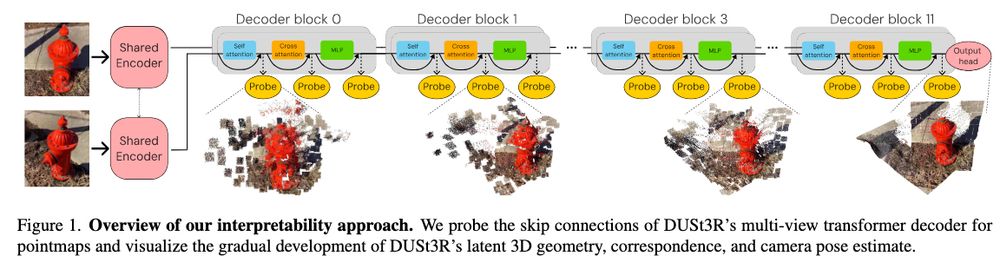
To open up DUSt3R, we train individual MLP probes on intermediate layers of an early checkpoint, using the same pointmap objective.
We can then analyze its inference through the sequence of reconstructions - see below! [2/8]
We can then analyze its inference through the sequence of reconstructions - see below! [2/8]

November 4, 2025 at 7:40 PM
To open up DUSt3R, we train individual MLP probes on intermediate layers of an early checkpoint, using the same pointmap objective.
We can then analyze its inference through the sequence of reconstructions - see below! [2/8]
We can then analyze its inference through the sequence of reconstructions - see below! [2/8]
DUSt3R et al. are impressive, but how do they actually work? We investigate this in our project 𝘜𝘯𝘥𝘦𝘳𝘴𝘵𝘢𝘯𝘥𝘪𝘯𝘨 𝘔𝘶𝘭𝘵𝘪-𝘝𝘪𝘦𝘸 𝘛𝘳𝘢𝘯𝘴𝘧𝘰𝘳𝘮𝘦𝘳𝘴!
We share findings on the iterative nature of reconstruction, the roles of cross and self-attention, and the emergence of correspondences across the network [1/8] ⬇️
We share findings on the iterative nature of reconstruction, the roles of cross and self-attention, and the emergence of correspondences across the network [1/8] ⬇️
𝗨𝗻𝗱𝗲𝗿𝘀𝘁𝗮𝗻𝗱𝗶𝗻𝗴 𝗠𝘂𝗹𝘁𝗶-𝗩𝗶𝗲𝘄 𝗧𝗿𝗮𝗻𝘀𝗳𝗼𝗿𝗺𝗲𝗿𝘀
Michal Stary, Julien Gaubil, Ayush Tewari, Vincent Sitzmann
arxiv.org/abs/2510.24907
Trending on www.scholar-inbox.com
Michal Stary, Julien Gaubil, Ayush Tewari, Vincent Sitzmann
arxiv.org/abs/2510.24907
Trending on www.scholar-inbox.com


November 4, 2025 at 7:40 PM
DUSt3R et al. are impressive, but how do they actually work? We investigate this in our project 𝘜𝘯𝘥𝘦𝘳𝘴𝘵𝘢𝘯𝘥𝘪𝘯𝘨 𝘔𝘶𝘭𝘵𝘪-𝘝𝘪𝘦𝘸 𝘛𝘳𝘢𝘯𝘴𝘧𝘰𝘳𝘮𝘦𝘳𝘴!
We share findings on the iterative nature of reconstruction, the roles of cross and self-attention, and the emergence of correspondences across the network [1/8] ⬇️
We share findings on the iterative nature of reconstruction, the roles of cross and self-attention, and the emergence of correspondences across the network [1/8] ⬇️
Reposted by Julien Gaubil

𝗨𝗻𝗱𝗲𝗿𝘀𝘁𝗮𝗻𝗱𝗶𝗻𝗴 𝗠𝘂𝗹𝘁𝗶-𝗩𝗶𝗲𝘄 𝗧𝗿𝗮𝗻𝘀𝗳𝗼𝗿𝗺𝗲𝗿𝘀
Michal Stary, Julien Gaubil, Ayush Tewari, Vincent Sitzmann
arxiv.org/abs/2510.24907
Trending on www.scholar-inbox.com
Michal Stary, Julien Gaubil, Ayush Tewari, Vincent Sitzmann
arxiv.org/abs/2510.24907
Trending on www.scholar-inbox.com
October 31, 2025 at 7:00 AM
𝗨𝗻𝗱𝗲𝗿𝘀𝘁𝗮𝗻𝗱𝗶𝗻𝗴 𝗠𝘂𝗹𝘁𝗶-𝗩𝗶𝗲𝘄 𝗧𝗿𝗮𝗻𝘀𝗳𝗼𝗿𝗺𝗲𝗿𝘀
Michal Stary, Julien Gaubil, Ayush Tewari, Vincent Sitzmann
arxiv.org/abs/2510.24907
Trending on www.scholar-inbox.com
Michal Stary, Julien Gaubil, Ayush Tewari, Vincent Sitzmann
arxiv.org/abs/2510.24907
Trending on www.scholar-inbox.com
Reposted by Julien Gaubil

Stary and Gaubil et al., "Understanding multi-view transformers"
We use Dust3r as a black box. This work looks under the hood at what is going on. The internal representations seem to "iteratively" refine towards the final answer. Quite similar to what goes on in point cloud net
We use Dust3r as a black box. This work looks under the hood at what is going on. The internal representations seem to "iteratively" refine towards the final answer. Quite similar to what goes on in point cloud net
October 30, 2025 at 9:00 PM
Stary and Gaubil et al., "Understanding multi-view transformers"
We use Dust3r as a black box. This work looks under the hood at what is going on. The internal representations seem to "iteratively" refine towards the final answer. Quite similar to what goes on in point cloud net
We use Dust3r as a black box. This work looks under the hood at what is going on. The internal representations seem to "iteratively" refine towards the final answer. Quite similar to what goes on in point cloud net
Reposted by Julien Gaubil
1/n🚀Gaussians > Differentiable function > Mesh?
Check out our new work: MILo: Mesh-In-the-Loop Gaussian Splatting!
🎉Accepted to SIGGRAPH Asia 2025 (TOG)
MILo is a novel differentiable framework that extracts meshes directly from Gaussian parameters during training.
🧵👇
Check out our new work: MILo: Mesh-In-the-Loop Gaussian Splatting!
🎉Accepted to SIGGRAPH Asia 2025 (TOG)
MILo is a novel differentiable framework that extracts meshes directly from Gaussian parameters during training.
🧵👇
September 8, 2025 at 11:35 AM
1/n🚀Gaussians > Differentiable function > Mesh?
Check out our new work: MILo: Mesh-In-the-Loop Gaussian Splatting!
🎉Accepted to SIGGRAPH Asia 2025 (TOG)
MILo is a novel differentiable framework that extracts meshes directly from Gaussian parameters during training.
🧵👇
Check out our new work: MILo: Mesh-In-the-Loop Gaussian Splatting!
🎉Accepted to SIGGRAPH Asia 2025 (TOG)
MILo is a novel differentiable framework that extracts meshes directly from Gaussian parameters during training.
🧵👇
Where would understanding surface geometry (as in distances, curvatures, and so on) fit in this diagram?
I’d say it implies multi-view consistency of the geometry and would therefore add an arrow at the left of your chart. Do you agree, and if so, don’t you think we should start there?
I’d say it implies multi-view consistency of the geometry and would therefore add an arrow at the left of your chart. Do you agree, and if so, don’t you think we should start there?
August 13, 2025 at 11:51 AM
Where would understanding surface geometry (as in distances, curvatures, and so on) fit in this diagram?
I’d say it implies multi-view consistency of the geometry and would therefore add an arrow at the left of your chart. Do you agree, and if so, don’t you think we should start there?
I’d say it implies multi-view consistency of the geometry and would therefore add an arrow at the left of your chart. Do you agree, and if so, don’t you think we should start there?
Reposted by Julien Gaubil

🚨🚨 WiGRAPH CONFERENCE COFFEE @ SIGGRAPH '25 🚨🚨
Sign up now to be randomly matched with peers for a SIGGRAPH conference coffee!
Sign up now to be randomly matched with peers for a SIGGRAPH conference coffee!

🎉☕ Announcing WiGRAPH Conference Coffees: SIGGRAPH 2025 Edition! ☕🎉
Are you a researcher of an underrepresented gender registered for SIGGRAPH? Do you want an opportunity to network with your peers? Learn more and sign up here:
www.wigraph.org/events/2025-...
Are you a researcher of an underrepresented gender registered for SIGGRAPH? Do you want an opportunity to network with your peers? Learn more and sign up here:
www.wigraph.org/events/2025-...

WiGRAPH Conference Coffee: Sign-Up
WiGRAPH is organizing a SIGGRAPH 2025 conference coffee!
Are you a researcher of a gender that is underrepresented at SIGGRAPH? Would you like for an opportunity to network with peers? Sign up for th...
tinyurl.com
July 10, 2025 at 4:39 PM
🚨🚨 WiGRAPH CONFERENCE COFFEE @ SIGGRAPH '25 🚨🚨
Sign up now to be randomly matched with peers for a SIGGRAPH conference coffee!
Sign up now to be randomly matched with peers for a SIGGRAPH conference coffee!
Reposted by Julien Gaubil
💻We've released the code for our #CVPR2025 paper MAtCha!
🍵MAtCha reconstructs sharp, accurate and scalable meshes of both foreground AND background from just a few unposed images (eg 3 to 10 images)...
...While also working with dense-view datasets (hundreds of images)!
🍵MAtCha reconstructs sharp, accurate and scalable meshes of both foreground AND background from just a few unposed images (eg 3 to 10 images)...
...While also working with dense-view datasets (hundreds of images)!


April 3, 2025 at 10:33 AM
💻We've released the code for our #CVPR2025 paper MAtCha!
🍵MAtCha reconstructs sharp, accurate and scalable meshes of both foreground AND background from just a few unposed images (eg 3 to 10 images)...
...While also working with dense-view datasets (hundreds of images)!
🍵MAtCha reconstructs sharp, accurate and scalable meshes of both foreground AND background from just a few unposed images (eg 3 to 10 images)...
...While also working with dense-view datasets (hundreds of images)!
I think there is too much (good) content pouring in the Vision/3D communities daily to read thoroughly while preserving room for creativity. I believe what's important is to know 'what exists', without necessarily knowing all the details, to have an accurate picture of what remains to be done
Sometimes reading Hamming makes me sad, because I recognize myself in this quote.

February 25, 2025 at 5:31 PM
I think there is too much (good) content pouring in the Vision/3D communities daily to read thoroughly while preserving room for creativity. I believe what's important is to know 'what exists', without necessarily knowing all the details, to have an accurate picture of what remains to be done
Reposted by Julien Gaubil

Sometimes reading Hamming makes me sad, because I recognize myself in this quote.
February 25, 2025 at 9:17 AM
Sometimes reading Hamming makes me sad, because I recognize myself in this quote.