



Jessica M. Ross
@jessicamross8.bsky.social
Instructor (she/hers)
Psychiatry and Behavioral Sciences, Stanford University
Veterans Affairs Palo Alto Healthcare System
https://jessicamarieross.com/
Psychiatry and Behavioral Sciences, Stanford University
Veterans Affairs Palo Alto Healthcare System
https://jessicamarieross.com/

Help shape the future of science, technology, and wildlife conservation -- Like and share to spread the word, or donate now to make an immediate impact on both environmental conservation and education. youtu.be/ndMGNRx7DU4?...

The Back Story Behind the Big Sur California Condors and Bald Eagles
YouTube video by cfmontereycounty
youtu.be
April 26, 2025 at 9:23 PM
Help shape the future of science, technology, and wildlife conservation -- Like and share to spread the word, or donate now to make an immediate impact on both environmental conservation and education. youtu.be/ndMGNRx7DU4?...
Reposted by Jessica M. Ross

🧠 NEW PAPER: How do we capture excitability noninvasively in mood and emotion networks in the human brain? Here, we used real-time optimization to improve these measures!
@saraparmi @KellerStanfordU @ClinicalNeuroph doi.org/10.1016/j.clinph.2025.02.261 1/7
@saraparmi @KellerStanfordU @ClinicalNeuroph doi.org/10.1016/j.clinph.2025.02.261 1/7

April 4, 2025 at 7:42 PM
🧠 NEW PAPER: How do we capture excitability noninvasively in mood and emotion networks in the human brain? Here, we used real-time optimization to improve these measures!
@saraparmi @KellerStanfordU @ClinicalNeuroph doi.org/10.1016/j.clinph.2025.02.261 1/7
@saraparmi @KellerStanfordU @ClinicalNeuroph doi.org/10.1016/j.clinph.2025.02.261 1/7
Reposted by Jessica M. Ross

When we use TMS to treat depression, we think it alters neural activity in a deep brain structure known as the subgenual anterior cingulate (sgACC). But this is hard to test directly, until our preprint with @coreykeller.bsky.social, @neuro-engineer.bsky.social, Nick Trapp, and Aaron Boes (UIowa) 1/

DLPFC Stimulation Suppresses High-Frequency Neural Activity in the Human sgACC
Transcranial magnetic stimulation (TMS) to the dorsolateral prefrontal cortex (DLPFC) is hypothesized to relieve symptoms of depression by inhibiting activity in the subgenual anterior cingulate corte...
www.biorxiv.org
April 3, 2025 at 6:15 PM
When we use TMS to treat depression, we think it alters neural activity in a deep brain structure known as the subgenual anterior cingulate (sgACC). But this is hard to test directly, until our preprint with @coreykeller.bsky.social, @neuro-engineer.bsky.social, Nick Trapp, and Aaron Boes (UIowa) 1/
Reposted by Jessica M. Ross
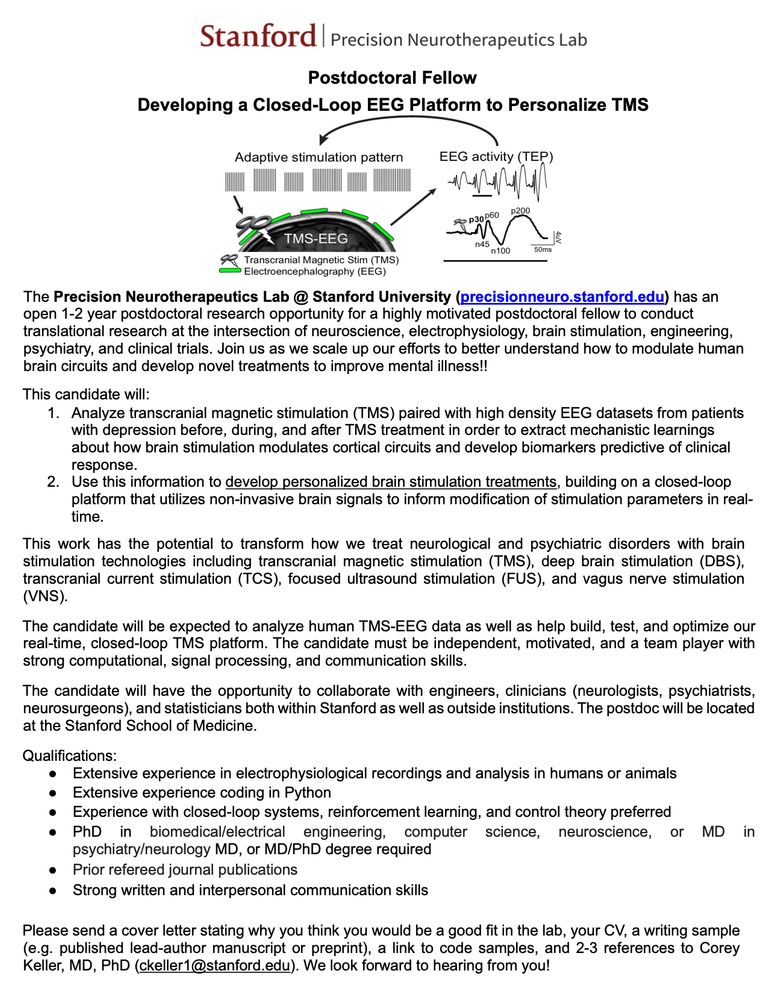
🧠 We are #hiring! Postdoc @stanfordmedicine.bsky.social: help us develop closed-loop EEG platforms to improve TMS treatment for depression! Coding and neuroscience / engineering backgrounds required. Join our team! precisionneuro.stanford.edu email: ckeller1@stanford.edu
February 18, 2025 at 9:35 PM
🧠 We are #hiring! Postdoc @stanfordmedicine.bsky.social: help us develop closed-loop EEG platforms to improve TMS treatment for depression! Coding and neuroscience / engineering backgrounds required. Join our team! precisionneuro.stanford.edu email: ckeller1@stanford.edu
Reposted by Jessica M. Ross
1/10 🧠 We need better ways to measure brain excitability in psychiatric disorders. The prefrontal cortex—key target for brain stimulation treatments—is particularly hard to assess. Our new studies tackle this with systematic mapping! bit.ly/4cjHknX & bit.ly/3PW8RCx
Redirecting
bit.ly
February 14, 2025 at 10:06 PM
1/10 🧠 We need better ways to measure brain excitability in psychiatric disorders. The prefrontal cortex—key target for brain stimulation treatments—is particularly hard to assess. Our new studies tackle this with systematic mapping! bit.ly/4cjHknX & bit.ly/3PW8RCx
Reposted by Jessica M. Ross
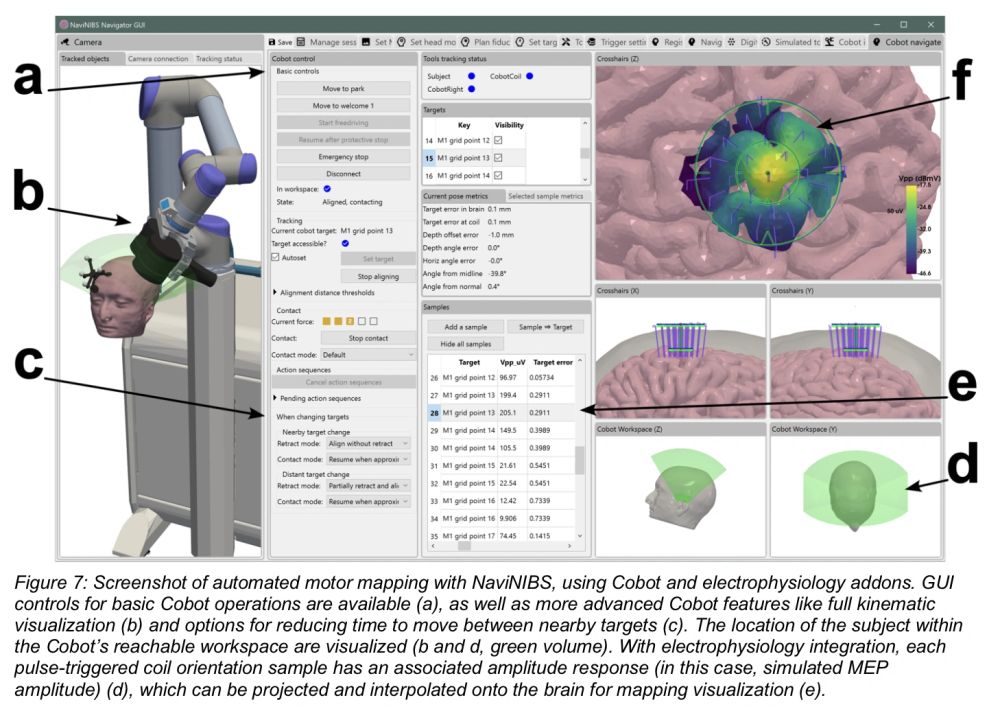
We're excited to share NaviNIBS, our new open-source tool 🔨 for neuronavigated noninvasive #brainstim 🧠⚡️
🎉Congrats to our co-director Chris Cline, lead developer of NaviNIBS!
We hope to enable new possibilities for innovations in neuronavigation #TMSEEG @stanfordmedicine.bsky.social (1/5)
🎉Congrats to our co-director Chris Cline, lead developer of NaviNIBS!
We hope to enable new possibilities for innovations in neuronavigation #TMSEEG @stanfordmedicine.bsky.social (1/5)
December 9, 2024 at 5:00 PM
We're excited to share NaviNIBS, our new open-source tool 🔨 for neuronavigated noninvasive #brainstim 🧠⚡️
🎉Congrats to our co-director Chris Cline, lead developer of NaviNIBS!
We hope to enable new possibilities for innovations in neuronavigation #TMSEEG @stanfordmedicine.bsky.social (1/5)
🎉Congrats to our co-director Chris Cline, lead developer of NaviNIBS!
We hope to enable new possibilities for innovations in neuronavigation #TMSEEG @stanfordmedicine.bsky.social (1/5)
Reposted by Jessica M. Ross
🚨 New preprint alert 🚨 Musical rhythms can boost brain stimulation effects! ⚡️ Sensory-entrained #TMS (seTMS) synchronizes TMS pulses with auditory rhythm-induced high-excitability brain states 🎶🧠
Thread below 👇 @stanfordmedicine.bsky.social #StanfordMed #StanfordBrain (1/10)
Thread below 👇 @stanfordmedicine.bsky.social #StanfordMed #StanfordBrain (1/10)
December 7, 2024 at 12:26 AM
🚨 New preprint alert 🚨 Musical rhythms can boost brain stimulation effects! ⚡️ Sensory-entrained #TMS (seTMS) synchronizes TMS pulses with auditory rhythm-induced high-excitability brain states 🎶🧠
Thread below 👇 @stanfordmedicine.bsky.social #StanfordMed #StanfordBrain (1/10)
Thread below 👇 @stanfordmedicine.bsky.social #StanfordMed #StanfordBrain (1/10)
Reposted by Jessica M. Ross
Hello BlueSky community! 🦋👋 We're the Stanford Precision Neurotherapeutics Lab 🧠
Dedicated to advancing neuroscience by deconstructing brain stimulation to build personalized treatments for mental health disorders 🚀
Check out our work and learn more about us!
🔗 precisionneuro.stanford.edu (1/2)
Dedicated to advancing neuroscience by deconstructing brain stimulation to build personalized treatments for mental health disorders 🚀
Check out our work and learn more about us!
🔗 precisionneuro.stanford.edu (1/2)
PNT Lab
Explore Precision Neurotherapeutics Lab at Stanford, dedicated to advancing neurotechnology and computational methods for precision health. Discover our interdisciplinary research and collaborations a...
precisionneuro.stanford.edu
December 6, 2024 at 6:36 PM
Hello BlueSky community! 🦋👋 We're the Stanford Precision Neurotherapeutics Lab 🧠
Dedicated to advancing neuroscience by deconstructing brain stimulation to build personalized treatments for mental health disorders 🚀
Check out our work and learn more about us!
🔗 precisionneuro.stanford.edu (1/2)
Dedicated to advancing neuroscience by deconstructing brain stimulation to build personalized treatments for mental health disorders 🚀
Check out our work and learn more about us!
🔗 precisionneuro.stanford.edu (1/2)