



Peter Adamson
banner
histphilosophy.bsky.social
Peter Adamson
@histphilosophy.bsky.social

Professor of Philosophy at the LMU in Munich; hosts podcast about the History of Philosophy... without any gaps. www.historyofphilosophy.net

Peter Scott Adamson is an American philosopher and intellectual historian. He holds two academic positions: professor of philosophy in late antiquity and in the Islamic world at the Ludwig Maximilian University of Munich; and professor of ancient and medieval philosophy at King's College London. .. more

Philosophy 46%
History 19%
Pinned
Thanks for following me here on Bluesky!

Here a link to my podcast on the History of Philosophy "without any gaps":

www.historyofphilosophy.net

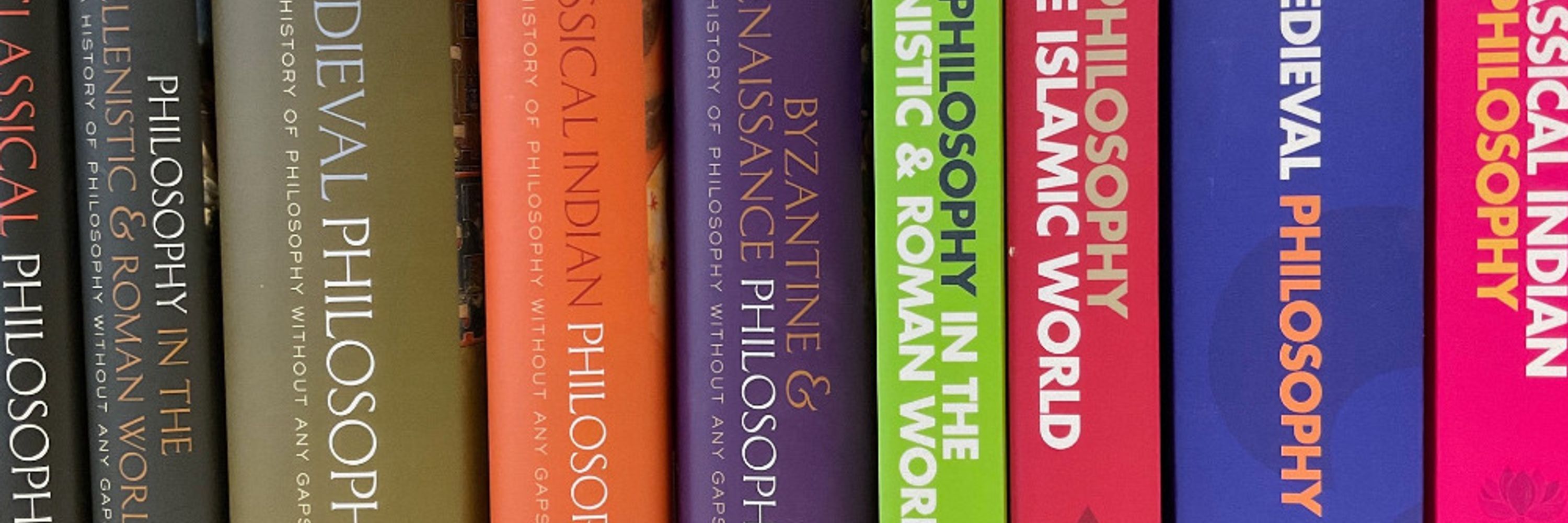
And to the corresponding book series from Oxford University Press:

global.oup.com/academic/con...
Home | History of Philosophy without any gaps
Podcast by Peter Adamson, Professor of Philosophy at LMU Munich and KCL London. Includes western, Islamic, Indian, and Africana philsosophy.
www.historyofphilosophy.net

Admittedly that was a cheap shot but it made me laugh when I wrote it, so I left it in.

Rule 5 on writing about the history of philosophy: on the tricky issue of how best to use quotations from your primary sources in your writing.

www.historyofphilosophy.net/rules-writin...

#philsky #philosophy #writingtips
Rules for Writing 5: Use quotes wisely | History of Philosophy without any gaps
In my published research I try to create a kind of visual rhythm on the page, which is produced by “block quotes”: chunks of quotation from the primary texts I am dealing with, which come along every ...
www.historyofphilosophy.net

Reposted by Constantine Sandis

Also new today, my fourth piece of advice on writing about history of philosophy: about focusing on the primary text instead of secondary literature (and how to use secondary literature when you do use it).

www.historyofphilosophy.net/rules-writin...

#philosophy #philsky #writingtips
Rules for Writing 4: The primary text is primary | History of Philosophy without any gaps
This overlaps with a point I made in the previous series of “20 rules for doing history of philosophy,” but I’m going to say something similar here because it is so important.
www.historyofphilosophy.net

New #HoPWaG for you today, on animals in the Daoist classic, the Zhuangzi! With discussion of one of my all time favorite passages, the "happy fish" story.

www.historyofphilosophy.net/zhuangzi-ani...

#philosophy #philsky #daoism #podcasts

Maybe Penelope from the Odyssey was actually just listening to podcasts?

Thanks, glad you like the series!

I love the idea of Zhuangzi as a gateway drug to analytic philosophy!

Relatedly, Mike Beaney just published a book about one story in the Zhuangzi which is only a few sentences long:

www.degruyterbrill.com/document/doi...
The Joy of Chinese Philosophy
This book introduces some central ideas and themes in ancient Chinese philosophy through a detailed analysis of one famous passage – the happy fish dialogue – in the Zhuangzi , one of the two founding...
www.degruyterbrill.com

Well, it depends a bit on the sentence of course! But I think if you take into account the full argument leading up to the sentence, its place within the work as a whole, the terminology used, possible allusions, then it is most definitely possible.
I’ve frequently heard the “focus on a single sentence” line, and I have never figured out how that is supposed to work. I don’t think I have read a single sentence in my life that has inspired me enough to write three pages much less the 15. What would this look like in actual practice?

Reposted by Peter Adamson

I’ve frequently heard the “focus on a single sentence” line, and I have never figured out how that is supposed to work. I don’t think I have read a single sentence in my life that has inspired me enough to write three pages much less the 15. What would this look like in actual practice?

Yes absolutely, that was a good feature of medieval training! Maybe we should start doing disputed questions at modern universities again...

Second installment of my series of blog posts giving advice on writing about history of philosophy: in this one I discuss the need to reflect not just on your own position but also on the possible opposing argument.

www.historyofphilosophy.net/rules-writin...
Rule 2: Make the weaker argument strong | History of Philosophy without any gaps
This rule might sound shocking, with its echo of the accusation made against the ancient sophists, that they “made the weaker argument the stronger,” but there is a crucial difference between “strong”...
www.historyofphilosophy.net

Yes definitely!

In this case the episode is about the nature and scope of Africana philosophy so it is centrally there in the discussion anyway.

My podcast co-author Chike Jeffers (@chikej.bsky.social) is on the latest Philosophy Bites podcast, talking with @davidedmonds100.bsky.social about the subject it took HopWag 140+ episodes to cover. This time it takes just 15 minutes!

philosophybites.com/podcast/chik...

#philosophy #philsky
Chike Jeffers on Africana Philosophy - Philosophy Bites
David Edmonds talks to Chike Jeffers of Dalhousie Universtity about Afrikana Philosophy. This episode was supported by the Ideas Workshop, part of the Open Society Foundations.
philosophybites.com

I guess he'll give it his undivided attention

Reposted by Mark D. White

My math fan father always sends out an email at New Year's factorizing the new year. (2025 was very interesting because it's 3ˆ4 × 5ˆ2).

He says: obviously 2026 is 2x10¹³ and it turns out 1013 is prime! So that was quick.

Despite everything I'm glad to be living in 2026 CE and not 1013 CE.

First of a series of "rules" giving advice on academic writing about history of philosophy. I'll be posting this as a series over the coming days. Hope people will find this useful and interesting! Feedback more than welcome.

www.historyofphilosophy.net/rules-writin...

#philsky #philosophy
Rules for Writing 1: The first question is, what is the question? | History of Philosophy without any gaps
Having spent the last 25 years of my life teaching history of philosophy, I’ve obviously had a lot of opportunity to give advice and feedback to students on their writing projects. I often find myself...
www.historyofphilosophy.net

Reposted by James A. Benn

Reposted by Peter Adamson

Buridan's Ass

And they buy facts and values at the Is-Ought Gap

Reposted by Peter Adamson

Semiotic paradox alert!

Reposted by Mark Blyth, Mel Ainscow, Bruce E. Hansen , and 194 more