



Eduardo Garcia-Padilla
@garciapadilla.bsky.social
Chemistry thoughts coming out of the bell of a French horn.
Postdoctoral Researcher in the Qiu Group, MPI für Kohlenforschung.
PhD 2023 @ ICIQ
Often found ∝ Ψ^2
Postdoctoral Researcher in the Qiu Group, MPI für Kohlenforschung.
PhD 2023 @ ICIQ
Often found ∝ Ψ^2
Our paper on the derivation of the relationship describing the response of energy barriers to change in reaction energies is now on @chemicalscience.rsc.org ! Do have a read!
pubs.rsc.org/en/content/a...
pubs.rsc.org/en/content/a...
The global kinetic–thermodynamic relationship derived from first principles - Chemical Science (RSC Publishing) DOI:10.1039/D5SC04829J
pubs.rsc.org
September 19, 2025 at 10:24 AM
Our paper on the derivation of the relationship describing the response of energy barriers to change in reaction energies is now on @chemicalscience.rsc.org ! Do have a read!
pubs.rsc.org/en/content/a...
pubs.rsc.org/en/content/a...
Reposted by Eduardo Garcia-Padilla

Our last work is online in @InorgChem. We rationalize spin-crossover properties of substituted Fe (II) complexes pubs.acs.org/doi/10.1021/...

Rationalizing Spin-Crossover Properties of Substituted Fe (II) Complexes
We investigate spin-state transitions in a series of 24 [FeII(bppX)2]2+ spin-crossover (SCO) complexes using density functional theory (DFT). The TPSSh/def2-TZVP approach demonstrates reasonable accuracy in predicting spin-state energetics compared to other functionals, though significant deviations persist in transition temperature (T1/2) estimates. Temperature-dependent and quasi-harmonic corrections for low-frequency vibrational contributions to enthalpic and entropic terms yielded only marginal improvements. To improve T1/2 prediction accuracy, we develop electronic descriptors based on effective fragment orbitals (EFOs) and their occupations, quantifying ligand σ-donation and π-acceptor characteristics that govern ligand field strength. Additionally, we introduce a resonance descriptor (R) derived solely from the effective atomic orbitals (eff-AOs) of isolated ligands. Our analysis reveals that electron-donating groups (EDGs) enhance π-electron density in the ligands while simultaneously reducing both σ-donor and π-acceptor capabilities, ultimately lowering the T1/2 value. These descriptors perform reasonably well also for a set of 12 [FeII(pyboxX)2]2+ SCO complexes. This new methodology provides a computationally efficient framework for modulating spin-state properties in transition metal complexes, enabling rational design of SCO materials.
pubs.acs.org
July 24, 2025 at 3:06 PM
Our last work is online in @InorgChem. We rationalize spin-crossover properties of substituted Fe (II) complexes pubs.acs.org/doi/10.1021/...
Very happy to have had the opportunity to present our recent work on the deductive relationship between activation energies and reaction energies at the #BienalRSEQ2025 in Bilbao. Really good discussion and many inspiring talks over the last few days!

July 3, 2025 at 2:15 PM
Very happy to have had the opportunity to present our recent work on the deductive relationship between activation energies and reaction energies at the #BienalRSEQ2025 in Bilbao. Really good discussion and many inspiring talks over the last few days!
Reposted by Eduardo Garcia-Padilla

Check out our work just accepted in @chemistryeurope.bsky.social (ChemEurJ) on Understanding Small Molecule Activation by Heavier Benzene 1,4‐diides: Interplay between Diradical Character and Aromaticity @ghadwalgroup.bsky.social chemistry-europe.onlinelibrary.wiley.com/doi/10.1002/...
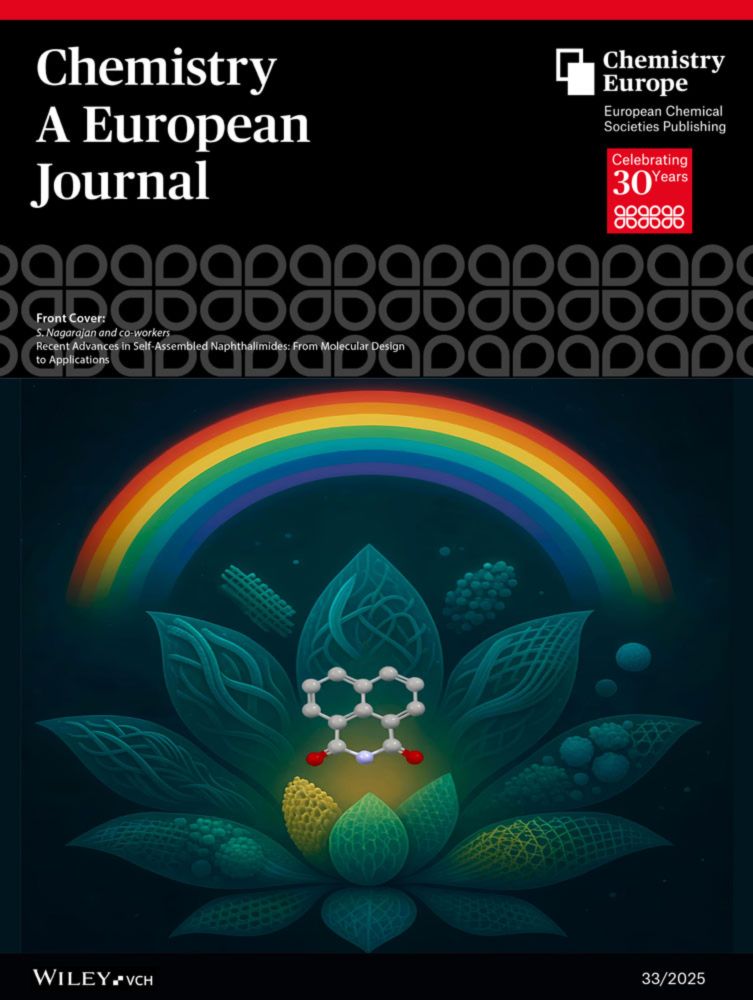
Understanding Small Molecule Activation Promoted by Heavier Benzene 1,4‐diides: Interplay between Diradical Character and Aromaticity
The intricate relationship between diradical character, aromaticity, and reactivity in annulated heavier Group 14 benzene-1,4-diides, i.e. [(ADC)E]2 (E = Si, Ge, Sn), based on an anionic dicarbene fr...
chemistry-europe.onlinelibrary.wiley.com
June 17, 2025 at 6:16 AM
Check out our work just accepted in @chemistryeurope.bsky.social (ChemEurJ) on Understanding Small Molecule Activation by Heavier Benzene 1,4‐diides: Interplay between Diradical Character and Aromaticity @ghadwalgroup.bsky.social chemistry-europe.onlinelibrary.wiley.com/doi/10.1002/...
Reposted by Eduardo Garcia-Padilla

Thanks to everyone who joined the release even for ORCA 6.1 yesterday. It was fun to interact with all of you.
ORCA6.1 is downloadable from the ORCA forum now
orcaforum.kofo.mpg.de/app.php/dlex...
Enjoy ORCA 6.1!
ORCA6.1 is downloadable from the ORCA forum now
orcaforum.kofo.mpg.de/app.php/dlex...
Enjoy ORCA 6.1!
ORCA Forum - Downloads
orcaforum.kofo.mpg.de
June 18, 2025 at 5:55 AM
Thanks to everyone who joined the release even for ORCA 6.1 yesterday. It was fun to interact with all of you.
ORCA6.1 is downloadable from the ORCA forum now
orcaforum.kofo.mpg.de/app.php/dlex...
Enjoy ORCA 6.1!
ORCA6.1 is downloadable from the ORCA forum now
orcaforum.kofo.mpg.de/app.php/dlex...
Enjoy ORCA 6.1!
Reposted by Eduardo Garcia-Padilla

Oxidizing PPh3 generates a powerful reagent - Read more about this cool molecule @jacs.acspublications.org (previously @chemrxiv.bsky.social) Congrats to @fabiandankert.bsky.social, Simon, Sergi, Chandan & Sneha 🎊🍾
[Ph3P–PPh3]2+: Superacid, Superoxidant, Super Reagent? pubs.acs.org/doi/10.1021/...
[Ph3P–PPh3]2+: Superacid, Superoxidant, Super Reagent? pubs.acs.org/doi/10.1021/...
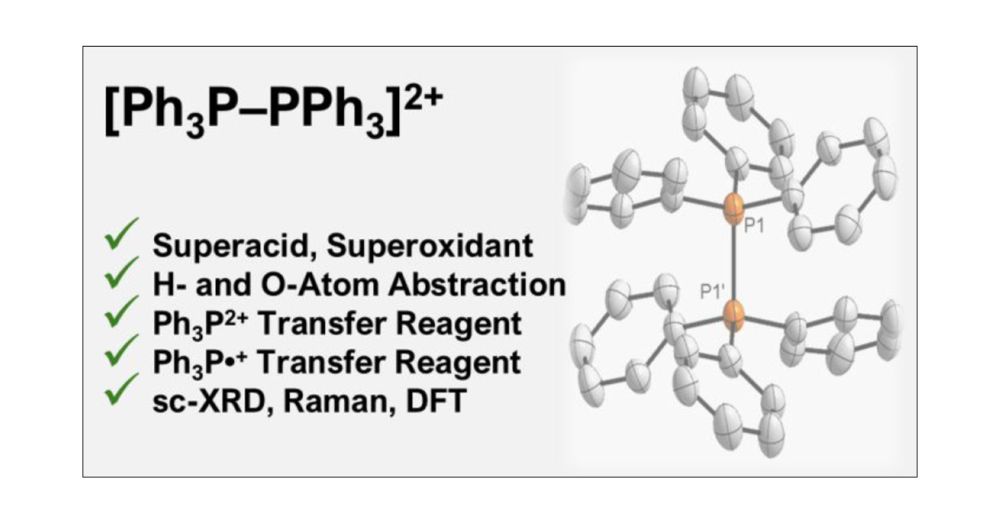
Hexaphenyl-1,2-Diphosphonium Dication [Ph3P–PPh3]2+: Superacid, Superoxidant, or Super Reagent?
The oxidation of triphenylphosphine by perfluorinated phenaziniumF aluminate in difluorobenzene affords hexaaryl-1,2-diphosphonium dialuminate 1. Dication 12+ is valence isoelectronic with elusive hex...
pubs.acs.org
April 26, 2025 at 11:05 AM
Oxidizing PPh3 generates a powerful reagent - Read more about this cool molecule @jacs.acspublications.org (previously @chemrxiv.bsky.social) Congrats to @fabiandankert.bsky.social, Simon, Sergi, Chandan & Sneha 🎊🍾
[Ph3P–PPh3]2+: Superacid, Superoxidant, Super Reagent? pubs.acs.org/doi/10.1021/...
[Ph3P–PPh3]2+: Superacid, Superoxidant, Super Reagent? pubs.acs.org/doi/10.1021/...
Reposted by Eduardo Garcia-Padilla
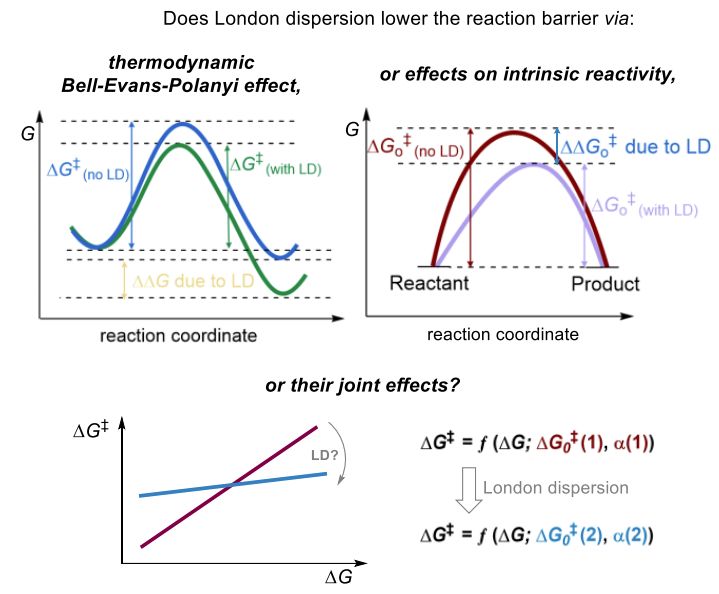
Our new work! Beyond thermodynamic effects, we present a previously unrecognized dimension: dispersion also affects how sensitively reaction barriers respond to changes in thermodynamic driving force. With that, we got another intrinsic reactivity modulator in hand 🔥
chemrxiv.org/engage/chemr...
chemrxiv.org/engage/chemr...
April 9, 2025 at 7:53 AM
Our new work! Beyond thermodynamic effects, we present a previously unrecognized dimension: dispersion also affects how sensitively reaction barriers respond to changes in thermodynamic driving force. With that, we got another intrinsic reactivity modulator in hand 🔥
chemrxiv.org/engage/chemr...
chemrxiv.org/engage/chemr...
Reposted by Eduardo Garcia-Padilla

There's an open position with Prof. Frank Neese, together with Prof. Stefan Grime to work on the next gen. of xTB in ORCA.
Two of the most brilliant people out there in #compchem within a great group environment. It's a one-of-a-kind opportunity here!
I have seen some data, g-xTB will be a blast.
Two of the most brilliant people out there in #compchem within a great group environment. It's a one-of-a-kind opportunity here!
I have seen some data, g-xTB will be a blast.
The ORCA team is looking for a postdoctoral fellow or Ph.D. student to work on XTB methodology jointly with the group of Prof. Stefan Grimme (University of Bonn).

March 2, 2025 at 8:00 AM
There's an open position with Prof. Frank Neese, together with Prof. Stefan Grime to work on the next gen. of xTB in ORCA.
Two of the most brilliant people out there in #compchem within a great group environment. It's a one-of-a-kind opportunity here!
I have seen some data, g-xTB will be a blast.
Two of the most brilliant people out there in #compchem within a great group environment. It's a one-of-a-kind opportunity here!
I have seen some data, g-xTB will be a blast.
Very happy to share the latest publication with the Maseras group at @iciq.org! Interested in how DFT can be applied to ball-milling reactions? Exploring a rare divergence in outcome between ball milling and solution-phase reactions of C60...
Read more here:
www.cell.com/cell-reports...
Read more here:
www.cell.com/cell-reports...

Understanding the divergence in outcomes between mechanochemical and solution phase reactivity of fullerenes
Garcia-Padilla and Maseras computationally investigate the origin of the selectivity
switch in the reaction of fullerene with cyanides in solution and under ball-milling
conditions. The concentration ...
www.cell.com
February 11, 2025 at 8:48 PM
Very happy to share the latest publication with the Maseras group at @iciq.org! Interested in how DFT can be applied to ball-milling reactions? Exploring a rare divergence in outcome between ball milling and solution-phase reactions of C60...
Read more here:
www.cell.com/cell-reports...
Read more here:
www.cell.com/cell-reports...
Reposted by Eduardo Garcia-Padilla

Looking for a stimulating conference on physical-organic chemistry ? We are organizing the 20th edition of ESOR from 9-12 September 2025 in Padova, Italy. Visit www.esor2025.com for info. Follow us on @esor2025.bsky.social to stay informed. #Chemsky. Reposts appreciated.

February 3, 2025 at 10:15 AM
Looking for a stimulating conference on physical-organic chemistry ? We are organizing the 20th edition of ESOR from 9-12 September 2025 in Padova, Italy. Visit www.esor2025.com for info. Follow us on @esor2025.bsky.social to stay informed. #Chemsky. Reposts appreciated.
Extremely happy to share the preprint of our latest work (with @guanqichem.bsky.social), where we derive the global function that governs the relationship between energy barriers and reaction energies!
Find out more here:
chemrxiv.org/engage/chemr...
Find out more here:
chemrxiv.org/engage/chemr...

Global Kinetic-Thermodynamic Responses: Derivation of a General Non-Linear Equation and Demonstrations on Chemical Reactions
How to accelerate a reaction has been a critical question in physical organic chemistry, eliciting multiple models describing the interplay between kinetics and thermodynamic driving forces. However, ...
chemrxiv.org
February 3, 2025 at 11:43 AM
Extremely happy to share the preprint of our latest work (with @guanqichem.bsky.social), where we derive the global function that governs the relationship between energy barriers and reaction energies!
Find out more here:
chemrxiv.org/engage/chemr...
Find out more here:
chemrxiv.org/engage/chemr...
Definitely worth a read #ChemSky. How can we move away from the increasingly "ornate" pseudo-contextualisation of science?
A great read from Professor Antonio Togni on scientific communication.
www.chimia.ch/chimia/artic...
www.chimia.ch/chimia/artic...
View of Orchestrating Relevance – Critique of a Questionable Trait of Modern Science Communication
www.chimia.ch
February 1, 2025 at 10:36 PM
Definitely worth a read #ChemSky. How can we move away from the increasingly "ornate" pseudo-contextualisation of science?
❗️Sharing a new preprint from the Maseras group!
A computational study on the feasibility and interest of new mesoionic reactants in gold catalysis.
chemrxiv.org/engage/chemr...
A computational study on the feasibility and interest of new mesoionic reactants in gold catalysis.
chemrxiv.org/engage/chemr...

Gold(I)-Mediated Reactivity of Allenes with Mesoionic Nucleophiles: A Computational Study
We explore the factors leading to regioselective nucleophilic additions in gold(I)-mediated reactions with allenes through DFT analysis of model systems. The reactivity and selectivity are determined ...
chemrxiv.org
January 29, 2025 at 1:43 PM
❗️Sharing a new preprint from the Maseras group!
A computational study on the feasibility and interest of new mesoionic reactants in gold catalysis.
chemrxiv.org/engage/chemr...
A computational study on the feasibility and interest of new mesoionic reactants in gold catalysis.
chemrxiv.org/engage/chemr...