


Freya Blekman
@freyablekman.bsky.social
Particle physicist at @CMSExperiment at @CERN - Lead Scientist DESY & Professor of Physics University of Hamburg - World citizen ➡🇳🇱🇺🇸 🇬🇧🇨🇭🇧🇪🇩🇪
Posts: #physics #SciComm + academia/tech stuff + my opinions + summaries of #CMSpapers
Posts: #physics #SciComm + academia/tech stuff + my opinions + summaries of #CMSpapers
Pinned
Freya Blekman
@freyablekman.bsky.social
· Nov 19

Freya Blekman: on the particle pathway of big science – Physics World
Experimental physicist Freya Blekman talks to Tushna Commissariat about the joy of working on big science collaborations
physicsworld.com
You can read a lot more about me and my career in this physicsworld.com/a/freya-blek...
The LHC produces a large number of Z bosons. So it is worthwhile checking if some of them behave inconsistently with the standard model. This #CMSPaper measured that the chance that Z bosons decay to two different kinds of leptons is smaller than one in 10 million arxiv.org/abs/2508.07512

February 10, 2026 at 9:05 PM
The LHC produces a large number of Z bosons. So it is worthwhile checking if some of them behave inconsistently with the standard model. This #CMSPaper measured that the chance that Z bosons decay to two different kinds of leptons is smaller than one in 10 million arxiv.org/abs/2508.07512
Reposted by Freya Blekman
New video! I went on a tour of the @cmsexperiment.bsky.social at @cern.bsky.social with Prof. @freyablekman.bsky.social ⏬
youtu.be/dumEjuLWo3Q
youtu.be/dumEjuLWo3Q

Visiting the competition at #CERN
YouTube video by Dr Clara Nellist
youtu.be
February 10, 2026 at 9:03 PM
New video! I went on a tour of the @cmsexperiment.bsky.social at @cern.bsky.social with Prof. @freyablekman.bsky.social ⏬
youtu.be/dumEjuLWo3Q
youtu.be/dumEjuLWo3Q
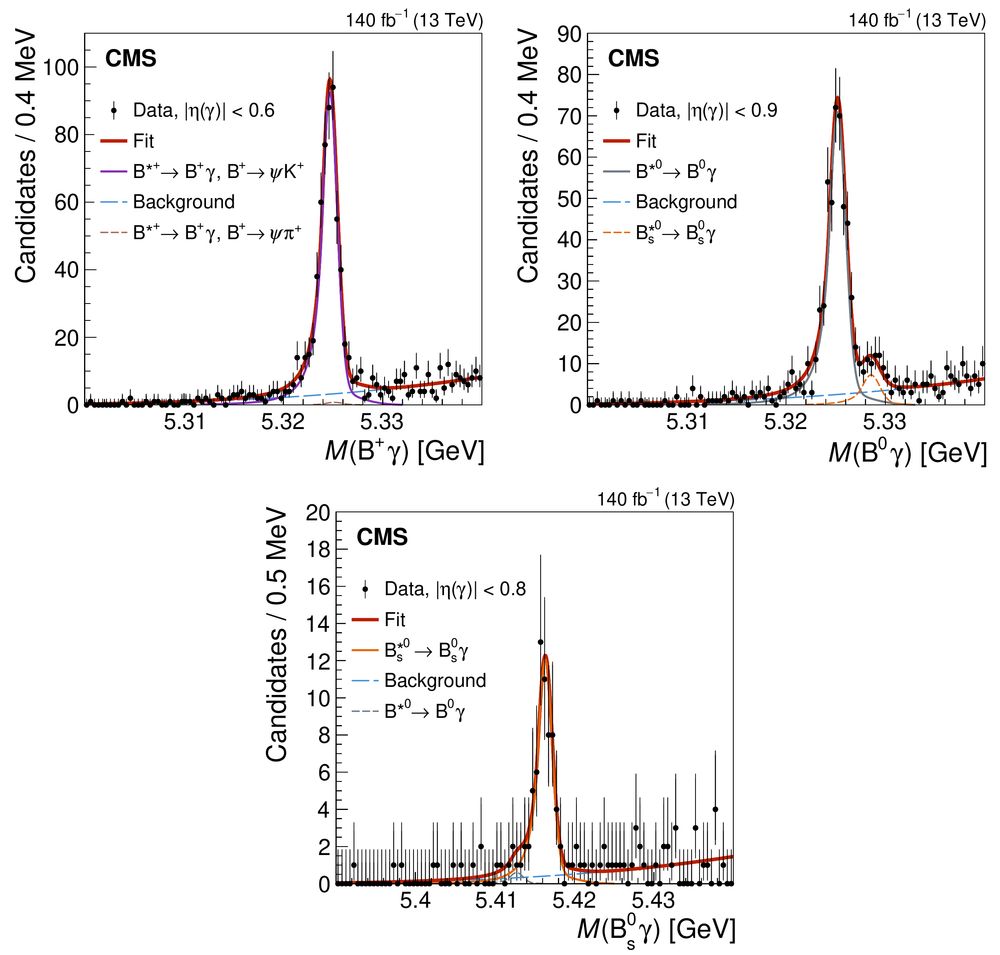
This #CMSPaper explores the excitation of three particles with a B quark and other quark, examining how they store extra energy beyond the ground state. It marks the first simultaneous measurement of these particles. This improves knowledge of particles that contain quarks arxiv.org/abs/2508.05820
February 10, 2026 at 8:05 PM
This #CMSPaper explores the excitation of three particles with a B quark and other quark, examining how they store extra energy beyond the ground state. It marks the first simultaneous measurement of these particles. This improves knowledge of particles that contain quarks arxiv.org/abs/2508.05820
Want to know how to actually collect undiscovered long lived particles so we can maybe then discover them? Then check out this #cmspaper, with a large contribution from people in my team arxiv.org/abs/2601.17544

February 9, 2026 at 6:47 PM
Want to know how to actually collect undiscovered long lived particles so we can maybe then discover them? Then check out this #cmspaper, with a large contribution from people in my team arxiv.org/abs/2601.17544
It's #LoveDataWeek, and this week my team and I are even more passionate about our data! How does data influence your everyday life?
Catch our videos on:
Instagram: www.instagram.com/reel/DUiJ_MS...
or mastodon: nfdi.social/@punch4nfdi/...
Catch our videos on:
Instagram: www.instagram.com/reel/DUiJ_MS...
or mastodon: nfdi.social/@punch4nfdi/...

PUNCH4NFDI (@punch4nfdi@nfdi.social)
Attached: 1 video It is #lovedataweek 2026 ♥️ Jointly with colleagues from @CMSexperiment@sciencemastodon.com we passed on this year’s theme to our colleagues at @DESYnews@helmholtz.social and asked…
nfdi.social
February 9, 2026 at 5:47 PM
It's #LoveDataWeek, and this week my team and I are even more passionate about our data! How does data influence your everyday life?
Catch our videos on:
Instagram: www.instagram.com/reel/DUiJ_MS...
or mastodon: nfdi.social/@punch4nfdi/...
Catch our videos on:
Instagram: www.instagram.com/reel/DUiJ_MS...
or mastodon: nfdi.social/@punch4nfdi/...
This is going to be amazing 🤩
Sign up if you have time. It will be worth it!
Sign up if you have time. It will be worth it!
👉Join our scientists as they take you into the experimental cavern at the CMS Experiment at @CERN!
🧲The CMS solenoid magnet is on RIGHT NOW, and we're streaming from inside its magnetic field & answering all your questions!
📝Sign up here: indi.to/LqtTM
🧲The CMS solenoid magnet is on RIGHT NOW, and we're streaming from inside its magnetic field & answering all your questions!
📝Sign up here: indi.to/LqtTM

February 9, 2026 at 4:38 PM
This is going to be amazing 🤩
Sign up if you have time. It will be worth it!
Sign up if you have time. It will be worth it!
Reposted by Freya Blekman

👉Join our scientists as they take you into the experimental cavern at the CMS Experiment at @CERN!
🧲The CMS solenoid magnet is on RIGHT NOW, and we're streaming from inside its magnetic field & answering all your questions!
📝Sign up here: indi.to/LqtTM
🧲The CMS solenoid magnet is on RIGHT NOW, and we're streaming from inside its magnetic field & answering all your questions!
📝Sign up here: indi.to/LqtTM
February 9, 2026 at 4:01 PM
👉Join our scientists as they take you into the experimental cavern at the CMS Experiment at @CERN!
🧲The CMS solenoid magnet is on RIGHT NOW, and we're streaming from inside its magnetic field & answering all your questions!
📝Sign up here: indi.to/LqtTM
🧲The CMS solenoid magnet is on RIGHT NOW, and we're streaming from inside its magnetic field & answering all your questions!
📝Sign up here: indi.to/LqtTM
I’m on shift at @cmsexperiment. And eating some stroopwafels!
February 8, 2026 at 2:59 PM
I’m on shift at @cmsexperiment. And eating some stroopwafels!
Reposted by Freya Blekman

“AI is actually brown people in a shed” part 6519

Once again, it turns out “fully autonomous” means “a guy in the Philippines.”

It Turns Out Waymos Are Being Controlled by Workers in the Philippines
During a Congressional hearing, Waymo's chief safety officer, Mauricio Peña, was grilled over the company's reliance on overseas workers.
futurism.com
February 6, 2026 at 4:13 PM
“AI is actually brown people in a shed” part 6519
What is it like to collect data with the@CMSexperiment at #CERN?
As the start of #ILoveDataWeek I figured I'd share how we GET to the data. The first step after all!
(The Love Data Week celebrates research data and research data management researchdatasupport.ch/lovedata )
As the start of #ILoveDataWeek I figured I'd share how we GET to the data. The first step after all!
(The Love Data Week celebrates research data and research data management researchdatasupport.ch/lovedata )
February 7, 2026 at 8:39 AM
What is it like to collect data with the@CMSexperiment at #CERN?
As the start of #ILoveDataWeek I figured I'd share how we GET to the data. The first step after all!
(The Love Data Week celebrates research data and research data management researchdatasupport.ch/lovedata )
As the start of #ILoveDataWeek I figured I'd share how we GET to the data. The first step after all!
(The Love Data Week celebrates research data and research data management researchdatasupport.ch/lovedata )
I‘m yet again on a long distance fast-ish train, this time a Swiss ECE, from Hamburg to Basel (on my way to do shifts at CERN).
The German lady next to me is complaining that she can’t do an online check in of her ticket. My comment : instead we will arrive on time
The German lady next to me is complaining that she can’t do an online check in of her ticket. My comment : instead we will arrive on time
February 5, 2026 at 7:47 AM
I‘m yet again on a long distance fast-ish train, this time a Swiss ECE, from Hamburg to Basel (on my way to do shifts at CERN).
The German lady next to me is complaining that she can’t do an online check in of her ticket. My comment : instead we will arrive on time
The German lady next to me is complaining that she can’t do an online check in of her ticket. My comment : instead we will arrive on time
Reposted by Freya Blekman

I think there are a lot of academics who were knowingly attended dinners and lunches where they knew Epstein would be in the 2010s that are telling themselves that actually it's cool because it's not like they're pedophiles but by the 2010s he was an unrepentant convicted pedophile, folks
February 2, 2026 at 5:57 PM
I think there are a lot of academics who were knowingly attended dinners and lunches where they knew Epstein would be in the 2010s that are telling themselves that actually it's cool because it's not like they're pedophiles but by the 2010s he was an unrepentant convicted pedophile, folks
Reposted by Freya Blekman
And I mean, I have gotten an email! From someone in the files!
February 2, 2026 at 6:16 PM
And I mean, I have gotten an email! From someone in the files!
Sleepy time? No I’m just faking it and wide awake… Or am I?
I’m on a very early train to the GSI Helmholtz Centre for Heavy Ion Research in Darmstadt where I will give the colloquium today. If you are there I look forward to seeing you
(I will be more awake by then, guaranteed!)
#science #physics
I’m on a very early train to the GSI Helmholtz Centre for Heavy Ion Research in Darmstadt where I will give the colloquium today. If you are there I look forward to seeing you
(I will be more awake by then, guaranteed!)
#science #physics

February 3, 2026 at 5:39 AM
Missing momentum is effectively the only way that the main detectors at the LHC (like CMS) can measure the indirect signs of neutrinos (or undiscovered particles). This #CMSPaper present how we use #machinelearning to make our missing momentum measurement much, much better: arxiv.org/abs/2509.12012

February 2, 2026 at 6:47 PM
Missing momentum is effectively the only way that the main detectors at the LHC (like CMS) can measure the indirect signs of neutrinos (or undiscovered particles). This #CMSPaper present how we use #machinelearning to make our missing momentum measurement much, much better: arxiv.org/abs/2509.12012
This #CMSPaper examines the missing energy from neutrino pairs in top quark pair production. Accurate measurement of those neutrinos is crucial for simulating top quarks in the standard model and for setting constraints on invisible particle production with top quarks. arxiv.org/abs/2510.00160

February 2, 2026 at 5:47 PM
This #CMSPaper examines the missing energy from neutrino pairs in top quark pair production. Accurate measurement of those neutrinos is crucial for simulating top quarks in the standard model and for setting constraints on invisible particle production with top quarks. arxiv.org/abs/2510.00160
This #CMSPaper investigates different #AI #machinelearning methods that aim to find jets that are inconsistent with the standard model. It shows that a new method called #Wasserstein normalized autoencodes works much better than other neural networks arxiv.org/abs/2510.02168

February 1, 2026 at 11:03 AM
This #CMSPaper investigates different #AI #machinelearning methods that aim to find jets that are inconsistent with the standard model. It shows that a new method called #Wasserstein normalized autoencodes works much better than other neural networks arxiv.org/abs/2510.02168
The LHC recently collided Oxygen and Neon ions. That is an important input to understanding how nuclear interactions change depending on the size of the colliding objects. This #CMSPaper observes "collective flow", essentially a sign of the quark gluon plasma, in those collisions buff.ly/NcLWdAj

February 1, 2026 at 9:03 AM
The LHC recently collided Oxygen and Neon ions. That is an important input to understanding how nuclear interactions change depending on the size of the colliding objects. This #CMSPaper observes "collective flow", essentially a sign of the quark gluon plasma, in those collisions buff.ly/NcLWdAj
The production of top quark pairs together with a W boson is a great way to test the quality of standard model predictions. This #CMSPaper measures provides boundaries on things like the difference between ttW+/- production, a very sensitive quantity to test the predictions arxiv.org/abs/2509.13512

January 31, 2026 at 10:12 AM
The production of top quark pairs together with a W boson is a great way to test the quality of standard model predictions. This #CMSPaper measures provides boundaries on things like the difference between ttW+/- production, a very sensitive quantity to test the predictions arxiv.org/abs/2509.13512
The production of the Higgs boson along with an undiscovered hypothetical particle is an important signature for detecting physics beyond the standard model. This #CMSPaper looks for the "Higgs boson+jet not consistent with the standard model" signature (we didn't see any): arxiv.org/abs/2509.13635

January 31, 2026 at 9:12 AM
The production of the Higgs boson along with an undiscovered hypothetical particle is an important signature for detecting physics beyond the standard model. This #CMSPaper looks for the "Higgs boson+jet not consistent with the standard model" signature (we didn't see any): arxiv.org/abs/2509.13635
Are there undiscovered particles (that are very light for LHC standard) produced in Higgs boson decays? This #CMSPaper describes how we look for them, but did not see any arxiv.org/abs/2508.06947

January 30, 2026 at 9:42 PM
Are there undiscovered particles (that are very light for LHC standard) produced in Higgs boson decays? This #CMSPaper describes how we look for them, but did not see any arxiv.org/abs/2508.06947
Reposted by Freya Blekman

"Put a single woman in a group of men and she will feel awkward. Put a single man in a group of women and he will feel in charge."
@athenedonald.bsky.social
occamstypewriter.org/athenedonald...
@athenedonald.bsky.social
occamstypewriter.org/athenedonald...
She’s a Feisty Little Thing! | Athene Donald's Blog
occamstypewriter.org
January 30, 2026 at 5:46 PM
"Put a single woman in a group of men and she will feel awkward. Put a single man in a group of women and he will feel in charge."
@athenedonald.bsky.social
occamstypewriter.org/athenedonald...
@athenedonald.bsky.social
occamstypewriter.org/athenedonald...
If you need a reference model of what an extension of the standard model with many new particles would look like, Supersymmetry is a good benchmark. This #CMSPaper shows a general search in many standard signatures, looking for deviations spread over different signatures arxiv.org/abs/2508.13900

January 30, 2026 at 8:42 PM
If you need a reference model of what an extension of the standard model with many new particles would look like, Supersymmetry is a good benchmark. This #CMSPaper shows a general search in many standard signatures, looking for deviations spread over different signatures arxiv.org/abs/2508.13900
Are there invisible (and long-lived) undiscovered particles produced in the decays of B mesons? Those would be super rare, so we use a huge dataset of B mesons with dedicated data taking techniques. We didn't see any new particles though, this #CMSPaper is a #nullresult arxiv.org/abs/2508.06363

January 29, 2026 at 9:19 PM
Are there invisible (and long-lived) undiscovered particles produced in the decays of B mesons? Those would be super rare, so we use a huge dataset of B mesons with dedicated data taking techniques. We didn't see any new particles though, this #CMSPaper is a #nullresult arxiv.org/abs/2508.06363
The LHC produces a large number of Z bosons. So it is worthwhile checking if some of them behave inconsistently with the standard model. This #CMSPaper measured that the chance that Z bosons decay to two different kinds of leptons is smaller than one in 10 million arxiv.org/abs/2508.07512
January 29, 2026 at 8:19 PM
The LHC produces a large number of Z bosons. So it is worthwhile checking if some of them behave inconsistently with the standard model. This #CMSPaper measured that the chance that Z bosons decay to two different kinds of leptons is smaller than one in 10 million arxiv.org/abs/2508.07512