



Florian Onur Kuhlmeier
@florianonur.bsky.social
Postdoctoral researcher | research on mental health chatbots | human-centered systems lab @kit.edu
Reposted by Florian Onur Kuhlmeier


Finally published! 🎉 check it out: humanfactors.jmir.org/2025/1/e66632. @jmirpub.bsky.social
June 20, 2025 at 7:39 AM
Finally published! 🎉 check it out: humanfactors.jmir.org/2025/1/e66632. @jmirpub.bsky.social
Reposted by Florian Onur Kuhlmeier

Published today in Nature Medicine. In one of the world’s largest RCTs of its kind (n=3,936), a smartphone app teaching 5 key cognitive-behavioral therapy skills improved subthreshold depression—and the effects lasted 6 months.
www.nature.com/articles/s41...
www.nature.com/articles/s41...
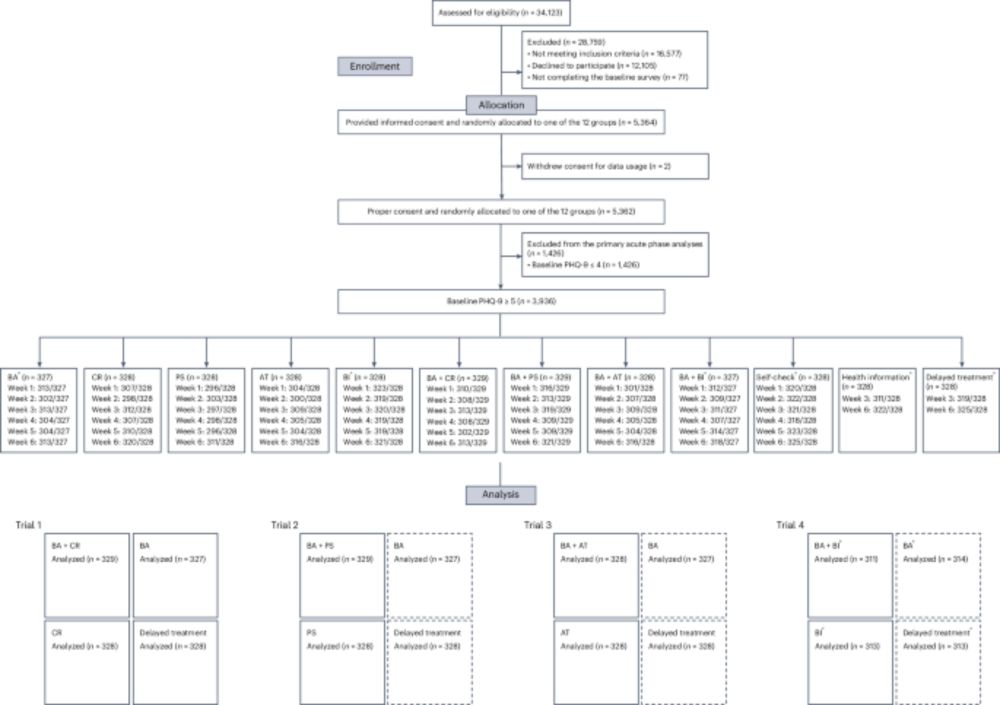
Cognitive behavioral therapy skills via a smartphone app for subthreshold depression among adults in the community: the RESiLIENT randomized controlled trial - Nature Medicine
A trial that used a master randomized design found that the skills commonly found in smartphone-based cognitive behavioral therapy, when tested alone or in combination with behavioral activation, were...
www.nature.com
April 23, 2025 at 10:01 AM
Published today in Nature Medicine. In one of the world’s largest RCTs of its kind (n=3,936), a smartphone app teaching 5 key cognitive-behavioral therapy skills improved subthreshold depression—and the effects lasted 6 months.
www.nature.com/articles/s41...
www.nature.com/articles/s41...
Reposted by Florian Onur Kuhlmeier
🚨 REPLICATION REPORT UPDATE: One year ago, a tweet by John Holbein alerted me, @ollefolke.bsky.social, and @jopieboy.bsky.social to a paper with a shocking result about Sweden’s law criminalizing the purchase of sex.🧵
May 9, 2025 at 9:29 AM
🚨 REPLICATION REPORT UPDATE: One year ago, a tweet by John Holbein alerted me, @ollefolke.bsky.social, and @jopieboy.bsky.social to a paper with a shocking result about Sweden’s law criminalizing the purchase of sex.🧵
Ich durfte beim @deutschlandfunk.de.web.brid.gy über unsere Forschung zu LLM-basierten Chatbots und erste Tests mit LLM-basierten Nutzer:innen sprechen. Der zugehörige Preprint kommt bis Ende des Monats! 🤞
www.deutschlandfunk.de/ki-therapeut...
www.deutschlandfunk.de/ki-therapeut...

KI-Apps für Psychotherapie: Hilfe bei psychischen Erkrankungen
KI-Systeme zeigen Potenzial für die Behandlung psychischer Erkrankungen. Obwohl sie keine Empathie haben, können sie die Therapie von Patienten unterstützen.
www.deutschlandfunk.de
March 6, 2025 at 6:56 AM
Ich durfte beim @deutschlandfunk.de.web.brid.gy über unsere Forschung zu LLM-basierten Chatbots und erste Tests mit LLM-basierten Nutzer:innen sprechen. Der zugehörige Preprint kommt bis Ende des Monats! 🤞
www.deutschlandfunk.de/ki-therapeut...
www.deutschlandfunk.de/ki-therapeut...
Reposted by Florian Onur Kuhlmeier
November 18, 2024 at 4:17 PM
Reposted by Florian Onur Kuhlmeier

Understanding and communicating uncertainty should be a major ethical obligation for scientists. Currently it's largely viewed as a side quest. "Let's disseminate the results, we'll deal with the rest later when we have time" should never fly. Dealing with uncertainty *is* the job of a scientist.
November 2, 2024 at 3:52 PM
Understanding and communicating uncertainty should be a major ethical obligation for scientists. Currently it's largely viewed as a side quest. "Let's disseminate the results, we'll deal with the rest later when we have time" should never fly. Dealing with uncertainty *is* the job of a scientist.
It’s taken too long, but I’ve finally published the preprint of the first study of my PhD: preprints.jmir.org/preprint/66632
How to design a chatbot to treat depression among youth? Insights from an exploratory mixed-methods study.
Background: Depression is a severe and prevalent mental disorder among youth that requires professional care, but various barriers hinder access to effective treatments. Chatbots, the latest...
preprints.jmir.org
October 24, 2024 at 4:08 PM
It’s taken too long, but I’ve finally published the preprint of the first study of my PhD: preprints.jmir.org/preprint/66632