



Flavio Donato
@flaviodonato82.bsky.social
Interested in all things memory, space, and the infant brain. @FensKavliNet Scholar. Assistant Professor @biozentrum @unibasel_en. Donatolab.com 🧠👨🏻🔬🏳️🌈
Reposted by Flavio Donato
Our new preprint is out!
A state-dependent neural circuit resolves approach–avoidance conflicts
www.biorxiv.org/content/10.6...
Fantastic work led by Devika Bodas, with key contributions from Marine Balcou, and a great collaboration with Lisa Scheunemann Lab, fearuting Şevval Demirci.
A state-dependent neural circuit resolves approach–avoidance conflicts
www.biorxiv.org/content/10.6...
Fantastic work led by Devika Bodas, with key contributions from Marine Balcou, and a great collaboration with Lisa Scheunemann Lab, fearuting Şevval Demirci.
www.biorxiv.org
February 13, 2026 at 2:29 PM
Our new preprint is out!
A state-dependent neural circuit resolves approach–avoidance conflicts
www.biorxiv.org/content/10.6...
Fantastic work led by Devika Bodas, with key contributions from Marine Balcou, and a great collaboration with Lisa Scheunemann Lab, fearuting Şevval Demirci.
A state-dependent neural circuit resolves approach–avoidance conflicts
www.biorxiv.org/content/10.6...
Fantastic work led by Devika Bodas, with key contributions from Marine Balcou, and a great collaboration with Lisa Scheunemann Lab, fearuting Şevval Demirci.
Reposted by Flavio Donato

The hippocampal map has its own attentional control signal!
Our new study reveals that theta #sweeps can be instantly biased towards behaviourally relevant locations. See 📹 in post 4/6 and preprint here 👉
www.biorxiv.org/content/10.6...
🧵(1/6)
Our new study reveals that theta #sweeps can be instantly biased towards behaviourally relevant locations. See 📹 in post 4/6 and preprint here 👉
www.biorxiv.org/content/10.6...
🧵(1/6)
Attention-like regulation of theta sweeps in the brain's spatial navigation circuit
Spatial attention supports navigation by prioritizing information from selected locations. A candidate neural mechanism is provided by theta-paced sweeps in grid- and place-cell population activity, which sample nearby space in a left-right-alternating pattern coordinated by parasubicular direction signals. During exploration, this alternation promotes uniform spatial coverage, but whether sweeps can be flexibly tuned to locations of particular interest remains unclear. Using large-scale Neuropixels recordings in freely-behaving rats, we show that sweeps and direction signals are rapidly and dynamically modulated: they track moving targets during pursuit, precede orienting responses during immobility, and reverse during backward locomotion — without prior spatial learning. Similar modulation occurs during REM sleep. Canonical head-direction signals remain head-aligned. These findings identify sweeps as a flexible, attention-like mechanism for selectively sampling allocentric cognitive maps. ### Competing Interest Statement The authors have declared no competing interest. European Research Council, Synergy Grant 951319 (EIM) The Research Council of Norway, Centre of Neural Computation 223262 (EIM, MBM), Centre for Algorithms in the Cortex 332640 (EIM, MBM), National Infrastructure grant (NORBRAIN, 295721 and 350201) The Kavli Foundation, https://ror.org/00kztt736 Ministry of Science and Education, Norway (EIM, MBM) Faculty of Medicine and Health Sciences; NTNU, Norway (AZV)
www.biorxiv.org
January 28, 2026 at 10:03 AM
The hippocampal map has its own attentional control signal!
Our new study reveals that theta #sweeps can be instantly biased towards behaviourally relevant locations. See 📹 in post 4/6 and preprint here 👉
www.biorxiv.org/content/10.6...
🧵(1/6)
Our new study reveals that theta #sweeps can be instantly biased towards behaviourally relevant locations. See 📹 in post 4/6 and preprint here 👉
www.biorxiv.org/content/10.6...
🧵(1/6)
Reposted by Flavio Donato
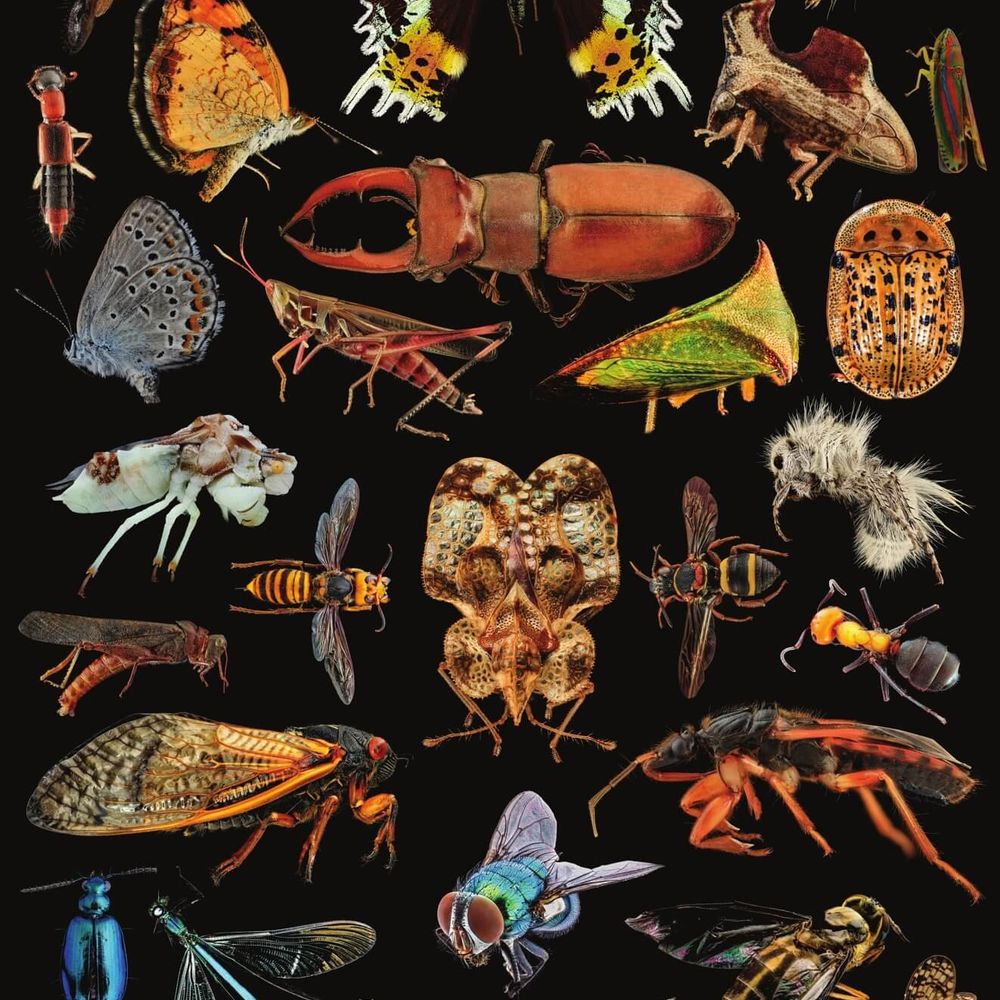
I am very happy (and a bit scared) to present to you what we have been working on over the last 4 years. This manuscript is exactly what I dreamt of when I started the lab and I could not be happier and prouder of the outcome!

Evolutionary dynamics of temporal transcription factor series in the insect optic lobe https://www.biorxiv.org/content/10.64898/2026.01.08.698497v1
January 10, 2026 at 9:43 AM
I am very happy (and a bit scared) to present to you what we have been working on over the last 4 years. This manuscript is exactly what I dreamt of when I started the lab and I could not be happier and prouder of the outcome!
Reposted by Flavio Donato

New study on axon initial segment plasticity by Chloé Benoit and Dan Ganea. Using a deep brain imaging approach, we find that AIS length changes dynamically during associative learning. Thank you to the wonderful team and collaborators who made this work possible. www.nature.com/articles/s41...

Axon initial segment dynamics during associative fear learning - Nature Neuroscience
Benoit, Ganea et al. show that changes in axon initial segment (AIS) length in the prefrontal cortex of mice accompany fear learning and extinction, revealing AIS plasticity as a key feature of neuron...
www.nature.com
December 23, 2025 at 10:12 AM
New study on axon initial segment plasticity by Chloé Benoit and Dan Ganea. Using a deep brain imaging approach, we find that AIS length changes dynamically during associative learning. Thank you to the wonderful team and collaborators who made this work possible. www.nature.com/articles/s41...
Check this amazing resource by @octoscience.bsky.social !! Can’t wait to try it out!!
Do you love quantifying animal behavior as much as we do? We have just the tool for you! Presenting #OCTRON - a pipeline that helps you create rich annotation data and enables training of custom segmentation models. Have a look, particularly if you work with non-model / invertebrate organisms!
December 23, 2025 at 8:15 PM
Check this amazing resource by @octoscience.bsky.social !! Can’t wait to try it out!!
Reposted by Flavio Donato
lab preprint! Interopceptive predictions are central to many brain-body interactions theories, but it's unclear if/how they affect bodily physiology. We (fearless Einav Litvak et al) show that insular cortex predictions are essential for glucose homeostasis-THREAD.. www.biorxiv.org/content/10.6...

Insular cortex predictions regulate glucose homeostasis
Brain-body interactions are essential for physical and emotional homeostasis. The brain uses information from the external world to predict upcoming bodily changes. This process involves interoceptive...
www.biorxiv.org
December 12, 2025 at 1:15 PM
lab preprint! Interopceptive predictions are central to many brain-body interactions theories, but it's unclear if/how they affect bodily physiology. We (fearless Einav Litvak et al) show that insular cortex predictions are essential for glucose homeostasis-THREAD.. www.biorxiv.org/content/10.6...
Reposted by Flavio Donato

From artificial intelligence to memory and from gene regulation to treatments for blindness: four projects at the University of Basel will each receive around EUR 2 million over a five-year period to pave the way for new discoveries.
👉 www.unibas.ch/en/News-Even...
👉 www.unibas.ch/en/News-Even...

December 10, 2025 at 8:48 AM
From artificial intelligence to memory and from gene regulation to treatments for blindness: four projects at the University of Basel will each receive around EUR 2 million over a five-year period to pave the way for new discoveries.
👉 www.unibas.ch/en/News-Even...
👉 www.unibas.ch/en/News-Even...
Incredibly excited to share that we've been awarded an ERC Consolidator Grant to reach new depths in our memory research! @erc.europa.eu #ERCCoG @biozentrum.unibas.ch @unibas.ch
Congratulations to our Professors Claudia Keller Valsecchi and Flavio Donato, who have both been awarded prestigious ERC Consolidator Grants. @flaviodonato82.bsky.social @kellervalsecchi.bsky.social @erc.europa.eu uropa.eu #ERCCoG More about their projects 👇 www.biozentrum.unibas.ch/news/detail/...

ERC Consolidator Grants for two Biozentrum researchers
The European Research Council (ERC) has awarded Prof. Claudia Keller Valsecchi and Prof. Flavio Donato at the Biozentrum, University of Basel, each a prestigious Consolidator Grant. The five-year proj...
www.biozentrum.unibas.ch
December 9, 2025 at 3:46 PM
Incredibly excited to share that we've been awarded an ERC Consolidator Grant to reach new depths in our memory research! @erc.europa.eu #ERCCoG @biozentrum.unibas.ch @unibas.ch
Reposted by Flavio Donato
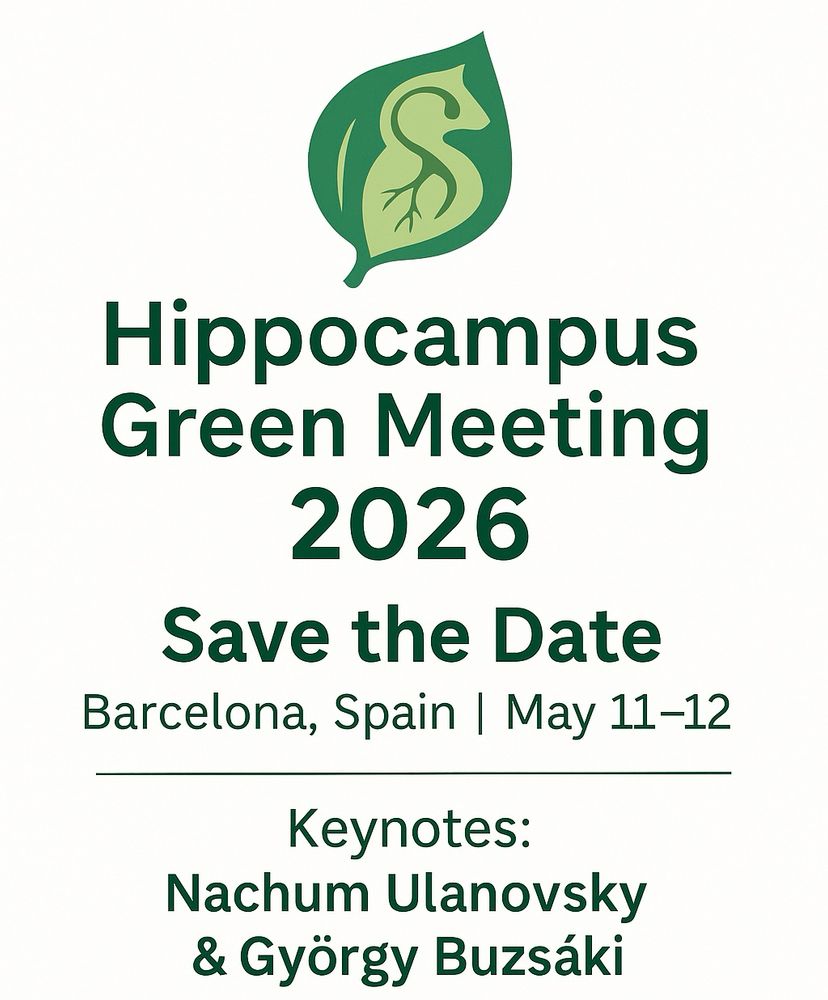
Happy to announce the 2nd Hippocampus Green Meeting
📍 Barcelona, Spain
🗓️ May 11–12, 2026
Organized together with Manu Valero, Lisa Roux and Dan Bendor
🎤 Keynotes: Nachum Ulanovsky & György Buzsáki
‼️ Call for abstracts now open
🔗 hippocampusgreen.net/wp/
#HippocampusGreen
📍 Barcelona, Spain
🗓️ May 11–12, 2026
Organized together with Manu Valero, Lisa Roux and Dan Bendor
🎤 Keynotes: Nachum Ulanovsky & György Buzsáki
‼️ Call for abstracts now open
🔗 hippocampusgreen.net/wp/
#HippocampusGreen
December 7, 2025 at 11:51 AM
Happy to announce the 2nd Hippocampus Green Meeting
📍 Barcelona, Spain
🗓️ May 11–12, 2026
Organized together with Manu Valero, Lisa Roux and Dan Bendor
🎤 Keynotes: Nachum Ulanovsky & György Buzsáki
‼️ Call for abstracts now open
🔗 hippocampusgreen.net/wp/
#HippocampusGreen
📍 Barcelona, Spain
🗓️ May 11–12, 2026
Organized together with Manu Valero, Lisa Roux and Dan Bendor
🎤 Keynotes: Nachum Ulanovsky & György Buzsáki
‼️ Call for abstracts now open
🔗 hippocampusgreen.net/wp/
#HippocampusGreen
Reposted by Flavio Donato
YES! "to explain all human cognition, we inherently must include development".
Beyond the Adult Mind: A Developmental Framework for Predictive Processing in Infancy - Ward - Topics in Cognitive Science - Wiley Online Library onlinelibrary.wiley.com/doi/full/10....
Beyond the Adult Mind: A Developmental Framework for Predictive Processing in Infancy - Ward - Topics in Cognitive Science - Wiley Online Library onlinelibrary.wiley.com/doi/full/10....

Beyond the Adult Mind: A Developmental Framework for Predictive Processing in Infancy
In this paper, we argue that Predictive Processing cannot be a unifying account of cognition until it can explain infant development. We show why development is crucial for understanding human cognit...
onlinelibrary.wiley.com
November 2, 2025 at 11:54 AM
YES! "to explain all human cognition, we inherently must include development".
Beyond the Adult Mind: A Developmental Framework for Predictive Processing in Infancy - Ward - Topics in Cognitive Science - Wiley Online Library onlinelibrary.wiley.com/doi/full/10....
Beyond the Adult Mind: A Developmental Framework for Predictive Processing in Infancy - Ward - Topics in Cognitive Science - Wiley Online Library onlinelibrary.wiley.com/doi/full/10....
Reposted by Flavio Donato
1/5 How does the brain turn the low-dimensional, universal grid cell metric into the rich, diverse codes needed for memory in hippocampal place cells? 🧵
Preprint link 👇
www.biorxiv.org/content/10.1...
Preprint link 👇
www.biorxiv.org/content/10.1...

Functional independence of entorhinal grid cell modules enables remapping in hippocampal place cells
A systems-level understanding of cortical computation requires insight into how neural codes are transformed across distinct brain circuits. In the mammalian cortex, one of the few systems where such ...
www.biorxiv.org
September 25, 2025 at 4:06 AM
1/5 How does the brain turn the low-dimensional, universal grid cell metric into the rich, diverse codes needed for memory in hippocampal place cells? 🧵
Preprint link 👇
www.biorxiv.org/content/10.1...
Preprint link 👇
www.biorxiv.org/content/10.1...
Reposted by Flavio Donato
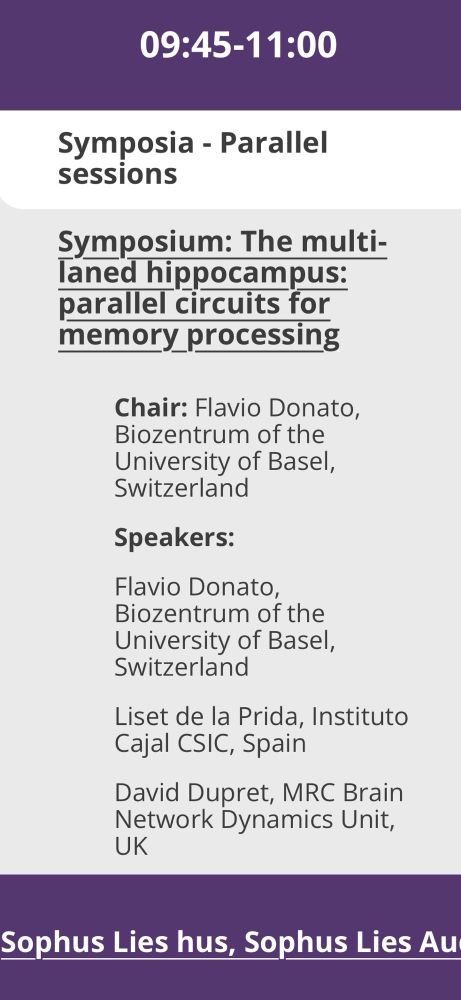
Looking forward to the #FRM25 @fens.org in Oslo! Excited to talk about the multi-laned hippocampus alongside @flaviodonato82.bsky.social and David Dupret. Great science and discussions ahead!

June 17, 2025 at 7:14 AM
Looking forward to the #FRM25 @fens.org in Oslo! Excited to talk about the multi-laned hippocampus alongside @flaviodonato82.bsky.social and David Dupret. Great science and discussions ahead!
Super proud PI moment today when my first PhD student Vilde Kveim received the Shepherd price for her PhD work at today’s Biozentrum symposium. So lucky to have started my lab with you, Vilde!! @biozentrum.unibas.ch @biozentrum-phd.bsky.social

June 12, 2025 at 6:46 PM
Super proud PI moment today when my first PhD student Vilde Kveim received the Shepherd price for her PhD work at today’s Biozentrum symposium. So lucky to have started my lab with you, Vilde!! @biozentrum.unibas.ch @biozentrum-phd.bsky.social
Reposted by Flavio Donato

On Friday, June 6, we will welcome Carlos Ribeiro @ribeirocarlitos.bsky.social @champalimaudr.bsky.social as the next speaker in our #BiozentrumDiscoverySeminar series. He will talk on "The Metabolic Mosaic: Illuminating the Interplay of Diet, Microbiome, Brain, and Metabolism"

June 3, 2025 at 6:58 AM
On Friday, June 6, we will welcome Carlos Ribeiro @ribeirocarlitos.bsky.social @champalimaudr.bsky.social as the next speaker in our #BiozentrumDiscoverySeminar series. He will talk on "The Metabolic Mosaic: Illuminating the Interplay of Diet, Microbiome, Brain, and Metabolism"
Reposted by Flavio Donato

Forelimb movement control at the basal ganglia - brainstem interface!
Happy to finally share this work from me and @harsh-kanodia.bsky.social with Silvia Arber!
@biozentrum.unibas.ch @fmiscience.bsky.social
www.nature.com/articles/s41...
Happy to finally share this work from me and @harsh-kanodia.bsky.social with Silvia Arber!
@biozentrum.unibas.ch @fmiscience.bsky.social
www.nature.com/articles/s41...
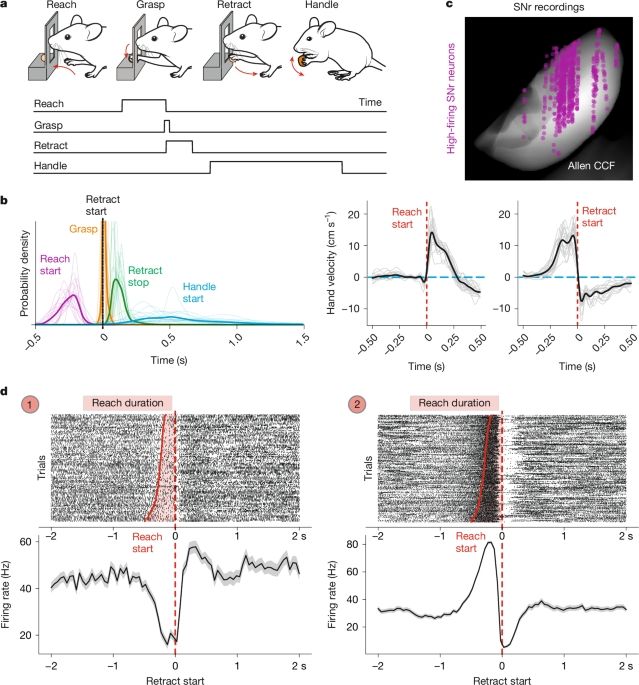
Dynamic basal ganglia output signals license and suppress forelimb movements - Nature
Basal ganglia output neurons fire dynamically in bidirectional and movement-specific patterns to license forelimb movements.
www.nature.com
May 28, 2025 at 3:32 PM
Forelimb movement control at the basal ganglia - brainstem interface!
Happy to finally share this work from me and @harsh-kanodia.bsky.social with Silvia Arber!
@biozentrum.unibas.ch @fmiscience.bsky.social
www.nature.com/articles/s41...
Happy to finally share this work from me and @harsh-kanodia.bsky.social with Silvia Arber!
@biozentrum.unibas.ch @fmiscience.bsky.social
www.nature.com/articles/s41...
Reposted by Flavio Donato
What do bacterial cells do when they run out of nutrients? Although most bacterial studies focus on cells in exponentially growing states, in the wild bacteria likely spend most of their time slowly starving to death. 1/n
www.biorxiv.org/content/10.1...
www.biorxiv.org/content/10.1...

E. coli prepares for starvation by dramatically remodeling its proteome in the first hours after loss of nutrients
It is widely believed that due to nutrient limitations in natural environments, bacteria spend most of their life in non-growing states. However, very little is known about how bacteria change their p...
www.biorxiv.org
January 15, 2025 at 11:12 AM
What do bacterial cells do when they run out of nutrients? Although most bacterial studies focus on cells in exponentially growing states, in the wild bacteria likely spend most of their time slowly starving to death. 1/n
www.biorxiv.org/content/10.1...
www.biorxiv.org/content/10.1...
Reposted by Flavio Donato

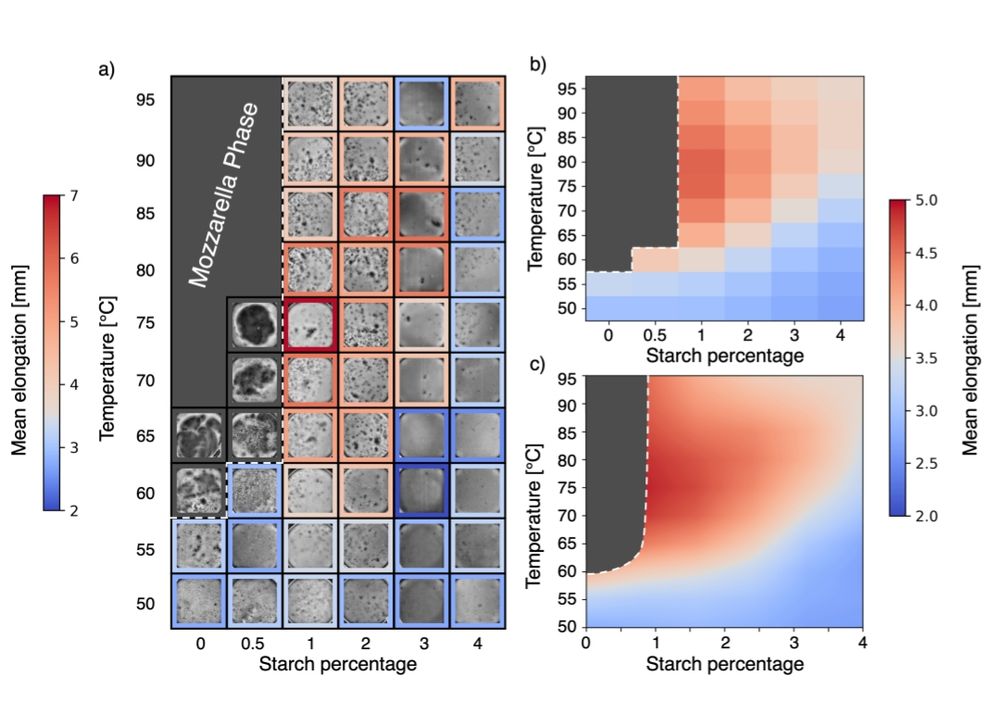
1/n Some time ago my colleague, excellent cook, and friend Ivan told me: "Cacio e pepe is the recipe that I screw up more often. Let's make a project studying systematically the physics of that sauce".
Prepare to get cheesy, I'm glad to share the Cacio e paper preprint:
arxiv.org/abs/2501.00536
Prepare to get cheesy, I'm glad to share the Cacio e paper preprint:
arxiv.org/abs/2501.00536
January 4, 2025 at 9:34 AM
1/n Some time ago my colleague, excellent cook, and friend Ivan told me: "Cacio e pepe is the recipe that I screw up more often. Let's make a project studying systematically the physics of that sauce".
Prepare to get cheesy, I'm glad to share the Cacio e paper preprint:
arxiv.org/abs/2501.00536
Prepare to get cheesy, I'm glad to share the Cacio e paper preprint:
arxiv.org/abs/2501.00536