




European Society of Human Genetics
@eshg.bsky.social
The ESHG is a non-profit organization. Its aims are to promote research in basic and applied human and medical genetics, to ensure high standards in clinical practice and to facilitate contacts between all persons who share these aims.
The abstract book of #eshg2025 has just been published!
Explore the latest research here 👉 www.nature.com/collections/...
Explore the latest research here 👉 www.nature.com/collections/...
January 19, 2026 at 8:33 AM
The abstract book of #eshg2025 has just been published!
Explore the latest research here 👉 www.nature.com/collections/...
Explore the latest research here 👉 www.nature.com/collections/...
👥Guidance for practice: ERN GENTURIS publishes a new guideline on reproductive counselling for individuals with cancer predisposition syndromes and their family members, aiming to improve consistency, quality, and patient-centred care.
www.nature.com/articles/s41...
www.nature.com/articles/s41...
ERN GENTURIS guideline on counselling on reproductive options for individuals with a cancer predisposition syndrome (including genturis) - European Journal of Human Genetics
European Journal of Human Genetics - ERN GENTURIS guideline on counselling on reproductive options for individuals with a cancer predisposition syndrome (including genturis)
www.nature.com
January 16, 2026 at 10:04 AM
👥Guidance for practice: ERN GENTURIS publishes a new guideline on reproductive counselling for individuals with cancer predisposition syndromes and their family members, aiming to improve consistency, quality, and patient-centred care.
www.nature.com/articles/s41...
www.nature.com/articles/s41...
🎥 The ESHG Webinar Series returns with Season 2 (2026)!
🗓️ Wednesday, 28 January | 14:00 CET
🎙️ Sarah Norris (Univ. of Sydney)
🧬 Newborn genome sequencing: benefits, risks & challenges
✅ Free to attend | 🔗 Zoom link will be on our website
🔔 Register for reminders: wma.eventsair.com/eshg-webinar...
🗓️ Wednesday, 28 January | 14:00 CET
🎙️ Sarah Norris (Univ. of Sydney)
🧬 Newborn genome sequencing: benefits, risks & challenges
✅ Free to attend | 🔗 Zoom link will be on our website
🔔 Register for reminders: wma.eventsair.com/eshg-webinar...

January 13, 2026 at 12:35 PM
🎥 The ESHG Webinar Series returns with Season 2 (2026)!
🗓️ Wednesday, 28 January | 14:00 CET
🎙️ Sarah Norris (Univ. of Sydney)
🧬 Newborn genome sequencing: benefits, risks & challenges
✅ Free to attend | 🔗 Zoom link will be on our website
🔔 Register for reminders: wma.eventsair.com/eshg-webinar...
🗓️ Wednesday, 28 January | 14:00 CET
🎙️ Sarah Norris (Univ. of Sydney)
🧬 Newborn genome sequencing: benefits, risks & challenges
✅ Free to attend | 🔗 Zoom link will be on our website
🔔 Register for reminders: wma.eventsair.com/eshg-webinar...
📣 Poster Abstract Submission Reminder
Poster abstract submissions for our partners’ ECRD 2026 are open until 6 March 2026! Patient groups, researchers & healthcare professionals are encouraged to submit.
🔗 More info: www.rare-diseases.eu/posters/
Poster abstract submissions for our partners’ ECRD 2026 are open until 6 March 2026! Patient groups, researchers & healthcare professionals are encouraged to submit.
🔗 More info: www.rare-diseases.eu/posters/

January 12, 2026 at 1:02 PM
📣 Poster Abstract Submission Reminder
Poster abstract submissions for our partners’ ECRD 2026 are open until 6 March 2026! Patient groups, researchers & healthcare professionals are encouraged to submit.
🔗 More info: www.rare-diseases.eu/posters/
Poster abstract submissions for our partners’ ECRD 2026 are open until 6 March 2026! Patient groups, researchers & healthcare professionals are encouraged to submit.
🔗 More info: www.rare-diseases.eu/posters/
🧾New study highlights the role of snRNA genes in Mendelian disease:
Heterozygous de novo and inherited variants in RNU4-2 and four RNU6 paralogs may explain up to 1.4% of previously unsolved cases of nonsyndromic retinitis pigmentosa.
www.nature.com/articles/s41...
Heterozygous de novo and inherited variants in RNU4-2 and four RNU6 paralogs may explain up to 1.4% of previously unsolved cases of nonsyndromic retinitis pigmentosa.
www.nature.com/articles/s41...

De novo and inherited dominant variants in U4 and U6 snRNA genes cause retinitis pigmentosa - Nature Genetics
De novo and inherited dominant variants in genes encoding U4 and U6 small nuclear RNAs are identified in individuals with retinitis pigmentosa. The variants cluster at nucleotide positions distinct…
www.nature.com
January 12, 2026 at 9:24 AM
🧾New study highlights the role of snRNA genes in Mendelian disease:
Heterozygous de novo and inherited variants in RNU4-2 and four RNU6 paralogs may explain up to 1.4% of previously unsolved cases of nonsyndromic retinitis pigmentosa.
www.nature.com/articles/s41...
Heterozygous de novo and inherited variants in RNU4-2 and four RNU6 paralogs may explain up to 1.4% of previously unsolved cases of nonsyndromic retinitis pigmentosa.
www.nature.com/articles/s41...
🧬New Solve-RD study (18,462 individuals) provides practical recommendations for TTN variant interpretation and reporting in clinical genomic testing, from rare disease diagnostics to secondary findings and preconception counselling.
#TTN #GenomicMedicine
www.sciencedirect.com/science/arti...
#TTN #GenomicMedicine
www.sciencedirect.com/science/arti...
www.sciencedirect.com
January 9, 2026 at 10:42 AM
🧬New Solve-RD study (18,462 individuals) provides practical recommendations for TTN variant interpretation and reporting in clinical genomic testing, from rare disease diagnostics to secondary findings and preconception counselling.
#TTN #GenomicMedicine
www.sciencedirect.com/science/arti...
#TTN #GenomicMedicine
www.sciencedirect.com/science/arti...
📣New in EJHG:
In 38 RD-Connect cases with candidate genotypes in 10 mt-aaRS genes, a phenotype similarity score against a literature-curated HPO reference supported ACMG PP4 evidence, improving yield and offering a reusable framework for other cohorts.
www.nature.com/articles/s41...
In 38 RD-Connect cases with candidate genotypes in 10 mt-aaRS genes, a phenotype similarity score against a literature-curated HPO reference supported ACMG PP4 evidence, improving yield and offering a reusable framework for other cohorts.
www.nature.com/articles/s41...

A systematic analysis of mitochondrial aminoacyl tRNA synthetase variants in a rare disease cohort
Mitochondrial aminoacyl-tRNA synthetases (mt-aaRSs) are a group of proteins encoded by nuclear DNA that play a crucial role in mitochondrial protein synthesis. Mitochondrial diseases caused by mt-aaRS...
www.nature.com
January 5, 2026 at 2:31 PM
📣New in EJHG:
In 38 RD-Connect cases with candidate genotypes in 10 mt-aaRS genes, a phenotype similarity score against a literature-curated HPO reference supported ACMG PP4 evidence, improving yield and offering a reusable framework for other cohorts.
www.nature.com/articles/s41...
In 38 RD-Connect cases with candidate genotypes in 10 mt-aaRS genes, a phenotype similarity score against a literature-curated HPO reference supported ACMG PP4 evidence, improving yield and offering a reusable framework for other cohorts.
www.nature.com/articles/s41...
📢 Out in AJHG:
De novo KDM2A variants cause a syndromic neurodevelopmental disorder. Functional assays and methylation data support this novel gene–disease association.
#RareDisease #NDD #EpiSignature
www.cell.com/ajhg/fulltex...
De novo KDM2A variants cause a syndromic neurodevelopmental disorder. Functional assays and methylation data support this novel gene–disease association.
#RareDisease #NDD #EpiSignature
www.cell.com/ajhg/fulltex...
www.cell.com
January 2, 2026 at 10:30 AM
📢 Out in AJHG:
De novo KDM2A variants cause a syndromic neurodevelopmental disorder. Functional assays and methylation data support this novel gene–disease association.
#RareDisease #NDD #EpiSignature
www.cell.com/ajhg/fulltex...
De novo KDM2A variants cause a syndromic neurodevelopmental disorder. Functional assays and methylation data support this novel gene–disease association.
#RareDisease #NDD #EpiSignature
www.cell.com/ajhg/fulltex...
🎉✨ Happy New Year from ESHG!
It’s the last day of the year—but not too late to renew (or re-join) your ESHG membership for 2026 and avoid interruption of your access to the European Journal of Human Genetics (@ejhg-journal.bsky.social).
Start the new year with us! 🧬
It’s the last day of the year—but not too late to renew (or re-join) your ESHG membership for 2026 and avoid interruption of your access to the European Journal of Human Genetics (@ejhg-journal.bsky.social).
Start the new year with us! 🧬

December 31, 2025 at 2:02 PM
🎉✨ Happy New Year from ESHG!
It’s the last day of the year—but not too late to renew (or re-join) your ESHG membership for 2026 and avoid interruption of your access to the European Journal of Human Genetics (@ejhg-journal.bsky.social).
Start the new year with us! 🧬
It’s the last day of the year—but not too late to renew (or re-join) your ESHG membership for 2026 and avoid interruption of your access to the European Journal of Human Genetics (@ejhg-journal.bsky.social).
Start the new year with us! 🧬
📝 Registration is Open!
Registration for our partners’ European Conference on Rare Diseases & Orphan Products (ECRD), taking place 3–4 June 2026 in Prague & online, is now open.
💡 Register before 26 Feb 2026 to benefit from Early-Bird rates!
🔗 www.rare-diseases.eu/register/
Registration for our partners’ European Conference on Rare Diseases & Orphan Products (ECRD), taking place 3–4 June 2026 in Prague & online, is now open.
💡 Register before 26 Feb 2026 to benefit from Early-Bird rates!
🔗 www.rare-diseases.eu/register/

December 28, 2025 at 8:00 AM
📝 Registration is Open!
Registration for our partners’ European Conference on Rare Diseases & Orphan Products (ECRD), taking place 3–4 June 2026 in Prague & online, is now open.
💡 Register before 26 Feb 2026 to benefit from Early-Bird rates!
🔗 www.rare-diseases.eu/register/
Registration for our partners’ European Conference on Rare Diseases & Orphan Products (ECRD), taking place 3–4 June 2026 in Prague & online, is now open.
💡 Register before 26 Feb 2026 to benefit from Early-Bird rates!
🔗 www.rare-diseases.eu/register/
🎄✨ Happy Holidays from ESHG!
We wish you a joyful holiday season, time to relax, and a refreshing start to the new year. Thank you for being part of our community!
We wish you a joyful holiday season, time to relax, and a refreshing start to the new year. Thank you for being part of our community!

December 24, 2025 at 8:00 AM
🎄✨ Happy Holidays from ESHG!
We wish you a joyful holiday season, time to relax, and a refreshing start to the new year. Thank you for being part of our community!
We wish you a joyful holiday season, time to relax, and a refreshing start to the new year. Thank you for being part of our community!
📺 Now Online! Episodes 7 (Elfride de Baere) & 8 (Lisenka Vissers) of the ESHG Webinar Series are now available on YouTube: buff.ly/T5HTfyr
Zoom links for 2026 webinars will be shared on our website.
Sign up to receive reminders and updates: buff.ly/Hq48zjs
Zoom links for 2026 webinars will be shared on our website.
Sign up to receive reminders and updates: buff.ly/Hq48zjs
December 22, 2025 at 4:05 PM
📺 Now Online! Episodes 7 (Elfride de Baere) & 8 (Lisenka Vissers) of the ESHG Webinar Series are now available on YouTube: buff.ly/T5HTfyr
Zoom links for 2026 webinars will be shared on our website.
Sign up to receive reminders and updates: buff.ly/Hq48zjs
Zoom links for 2026 webinars will be shared on our website.
Sign up to receive reminders and updates: buff.ly/Hq48zjs
📢 Save the Date!
Our partners are hosting the European Conference on Rare Diseases & Orphan Products (ECRD) on 3–4 June 2026 in Prague & online.
🧬 Rare Diseases in a Changing & Competitive Europe — shaping policies to address unmet needs.
🔗 More info: www.rare-diseases.eu
Our partners are hosting the European Conference on Rare Diseases & Orphan Products (ECRD) on 3–4 June 2026 in Prague & online.
🧬 Rare Diseases in a Changing & Competitive Europe — shaping policies to address unmet needs.
🔗 More info: www.rare-diseases.eu

December 19, 2025 at 1:33 PM
📢 Save the Date!
Our partners are hosting the European Conference on Rare Diseases & Orphan Products (ECRD) on 3–4 June 2026 in Prague & online.
🧬 Rare Diseases in a Changing & Competitive Europe — shaping policies to address unmet needs.
🔗 More info: www.rare-diseases.eu
Our partners are hosting the European Conference on Rare Diseases & Orphan Products (ECRD) on 3–4 June 2026 in Prague & online.
🧬 Rare Diseases in a Changing & Competitive Europe — shaping policies to address unmet needs.
🔗 More info: www.rare-diseases.eu
📣 The ESHG DNA Day Essay & Video Contest 2026 is open! A yearly contest for high school students—submit now until DNA Day, April 25, 2026. Help promote genetics across Europe: spread the word to schools & educators! 🧬 More information: www.dnaday.eu

December 18, 2025 at 9:07 AM
📣 The ESHG DNA Day Essay & Video Contest 2026 is open! A yearly contest for high school students—submit now until DNA Day, April 25, 2026. Help promote genetics across Europe: spread the word to schools & educators! 🧬 More information: www.dnaday.eu
ESHG Membership Renewals are now open for individuals in Europe & beyond, with updated membership categories and fees.
🔗 View categories and fees: www.eshg.org/membership/m...
🔗 Join or renew now: cpeople.ctimeetingtech.com/eshg/members...
✨ Happy Holidays — and see you in the new year!
🔗 View categories and fees: www.eshg.org/membership/m...
🔗 Join or renew now: cpeople.ctimeetingtech.com/eshg/members...
✨ Happy Holidays — and see you in the new year!

December 17, 2025 at 2:39 PM
ESHG Membership Renewals are now open for individuals in Europe & beyond, with updated membership categories and fees.
🔗 View categories and fees: www.eshg.org/membership/m...
🔗 Join or renew now: cpeople.ctimeetingtech.com/eshg/members...
✨ Happy Holidays — and see you in the new year!
🔗 View categories and fees: www.eshg.org/membership/m...
🔗 Join or renew now: cpeople.ctimeetingtech.com/eshg/members...
✨ Happy Holidays — and see you in the new year!
Abstract submission for #eshg2026 is open! The Scientific Programme Committee invites abstracts to be submitted for inclusion in the programme as posters or oral presentations until 12th February 2026. More information found on the conference website: 2026.eshg.org/abstracts/

Abstracts
Regular abstract submission for ESHG 2026 is now open. The deadline for abstract submission is Thursday, February 12, 2026, 23.59 hrs CET. Notifications about the outcome of the abstract assessment…
2026.eshg.org
December 15, 2025 at 2:59 PM
Abstract submission for #eshg2026 is open! The Scientific Programme Committee invites abstracts to be submitted for inclusion in the programme as posters or oral presentations until 12th February 2026. More information found on the conference website: 2026.eshg.org/abstracts/
🧬Pathogenic variants in snRNA genes seem to be a more frequent cause of Mendelian disorders than previously thought, with major relevance for #NDDs and retinal disease.
This Review summarizes recent advances and future perspectives in the field:
📄 www.nature.com/articles/s41...
This Review summarizes recent advances and future perspectives in the field:
📄 www.nature.com/articles/s41...

Small nuclear RNA genes in Mendelian disorders - Nature Genetics
This Review discusses the high-impact variants in 12 small nuclear RNA genes that cause Mendelian disorders with either autosomal dominant or recessive inheritance patterns, highlighting the…
www.nature.com
December 12, 2025 at 2:25 PM
🧬Pathogenic variants in snRNA genes seem to be a more frequent cause of Mendelian disorders than previously thought, with major relevance for #NDDs and retinal disease.
This Review summarizes recent advances and future perspectives in the field:
📄 www.nature.com/articles/s41...
This Review summarizes recent advances and future perspectives in the field:
📄 www.nature.com/articles/s41...
Reposted by European Society of Human Genetics

📢 The December issue of #EJHG is online! 🧬
New genes, new discoveries, new insights in #HumanGenetics
⬇️⬇️⬇️
www.nature.com/ejhg/volumes...
New genes, new discoveries, new insights in #HumanGenetics
⬇️⬇️⬇️
www.nature.com/ejhg/volumes...

December 8, 2025 at 8:28 AM
📢 The December issue of #EJHG is online! 🧬
New genes, new discoveries, new insights in #HumanGenetics
⬇️⬇️⬇️
www.nature.com/ejhg/volumes...
New genes, new discoveries, new insights in #HumanGenetics
⬇️⬇️⬇️
www.nature.com/ejhg/volumes...
📄New in @AJHGNews: Recurrent structural variants at 16p13.3 palindrome cause a novel neurodegenerative disorder with progressive ataxia, cognitive decline and distinctive brain MRI pattern, highlighting ATP6V0C dosage.
Read more:
www.cell.com/ajhg/fulltex...
Read more:
www.cell.com/ajhg/fulltex...

Palindrome-mediated 16p13.3 triplications cause a recognizable neurodegenerative disorder with ataxia
Fasham and colleagues report a palindrome-mediated genomic disorder causing a recognizable, severe phenotype marked by early-onset progressive ataxia, cognitive decline, and cerebellar atrophy.…
www.cell.com
December 11, 2025 at 8:42 AM
📄New in @AJHGNews: Recurrent structural variants at 16p13.3 palindrome cause a novel neurodegenerative disorder with progressive ataxia, cognitive decline and distinctive brain MRI pattern, highlighting ATP6V0C dosage.
Read more:
www.cell.com/ajhg/fulltex...
Read more:
www.cell.com/ajhg/fulltex...
📊Large-scale data sharing is indispensable for human genetics & genomics. ASHG calls for a broad data-sharing ethos and responsible stewardship that protects participants while enabling collaboration.
#HumanGenetics #OpenScience
www.cell.com/ajhg/fulltex...
#HumanGenetics #OpenScience
www.cell.com/ajhg/fulltex...

Collaborative science in genomics: The value of data sharing and thoughtful stewardship
Large-scale data sharing is indispensable for advancing human genetics and genomics (HGG) research and medicine. The willingness of study participants and researchers to share data has been the…
www.cell.com
December 5, 2025 at 10:52 AM
📊Large-scale data sharing is indispensable for human genetics & genomics. ASHG calls for a broad data-sharing ethos and responsible stewardship that protects participants while enabling collaboration.
#HumanGenetics #OpenScience
www.cell.com/ajhg/fulltex...
#HumanGenetics #OpenScience
www.cell.com/ajhg/fulltex...
📢Paper alert!
Read about popEVE, a deep generative model that ranks missense variants by deleteriousness across the proteome, by combining evolutionary and population data. It flags novel genes and can identify causal variants even in singleton exomes.
www.nature.com/articles/s41...
Read about popEVE, a deep generative model that ranks missense variants by deleteriousness across the proteome, by combining evolutionary and population data. It flags novel genes and can identify causal variants even in singleton exomes.
www.nature.com/articles/s41...

Proteome-wide model for human disease genetics - Nature Genetics
popEVE is a proteome-wide deep generative model to identify and predict pathogenicity of missense mutations causing genetic disorders.
www.nature.com
November 28, 2025 at 10:56 AM
📢Paper alert!
Read about popEVE, a deep generative model that ranks missense variants by deleteriousness across the proteome, by combining evolutionary and population data. It flags novel genes and can identify causal variants even in singleton exomes.
www.nature.com/articles/s41...
Read about popEVE, a deep generative model that ranks missense variants by deleteriousness across the proteome, by combining evolutionary and population data. It flags novel genes and can identify causal variants even in singleton exomes.
www.nature.com/articles/s41...
🧬 Episode 8 of the ESHG Webinar Series is coming up on Nov 26, 2025 at 16:00 CET!
Lisenka Vissers (Radboudumc, NL) will speak on translating long-read genome sequencing into clinical applications for rare diseases.
Free via Zoom – registration required.
wma.eventsair.com/eshg-webinar...
Lisenka Vissers (Radboudumc, NL) will speak on translating long-read genome sequencing into clinical applications for rare diseases.
Free via Zoom – registration required.
wma.eventsair.com/eshg-webinar...

November 21, 2025 at 12:33 PM
🧬 Episode 8 of the ESHG Webinar Series is coming up on Nov 26, 2025 at 16:00 CET!
Lisenka Vissers (Radboudumc, NL) will speak on translating long-read genome sequencing into clinical applications for rare diseases.
Free via Zoom – registration required.
wma.eventsair.com/eshg-webinar...
Lisenka Vissers (Radboudumc, NL) will speak on translating long-read genome sequencing into clinical applications for rare diseases.
Free via Zoom – registration required.
wma.eventsair.com/eshg-webinar...
🤝 We’re delighted to partner with the Japanese & American societies for the joint symposium “Genetics and Genomics Surrounding Newborn Screening” on Dec 19 at the 70th JSHG Annual Meeting in Yokohama.
Programme: congre.co.jp/jshg2025/en/program.html
Programme: congre.co.jp/jshg2025/en/program.html
congre.co.jp
November 18, 2025 at 6:30 AM
🤝 We’re delighted to partner with the Japanese & American societies for the joint symposium “Genetics and Genomics Surrounding Newborn Screening” on Dec 19 at the 70th JSHG Annual Meeting in Yokohama.
Programme: congre.co.jp/jshg2025/en/program.html
Programme: congre.co.jp/jshg2025/en/program.html
🕒 Last call!
Applications for the 2026 ESHG Mentorship & Observership Programmes close Nov 30, 2025.
Funding available for training visits in genetics 🌍🧬
Apply now & share with interested colleagues!
www.eshg.org/education/es...
www.eshg.org/education/es...
Applications for the 2026 ESHG Mentorship & Observership Programmes close Nov 30, 2025.
Funding available for training visits in genetics 🌍🧬
Apply now & share with interested colleagues!
www.eshg.org/education/es...
www.eshg.org/education/es...

ESHG: ESHG Observership Programme
The ESHG coordinates the “ESHG Observership for Young Geneticists” which is an important educational initiative that offers support each year for 5 young human geneticists who wish to observe…
www.eshg.org
November 17, 2025 at 2:46 PM
🕒 Last call!
Applications for the 2026 ESHG Mentorship & Observership Programmes close Nov 30, 2025.
Funding available for training visits in genetics 🌍🧬
Apply now & share with interested colleagues!
www.eshg.org/education/es...
www.eshg.org/education/es...
Applications for the 2026 ESHG Mentorship & Observership Programmes close Nov 30, 2025.
Funding available for training visits in genetics 🌍🧬
Apply now & share with interested colleagues!
www.eshg.org/education/es...
www.eshg.org/education/es...
New study in Nature Biotech reveals most mitotic errors in human embryos occur in the placenta-precursor cells, not the inner cell mass that forms the fetus. 🧬
Findings could reshape how IVF clinics interpret PGT-A results.
#IVF #Embryology #Biotech
www.nature.com/articles/s41...
Findings could reshape how IVF clinics interpret PGT-A results.
#IVF #Embryology #Biotech
www.nature.com/articles/s41...
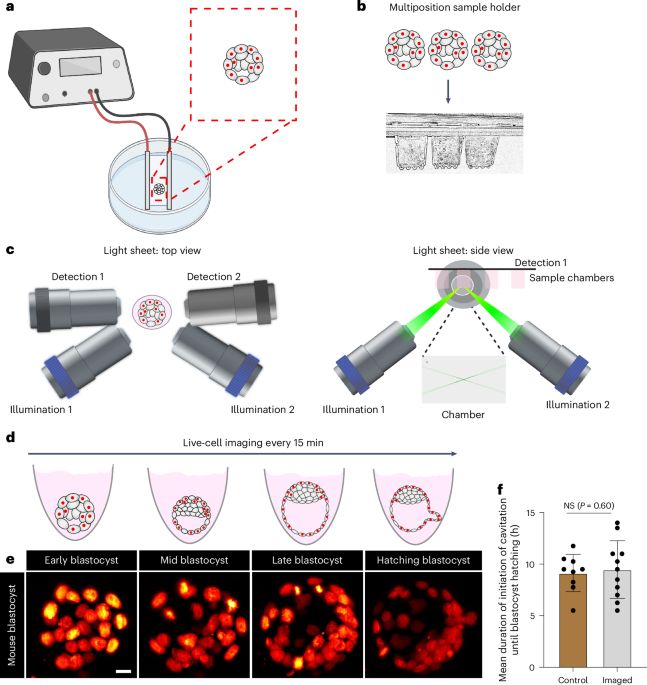
Live imaging of late-stage preimplantation human embryos reveals de novo mitotic errors - Nature Biotechnology
A method to label cultured human embryos finds chromosome segregation errors in placenta-fated cells.
www.nature.com
November 7, 2025 at 12:18 PM
New study in Nature Biotech reveals most mitotic errors in human embryos occur in the placenta-precursor cells, not the inner cell mass that forms the fetus. 🧬
Findings could reshape how IVF clinics interpret PGT-A results.
#IVF #Embryology #Biotech
www.nature.com/articles/s41...
Findings could reshape how IVF clinics interpret PGT-A results.
#IVF #Embryology #Biotech
www.nature.com/articles/s41...