


Matthias Rauls
@dobsonaut.bsky.social
Hobby astronomer who loves to share his inspiration
Pinned
Matthias Rauls
@dobsonaut.bsky.social
· Aug 27


The star that expanded the universe was discovered by Edwin Hubble in 1923 with a 2.5m telescope. The Cepheid star V1 gave first prove that Andromeda is a galaxy outside our milkyway. Today, this #Astrophotography with my little #CelestronOrigin clearly shows this star in the gorgeous spiral of M31.
Thanks - but my brain starts spinning ... (or is it expanding?)
February 7, 2026 at 12:23 PM
Thanks - but my brain starts spinning ... (or is it expanding?)
Wouldn't the "galaxies move through space" argument quickly 'collide' with the speed limits of relativity?
February 7, 2026 at 12:02 PM
Wouldn't the "galaxies move through space" argument quickly 'collide' with the speed limits of relativity?
This maps neglects the long history of making excellent wines in many European regions before 1960, German Riesling being only one among many.
January 10, 2026 at 4:40 PM
This maps neglects the long history of making excellent wines in many European regions before 1960, German Riesling being only one among many.
This illustration is not appropriate. No question about it. Without wishing to defend the authors, I could imagine that the extremely rapid rotation of the asteroid gave rise to the idea of it having a more solid structure and less being of the rubble heap type.
January 10, 2026 at 11:47 AM
This illustration is not appropriate. No question about it. Without wishing to defend the authors, I could imagine that the extremely rapid rotation of the asteroid gave rise to the idea of it having a more solid structure and less being of the rubble heap type.
Reposted by Matthias Rauls

The universe is still full of surprises! This is Cloud-9, a starless blob held together by dark matter--a "failed galaxy."
Astronomers have long speculated that such hidden objects formed the building blocks of bright galaxies like our own. Now we've found one. 🧪🔭
esahubble.org/news/heic2601/
Astronomers have long speculated that such hidden objects formed the building blocks of bright galaxies like our own. Now we've found one. 🧪🔭
esahubble.org/news/heic2601/

January 5, 2026 at 11:25 PM
The universe is still full of surprises! This is Cloud-9, a starless blob held together by dark matter--a "failed galaxy."
Astronomers have long speculated that such hidden objects formed the building blocks of bright galaxies like our own. Now we've found one. 🧪🔭
esahubble.org/news/heic2601/
Astronomers have long speculated that such hidden objects formed the building blocks of bright galaxies like our own. Now we've found one. 🧪🔭
esahubble.org/news/heic2601/
I enjoyed reading your summary on the physics of skating. I remembered, however, that 40y ago I was told in Chemical Physics, that transient pressure on ice can not suffice to melt it. May I bring to your attention this recent MD study on an interesting alternative? journals.aps.org/prl/abstract...
Cold Self-Lubrication of Sliding Ice
The low kinetic friction between ice and numerous counterbodies is commonly attributed to an interfacial water layer, which is believed to originate from preexisting surface water or from melt water i...
journals.aps.org
December 30, 2025 at 9:52 AM
I enjoyed reading your summary on the physics of skating. I remembered, however, that 40y ago I was told in Chemical Physics, that transient pressure on ice can not suffice to melt it. May I bring to your attention this recent MD study on an interesting alternative? journals.aps.org/prl/abstract...
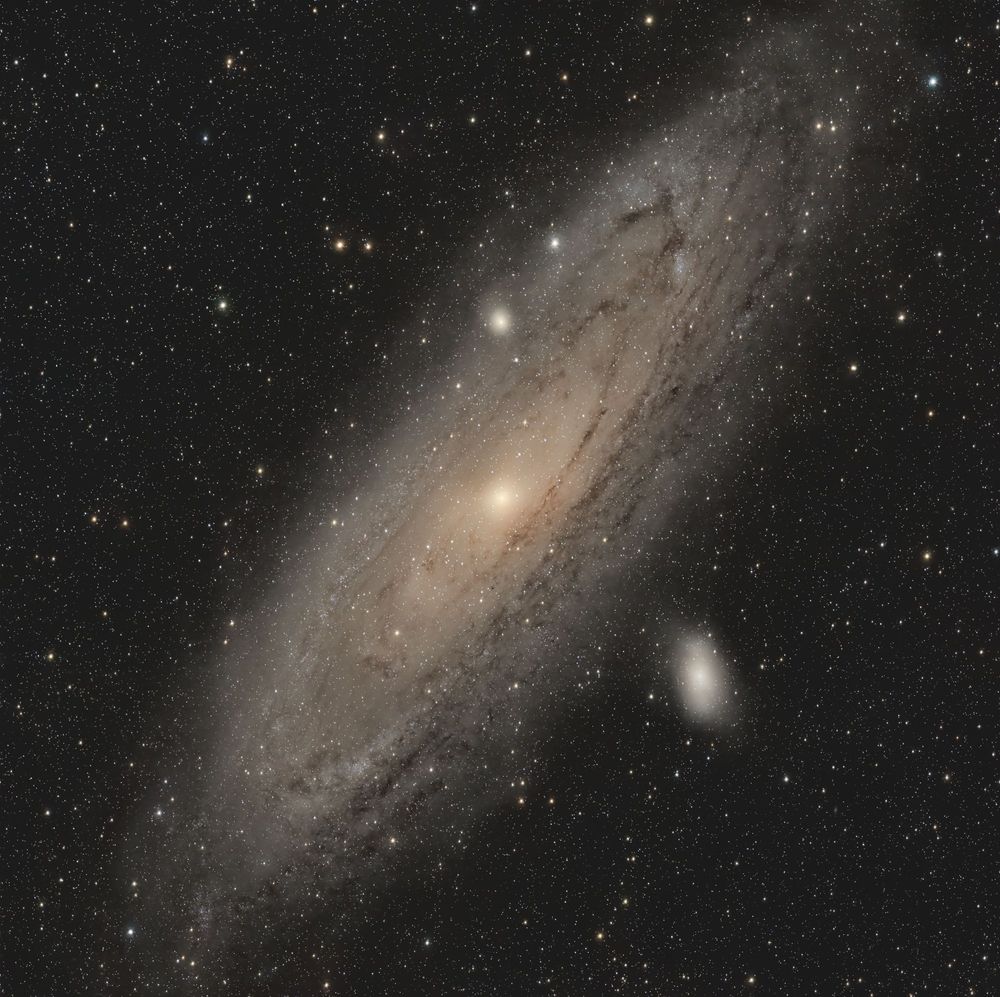
M31 is our neighbor in the ocean of the universe. I recently showed that my telescope can detect individual stars 2.5Mio LY away. Imaging the entire galaxy with the same telescope is more difficult. This #astrophotography with my #CelestonOrigin is a mosaic from 6 images, each 1h of exposure time.
December 13, 2025 at 5:43 PM
M31 is our neighbor in the ocean of the universe. I recently showed that my telescope can detect individual stars 2.5Mio LY away. Imaging the entire galaxy with the same telescope is more difficult. This #astrophotography with my #CelestonOrigin is a mosaic from 6 images, each 1h of exposure time.
What a beautiful, instructive visualization (and it is still even if people dispute the one or the other color shade by 10.000y).
December 1, 2025 at 8:40 AM
What a beautiful, instructive visualization (and it is still even if people dispute the one or the other color shade by 10.000y).
Is there a higher resolution version of this map available?
October 26, 2025 at 8:59 AM
Is there a higher resolution version of this map available?
There seems to be a bad link attached!? But gorgeous image!!
October 25, 2025 at 8:40 AM
There seems to be a bad link attached!? But gorgeous image!!
Great visualization!
October 23, 2025 at 7:23 AM
Great visualization!
Have you yet seen two lava fountains close to each other? Check this live cam from Kilauea:
www.youtube.com/live/BqmpkUd...
www.youtube.com/live/BqmpkUd...

[V3cam] Kīlauea volcano, Hawaii (south Halemaʻumaʻu crater)
YouTube video by USGS
www.youtube.com
October 18, 2025 at 8:12 AM
Have you yet seen two lava fountains close to each other? Check this live cam from Kilauea:
www.youtube.com/live/BqmpkUd...
www.youtube.com/live/BqmpkUd...
Today, that star marked with "Var!" can be imaged with a 6 inch telescope: bsky.app/profile/dobs...
The star that expanded the universe was discovered by Edwin Hubble in 1923 with a 2.5m telescope. The Cepheid star V1 gave first prove that Andromeda is a galaxy outside our milkyway. Today, this #Astrophotography with my little #CelestronOrigin clearly shows this star in the gorgeous spiral of M31.
October 6, 2025 at 7:04 AM
Today, that star marked with "Var!" can be imaged with a 6 inch telescope: bsky.app/profile/dobs...
But the point you are making is interesting, though!
October 5, 2025 at 11:43 AM
But the point you are making is interesting, though!
I am sure that you are using the word lie as a rethoric hyperbole here. To me, it's just our eyes (and monitors) that are incapable of displaying and recognizing exponential brightness profiles.
October 5, 2025 at 11:42 AM
I am sure that you are using the word lie as a rethoric hyperbole here. To me, it's just our eyes (and monitors) that are incapable of displaying and recognizing exponential brightness profiles.
Reposted by Matthias Rauls

Happy 120th birthday, special relativity!
Albert Einstein introduced special relativity in the paper "On The Electrodynamics Of Moving Bodies," published in Annalen der Physik #OTD in 1905. 🧪 ⚛️ 🔭
Manuscript: onlinelibrary.wiley.com/doi/abs/10.1...
English: www.fourmilab.ch/etexts/einst...
Albert Einstein introduced special relativity in the paper "On The Electrodynamics Of Moving Bodies," published in Annalen der Physik #OTD in 1905. 🧪 ⚛️ 🔭
Manuscript: onlinelibrary.wiley.com/doi/abs/10.1...
English: www.fourmilab.ch/etexts/einst...


September 26, 2025 at 6:17 PM
Happy 120th birthday, special relativity!
Albert Einstein introduced special relativity in the paper "On The Electrodynamics Of Moving Bodies," published in Annalen der Physik #OTD in 1905. 🧪 ⚛️ 🔭
Manuscript: onlinelibrary.wiley.com/doi/abs/10.1...
English: www.fourmilab.ch/etexts/einst...
Albert Einstein introduced special relativity in the paper "On The Electrodynamics Of Moving Bodies," published in Annalen der Physik #OTD in 1905. 🧪 ⚛️ 🔭
Manuscript: onlinelibrary.wiley.com/doi/abs/10.1...
English: www.fourmilab.ch/etexts/einst...
Interesting! The word "kwaksalver" also is equivalent to the old German word for the element mercury, whick is "Quecksilber". So this could be someone who prepares mercury containing ointments which must have been quite common then.
September 27, 2025 at 7:34 AM
Interesting! The word "kwaksalver" also is equivalent to the old German word for the element mercury, whick is "Quecksilber". So this could be someone who prepares mercury containing ointments which must have been quite common then.
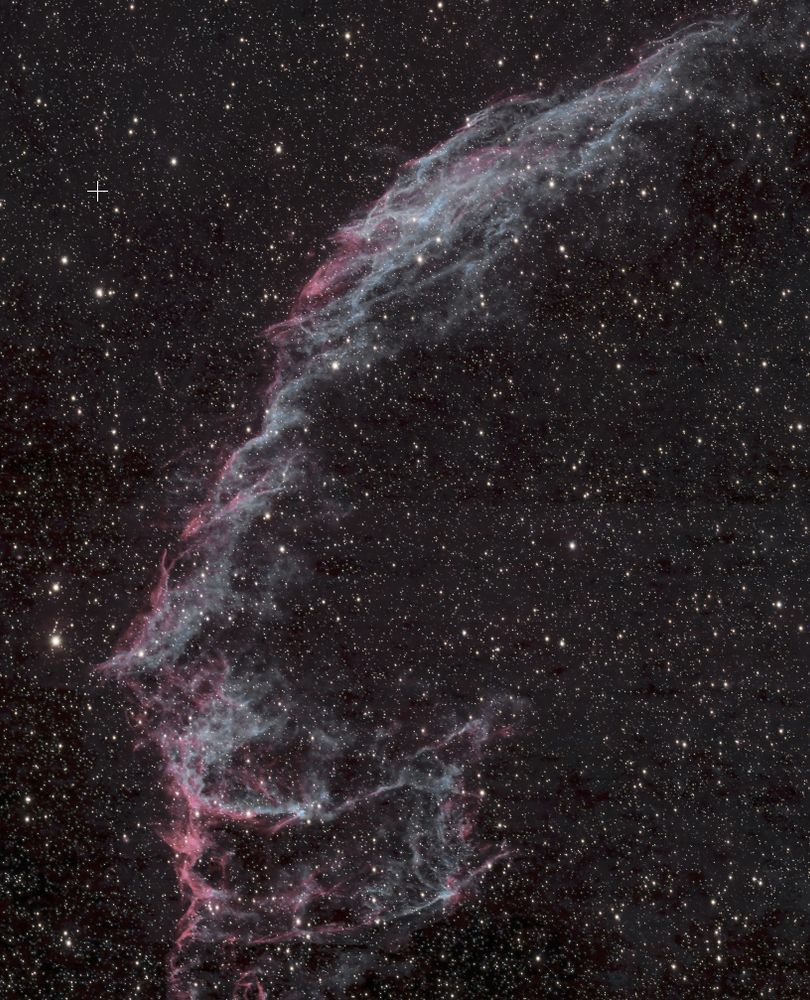
Constellation Cygnus hides a marvel of galactic nebulae. The Eastern Veil Nebula is part of a much larger remnant of a supernova that exploded around 8,000 years ago. This #astrophotography was created as a mosaic of two images taken with my #CelestronOrigin, each with an exposure time of one hour.

September 20, 2025 at 8:44 AM
Constellation Cygnus hides a marvel of galactic nebulae. The Eastern Veil Nebula is part of a much larger remnant of a supernova that exploded around 8,000 years ago. This #astrophotography was created as a mosaic of two images taken with my #CelestronOrigin, each with an exposure time of one hour.
That person in the '70s is exactly me!
September 16, 2025 at 9:12 AM
That person in the '70s is exactly me!
"The star that changed the size of the universe" was discovered in 1923 by Hubble on a plate taken with the 2.5m Hooker telescope. This variable Cepheid star proved that Andromeda is a far away galaxy like our own. Today, #astrophotography with my little #CelestronOrigin can show this star clearly.


September 16, 2025 at 8:18 AM
"The star that changed the size of the universe" was discovered in 1923 by Hubble on a plate taken with the 2.5m Hooker telescope. This variable Cepheid star proved that Andromeda is a far away galaxy like our own. Today, #astrophotography with my little #CelestronOrigin can show this star clearly.
Congratulations on that phantastic journey!
September 15, 2025 at 3:40 PM
Congratulations on that phantastic journey!
Sehr interessante Seite, danke! Vor allem, da ich mich da altersgemäß (und damit vorteilhaft!) einordnen kann.
September 11, 2025 at 7:52 AM
Sehr interessante Seite, danke! Vor allem, da ich mich da altersgemäß (und damit vorteilhaft!) einordnen kann.
Reposted by Matthias Rauls

August 28, 2025 at 5:31 AM