George Turner
dlimnothrissa.bsky.social
George Turner
@dlimnothrissa.bsky.social

UK-based prof of Zoology, father, African cichlid expert, lover of the natural world, museums, music, education, the welfare state.

Environmental science 41%
Biology 31%

Cool discussion of social insect evolution and how to navigate the Xosphere. With my wonderful daughter. www.youtube.com/watch?v=v_46...
Dr. Juliet Turner - The Evolution of Cooperation and Division of Labour in Insects
YouTube video by Stated Casually
www.youtube.com

Part 3 of my Malawi cichlid ID guide is out. I realise i haven't done part 2 yet! It is in progress. ecoevorxiv.org/repository/v...
Identification of the Cichlid Fishes of Lake Malawi/Nyasa Part 3: Rhamphochromina and others.
ecoevorxiv.org

Another new preprint, this one intended for a peer-reviewed journal, reports a new species of Lake Malawi cichlid, which probably attacks mouthbrooding female cichlids to feed on the eggs and larvae they are carrying. Preprints are not valid taxonomic publications.
ecoevorxiv.org/repository/v...
Hemitaeniochromis pumba, a new species of cichlid fish from Lake Malawi, Africa, with comments on related species.
ecoevorxiv.org

Chindongo minutus, a small, but fiercely territorial cichlid from the rocky shores around Nkhata Bay, Lake Malawi. Males defend 'algal gardens', picking off nutritious material from among the tough attached filaments & a spawning site among the rocks. The drab females are able to range more widely.

Thanks. At this stage, it is mainly backing up our collaborative genomic paper in Science, but I am planning to use the flexibility of the preprint format to build it up to be comprehensive! Also, its free access, which should help other researchers (esp. in Africa). www.science.org/doi/10.1126/...
Introgression dynamics of sex-linked chromosomal inversions shape the Malawi cichlid radiation
Chromosomal inversions can contribute to adaptive speciation by linking coadapted alleles. By querying 1375 genomes of the species-rich Malawi cichlid fish radiation, we discovered five large inversio...
www.science.org

Part 1 version 1 of my Malawi cichlid ID guide is out now. 2 more parts for follow, with my intention being to revise, expand and improve each over time. This one is essentially a companion to our whole genome sequence paper in Science (Blumer et al. 2025). ecoevorxiv.org/repository/v...
Identification of the Cichlid Fishes of Lake Malawi/Nyasa Part 1: Cyrtocarina (the ‘benthic’ or ‘hap’ sub-radiation).
ecoevorxiv.org

Amazing development of the genital tassel on the dominant male Oreochromis squamipinnis (Lake Malawi endemic).

Reposted by George F. Turner

With @hybridzones.bsky.social & @jenncoughlan.bsky.social, we have been working on an update to Daven Presgraves' influential 2010 review on hybrid incompatibilities (shorturl.at/cJndf). The preprint is available here (shorturl.at/DTC48) with an updated table of almost 100 incompatibilities!
The molecular evolutionary basis of species formation - Nature Reviews Genetics
Recently, several new speciation genes have been identified that have contributed to our understanding of the molecular details of the evolution of hybrid dysfunction. This Progress article describes ...
shorturl.at

Reposted by George F. Turner

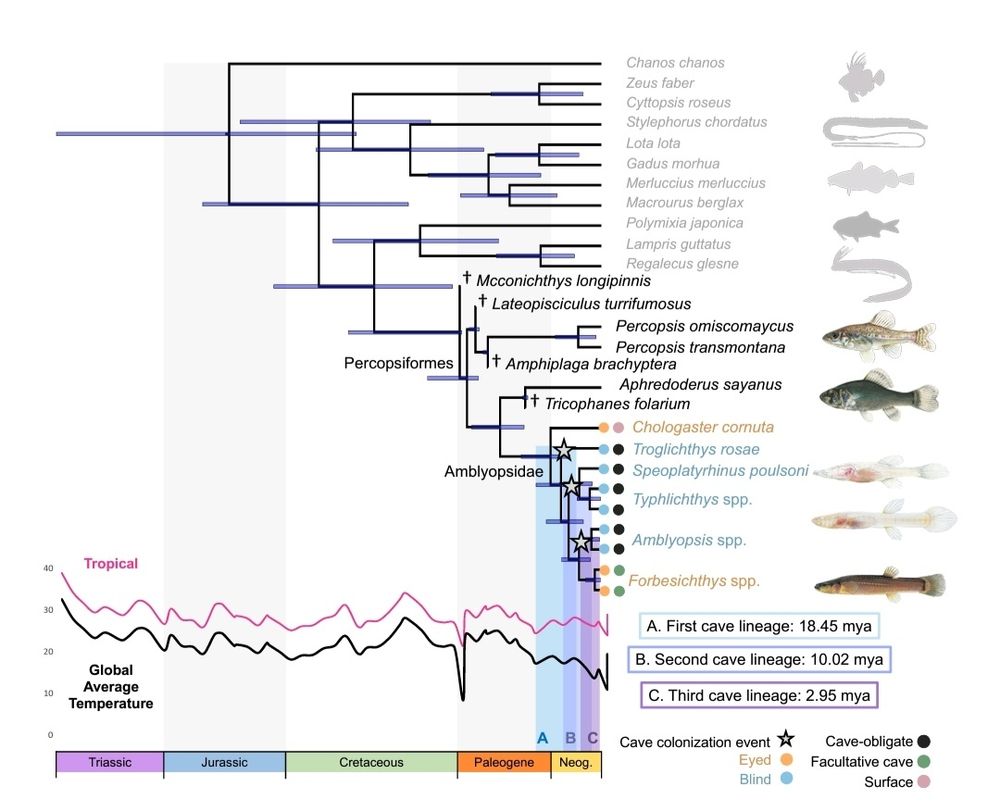
Check out our new paper! We find cavefish colonized caves 3x and global cooling events may have influenced these events.

royalsocietypublishing.org/doi/10.1098/...

Diving beetle at RSPB Conway. Colymbetes fuscus?

A bundle of axolotls

Butterwort- carnivorous plant

Lake Malawi cichlids: even common, big, spectacular species are often a taxonomic mess, like these Taeniolethrinops species. Much work needed!

Yes, thats it. Lots of trawlers in south. Fewer people & less demand in north. And not many previous trawl surveys with good specimen collection / photo records / ID experts.

Front garden

Seaside bluebells yesterday.

Only described in 1977, Lethrinops microdon, once the dominant species in the bottom trawl fishery in southern Lake Malawi, had disappeared completely by the late 1990s. We rediscovered it in very deep water at the northern end of the lake in 2023.

Lethrinops micrentodon is another species that seems to have disappeared in the southern parts of Lake Malawi but cropped up again in the north. It has a similar pharyngeal bone to L. stridei & L. microdon (many tiny closely-packed teeth) but fewer gillrakers. It feeds mainly on sedimented diatoms.

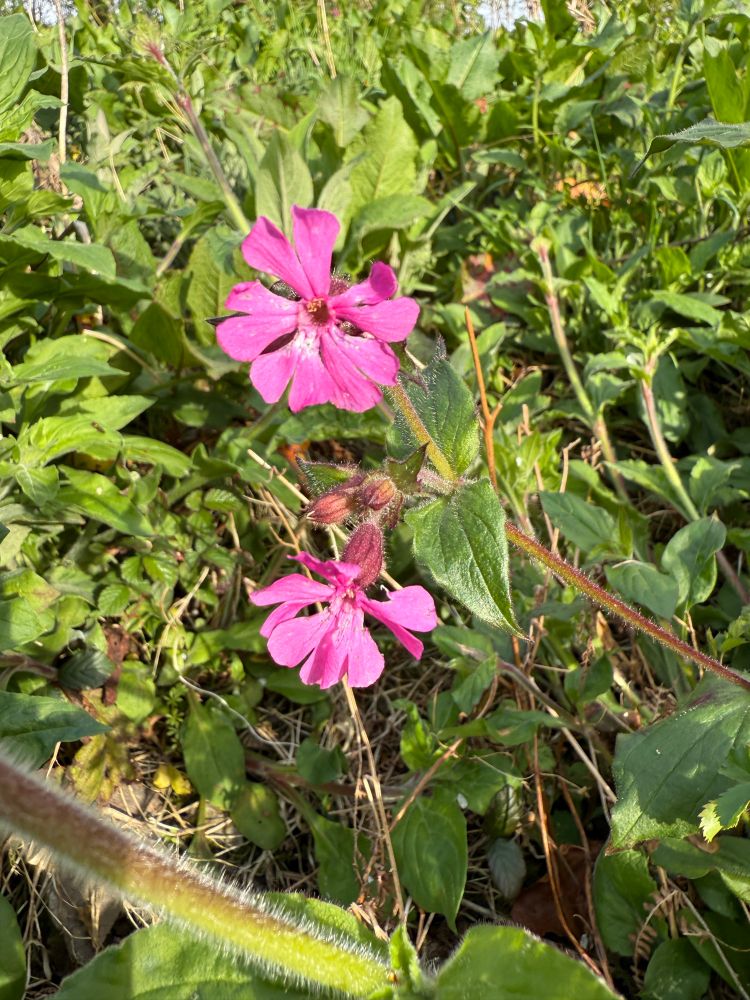
Early pink campion yesterday, near Bangor golf course

Lamps on Bangor Pier. Love the attention to detail! Why not just make it lovely?

Wild cherry trees have got extrafloral nectaries to reward ants. Didn't know about this before. I was taking pics of the flowers and spotted this. Amazing. Not many ants about at the moment, but something to look out for later on in the year!

Never seen before (unless you follow me on Fb), here is a Lake Malawi Protomelas with unusual square-ended oral jaws & lots of teeth (5-6 rows). Caught in shallow water near Ngara (Karonga District), we got quite a few from 2 different trawls, so it doesn't seem particularly rare in the area.

I first distinguished this species from a specimen at Cambridge from our 2016 survey. Nice to find some more specimens in stronger breeding colours and from the opposite end of the lake in the 2023 survey.

Might have rediscovered Lethrinops macracanthus, a deep water Lake Malawi cichlid missing since the early 1990s.

Baby axolotls. Bigger ones feeding on brine shrimp. Maybe some white ones?

Placidochromis nkhotakotae, described by Hanssens in 2004, has lots of gillrakers. I collected it in the 1990s but didn't get a fresh colour photo. We got one from Karonga in 2023, but actually a better one (sequenced) in 2017 from a pair trawl catch in the SW Arm. Clearly widely distributed.

This deepwater species from Karonga is definitely an Alticorpus (highly expanded lateral line pits, big mental process), but isn't one of the usual ones. It might be A. profundicola, which was described in 1988 from specimens collected 10 years before, and has never been photographed fresh.

Mylochromis sp. 'kande' was a new one for me in 2023. Originally identified by Konings from a breeding group at Kande Island, we got several nearby off Chintheche. Males have yellow chins and females an orange lower half of caudal.

Placidochromis ecclesi was described by Hanssens in 2004 from 4 specimens trawled from 123-125m in Lukoma Bay, Tanzania in 1998. I think this is another one: first fresh photo! It's a tiny fish: both these specimens are only 58mm SL and look like mature males.

A new species to me, from the 2023 trawl survey. I think we only got a single specimen of this from a deep water trawl from off Chintheche, on the sandy bay south of Nkhata Bay.