


Didac Vidal pineiro
@didacvp.bsky.social
Reposted by Didac Vidal pineiro

Vulnerability to memory decline in aging revealed by a mega-analysis of structural brain change www.nature.com/articles/s41...
Vulnerability to memory decline in aging revealed by a mega-analysis of structural brain change - Nature Communications
Across 13 longitudinal studies (3,737 adults), the authors show that brain atrophy parallels memory loss, with a stronger coupling in later life. APOE ε4 increases decline, yet genetic risk does not m...
www.nature.com
November 26, 2025 at 2:32 PM
Vulnerability to memory decline in aging revealed by a mega-analysis of structural brain change www.nature.com/articles/s41...
Reposted by Didac Vidal pineiro

Why do some people lose memory faster with age? A mega-analysis of 13 longitudinal datasets (3,700+ adults, 10,000+ MRIs) shows that memory decline tracks brain atrophy, especially in the hippocampus, and that these links strengthen with age, but not APOE status: www.nature.com/articles/s41...

November 27, 2025 at 9:37 AM
Why do some people lose memory faster with age? A mega-analysis of 13 longitudinal datasets (3,700+ adults, 10,000+ MRIs) shows that memory decline tracks brain atrophy, especially in the hippocampus, and that these links strengthen with age, but not APOE status: www.nature.com/articles/s41...
Reposted by Didac Vidal pineiro
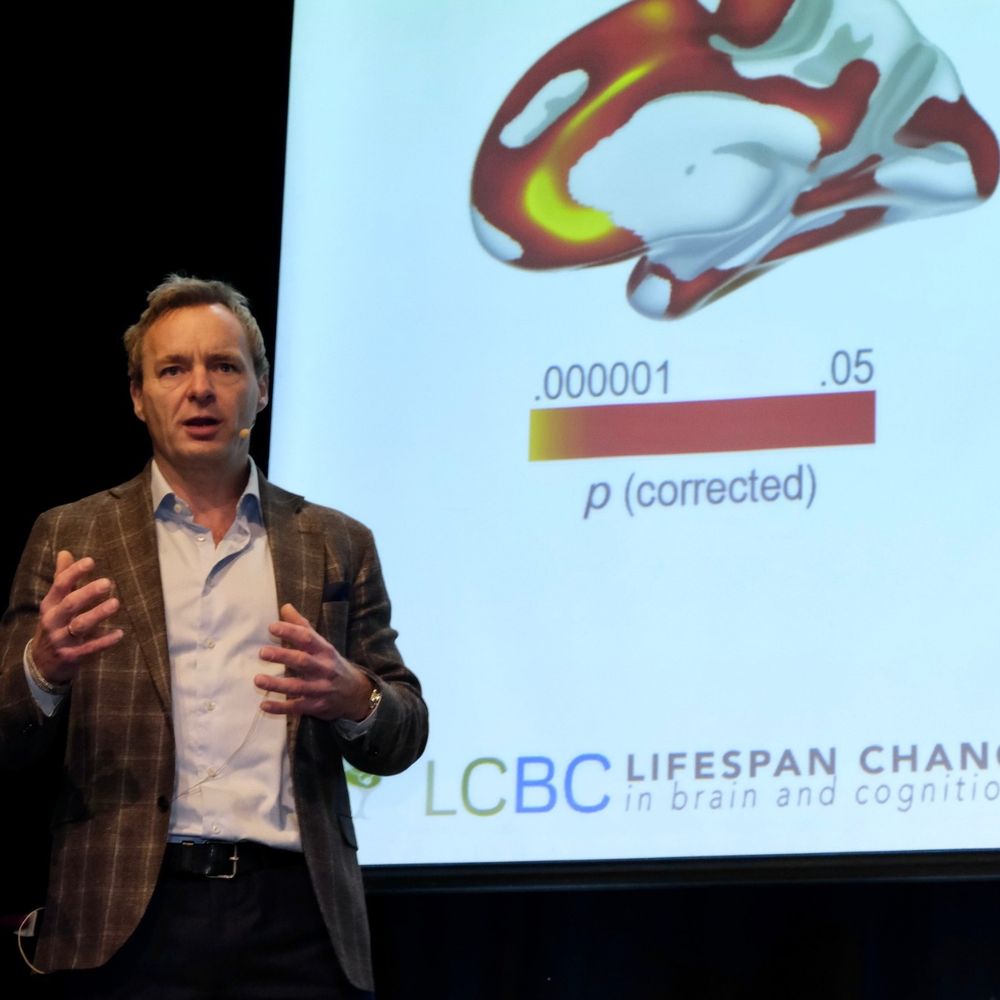
Very impressed with @didacvp.bsky.social's work in @natcomms.nature.com, the most thorough mapping of longitudinal memory-atrophy relationships in normal aging, showing both global and memory-specific associations, which grow stronger with age. Early accsess here: www.nature.com/articles/s41...

November 28, 2025 at 3:01 PM
Very impressed with @didacvp.bsky.social's work in @natcomms.nature.com, the most thorough mapping of longitudinal memory-atrophy relationships in normal aging, showing both global and memory-specific associations, which grow stronger with age. Early accsess here: www.nature.com/articles/s41...
Reposted by Didac Vidal pineiro
Using 4570 longitudinal MRIs + 1684 Aβ PET scans from cognitively healthy older adults @jamesmroe.bsky.social find cortical thickness changed ≥7 years before PET-detectable Aβ. Those who later developed high Aβ already had thicker cortex & less thinning.
@LCBC_uio www.biorxiv.org/content/10.1...
@LCBC_uio www.biorxiv.org/content/10.1...

Cortical thickness changes precede high levels of amyloid by at least seven years
Alzheimer's disease (AD) is now defined based on its underlying brain pathology, with the presence of amyloid (Aβ) plaques at high enough levels sufficient to warrant a diagnosis in the absence of cog...
www.biorxiv.org
August 21, 2025 at 7:43 AM
Using 4570 longitudinal MRIs + 1684 Aβ PET scans from cognitively healthy older adults @jamesmroe.bsky.social find cortical thickness changed ≥7 years before PET-detectable Aβ. Those who later developed high Aβ already had thicker cortex & less thinning.
@LCBC_uio www.biorxiv.org/content/10.1...
@LCBC_uio www.biorxiv.org/content/10.1...
Reposted by Didac Vidal pineiro
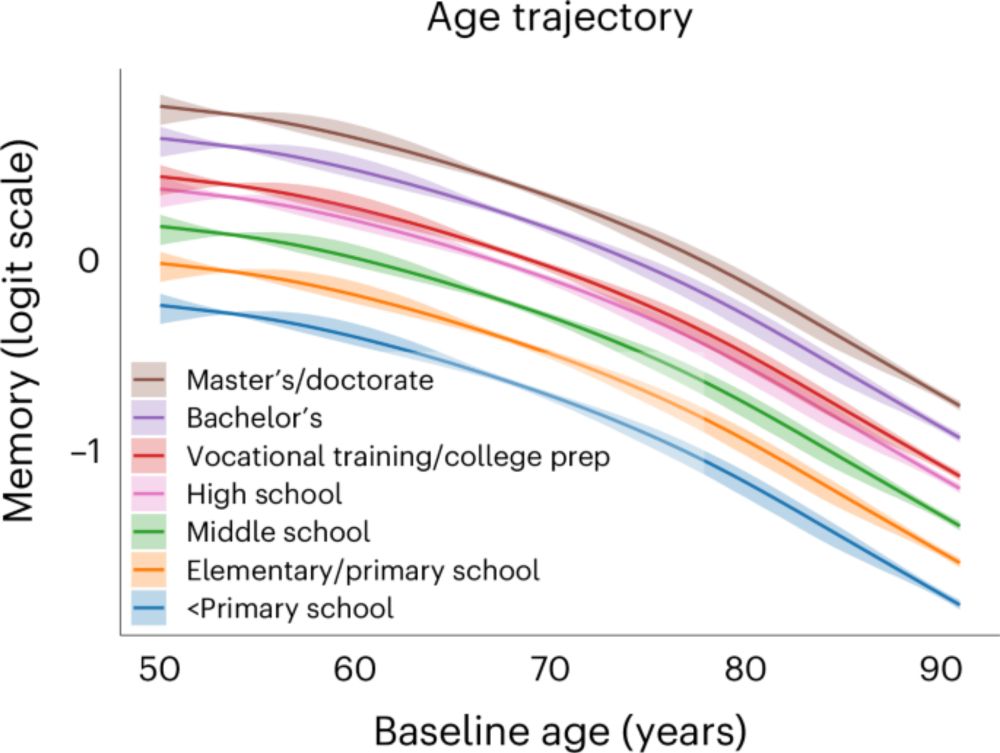
@natmed.nature.com made a nice Research Briefing about our paper. Highglights with less details, the main conclusion is the same: Education does not affect memory decline or brain aging @LCBC_UiO @LifebrainEU www.nature.com/articles/s41...
Education does not affect memory decline or brain aging - Nature Medicine
Competing explanations account for education’s link to better memory and brain structure in older age. By analyzing more than 400,000 memory scores and over 15,000 MRI scans, we found the association ...
www.nature.com
August 6, 2025 at 7:36 AM
@natmed.nature.com made a nice Research Briefing about our paper. Highglights with less details, the main conclusion is the same: Education does not affect memory decline or brain aging @LCBC_UiO @LifebrainEU www.nature.com/articles/s41...
Reposted by Didac Vidal pineiro
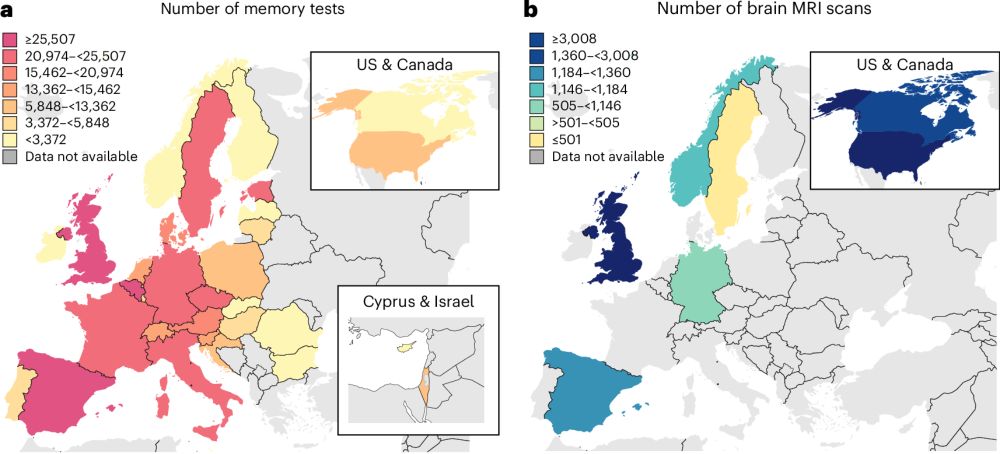
New in @NatureMedicine Education is not linked to slower memory or brain decline in aging. We analyzed 400,000 memory tests and 15,000 MRIs from 33 countries. Associations likely shaped by childhood schooling and development. @LCBC_UiO @LifebrainEU rdcu.be/ex8iC
Reevaluating the role of education on cognitive decline and brain aging in longitudinal cohorts across 33 Western countries
Nature Medicine - In a large cross-national study, education was linked to better memory and larger brain volumes but not to slower cognitive or brain decline with age, suggesting that the...
rdcu.be
August 1, 2025 at 11:39 AM
New in @NatureMedicine Education is not linked to slower memory or brain decline in aging. We analyzed 400,000 memory tests and 15,000 MRIs from 33 countries. Associations likely shaped by childhood schooling and development. @LCBC_UiO @LifebrainEU rdcu.be/ex8iC
Reposted by Didac Vidal pineiro
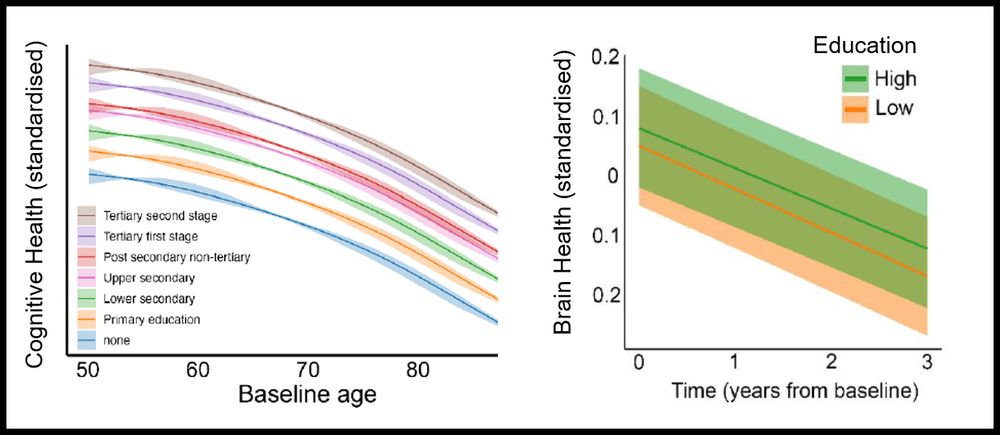
International study shows that higher levels of education do not reduce rates of cognitive and brain decline in later years, contrary to views that education protects against such decline: www.nature.com/articles/s41...
@rhens.bsky.social
@rhens.bsky.social
July 28, 2025 at 10:48 AM
International study shows that higher levels of education do not reduce rates of cognitive and brain decline in later years, contrary to views that education protects against such decline: www.nature.com/articles/s41...
@rhens.bsky.social
@rhens.bsky.social
Reposted by Didac Vidal pineiro
Preprint: before age 60, between-people diffs in brain vols almost exclusively reflect stable diffs, while systematic diffs in rate-of-change in aging cause up to 40% of the variation to be due to change at 80 years. @edvardg.bsky.social 🧵https://www.biorxiv.org/content/10.1101/2025.05.26.655710v1

May 30, 2025 at 8:54 AM
Preprint: before age 60, between-people diffs in brain vols almost exclusively reflect stable diffs, while systematic diffs in rate-of-change in aging cause up to 40% of the variation to be due to change at 80 years. @edvardg.bsky.social 🧵https://www.biorxiv.org/content/10.1101/2025.05.26.655710v1
Reposted by Didac Vidal pineiro
Very interesting from @VidalDidac - MUCH higher reliability for structural neuroimaging measures with longer follow-up time rather than more follow-ups or higher n. 2.-year follow-up requires 4 times higher n than 6-year follow up. @LCBC_UiO direct.mit.edu/imag/article...

Reliability of structural brain change in cognitively healthy adult samples
Abstract. In neuroimaging research, tracking individuals over time is key to understanding the interplay between brain changes and genetic, environmental, or cognitive factors across the lifespan. Yet...
direct.mit.edu
April 30, 2025 at 6:35 AM
Very interesting from @VidalDidac - MUCH higher reliability for structural neuroimaging measures with longer follow-up time rather than more follow-ups or higher n. 2.-year follow-up requires 4 times higher n than 6-year follow up. @LCBC_UiO direct.mit.edu/imag/article...
Reposted by Didac Vidal pineiro
Preprint from @didacvp.bsky.social - a common brain factor underlying memory decline in older age. Stronger associations in older, but independent of genetic Alzheimer risk. Very interesting work using >10.000 MRI scan. @LCBC_UiO www.biorxiv.org/content/10.1...

March 31, 2025 at 12:28 PM
Preprint from @didacvp.bsky.social - a common brain factor underlying memory decline in older age. Stronger associations in older, but independent of genetic Alzheimer risk. Very interesting work using >10.000 MRI scan. @LCBC_UiO www.biorxiv.org/content/10.1...
Check our latest: we mega-analysed 13 longitudinal studies, encompassing 3,737 adults and over 10,000 MRI scans, to explore the associations between structural brain changes and episodic memory decline with age and genetic predisposition (APOE 4 allele). 👇
www.biorxiv.org/content/10.1...
www.biorxiv.org/content/10.1...

Vulnerability to memory decline in aging. A mega-analysis of structural brain change.
Brain atrophy is a key factor behind episodic memory loss in aging, but the nature and ubiquity of this relationship remains poorly understood. This study leveraged 13 longitudinal datasets, including...
www.biorxiv.org
March 31, 2025 at 8:20 AM
Check our latest: we mega-analysed 13 longitudinal studies, encompassing 3,737 adults and over 10,000 MRI scans, to explore the associations between structural brain changes and episodic memory decline with age and genetic predisposition (APOE 4 allele). 👇
www.biorxiv.org/content/10.1...
www.biorxiv.org/content/10.1...
Reposted by Didac Vidal pineiro
Preprint: Why is edu associated with better memory in aging? We used >400k memory tests & 15k brain MRIs: (1) Edu linearly related to memory, larger ICV & (slightly) larger vol in memory regions, (3) not less decline (mem+brain), (4) not enhanced tolerance to atrophy.🧵
medrxiv.org/cgi/content/...
medrxiv.org/cgi/content/...

Reevaluating the Role of Education in Cognitive Decline and Brain Aging: Insights from Large-Scale Longitudinal Cohorts across 33 Countries
Why education is linked to higher cognitive function in aging is fiercely debated. Leading theories propose that education reduces brain decline in aging, enhances tolerance to brain pathology, or tha...
medrxiv.org
January 30, 2025 at 8:22 AM
Preprint: Why is edu associated with better memory in aging? We used >400k memory tests & 15k brain MRIs: (1) Edu linearly related to memory, larger ICV & (slightly) larger vol in memory regions, (3) not less decline (mem+brain), (4) not enhanced tolerance to atrophy.🧵
medrxiv.org/cgi/content/...
medrxiv.org/cgi/content/...