



Darius Parvizi-Wayne
@dariusparviziwayne.bsky.social
philosophy PhD student: being-in-the-world, active inference, skilful coping, relevance
Reposted by Darius Parvizi-Wayne
Ontologizing Enactivism: Worldmaking with Ezequiel Di Paolo (dialogue with Tim Jackson)
Timothy Jackson and I were back in the saddle, this time to discuss Ezequiel Di Paolo’s article seeking an enactive ontology: Di Paolo, E. A. (2023). F/acts: Ways of enactive worldmaking. Journal of…
Timothy Jackson and I were back in the saddle, this time to discuss Ezequiel Di Paolo’s article seeking an enactive ontology: Di Paolo, E. A. (2023). F/acts: Ways of enactive worldmaking. Journal of…
Ontologizing Enactivism: Worldmaking with Ezequiel Di Paolo (dialogue with Tim Jackson)
Timothy Jackson and I were back in the saddle, this time to discuss Ezequiel Di Paolo’s article seeking an enactive ontology: Di Paolo, E. A. (2023). F/acts: Ways of enactive worldmaking. Journal of Consciousness Studies, 30 (11–12): 159-89. doi: 10.53765/20512201.30.11.159. Ezequiel will be joining us to present in the biophilosophy track at this summer’s International Whitehead Conference in China…
footnotes2plato.com
January 30, 2026 at 5:18 AM
Ontologizing Enactivism: Worldmaking with Ezequiel Di Paolo (dialogue with Tim Jackson)
Timothy Jackson and I were back in the saddle, this time to discuss Ezequiel Di Paolo’s article seeking an enactive ontology: Di Paolo, E. A. (2023). F/acts: Ways of enactive worldmaking. Journal of…
Timothy Jackson and I were back in the saddle, this time to discuss Ezequiel Di Paolo’s article seeking an enactive ontology: Di Paolo, E. A. (2023). F/acts: Ways of enactive worldmaking. Journal of…
Reposted by Darius Parvizi-Wayne

Here is an opinionated overview in press at Philosophy Compass.
Critical 4E cognitive science, as we call this emerging research program, adopts the 4E frameworks and concepts but with a critical lens: questioning its hidden assumptions and leveraging its theoretical resources for social criticism.
Critical 4E cognitive science, as we call this emerging research program, adopts the 4E frameworks and concepts but with a critical lens: questioning its hidden assumptions and leveraging its theoretical resources for social criticism.

Shen-yi Liao & Zoe Brinner, Critical 4E Cognitive Science - PhilPapers
According to 4E cognitive science, our cognitive capacities depend on, and have been transformed by, the environments we have made. Most early works of 4E cognitive science tend to focus on ...
philpapers.org
January 2, 2026 at 11:06 AM
Here is an opinionated overview in press at Philosophy Compass.
Critical 4E cognitive science, as we call this emerging research program, adopts the 4E frameworks and concepts but with a critical lens: questioning its hidden assumptions and leveraging its theoretical resources for social criticism.
Critical 4E cognitive science, as we call this emerging research program, adopts the 4E frameworks and concepts but with a critical lens: questioning its hidden assumptions and leveraging its theoretical resources for social criticism.
If anyone has a pdf (or access to a pdf) of Hans Jonas' Biological Foundations of Individuality, please let me know!
January 17, 2026 at 10:25 AM
If anyone has a pdf (or access to a pdf) of Hans Jonas' Biological Foundations of Individuality, please let me know!
Reposted by Darius Parvizi-Wayne

Now published in Biological Reviews!
Continual decision‐making dynamics across biological organisms onlinelibrary.wiley.com/doi/10.1002/...
Continual decision‐making dynamics across biological organisms onlinelibrary.wiley.com/doi/10.1002/...

Continual decision‐making dynamics across biological organisms
Decision-making is a central function of adaptive behaviour in biological agents. However, strategies for adaptive decision-making can vary substantially across species. Here, we aim to extend the co...
onlinelibrary.wiley.com
December 27, 2025 at 10:34 PM
Now published in Biological Reviews!
Continual decision‐making dynamics across biological organisms onlinelibrary.wiley.com/doi/10.1002/...
Continual decision‐making dynamics across biological organisms onlinelibrary.wiley.com/doi/10.1002/...
Reposted by Darius Parvizi-Wayne

What is this ‘attention economy’? Is there really a market where people buy and sell human attention? If so, what’s wrong with that? New paper by Katharine Browne and me that argues: yes, there is an attention market and yes, there is something wrong with it. 🧵
link.springer.com/article/10.1...
link.springer.com/article/10.1...

The attention market—and what is wrong with it - Philosophical Studies
Attention is described as a “scarce commodity” that is traded in “a marketplace.” This, it is further claimed, contributes to a “widespread sense of attentional crisis.” But is there really an attenti...
link.springer.com
November 14, 2025 at 5:40 PM
What is this ‘attention economy’? Is there really a market where people buy and sell human attention? If so, what’s wrong with that? New paper by Katharine Browne and me that argues: yes, there is an attention market and yes, there is something wrong with it. 🧵
link.springer.com/article/10.1...
link.springer.com/article/10.1...
Reposted by Darius Parvizi-Wayne

#PhiMiSci published a new standalone article: In “What active inference still can’t do: The (frame) problem that just won’t go away”, Darius Parvizi-Wayne argues that both new and old attempts to solve the frame problem on the basis of the active inference framework are explanatorily inadequate.
What active inference still can’t do: The (frame) problem that just won’t go away
| Philosophy and the Mind Sciences
Philosophy and the Mind Sciences (PhiMiSci) focuses on the interface between philosophy of mind, psychology, and cognitive neuroscience. PhiMiSci is a peer-reviewed, not-for-profit open-access journal...
philosophymindscience.org
October 23, 2025 at 10:03 AM
#PhiMiSci published a new standalone article: In “What active inference still can’t do: The (frame) problem that just won’t go away”, Darius Parvizi-Wayne argues that both new and old attempts to solve the frame problem on the basis of the active inference framework are explanatorily inadequate.
Very excited to have the first paper of my PhD — What active inference still can’t do: The (frame) problem that just won’t go away — published in @phimisci.bsky.social !
philosophymindscience.org/index.php/ph...
#PhilMind #PhilCognition #Philpsy #Philsky
philosophymindscience.org/index.php/ph...
#PhilMind #PhilCognition #Philpsy #Philsky
What active inference still can’t do: The (frame) problem that just won’t go away
| Philosophy and the Mind Sciences
Philosophy and the Mind Sciences (PhiMiSci) focuses on the interface between philosophy of mind, psychology, and cognitive neuroscience. PhiMiSci is a peer-reviewed, not-for-profit open-access journal...
philosophymindscience.org
October 17, 2025 at 6:54 AM
Very excited to have the first paper of my PhD — What active inference still can’t do: The (frame) problem that just won’t go away — published in @phimisci.bsky.social !
philosophymindscience.org/index.php/ph...
#PhilMind #PhilCognition #Philpsy #Philsky
philosophymindscience.org/index.php/ph...
#PhilMind #PhilCognition #Philpsy #Philsky
Reposted by Darius Parvizi-Wayne

'The Idealized Mind: From Model-based Science to Cognitive Science' published by MIT Press. Claims: models of the mind are idealized models; this is consistent with scientific realism; yet, it blocks realism about neural representation and neural computation based on evidence from neuroscience.

August 25, 2025 at 9:04 AM
'The Idealized Mind: From Model-based Science to Cognitive Science' published by MIT Press. Claims: models of the mind are idealized models; this is consistent with scientific realism; yet, it blocks realism about neural representation and neural computation based on evidence from neuroscience.
Reposted by Darius Parvizi-Wayne
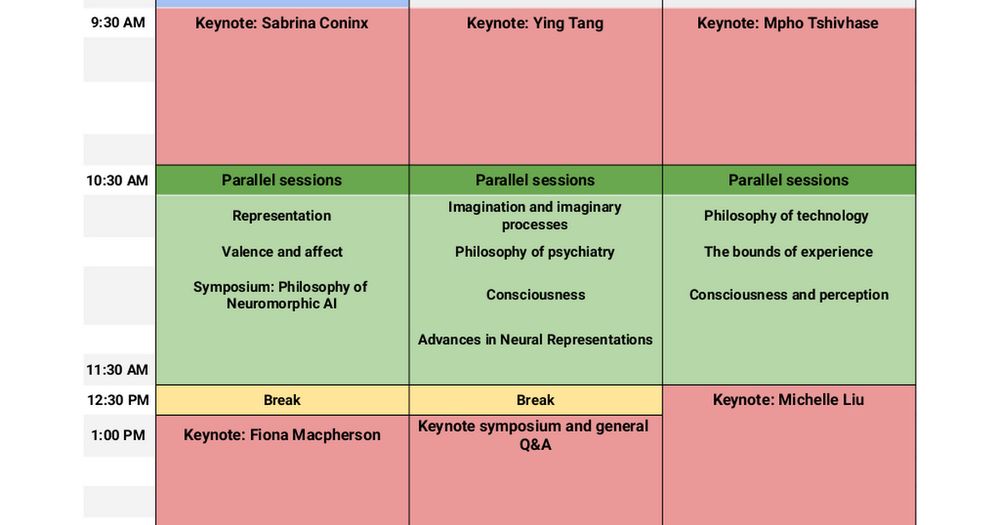
We are very excited to share the conference schedule and book of abstracts for this year’s ISPSM! 💫
Link to schedule: tiny.cc/ISPSM2025sch...
Link to book of abstracts: tiny.cc/ISPSM2025boo...
#philmind #philsky
Link to schedule: tiny.cc/ISPSM2025sch...
Link to book of abstracts: tiny.cc/ISPSM2025boo...
#philmind #philsky
Timetables to share
tiny.cc
August 1, 2025 at 9:45 AM
We are very excited to share the conference schedule and book of abstracts for this year’s ISPSM! 💫
Link to schedule: tiny.cc/ISPSM2025sch...
Link to book of abstracts: tiny.cc/ISPSM2025boo...
#philmind #philsky
Link to schedule: tiny.cc/ISPSM2025sch...
Link to book of abstracts: tiny.cc/ISPSM2025boo...
#philmind #philsky
in Wheeler (2005) 🤠

March 25, 2025 at 6:12 AM
in Wheeler (2005) 🤠

Reposted by Darius Parvizi-Wayne

Call for abstracts: Workshop “Evaluating Artificial Consciousness”:
eac-2025.sciencesconf.org
10-11 June 2025 at RUB Bochum
#PhilMind #consciousness #consci #sentience #Ethics #CogSci
eac-2025.sciencesconf.org
10-11 June 2025 at RUB Bochum
#PhilMind #consciousness #consci #sentience #Ethics #CogSci
Evaluating Artificial Consciousness 2025 - Sciencesconf.org
eac-2025.sciencesconf.org
January 17, 2025 at 2:19 PM
Call for abstracts: Workshop “Evaluating Artificial Consciousness”:
eac-2025.sciencesconf.org
10-11 June 2025 at RUB Bochum
#PhilMind #consciousness #consci #sentience #Ethics #CogSci
eac-2025.sciencesconf.org
10-11 June 2025 at RUB Bochum
#PhilMind #consciousness #consci #sentience #Ethics #CogSci
Reposted by Darius Parvizi-Wayne
Article: "Flow and intuition: a systems neuroscience comparison"
Coauthors: Steven Kotler @dariusparviziwayne.bsky.social Michael Mannino
academic.oup.com/nc/article/2...
Coauthors: Steven Kotler @dariusparviziwayne.bsky.social Michael Mannino
academic.oup.com/nc/article/2...

Flow and intuition: a systems neuroscience comparison
Abstract. This paper explores the relationship between intuition and flow from a neurodynamics perspective. Flow and intuition represent two cognitive phen
academic.oup.com
January 8, 2025 at 3:28 PM
Article: "Flow and intuition: a systems neuroscience comparison"
Coauthors: Steven Kotler @dariusparviziwayne.bsky.social Michael Mannino
academic.oup.com/nc/article/2...
Coauthors: Steven Kotler @dariusparviziwayne.bsky.social Michael Mannino
academic.oup.com/nc/article/2...
New paper alert! Flow and Intuition, out now in Neuroscience of Consciousness.
academic.oup.com/nc/article/2...
Very happy to have worked on this with Steven Kotler, Michael Mannino, and Karl Friston. The era of habitual mental actions is upon us!
academic.oup.com/nc/article/2...
Very happy to have worked on this with Steven Kotler, Michael Mannino, and Karl Friston. The era of habitual mental actions is upon us!

Flow and intuition: a systems neuroscience comparison
Abstract. This paper explores the relationship between intuition and flow from a neurodynamics perspective. Flow and intuition represent two cognitive phen
academic.oup.com
January 6, 2025 at 11:05 AM
New paper alert! Flow and Intuition, out now in Neuroscience of Consciousness.
academic.oup.com/nc/article/2...
Very happy to have worked on this with Steven Kotler, Michael Mannino, and Karl Friston. The era of habitual mental actions is upon us!
academic.oup.com/nc/article/2...
Very happy to have worked on this with Steven Kotler, Michael Mannino, and Karl Friston. The era of habitual mental actions is upon us!
right, so what’s different about this place?
December 24, 2024 at 2:17 PM
right, so what’s different about this place?