



Craig Gidney
@craiggidney.bsky.social
Research scientist on Google's quantum team, working on reducing the cost of quantum error correction.
Useful tools I've made:
- Quirk: https://algassert.com/quirk
- Stim: https://github.com/quantumlib/stim
- Crumble: https://algassert.com/crumble
Useful tools I've made:
- Quirk: https://algassert.com/quirk
- Stim: https://github.com/quantumlib/stim
- Crumble: https://algassert.com/crumble
A surface code that goes from a normal tiling to one where each row keeps using half as many qubits as the last.
I can't think of a reason to do this, but it's visually interesting.
I can't think of a reason to do this, but it's visually interesting.

February 3, 2026 at 11:30 PM
A surface code that goes from a normal tiling to one where each row keeps using half as many qubits as the last.
I can't think of a reason to do this, but it's visually interesting.
I can't think of a reason to do this, but it's visually interesting.
Another paper related to simulating magic state cultivation. This time it's algorithmic insights, rather than hulk-smashing at the circuit with GPUs: scirate.com/arxiv/2512.2...
(...¿porque no los dos?)
(...¿porque no los dos?)

Efficient simulation of logical magic state preparation protocols
Developing space- and time-efficient logical magic state preparation protocols will likely be an essential step towards building a large-scale fault-tolerant quantum computer. Motivated by this need, ...
scirate.com
January 3, 2026 at 8:50 PM
Another paper related to simulating magic state cultivation. This time it's algorithmic insights, rather than hulk-smashing at the circuit with GPUs: scirate.com/arxiv/2512.2...
(...¿porque no los dos?)
(...¿porque no los dos?)
Papers citing stim doubled again in 2025.
Stim is a python package for analyzing/simulating quantum error correction circuits. It was thousands of times faster than prior tools and popularized modelling fault tolerance in terms of "detectors" (see quantum-journal.org/papers/q-202...).
Stim is a python package for analyzing/simulating quantum error correction circuits. It was thousands of times faster than prior tools and popularized modelling fault tolerance in terms of "detectors" (see quantum-journal.org/papers/q-202...).

January 2, 2026 at 10:53 AM
Papers citing stim doubled again in 2025.
Stim is a python package for analyzing/simulating quantum error correction circuits. It was thousands of times faster than prior tools and popularized modelling fault tolerance in terms of "detectors" (see quantum-journal.org/papers/q-202...).
Stim is a python package for analyzing/simulating quantum error correction circuits. It was thousands of times faster than prior tools and popularized modelling fault tolerance in terms of "detectors" (see quantum-journal.org/papers/q-202...).
Better simulations of magic state cultivation: scirate.com/arxiv/2512.2... .
In my initial paper, I approximated T with S by using a 2x safety factor measured at d=3. IMO this paper suggests another 2x at d=5. They *claim* another 7.65x; an attempts-vs-error curve would help tell.
In my initial paper, I approximated T with S by using a 2x safety factor measured at d=3. IMO this paper suggests another 2x at d=5. They *claim* another 7.65x; an attempts-vs-error curve would help tell.
SOFT: a high-performance simulator for universal fault-tolerant quantum circuits
Circuit simulation tools are critical for developing and assessing quantum-error-correcting and fault-tolerant strategies. In this work, we present SOFT, a high-performance SimulatOr for universal Fau...
scirate.com
December 30, 2025 at 7:11 PM
Better simulations of magic state cultivation: scirate.com/arxiv/2512.2... .
In my initial paper, I approximated T with S by using a 2x safety factor measured at d=3. IMO this paper suggests another 2x at d=5. They *claim* another 7.65x; an attempts-vs-error curve would help tell.
In my initial paper, I approximated T with S by using a 2x safety factor measured at d=3. IMO this paper suggests another 2x at d=5. They *claim* another 7.65x; an attempts-vs-error curve would help tell.

December 25, 2025 at 2:56 AM
History of quantum rep code error rates from the UCSB→Google team
2014: 0.1% arxiv.org/abs/1411.7403
2015:
2016:
2017:
2018:
2019:
2020:
2021: 0.01% arxiv.org/abs/2102.06132
2022:
2023: 0.0001% arxiv.org/abs/2207.06431
2024: 0.00000001% arxiv.org/abs/2408.13687
I call this pattern "QEC goes foom"
2014: 0.1% arxiv.org/abs/1411.7403
2015:
2016:
2017:
2018:
2019:
2020:
2021: 0.01% arxiv.org/abs/2102.06132
2022:
2023: 0.0001% arxiv.org/abs/2207.06431
2024: 0.00000001% arxiv.org/abs/2408.13687
I call this pattern "QEC goes foom"
December 24, 2025 at 3:28 AM
History of quantum rep code error rates from the UCSB→Google team
2014: 0.1% arxiv.org/abs/1411.7403
2015:
2016:
2017:
2018:
2019:
2020:
2021: 0.01% arxiv.org/abs/2102.06132
2022:
2023: 0.0001% arxiv.org/abs/2207.06431
2024: 0.00000001% arxiv.org/abs/2408.13687
I call this pattern "QEC goes foom"
2014: 0.1% arxiv.org/abs/1411.7403
2015:
2016:
2017:
2018:
2019:
2020:
2021: 0.01% arxiv.org/abs/2102.06132
2022:
2023: 0.0001% arxiv.org/abs/2207.06431
2024: 0.00000001% arxiv.org/abs/2408.13687
I call this pattern "QEC goes foom"
We did some experimental testing of magic state cultivation! arxiv.org/abs/2512.13908
A ~1e-4 end2end infidelity is tricky to measure with tomography, so we checked it vs more cultivation. The full escape stage is too wide for the chip, but we did try ending in the grafted code.
A ~1e-4 end2end infidelity is tricky to measure with tomography, so we checked it vs more cultivation. The full escape stage is too wide for the chip, but we did try ending in the grafted code.


December 17, 2025 at 6:44 AM
We did some experimental testing of magic state cultivation! arxiv.org/abs/2512.13908
A ~1e-4 end2end infidelity is tricky to measure with tomography, so we checked it vs more cultivation. The full escape stage is too wide for the chip, but we did try ending in the grafted code.
A ~1e-4 end2end infidelity is tricky to measure with tomography, so we checked it vs more cultivation. The full escape stage is too wide for the chip, but we did try ending in the grafted code.
This new quanta article (www.quantamagazine.org/physicists-t... arxiv.org/pdf/0810.1923) claims my blog post on spoofing real-only tests is a new discovery. I'm flattered... but since writing the post I learned McKague et al knew it in 2008 (see section II.C of arxiv.org/pdf/0810.1923).

Physicists Take the Imaginary Numbers Out of Quantum Mechanics | Quanta Magazine
Quantum mechanics has at last been formulated exclusively with real numbers, bringing a mathematical puzzle at the heart of the theory into a new era of inquiry.
www.quantamagazine.org
November 8, 2025 at 6:55 AM
This new quanta article (www.quantamagazine.org/physicists-t... arxiv.org/pdf/0810.1923) claims my blog post on spoofing real-only tests is a new discovery. I'm flattered... but since writing the post I learned McKague et al knew it in 2008 (see section II.C of arxiv.org/pdf/0810.1923).
OpenSSH added a "your session isn't secure against store-now-decrypt-later quantum attacks" warning: www.openssh.org/pq.html
I love it. Waiting until the problem is manifest is a great way to have waited too long. Fix shit now.
I love it. Waiting until the problem is manifest is a great way to have waited too long. Fix shit now.
OpenSSH: Post-Quantum Cryptography
OpenSSH post quantum cryptography
www.openssh.org
November 7, 2025 at 11:15 PM
OpenSSH added a "your session isn't secure against store-now-decrypt-later quantum attacks" warning: www.openssh.org/pq.html
I love it. Waiting until the problem is manifest is a great way to have waited too long. Fix shit now.
I love it. Waiting until the problem is manifest is a great way to have waited too long. Fix shit now.
Stim has received its first AI slop pull request: github.com/quantumlib/S...
(It's actually not the first AI generated pull request that's been submitted, but the other one was actually a correct bug fix thus not slop.)
(It's actually not the first AI generated pull request that's been submitted, but the other one was actually a correct bug fix thus not slop.)

October 27, 2025 at 5:08 PM
Stim has received its first AI slop pull request: github.com/quantumlib/S...
(It's actually not the first AI generated pull request that's been submitted, but the other one was actually a correct bug fix thus not slop.)
(It's actually not the first AI generated pull request that's been submitted, but the other one was actually a correct bug fix thus not slop.)
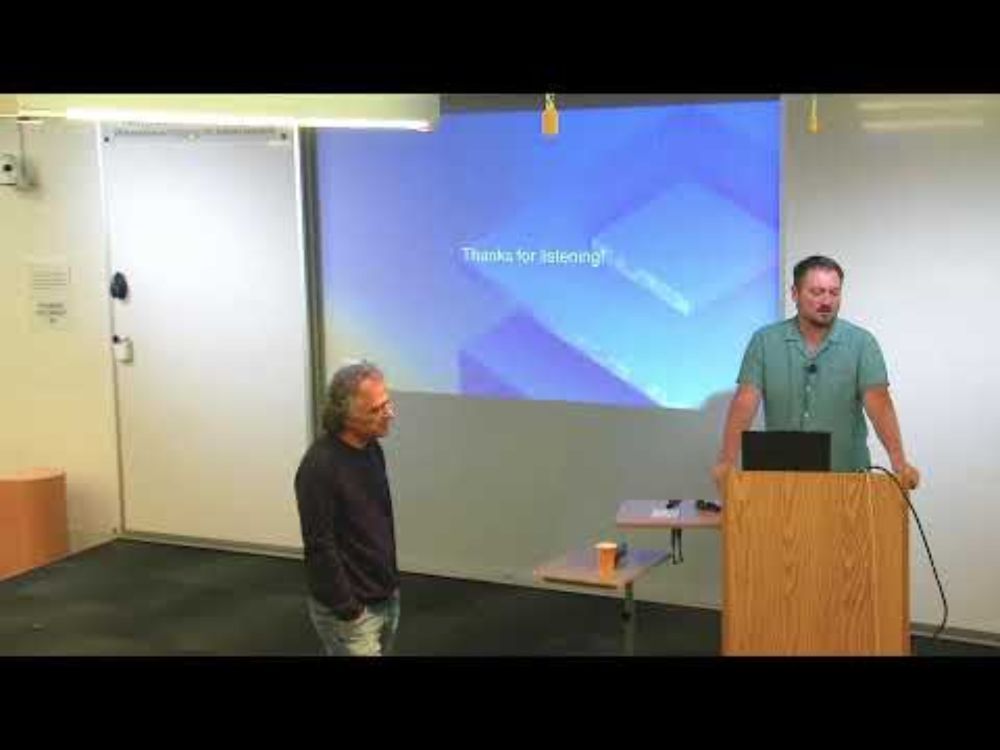
Here's the recording of my talk at the Simons institute quantum industry day: www.youtube.com/live/SULOaOQ...
And the slides: docs.google.com/presentation...
I was also on the panel discussion at the end of the day (also in the linked playlist).
And the slides: docs.google.com/presentation...
I was also on the panel discussion at the end of the day (also in the linked playlist).
Optimizing the Annoying Stuff: Reducing Costs Obscured by the Abstract Circuit Model
YouTube video by Simons Institute for the Theory of Computing
www.youtube.com
October 17, 2025 at 6:27 AM
Here's the recording of my talk at the Simons institute quantum industry day: www.youtube.com/live/SULOaOQ...
And the slides: docs.google.com/presentation...
I was also on the panel discussion at the end of the day (also in the linked playlist).
And the slides: docs.google.com/presentation...
I was also on the panel discussion at the end of the day (also in the linked playlist).
My contribution to arxiv.org/abs/2510.10967 is a space-efficient strategy for modular division under superposition. It's based on recording the branches taken during a GCD, to decompose a number+modulus into their "dialog representation", which unlike binary is entirely linear.


October 14, 2025 at 4:40 AM
My contribution to arxiv.org/abs/2510.10967 is a space-efficient strategy for modular division under superposition. It's based on recording the branches taken during a GCD, to decompose a number+modulus into their "dialog representation", which unlike binary is entirely linear.
I'll be speaking at the Simons Institute this Thursday: simons.berkeley.edu/events/quant... (Hopefully my flight doesn't get cancelled this time.)
Talk Title: Optimizing the Annoying Stuff: Reducing Costs Obscured by the Abstract Circuit Model
Abstract: attached as image
Talk Title: Optimizing the Annoying Stuff: Reducing Costs Obscured by the Abstract Circuit Model
Abstract: attached as image

October 13, 2025 at 10:23 PM
I'll be speaking at the Simons Institute this Thursday: simons.berkeley.edu/events/quant... (Hopefully my flight doesn't get cancelled this time.)
Talk Title: Optimizing the Annoying Stuff: Reducing Costs Obscured by the Abstract Circuit Model
Abstract: attached as image
Talk Title: Optimizing the Annoying Stuff: Reducing Costs Obscured by the Abstract Circuit Model
Abstract: attached as image
For their student researcher-ship, Satoshi Yoshida extended our work on dynamic surface code circuits to color codes. They built and simulated iswap color code circuits and wiggling color code circuits. The iswap circuits use fewer entangling layers than CX circuits!
arxiv.org/abs/2510.00370
arxiv.org/abs/2510.00370

Low Depth Color Code Circuits with CXSWAP gate
We present two new types of syndrome extraction circuits for the color code. Our first construction, which after [M. McEwen, D. Bacon, and C. Gidney, Quantum 7, 1172 (2023)] we call the semi-wiggling ...
arxiv.org
October 2, 2025 at 3:09 AM
For their student researcher-ship, Satoshi Yoshida extended our work on dynamic surface code circuits to color codes. They built and simulated iswap color code circuits and wiggling color code circuits. The iswap circuits use fewer entangling layers than CX circuits!
arxiv.org/abs/2510.00370
arxiv.org/abs/2510.00370
This HSBC paper reminds me of www.youtube.com/watch?v=EbfJ...
In the clip at 38:10, a speaker relays Pons being told a light water control had excess heat. Instead of "oh no", Pons replies "That's the most exciting thing, we see it too!". The audience bursts into laughter at the clear self-fooling.
In the clip at 38:10, a speaker relays Pons being told a light water control had excess heat. Instead of "oh no", Pons replies "That's the most exciting thing, we see it too!". The audience bursts into laughter at the clear self-fooling.
October 1, 2025 at 5:42 PM
This HSBC paper reminds me of www.youtube.com/watch?v=EbfJ...
In the clip at 38:10, a speaker relays Pons being told a light water control had excess heat. Instead of "oh no", Pons replies "That's the most exciting thing, we see it too!". The audience bursts into laughter at the clear self-fooling.
In the clip at 38:10, a speaker relays Pons being told a light water control had excess heat. Instead of "oh no", Pons replies "That's the most exciting thing, we see it too!". The audience bursts into laughter at the clear self-fooling.
Blog post: "Actually, you can't test if quantum uses complex numbers" algassert.com/post/2501
I doom the concept of that 2021 Nature paper by showing how to compile any distributed quantum protocol into real-only gates while preserving locality.
I doom the concept of that 2021 Nature paper by showing how to compile any distributed quantum protocol into real-only gates while preserving locality.

September 15, 2025 at 4:20 AM
Blog post: "Actually, you can't test if quantum uses complex numbers" algassert.com/post/2501
I doom the concept of that 2021 Nature paper by showing how to compile any distributed quantum protocol into real-only gates while preserving locality.
I doom the concept of that 2021 Nature paper by showing how to compile any distributed quantum protocol into real-only gates while preserving locality.
Remember the Nature paper constructing an experiment to distinguish real-number-only QM from complex-number-using QM?
In the supplementary material, they admit it doesn't work if pre-shared entanglement is present. Which there's no way to test for. So the experiment doesn't actually do the thing.
In the supplementary material, they admit it doesn't work if pre-shared entanglement is present. Which there's no way to test for. So the experiment doesn't actually do the thing.

September 12, 2025 at 1:42 AM
Remember the Nature paper constructing an experiment to distinguish real-number-only QM from complex-number-using QM?
In the supplementary material, they admit it doesn't work if pre-shared entanglement is present. Which there's no way to test for. So the experiment doesn't actually do the thing.
In the supplementary material, they admit it doesn't work if pre-shared entanglement is present. Which there's no way to test for. So the experiment doesn't actually do the thing.
Apparently September 5th is "cultivate with fold-transversal S" day:
arxiv.org/abs/2509.05232
arxiv.org/abs/2502.017...
arxiv.org/abs/2509.05212
arxiv.org/abs/2509.05232
arxiv.org/abs/2502.017...
arxiv.org/abs/2509.05212

September 8, 2025 at 9:53 PM
Apparently September 5th is "cultivate with fold-transversal S" day:
arxiv.org/abs/2509.05232
arxiv.org/abs/2502.017...
arxiv.org/abs/2509.05212
arxiv.org/abs/2509.05232
arxiv.org/abs/2502.017...
arxiv.org/abs/2509.05212
I used to write TODOs in my code. Now I write DIDNTDOs. Because let's be honest... these are apologies, not promises.
// DIDNTDO: handle negative values
// DIDNTDO: handle negative values
September 3, 2025 at 2:33 AM
I used to write TODOs in my code. Now I write DIDNTDOs. Because let's be honest... these are apologies, not promises.
// DIDNTDO: handle negative values
// DIDNTDO: handle negative values
Been awhile since I wrote a blog post.
Anyways... why haven't quantum computers factored 21 yet?
algassert.com/post/2500
Anyways... why haven't quantum computers factored 21 yet?
algassert.com/post/2500
Why haven't quantum computers factored 21 yet?
Craig Gidney's computer science blog
algassert.com
August 31, 2025 at 12:21 AM
Been awhile since I wrote a blog post.
Anyways... why haven't quantum computers factored 21 yet?
algassert.com/post/2500
Anyways... why haven't quantum computers factored 21 yet?
algassert.com/post/2500
Was wondering why my code suddenly got HALF AS FAST.
I traced it to extra error info.. in a switch default that never even runs! I think the compiler was unconditionally constructing a location for the temporary string or something?? 🤮
Clear example why people trust C more than C++.
I traced it to extra error info.. in a switch default that never even runs! I think the compiler was unconditionally constructing a location for the temporary string or something?? 🤮
Clear example why people trust C more than C++.

August 27, 2025 at 1:15 AM
Was wondering why my code suddenly got HALF AS FAST.
I traced it to extra error info.. in a switch default that never even runs! I think the compiler was unconditionally constructing a location for the temporary string or something?? 🤮
Clear example why people trust C more than C++.
I traced it to extra error info.. in a switch default that never even runs! I think the compiler was unconditionally constructing a location for the temporary string or something?? 🤮
Clear example why people trust C more than C++.
Been experimenting with generating circuit-specialized simulation code, to reduce branch mispredictions.
Generating a 1M line NASM file has gone far better than a 1M line C++ file. nasm finishes in a few seconds on inputs of that size (gcc was taking hours). But still unnecessarily slow...
Generating a 1M line NASM file has gone far better than a 1M line C++ file. nasm finishes in a few seconds on inputs of that size (gcc was taking hours). But still unnecessarily slow...
August 23, 2025 at 9:15 PM
Been experimenting with generating circuit-specialized simulation code, to reduce branch mispredictions.
Generating a 1M line NASM file has gone far better than a 1M line C++ file. nasm finishes in a few seconds on inputs of that size (gcc was taking hours). But still unnecessarily slow...
Generating a 1M line NASM file has gone far better than a 1M line C++ file. nasm finishes in a few seconds on inputs of that size (gcc was taking hours). But still unnecessarily slow...
The recording of my talk on denser planar storage, at QEC2025: yale.hosted.panopto.com/Panopto/Page...
And the slides: docs.google.com/presentation...
And the slides: docs.google.com/presentation...

Yoked surface codes - QEC2025
Hello everyone my name is Craig and I'm going to be talking about techniques for reducing the spatial overhead of surface codes without asking for anything more from hardware Yoked surface codes Craig...
docs.google.com
August 15, 2025 at 1:44 AM
The recording of my talk on denser planar storage, at QEC2025: yale.hosted.panopto.com/Panopto/Page...
And the slides: docs.google.com/presentation...
And the slides: docs.google.com/presentation...
An identity that'd be great... if it did 2 things instead of 3.
If one of the two CCZs on the right wasn't there, it'd yield an n-qubit incrementer with ̶4̶n̶→3n T gates.
If the CCCZ wasn't there, it'd yield n single-shared-control Toffolis to be done with ̶4̶n̶→3n T gates.
If one of the two CCZs on the right wasn't there, it'd yield an n-qubit incrementer with ̶4̶n̶→3n T gates.
If the CCCZ wasn't there, it'd yield n single-shared-control Toffolis to be done with ̶4̶n̶→3n T gates.

August 2, 2025 at 1:51 PM
An identity that'd be great... if it did 2 things instead of 3.
If one of the two CCZs on the right wasn't there, it'd yield an n-qubit incrementer with ̶4̶n̶→3n T gates.
If the CCCZ wasn't there, it'd yield n single-shared-control Toffolis to be done with ̶4̶n̶→3n T gates.
If one of the two CCZs on the right wasn't there, it'd yield an n-qubit incrementer with ̶4̶n̶→3n T gates.
If the CCCZ wasn't there, it'd yield n single-shared-control Toffolis to be done with ̶4̶n̶→3n T gates.
The first novel thing I did in quantum computing was find a way add +1 to a register using O(1) space and O(n) gates. For 10 years I've wanted to know how to generalize that from x+=1 to x+=C... and I finally figured out a way to do it!
arxiv.org/abs/2507.23079
arxiv.org/abs/2507.23079

August 1, 2025 at 3:03 AM
The first novel thing I did in quantum computing was find a way add +1 to a register using O(1) space and O(n) gates. For 10 years I've wanted to know how to generalize that from x+=1 to x+=C... and I finally figured out a way to do it!
arxiv.org/abs/2507.23079
arxiv.org/abs/2507.23079