



Brugues Lab
@brugueslab.bsky.social
We combine soft matter physics, biophysics and cell biology to uncover physical principles of cellular organization @ Cluster of Excellence Physics of Life, Dresden
Pinned
Excited to share Alison's @alisonkickuth.bsky.social paper from the lab out in @nature.com this week! We uncovered how a mechanical ratchet mechanism drives cytokinesis in early #zebrafish embryos. Read more in this thread 🧵 and at www.nature.com/articles/s41... 🤩
@poldresden.bsky.social @mpi-cbg.de
@poldresden.bsky.social @mpi-cbg.de
Thank you Simone!
January 30, 2026 at 12:32 PM
Thank you Simone!
Reposted by Brugues Lab

We are hiring for group leaders again — EBI is a great place to start your research group!
embl.wd103.myworkdayjobs.com/EMBL/job/Hin...
embl.wd103.myworkdayjobs.com/EMBL/job/Hin...

Research Group Leader
Do you want to lead groundbreaking research in computational biology? Join us at EMBL-EBI! EMBL's European Bioinformatics Institute (EMBL-EBI) is seeking talented and highly-motivated scientists to jo...
embl.wd103.myworkdayjobs.com
January 30, 2026 at 9:02 AM
We are hiring for group leaders again — EBI is a great place to start your research group!
embl.wd103.myworkdayjobs.com/EMBL/job/Hin...
embl.wd103.myworkdayjobs.com/EMBL/job/Hin...
It was great to work with you guys!
January 29, 2026 at 7:36 AM
It was great to work with you guys!
interestingly zebrafish and Drosophila embryos have roughly the same size at the one cell stage, but use the different partition strategies (unstable and stable), so it is more about regulating nucleation and timing I think!
January 29, 2026 at 7:33 AM
interestingly zebrafish and Drosophila embryos have roughly the same size at the one cell stage, but use the different partition strategies (unstable and stable), so it is more about regulating nucleation and timing I think!
Thank you! Yes, to the extend that organism size may regulate aster growth/size, but smaller organisms could potentially have the instability if autocatalytic growth dominates turnover. Temperature will certainly have an effect in both growth and cell cycle timing (which prevents instability).
January 29, 2026 at 7:33 AM
Thank you! Yes, to the extend that organism size may regulate aster growth/size, but smaller organisms could potentially have the instability if autocatalytic growth dominates turnover. Temperature will certainly have an effect in both growth and cell cycle timing (which prevents instability).
We thank @minclab.bsky.social, @buzzbaum.bsky.social, and an anonymous reviewer for their constructive feedback! This work has been a great collaboration between Melissa Rinaldin, @alisonkickuth.bsky.social, Adam Lamson, Benjamin Dalton, Yitong Xu, Pavel Mejstřík, and
@ditalialab.bsky.social (9/9)
@ditalialab.bsky.social (9/9)
January 28, 2026 at 4:10 PM
We thank @minclab.bsky.social, @buzzbaum.bsky.social, and an anonymous reviewer for their constructive feedback! This work has been a great collaboration between Melissa Rinaldin, @alisonkickuth.bsky.social, Adam Lamson, Benjamin Dalton, Yitong Xu, Pavel Mejstřík, and
@ditalialab.bsky.social (9/9)
@ditalialab.bsky.social (9/9)
Our results indicate that the temporal control of microtubule dynamics could have driven the evolutionary emergence of species-specific mechanisms for effective cytoplasmic organization, revealing a fundamental synergy between physical instabilities and biological clocks. (8/9)
January 28, 2026 at 4:10 PM
Our results indicate that the temporal control of microtubule dynamics could have driven the evolutionary emergence of species-specific mechanisms for effective cytoplasmic organization, revealing a fundamental synergy between physical instabilities and biological clocks. (8/9)
In zebrafish embryos, unstable microtubule waves fill the geometry of the entire embryo from the first division. In contrast, in Drosophila embryos, stable microtubule asters resulting from reduced microtubule nucleation gradually fill the cytoplasm throughout multiple divisions. (7/9)

January 28, 2026 at 4:10 PM
In zebrafish embryos, unstable microtubule waves fill the geometry of the entire embryo from the first division. In contrast, in Drosophila embryos, stable microtubule asters resulting from reduced microtubule nucleation gradually fill the cytoplasm throughout multiple divisions. (7/9)
These regulatory mechanisms give rise to two possible strategies to fill the cytoplasm, which we experimentally demonstrate in zebrafish and Drosophila embryos (6/9)

January 28, 2026 at 4:10 PM
These regulatory mechanisms give rise to two possible strategies to fill the cytoplasm, which we experimentally demonstrate in zebrafish and Drosophila embryos (6/9)
We found two distinct solutions: embryos can either
• match cell cycle duration to the time needed for the instability to unfold, or
• limit microtubule nucleation. (5/9)
• match cell cycle duration to the time needed for the instability to unfold, or
• limit microtubule nucleation. (5/9)
January 28, 2026 at 4:10 PM
We found two distinct solutions: embryos can either
• match cell cycle duration to the time needed for the instability to unfold, or
• limit microtubule nucleation. (5/9)
• match cell cycle duration to the time needed for the instability to unfold, or
• limit microtubule nucleation. (5/9)
This instability arises from a competition between autocatalytic microtubule nucleation and microtubule turnover. How do embryos achieve robust cytoplasmic partitioning despite this instability? (4/9)
January 28, 2026 at 4:10 PM
This instability arises from a competition between autocatalytic microtubule nucleation and microtubule turnover. How do embryos achieve robust cytoplasmic partitioning despite this instability? (4/9)
Cytoplasmic organization is orchestrated by microtubule structures that traverse the embryo, partitioning it into physically distinct and stable compartments. Despite robustness of embryonic development, we uncover an intrinsic instability in this process driven by the microtubule cytoskeleton (3/9)
January 28, 2026 at 4:10 PM
Cytoplasmic organization is orchestrated by microtubule structures that traverse the embryo, partitioning it into physically distinct and stable compartments. Despite robustness of embryonic development, we uncover an intrinsic instability in this process driven by the microtubule cytoskeleton (3/9)
This poses an intriguing question: how is cytoplasm robustly and accurately organized in absence of physical barriers, and how is cytoplasmic partitioning achieved within the constrained time window of rapid embryonic divisions? (2/9)
January 28, 2026 at 4:10 PM
This poses an intriguing question: how is cytoplasm robustly and accurately organized in absence of physical barriers, and how is cytoplasmic partitioning achieved within the constrained time window of rapid embryonic divisions? (2/9)
Establishing physical boundaries is a fundamental process in biology. During early embryonic development, the cytoplasm must be rapidly partitioned into individualised cells—often before or in absence of membrane ingression. This was beautifully recapitulated in frog extracts (Cheng et al,2019)(1/9)
January 28, 2026 at 4:10 PM
Establishing physical boundaries is a fundamental process in biology. During early embryonic development, the cytoplasm must be rapidly partitioned into individualised cells—often before or in absence of membrane ingression. This was beautifully recapitulated in frog extracts (Cheng et al,2019)(1/9)
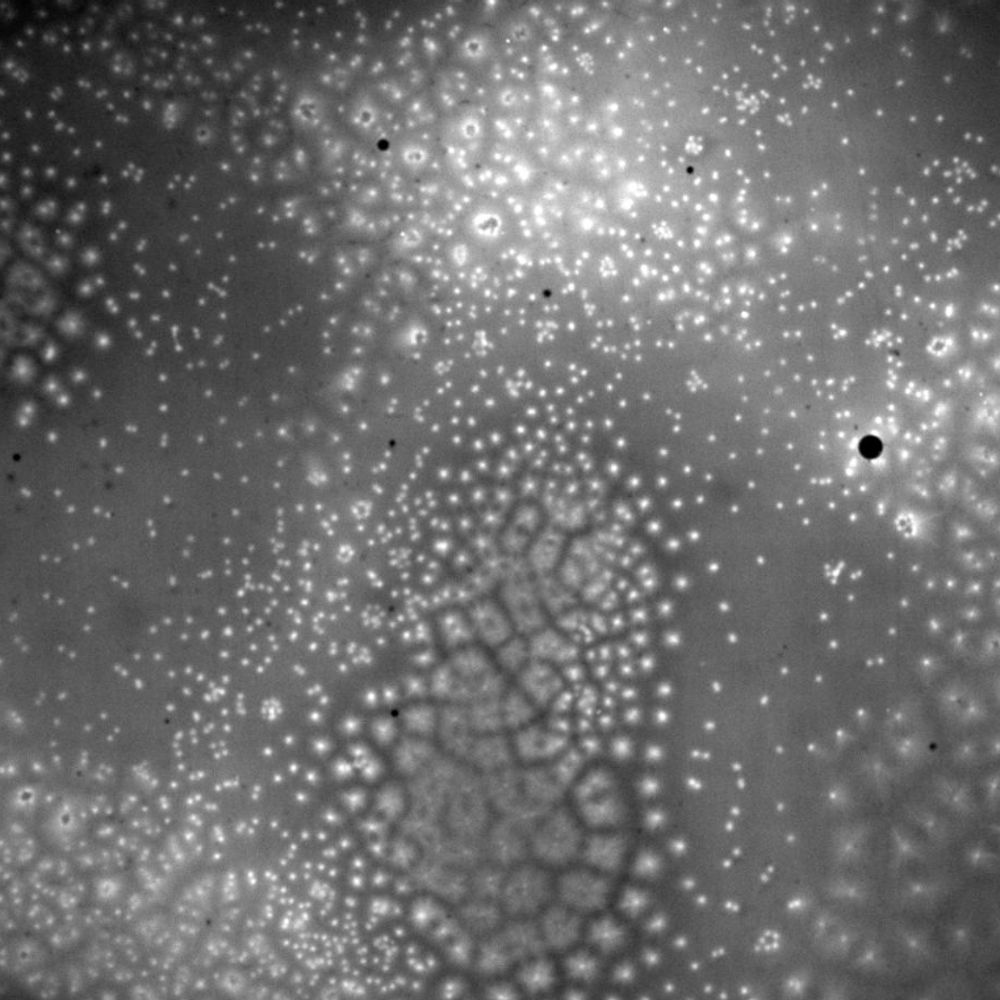
Really excited to share our new paper in @nature.com! We uncovered how a physical instability of the cytoplasm coupled with the cell cycle drives cytoplasmic partitioning in early embryos #zebrafish #drosophila. Read more in this🧵 www.nature.com/articles/s41... 🤩
@poldresden.bsky.social @mpi-cbg.de
@poldresden.bsky.social @mpi-cbg.de
January 28, 2026 at 4:10 PM
Really excited to share our new paper in @nature.com! We uncovered how a physical instability of the cytoplasm coupled with the cell cycle drives cytoplasmic partitioning in early embryos #zebrafish #drosophila. Read more in this🧵 www.nature.com/articles/s41... 🤩
@poldresden.bsky.social @mpi-cbg.de
@poldresden.bsky.social @mpi-cbg.de
Thanks for the nice words André!!
January 8, 2026 at 4:58 PM
Thanks for the nice words André!!
Thank you Stefano!!
January 8, 2026 at 1:44 PM
Thank you Stefano!!