




Axel Arango
@axelarango.bsky.social
Biologist trying to understand and explain biodiversity.
Reposted by Axel Arango

What do we know about mammal biodiversity patterns in the American tropics? Find out in the new book chapter by @liomys.mx and yours truly 👇
link.springer.com/rwe/10.1007/...
The whole book is a gem for those interested in the study of mammals of one of the world's most diverse regions!
link.springer.com/rwe/10.1007/...
The whole book is a gem for those interested in the study of mammals of one of the world's most diverse regions!

Advances in the Biogeography of Neotropical Mammals
Recent computational and methodological advances in phylogenetics and bioinformatics, along with the increasing availability of evolutionary and ecological data, have produced deeper insights into the...
link.springer.com
January 20, 2026 at 9:38 PM
What do we know about mammal biodiversity patterns in the American tropics? Find out in the new book chapter by @liomys.mx and yours truly 👇
link.springer.com/rwe/10.1007/...
The whole book is a gem for those interested in the study of mammals of one of the world's most diverse regions!
link.springer.com/rwe/10.1007/...
The whole book is a gem for those interested in the study of mammals of one of the world's most diverse regions!
Don't miss out on our guest speaker Dr. Elisa Thébault and her scientific talk "Species diversity, food web structure and ecosystem stability: Bridging the gap between theory and data"
More details about our Lunchbox models seminar series on: www.yomos.org/lunchbox-mod...
More details about our Lunchbox models seminar series on: www.yomos.org/lunchbox-mod...

January 21, 2026 at 10:25 AM
Don't miss out on our guest speaker Dr. Elisa Thébault and her scientific talk "Species diversity, food web structure and ecosystem stability: Bridging the gap between theory and data"
More details about our Lunchbox models seminar series on: www.yomos.org/lunchbox-mod...
More details about our Lunchbox models seminar series on: www.yomos.org/lunchbox-mod...
academic.oup.com/evolut/advan...
Better late than never! A little after our paper officially hit the press in Evolution, I’m finally sharing a thread on what we discovered about bird dispersal and diversification. (1/5)
Better late than never! A little after our paper officially hit the press in Evolution, I’m finally sharing a thread on what we discovered about bird dispersal and diversification. (1/5)

The effects of the dispersal ability in the diversification dynamics of Emberizoidea (Aves: Passeriformes)
Abstract. Understanding how ecological and evolutionary forces shape biodiversity is a core pursuit in macroevolutionary research. Species’ dispersal abili
academic.oup.com
January 18, 2026 at 11:13 AM
academic.oup.com/evolut/advan...
Better late than never! A little after our paper officially hit the press in Evolution, I’m finally sharing a thread on what we discovered about bird dispersal and diversification. (1/5)
Better late than never! A little after our paper officially hit the press in Evolution, I’m finally sharing a thread on what we discovered about bird dispersal and diversification. (1/5)
Reposted by Axel Arango

Congratulations to our @esme-ashe.bsky.social for winning one of the @biogeography.bsky.social poster award at #TIBS2026. Well deserved! 🎉


January 9, 2026 at 3:55 PM
Congratulations to our @esme-ashe.bsky.social for winning one of the @biogeography.bsky.social poster award at #TIBS2026. Well deserved! 🎉
Reposted by Axel Arango
Glad to be back at TIBS conference #TIBS2026. Specially, to find my former students and now colleagues @axelarango.bsky.social and @aberenicega.bsky.social presenting their cool postdoc work.
Got to see old friends and met new ones, always the best part ;)
Got to see old friends and met new ones, always the best part ;)


January 11, 2026 at 1:19 PM
Glad to be back at TIBS conference #TIBS2026. Specially, to find my former students and now colleagues @axelarango.bsky.social and @aberenicega.bsky.social presenting their cool postdoc work.
Got to see old friends and met new ones, always the best part ;)
Got to see old friends and met new ones, always the best part ;)
Reposted by Axel Arango

Read the latest issue of Evolution: academic.oup.com/evolut/issue...

November 19, 2025 at 8:36 PM
Read the latest issue of Evolution: academic.oup.com/evolut/issue...
Reposted by Axel Arango

Work by our @axelarango.bsky.social is now out!!! @uni-wuerzburg.de Effects of the #dispersal ability in the #diversification dynamics of Emberizoidea (Aves: Passeriformes) url: academic.oup.com/evolut/artic...

The effects of the dispersal ability in the diversification dynamics of Emberizoidea (Aves: Passeriformes)
Abstract. Understanding how ecological and evolutionary forces shape biodiversity is a core pursuit in macroevolutionary research. Species’ dispersal abili
academic.oup.com
November 18, 2025 at 9:14 AM
Work by our @axelarango.bsky.social is now out!!! @uni-wuerzburg.de Effects of the #dispersal ability in the #diversification dynamics of Emberizoidea (Aves: Passeriformes) url: academic.oup.com/evolut/artic...
Reposted by Axel Arango

One more step towards more insightful analyses in Evolutionary Macroecology. Thanks @fabrovillalobos.bsky.social and all coauthors still not blueskylized for the collaborative endeavor!
SBEARS - A site-based method to estimate ancestral ranges of species url: academic.oup.com/evolut/artic...
SBEARS - A site-based method to estimate ancestral ranges of species url: academic.oup.com/evolut/artic...

SBEARS - A site-based method to estimate ancestral ranges of species
Abstract. Assessing the geographic dimension of diversification is paramount to integrate macroecology and macroevolution. Estimating ancestral ranges of s
academic.oup.com
August 29, 2025 at 6:44 PM
One more step towards more insightful analyses in Evolutionary Macroecology. Thanks @fabrovillalobos.bsky.social and all coauthors still not blueskylized for the collaborative endeavor!
SBEARS - A site-based method to estimate ancestral ranges of species url: academic.oup.com/evolut/artic...
SBEARS - A site-based method to estimate ancestral ranges of species url: academic.oup.com/evolut/artic...
Reposted by Axel Arango
Know more about @axelarango.bsky.social, featured as an early career biogeography researcher!! biogeographynews.org/2025/10/30/e... postdoc with @gokhalecs.bsky.social

ECR feature: Axel Arango
Axel Arango is a postdoctoral researcher at the Universität Würzburg, Germany. He is a evolutionary biologist with special focus on Macroecology and Macroevolution. Here, Axel shares his recent wor…
biogeographynews.org
November 4, 2025 at 6:52 AM
Know more about @axelarango.bsky.social, featured as an early career biogeography researcher!! biogeographynews.org/2025/10/30/e... postdoc with @gokhalecs.bsky.social
Reposted by Axel Arango

To celebrate 20 years of #BiologyLetters, we’ve curated a collection of the journal’s most popular papers. View the papers below and discover more about Biology Letters here: royalsociety.org/blog/2025/03...

Celebrating 20 years of Biology Letters | Royal Society
Biology Letters turns 20
royalsociety.org
March 26, 2025 at 10:02 AM
To celebrate 20 years of #BiologyLetters, we’ve curated a collection of the journal’s most popular papers. View the papers below and discover more about Biology Letters here: royalsociety.org/blog/2025/03...
Reposted by Axel Arango
📢Our new paper on alien vertebrates in the world's mountains is now out @naturecomms.bsky.social. Using data on 700+ spp across ~3,000 mountains we explore their distribution patterns,flows across realms, presence in protected areas, and the factors driving these trends.
🐟🐸🦎🦜🦝⛰️
👉 rdcu.be/ebidu
🐟🐸🦎🦜🦝⛰️
👉 rdcu.be/ebidu
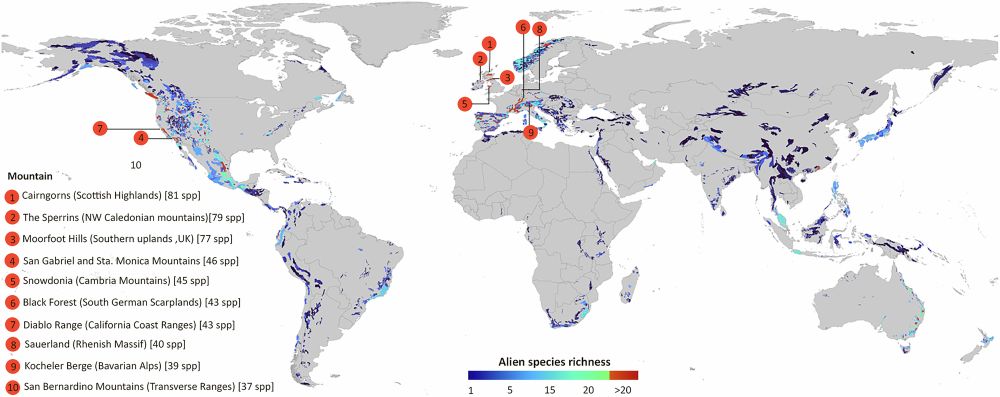
The global distribution patterns of alien vertebrate richness in mountains
Nature Communications - Among contemporary threats to mountain biodiversity, biological invasions have been understudied. This large-scale synthesis on alien vertebrates in global mountains delves...
rdcu.be
February 26, 2025 at 8:31 AM
📢Our new paper on alien vertebrates in the world's mountains is now out @naturecomms.bsky.social. Using data on 700+ spp across ~3,000 mountains we explore their distribution patterns,flows across realms, presence in protected areas, and the factors driving these trends.
🐟🐸🦎🦜🦝⛰️
👉 rdcu.be/ebidu
🐟🐸🦎🦜🦝⛰️
👉 rdcu.be/ebidu
Reposted by Axel Arango
#ProcB in nationalgeographic.com | Rapid evolution of prehistoric dogs from wolves by natural and sexual selection emerges from an agent-based model: royalsocietypublishing.org/doi/10.1098/... www.nationalgeographic.com/animals/arti...

New model shows dogs could have domesticated themselves
They may have been drawn to the discarded remains from ancient human meals, and a new model shows tame wolves could have become dogs in as little as 8,000 years.
www.nationalgeographic.com
February 27, 2025 at 3:36 PM
#ProcB in nationalgeographic.com | Rapid evolution of prehistoric dogs from wolves by natural and sexual selection emerges from an agent-based model: royalsocietypublishing.org/doi/10.1098/... www.nationalgeographic.com/animals/arti...
Reposted by Axel Arango

Science (and science policy, and conservation) friends, I need your help!
We are collecting *specific, clear* examples of harms caused by the Trump administration's attacks on science, to be included in an open letter.
Can be links to news stories/social media posts. 🧪🦑🌎 #SciComm #SciPol
We are collecting *specific, clear* examples of harms caused by the Trump administration's attacks on science, to be included in an open letter.
Can be links to news stories/social media posts. 🧪🦑🌎 #SciComm #SciPol

February 21, 2025 at 1:59 PM
Reposted by Axel Arango

I first read the famous 1925 Yule paper at its 80th birthday - during my Master thesis work, and it shaped my research profoundly. It was a pleasure and honour to lead this special 100 anniversary issue celebrating Yule's legacy and phylogenetic models with @noahrosenberg.bsky.social and Mike Steel!
A mathematical theory of evolution: phylogenetic models dating back 100 years—a new #PhilTransB theme issue describes recent developments in models of #evolutionary trees and networks, and in #phylogenetic modeling for applications in biology: https://buff.ly/41r1wkR @tanjastadler.bsky.social

buff.ly
February 21, 2025 at 8:46 AM
I first read the famous 1925 Yule paper at its 80th birthday - during my Master thesis work, and it shaped my research profoundly. It was a pleasure and honour to lead this special 100 anniversary issue celebrating Yule's legacy and phylogenetic models with @noahrosenberg.bsky.social and Mike Steel!
Reposted by Axel Arango

Where do species come from? where and when did they meet and exchange genes? find it out with our new R tool for historical biogeography, RRphylogeography is published:
doi.org/10.1111/2041...
doi.org/10.1111/2041...
January 31, 2025 at 9:31 AM
Where do species come from? where and when did they meet and exchange genes? find it out with our new R tool for historical biogeography, RRphylogeography is published:
doi.org/10.1111/2041...
doi.org/10.1111/2041...
Reposted by Axel Arango
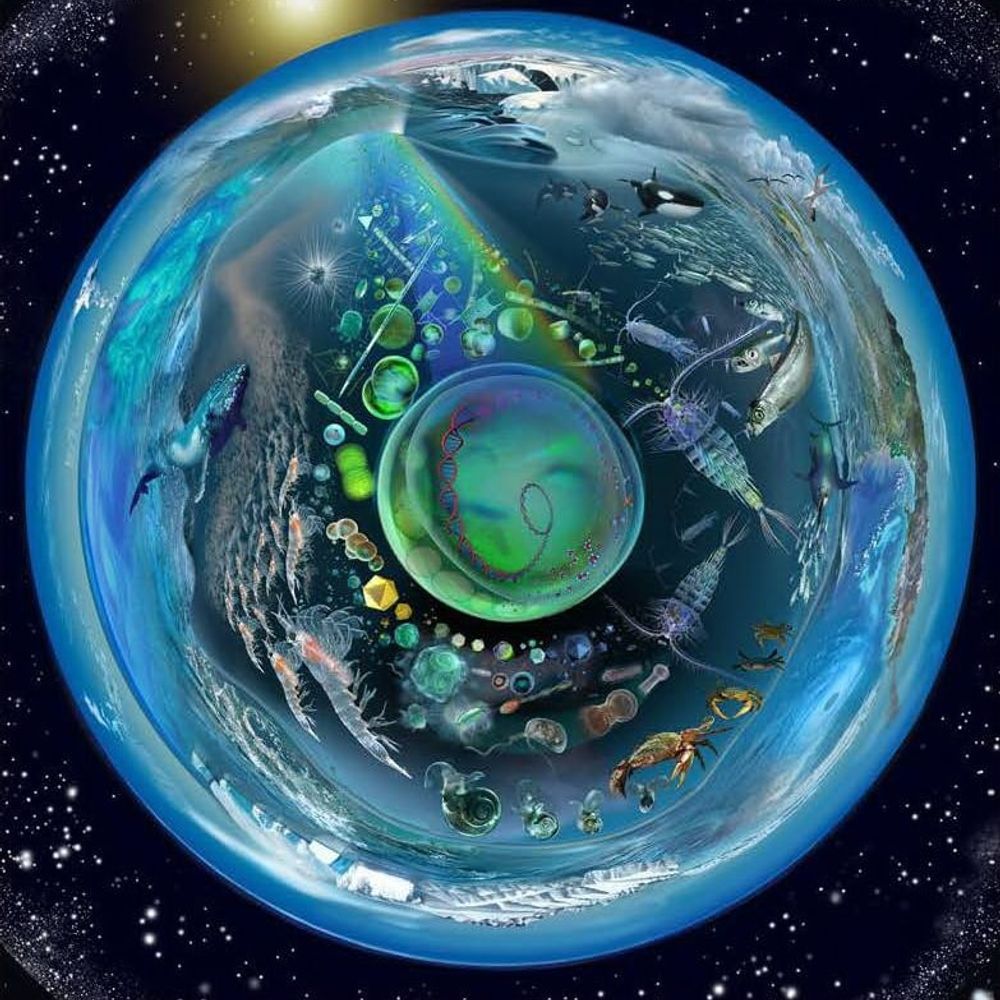
🌍 Ecosystems are shaped by feedbacks! ✨
From tipping points to spatial patterns, this study by @ricardsole.bsky.social shows how non-linear thresholds govern biodiversity loss and resilience 🌳🔥
👉 doi.org/10.1016/j.bi...
🔑 Embracing #Gaia’s complexity is key to conservation!
🌐🌍🦤🍁#GaiaTheory
From tipping points to spatial patterns, this study by @ricardsole.bsky.social shows how non-linear thresholds govern biodiversity loss and resilience 🌳🔥
👉 doi.org/10.1016/j.bi...
🔑 Embracing #Gaia’s complexity is key to conservation!
🌐🌍🦤🍁#GaiaTheory

January 27, 2025 at 1:29 PM
🌍 Ecosystems are shaped by feedbacks! ✨
From tipping points to spatial patterns, this study by @ricardsole.bsky.social shows how non-linear thresholds govern biodiversity loss and resilience 🌳🔥
👉 doi.org/10.1016/j.bi...
🔑 Embracing #Gaia’s complexity is key to conservation!
🌐🌍🦤🍁#GaiaTheory
From tipping points to spatial patterns, this study by @ricardsole.bsky.social shows how non-linear thresholds govern biodiversity loss and resilience 🌳🔥
👉 doi.org/10.1016/j.bi...
🔑 Embracing #Gaia’s complexity is key to conservation!
🌐🌍🦤🍁#GaiaTheory
Just opened my Bluesky account, and what better way to kick things off than with big news? Our paper, “Broad geographic dispersal is not a diversification driver for Emberizoidea,” is now out in PRSB!
1/3
#Macroevolution #Macroecology #Biogeography
1/3
#Macroevolution #Macroecology #Biogeography

Broad geographic dispersal is not a diversification driver for Emberizoidea | Proceedings of the Royal Society B: Biological Sciences
The movement of species to new geographical areas has been proposed to be crucial
for speciation. As such, dispersal has been regarded as a likely explanation for the
variation in species richness amo...
royalsocietypublishing.org
January 25, 2025 at 3:47 PM
Just opened my Bluesky account, and what better way to kick things off than with big news? Our paper, “Broad geographic dispersal is not a diversification driver for Emberizoidea,” is now out in PRSB!
1/3
#Macroevolution #Macroecology #Biogeography
1/3
#Macroevolution #Macroecology #Biogeography