




alymischa
@alymischa.bsky.social
Researcher Junior Assistant Professor (RTD A) 🌱 🧬 🦠 at @DagriUnifi
@UNI_FIRENZE
#Plants and #bacterial #geneticist, #rhizosphere fan!
@UNI_FIRENZE
#Plants and #bacterial #geneticist, #rhizosphere fan!
🚀 Our new paper is out! So happy to have participated in this work together with Martina Cappelletti's group 🤝
We investigated microbial life on #silica formations in a Mars-analog remote #cave using on-site DNAseq! #astrobiology #biogeoscience #microbialcommunity bg.copernicus.org/articles/22/...
We investigated microbial life on #silica formations in a Mars-analog remote #cave using on-site DNAseq! #astrobiology #biogeoscience #microbialcommunity bg.copernicus.org/articles/22/...

On-site microbiome study of silica structures in a subterranean Mars analog environment
Abstract. Amorphous silica deposits found in orthoquartzite caves offer valuable analogues for understanding early life on Earth and potential biosignatures on Mars. This study presents the fully on-s...
bg.copernicus.org
October 30, 2025 at 5:26 PM
🚀 Our new paper is out! So happy to have participated in this work together with Martina Cappelletti's group 🤝
We investigated microbial life on #silica formations in a Mars-analog remote #cave using on-site DNAseq! #astrobiology #biogeoscience #microbialcommunity bg.copernicus.org/articles/22/...
We investigated microbial life on #silica formations in a Mars-analog remote #cave using on-site DNAseq! #astrobiology #biogeoscience #microbialcommunity bg.copernicus.org/articles/22/...
🌿 Our new paper out in Planta @springernature.com !
doi.org/10.1007/s004... 🌱🧬
We uncover the gene networks driving Mimosa pudica leaf closure after single vs multiple stimuli, revealing distinct stress-response pathways.
#Transcriptomics #MimosaPudica #StressResponse
doi.org/10.1007/s004... 🌱🧬
We uncover the gene networks driving Mimosa pudica leaf closure after single vs multiple stimuli, revealing distinct stress-response pathways.
#Transcriptomics #MimosaPudica #StressResponse

The transcriptional mechanism behind Mimosa pudica leaf folding in response to mechanical disturbance - Planta
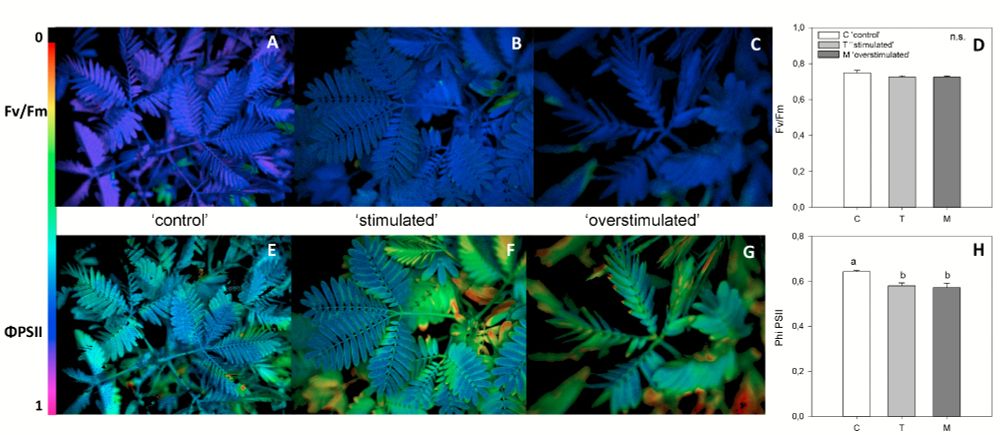
Main conclusions Repeated stress in Mimosa pudica reduces photosystem efficiency, alters gene expression, shifting from flavonoid biosynthesis to stress resistance pathways, offering insights for sustainable plant stress defense strategies. Abstract Mimosa pudica is a plant known for its ability to fold leaves in response to mechanical disturbances, which serves as a visible phenotypic stress marker. Leaf folding response occurs with a timing and an intensity that vary depending on the stimulus. This adaptive behavior may function as a defense mechanism, helping plant resist herbivores and environmental stressors. In this study, we investigated the gene regulatory networks underlying M. pudica leaf closure following single and multiple mechanical disturbances (whole pot drops). Chlorophyll fluorescence was measured as fast phenotypic indicator of transient or permanent photochemical damage, and transcriptional responses were measured to identify the key genes regulating phenotypic changes after single or multiple drops. A progressive reduction of the quantum yield of PSII revealed a lower electron transport rate in leaves subjected to one or more drops, which may indicate the onset of energy shortage, potentially caused by limited ATP availability that constrains both leaf movement and photosynthesis. The transcriptomic profiles revealed larger differences when plants were subjected to multiple drops than to a single drop, with respect to unstressed controls. Interestingly, following a single drop, the majority of up-regulated genes were associated with the flavonoid biosynthetic pathway. After multiple drops, however, genes associated with biotic and abiotic stress resistance pathways were predominantly up-regulated. These findings provide new insights into the gene regulatory networks driving stress-induced movements in M. pudica leaves and lay the groundwork for developing sustainable strategies for plant stress defense.
doi.org
October 6, 2025 at 7:06 PM
🌿 Our new paper out in Planta @springernature.com !
doi.org/10.1007/s004... 🌱🧬
We uncover the gene networks driving Mimosa pudica leaf closure after single vs multiple stimuli, revealing distinct stress-response pathways.
#Transcriptomics #MimosaPudica #StressResponse
doi.org/10.1007/s004... 🌱🧬
We uncover the gene networks driving Mimosa pudica leaf closure after single vs multiple stimuli, revealing distinct stress-response pathways.
#Transcriptomics #MimosaPudica #StressResponse
Happy to share our new preprint on @biorxivpreprint.bsky.social on the gene regulation process responsible for Mimosa pudica leaf movement triggered by physical touch! 🌱
doi.org/10.1101/2025...
doi.org/10.1101/2025...
July 22, 2025 at 7:39 AM
Happy to share our new preprint on @biorxivpreprint.bsky.social on the gene regulation process responsible for Mimosa pudica leaf movement triggered by physical touch! 🌱
doi.org/10.1101/2025...
doi.org/10.1101/2025...
Happy to repost on my new Bluesky profile 🌱
In our study published on May 8,we successfully adapted the #PhenotypeMicroarray approach to plant #protoplasts, opening new possibilities for high-throughput metabolic phenotyping at cell level!
🔗 📖 rdcu.be/ek5iH
@springernature.com @alessiome.bsky.social
In our study published on May 8,we successfully adapted the #PhenotypeMicroarray approach to plant #protoplasts, opening new possibilities for high-throughput metabolic phenotyping at cell level!
🔗 📖 rdcu.be/ek5iH
@springernature.com @alessiome.bsky.social
Phenotype microarray-based assessment of metabolic variability in plant protoplasts
rdcu.be
July 1, 2025 at 12:27 PM
Happy to repost on my new Bluesky profile 🌱
In our study published on May 8,we successfully adapted the #PhenotypeMicroarray approach to plant #protoplasts, opening new possibilities for high-throughput metabolic phenotyping at cell level!
🔗 📖 rdcu.be/ek5iH
@springernature.com @alessiome.bsky.social
In our study published on May 8,we successfully adapted the #PhenotypeMicroarray approach to plant #protoplasts, opening new possibilities for high-throughput metabolic phenotyping at cell level!
🔗 📖 rdcu.be/ek5iH
@springernature.com @alessiome.bsky.social