




Alexandrova Lab
@alexandrovalab.bsky.social
A group of computational chemists at UCLA. We study catalysts, materials, and complex (bio)molecular systems (and make them better!).
Student-run account.
https://alexandrova.chem.ucla.edu/
Student-run account.
https://alexandrova.chem.ucla.edu/
Turns out bombarding 💥 HOPG with Pt clusters doesn’t just stick them: it builds weird, strong Pt–C structures that supercharge HER activity!
Read all about it (ft. cool BOMD simulations) in our new paper in @jacs.acspublications.org
👉 doi.org/10.1021/jacs.5c16035
#chemsky #compchemsky #compchem
Read all about it (ft. cool BOMD simulations) in our new paper in @jacs.acspublications.org
👉 doi.org/10.1021/jacs.5c16035
#chemsky #compchemsky #compchem

Highly Active Hydrogen Evolution Reaction (HER) Catalysts Formed by Energetic Ptn Cluster Deposition: Deposition Dynamics and the HER Mechanism
Mass-selected Ptn+ (n ≤ 7) were deposited at variable energies on highly oriented pyrolytic graphite (HOPG), creating highly active hydrogen evolution reaction (HER) electrocatalysts. HER mass activit...
doi.org
January 9, 2026 at 5:22 AM
Turns out bombarding 💥 HOPG with Pt clusters doesn’t just stick them: it builds weird, strong Pt–C structures that supercharge HER activity!
Read all about it (ft. cool BOMD simulations) in our new paper in @jacs.acspublications.org
👉 doi.org/10.1021/jacs.5c16035
#chemsky #compchemsky #compchem
Read all about it (ft. cool BOMD simulations) in our new paper in @jacs.acspublications.org
👉 doi.org/10.1021/jacs.5c16035
#chemsky #compchemsky #compchem
Check our new paper in Advanced Materials Interfaces @wiley.com @wileyonlinelibrary.bsky.social which looks topological surface states of the semimetal Ru₃Sn₇ with chemically realistic terminations.
👉 doi.org/10.1002/admi.202500711
#chemsky #compchemsky #compchem #physicssky #physics
👉 doi.org/10.1002/admi.202500711
#chemsky #compchemsky #compchem #physicssky #physics
doi.org
January 8, 2026 at 7:40 PM
Check our new paper in Advanced Materials Interfaces @wiley.com @wileyonlinelibrary.bsky.social which looks topological surface states of the semimetal Ru₃Sn₇ with chemically realistic terminations.
👉 doi.org/10.1002/admi.202500711
#chemsky #compchemsky #compchem #physicssky #physics
👉 doi.org/10.1002/admi.202500711
#chemsky #compchemsky #compchem #physicssky #physics
Wrapping up this year with good food, lots of laughs, and even better company at our annual winter solstice party ✨
Wishing all our friends here on Bluesky a warm, restful, and happy holiday season!
#chemsky #compchemsky #chemchat
Wishing all our friends here on Bluesky a warm, restful, and happy holiday season!
#chemsky #compchemsky #chemchat

December 20, 2025 at 11:05 PM
Wrapping up this year with good food, lots of laughs, and even better company at our annual winter solstice party ✨
Wishing all our friends here on Bluesky a warm, restful, and happy holiday season!
#chemsky #compchemsky #chemchat
Wishing all our friends here on Bluesky a warm, restful, and happy holiday season!
#chemsky #compchemsky #chemchat
Vibronic coupling limits the use of high-lying electronic states in complex molecules for laser cooling
Out now in Phys. Rev. Research:
👉 doi.org/10.1103/kw2m...
#compchem #chemsky #compchemsky #quantum
Out now in Phys. Rev. Research:
👉 doi.org/10.1103/kw2m...
#compchem #chemsky #compchemsky #quantum
doi.org
December 9, 2025 at 7:06 PM
Vibronic coupling limits the use of high-lying electronic states in complex molecules for laser cooling
Out now in Phys. Rev. Research:
👉 doi.org/10.1103/kw2m...
#compchem #chemsky #compchemsky #quantum
Out now in Phys. Rev. Research:
👉 doi.org/10.1103/kw2m...
#compchem #chemsky #compchemsky #quantum
How do surface hydroxyls enable Cu restructuring during CO electroreduction?
Check out this new paper in @jacs.acspublications.org!
👉 doi.org/10.1021/jacs...
#compchem #chemsky #compchemsky
Check out this new paper in @jacs.acspublications.org!
👉 doi.org/10.1021/jacs...
#compchem #chemsky #compchemsky

Role of Surface Hydroxyls in Atomic-Scale Copper Restructuring during CO Electroreduction
The nanoscale structure of electrocatalyst surfaces governs the selectivity and kinetics of reactions including CO(2) electroreduction (CO(2)R). Yet, their evolution under reaction conditions remains elusive, and the roles of surface hydroxyls (OHad) and the interfacial microenvironment in surface restructuring are poorly understood. Combining electrochemical atomic force microscopy, Raman spectroscopy, and grand canonical modeling, we reveal that OHad acts synergistically with COad to restructure copper (Cu) electrocatalysts during COR. Mixed OHad/COad coverage promotes lifting of surface atoms into metastable states, generating Cu adatoms and nanoclusters at mild cathodic potentials, which aggregate or dissolve at more negative potentials. This restructuring into low-coordinated Cu sites is accompanied by disordering of the interfacial water network. Nanocluster stability depends critically on CO partial pressure, while hydroxyls remain kinetically trapped on the roughened Cu surface. These findings underscore the importance of surface kinetics and interfacial microenvironments in atomic-scale surface restructuring, urging a reassessment of catalytic surface states under realistic conditions.
doi.org
December 9, 2025 at 7:02 PM
How do surface hydroxyls enable Cu restructuring during CO electroreduction?
Check out this new paper in @jacs.acspublications.org!
👉 doi.org/10.1021/jacs...
#compchem #chemsky #compchemsky
Check out this new paper in @jacs.acspublications.org!
👉 doi.org/10.1021/jacs...
#compchem #chemsky #compchemsky
How does temperature affect the adsorbate-induced roughening of Cu in electrochemical CO2 reduction? Check out our latest paper in JPC Letters @pubs.acs.org!
👉 doi.org/10.1021/acs.jpclett.5c03061
#chemsky #compchem #compchemsky
👉 doi.org/10.1021/acs.jpclett.5c03061
#chemsky #compchem #compchemsky

Temperature-Dependent Adsorbate-Induced Surface Roughening Onset in Electrochemical CO2 Reduction on Copper
The dynamic restructuring of Cu surfaces under electrochemical CO2 reduction conditions is crucial for determining their catalytic performance, particularly for multicarbon products such as ethylene a...
doi.org
November 27, 2025 at 6:31 PM
How does temperature affect the adsorbate-induced roughening of Cu in electrochemical CO2 reduction? Check out our latest paper in JPC Letters @pubs.acs.org!
👉 doi.org/10.1021/acs.jpclett.5c03061
#chemsky #compchem #compchemsky
👉 doi.org/10.1021/acs.jpclett.5c03061
#chemsky #compchem #compchemsky
Check out our new study on the Role of Surface Hydroxyls in Atomic-Scale Copper Restructuring during CO Electroreduction, out in @jacs.acspublications.org!
👉 doi.org/10.1021/jacs...
#chemsky #compchem #compchemsky
👉 doi.org/10.1021/jacs...
#chemsky #compchem #compchemsky

Role of Surface Hydroxyls in Atomic-Scale Copper Restructuring during CO Electroreduction
The nanoscale structure of electrocatalyst surfaces governs the selectivity and kinetics of reactions including CO(2) electroreduction (CO(2)R). Yet, their evolution under reaction conditions remains elusive, and the roles of surface hydroxyls (OHad) and the interfacial microenvironment in surface restructuring are poorly understood. Combining electrochemical atomic force microscopy, Raman spectroscopy, and grand canonical modeling, we reveal that OHad acts synergistically with COad to restructure copper (Cu) electrocatalysts during COR. Mixed OHad/COad coverage promotes lifting of surface atoms into metastable states, generating Cu adatoms and nanoclusters at mild cathodic potentials, which aggregate or dissolve at more negative potentials. This restructuring into low-coordinated Cu sites is accompanied by disordering of the interfacial water network. Nanocluster stability depends critically on CO partial pressure, while hydroxyls remain kinetically trapped on the roughened Cu surface. These findings underscore the importance of surface kinetics and interfacial microenvironments in atomic-scale surface restructuring, urging a reassessment of catalytic surface states under realistic conditions.
doi.org
November 25, 2025 at 4:52 PM
Check out our new study on the Role of Surface Hydroxyls in Atomic-Scale Copper Restructuring during CO Electroreduction, out in @jacs.acspublications.org!
👉 doi.org/10.1021/jacs...
#chemsky #compchem #compchemsky
👉 doi.org/10.1021/jacs...
#chemsky #compchem #compchemsky
Hot off the press: Multi-level QTAIM-enriched graph neural networks for resolving properties of transition metal complexes, now out in @digital-discovery.rsc.org!
👉 doi.org/10.1039/D5DD...
#compchem #chemsky #compchemsky
👉 doi.org/10.1039/D5DD...
#compchem #chemsky #compchemsky

Multi-level QTAIM-enriched graph neural networks for resolving properties of transition metal complexes
Here we evaluate the robustness and utility of quantum mechanical descriptors for machine learning with transition metal complexes. We utilize ab initio information from the quantum theory of atoms-in...
doi.org
November 6, 2025 at 7:09 PM
Hot off the press: Multi-level QTAIM-enriched graph neural networks for resolving properties of transition metal complexes, now out in @digital-discovery.rsc.org!
👉 doi.org/10.1039/D5DD...
#compchem #chemsky #compchemsky
👉 doi.org/10.1039/D5DD...
#compchem #chemsky #compchemsky
Wondering what the true active sites for Ni-SACs look like during CO₂ reduction?
Take a look at our new paper in @jacs.acspublications.org
👉 doi.org/10.1021/jacs...
#compchem #chemsky #compchemsky
Take a look at our new paper in @jacs.acspublications.org
👉 doi.org/10.1021/jacs...
#compchem #chemsky #compchemsky

Uncovering the True Active Sites in Ni–N–C Catalysts for CO2 Electroreduction
Understanding and designing active sites in single-atom catalysts (SACs) requires going beyond static models to capture their dynamic evolution under realistic electrochemical conditions. Here, we dev...
doi.org
October 21, 2025 at 1:48 AM
Wondering what the true active sites for Ni-SACs look like during CO₂ reduction?
Take a look at our new paper in @jacs.acspublications.org
👉 doi.org/10.1021/jacs...
#compchem #chemsky #compchemsky
Take a look at our new paper in @jacs.acspublications.org
👉 doi.org/10.1021/jacs...
#compchem #chemsky #compchemsky
Check out our new paper on making cooler and bigger qubits in @natchem.nature.com!
👉https://rdcu.be/eKdGn
#compchem #chemsky #compchemsky
👉https://rdcu.be/eKdGn
#compchem #chemsky #compchemsky
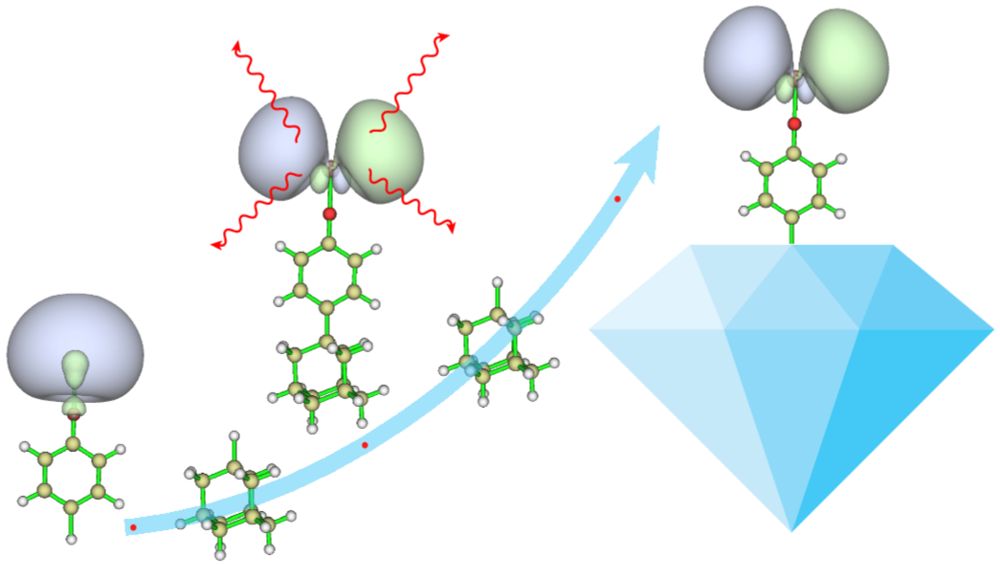
Bottom-up approach to making larger hydrocarbon molecules capable of optical cycling
Nature Chemistry - Alkaline-earth phenoxides show promise as optical cycling centres; however, their properties when connected to larger structures is unclear. Now it has been shown that their...
rdcu.be
October 9, 2025 at 6:31 PM
Check out our new paper on making cooler and bigger qubits in @natchem.nature.com!
👉https://rdcu.be/eKdGn
#compchem #chemsky #compchemsky
👉https://rdcu.be/eKdGn
#compchem #chemsky #compchemsky
Reposted by Alexandrova Lab

The 2025 #NobelPrize in Chemistry has been awarded to Susumu Kitagawa, Richard Robson and Omar M. Yaghi “for the development of metal–organic frameworks.” Stay tuned for the full story to come! cen.acs.org/people/nobel...
#ChemNobel #Chem #Chemistry #chemsky 🧪
#ChemNobel #Chem #Chemistry #chemsky 🧪

The 2025 chemistry Nobel goes to MOFs
Susumu Kitagawa, Richard Robson and Omar M. Yaghi win the prize for developing metal–organic frameworks
cen.acs.org
October 8, 2025 at 10:12 AM
The 2025 #NobelPrize in Chemistry has been awarded to Susumu Kitagawa, Richard Robson and Omar M. Yaghi “for the development of metal–organic frameworks.” Stay tuned for the full story to come! cen.acs.org/people/nobel...
#ChemNobel #Chem #Chemistry #chemsky 🧪
#ChemNobel #Chem #Chemistry #chemsky 🧪
We conducted a #ChemNobel prediction poll in the group on the #NobelPrize in Chemistry Eve!
(PS: we might be a little biased 😉) #chemsky #compchem #compchemsky
(PS: we might be a little biased 😉) #chemsky #compchem #compchemsky

October 8, 2025 at 3:14 AM
We conducted a #ChemNobel prediction poll in the group on the #NobelPrize in Chemistry Eve!
(PS: we might be a little biased 😉) #chemsky #compchem #compchemsky
(PS: we might be a little biased 😉) #chemsky #compchem #compchemsky
✨Exciting news - the Alexandrova Group is now on Bluesky!✨
Hello, friends on #chemsky and #compchemsky. We're glad to be here! Stay tuned for the latest #compchem 💻 research and news from the lab!
Hello, friends on #chemsky and #compchemsky. We're glad to be here! Stay tuned for the latest #compchem 💻 research and news from the lab!
October 3, 2025 at 10:45 PM
✨Exciting news - the Alexandrova Group is now on Bluesky!✨
Hello, friends on #chemsky and #compchemsky. We're glad to be here! Stay tuned for the latest #compchem 💻 research and news from the lab!
Hello, friends on #chemsky and #compchemsky. We're glad to be here! Stay tuned for the latest #compchem 💻 research and news from the lab!