


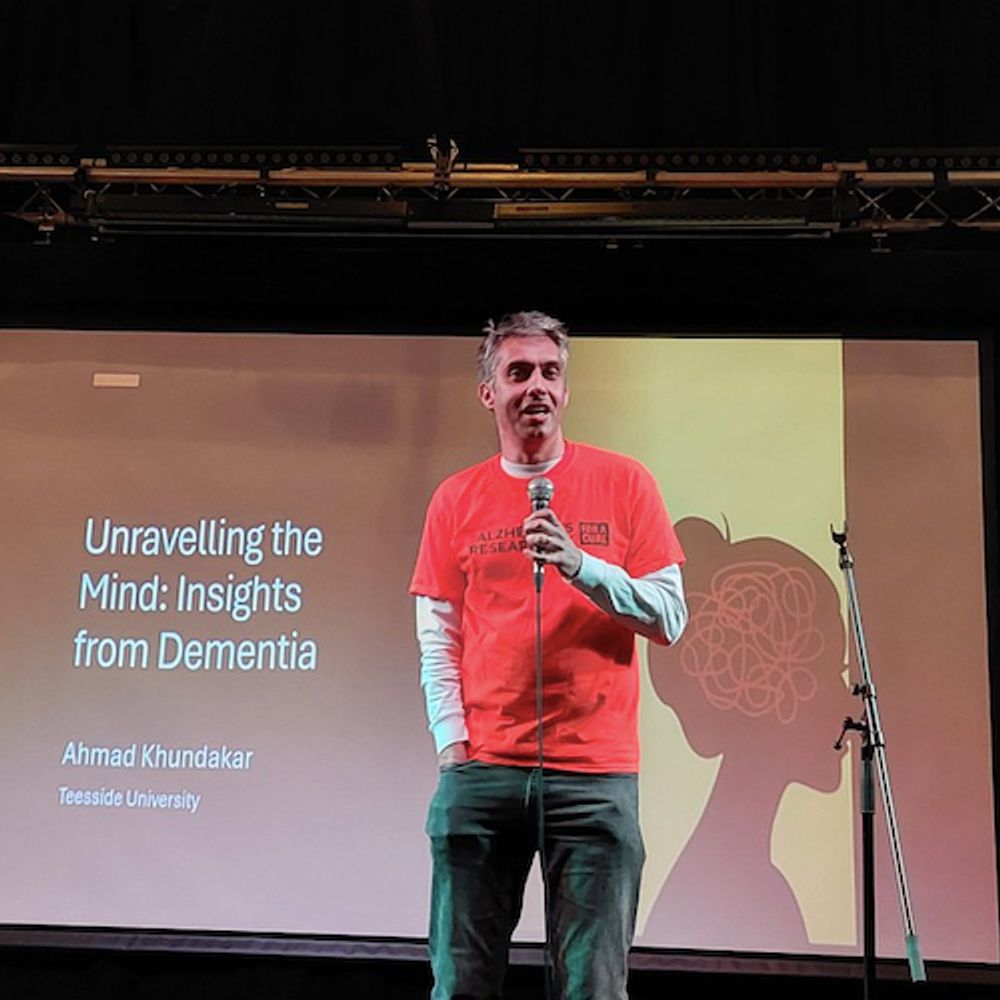
Ahmad Khundakar
@akhundakar.bsky.social
Dementia Researcher at Teesside University
Reposted by Ahmad Khundakar
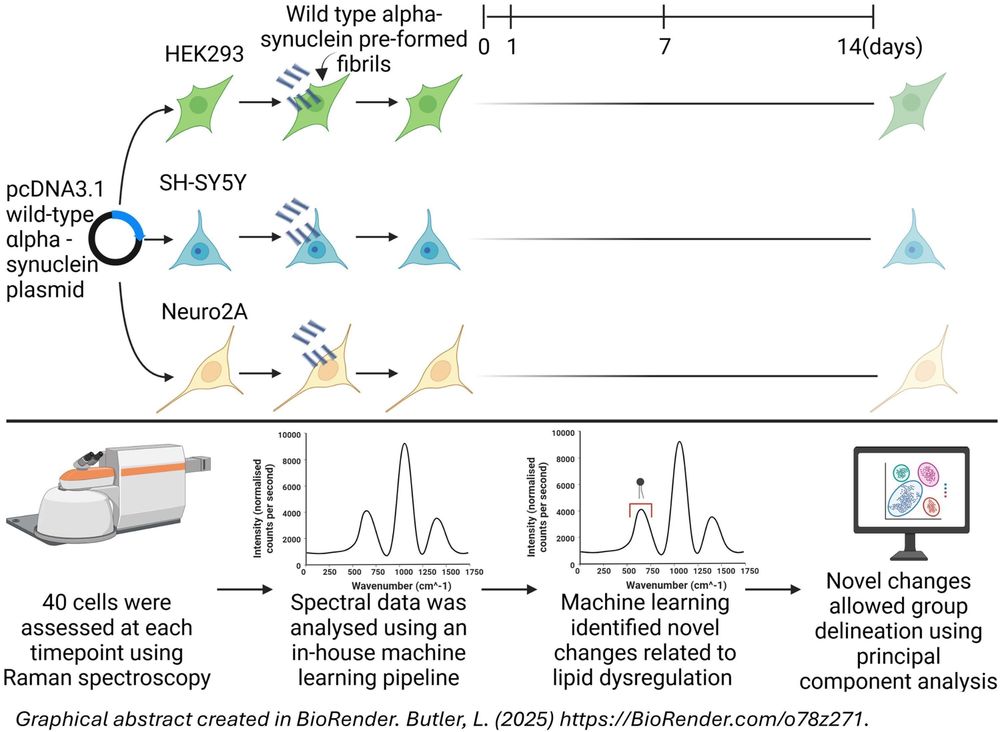
Coles et al. reveal how α-synuclein aggregation and lipid changes contribute to neurodegeneration in Parkinson’s disease and related Lewy body diseases using Raman spectroscopy and machine learning. Please read at: buff.ly/YZCPGww #Parkinsons #Neuroscience #Synuclein @akhundakar.bsky.social
April 22, 2025 at 3:03 PM
Coles et al. reveal how α-synuclein aggregation and lipid changes contribute to neurodegeneration in Parkinson’s disease and related Lewy body diseases using Raman spectroscopy and machine learning. Please read at: buff.ly/YZCPGww #Parkinsons #Neuroscience #Synuclein @akhundakar.bsky.social
A lot of fun in our interactive suite. I designed a new pathology lab for our biomed students in our wonderful BIOS building. @teessideuni.bsky.social @teesstudentlife.bsky.social


February 28, 2025 at 7:47 AM
A lot of fun in our interactive suite. I designed a new pathology lab for our biomed students in our wonderful BIOS building. @teessideuni.bsky.social @teesstudentlife.bsky.social
Thrilled to share a new publication - the first from Nathan Coles' PhD. Here, we tracked how α-synuclein, the main pathological hallmark in Lewy disorders, comes together using Raman spectroscopy and machine learning. pubs.acs.org/doi/10.1021/...

Molecular Insights into α-Synuclein Fibrillation: A Raman Spectroscopy and Machine Learning Approach
The aggregation of α-synuclein is crucial to the development of Lewy body diseases, including Parkinson’s disease and dementia with Lewy bodies. The aggregation pathway of α-synuclein typically involves a defined sequence of nucleation, elongation, and secondary nucleation, exhibiting prion-like spreading. This study employed Raman spectroscopy and machine learning analysis, alongside complementary techniques, to characterize the biomolecular changes during the fibrillation of purified recombinant wild-type α-synuclein protein. Monomeric α-synuclein was produced, purified, and subjected to a 7-day fibrillation assay to generate preformed fibrils. Stages of α-synuclein fibrillation were analyzed using Raman spectroscopy, with aggregation confirmed through negative staining transmission electron microscopy, mass spectrometry, and light scattering analyses. A machine learning pipeline incorporating principal component analysis and uniform manifold approximation and projection was used to analyze the Raman spectral data and identify significant peaks, resulting in differentiation between sample groups. Notable spectral shifts in α-synuclein were found in various stages of aggregation. Early changes (D1) included increases in α-helical structures (1303, 1330 cm–1) and β-sheet formation (1045 cm–1), with reductions in COO– and CH2 bond regions (1406, 1445 cm–1). By D4, these structural shifts persist with additional β-sheet features. At D7, a decrease in β-sheet H-bonding (1625 cm–1) and tyrosine ring breathing (830 cm–1) indicates further structural stabilization, suggesting a shift from initial helical structures to stabilized β-sheets and aggregated fibrils. Additionally, alterations in peaks related to tyrosine, alanine, proline, and glutamic acid were identified, emphasizing the role of these amino acids in intramolecular interactions during the transition from α-helical to β-sheet conformational states in α-synuclein fibrillation. This approach offers insight into α-synuclein aggregation, enhancing the understanding of its role in Lewy body disease pathophysiology and potential diagnostic relevance.
pubs.acs.org
January 29, 2025 at 3:36 PM
Thrilled to share a new publication - the first from Nathan Coles' PhD. Here, we tracked how α-synuclein, the main pathological hallmark in Lewy disorders, comes together using Raman spectroscopy and machine learning. pubs.acs.org/doi/10.1021/...
Another fantastic Dementia Research Partnership event yesterday. This time we established the key scope and purpose of the network. Some very important key themes are developing. Thank you all who attended!

January 17, 2025 at 10:21 PM
Another fantastic Dementia Research Partnership event yesterday. This time we established the key scope and purpose of the network. Some very important key themes are developing. Thank you all who attended!
Some fantastic news! Nathan Coles, a PhD student supervised by Dr. Panagiota Filippou, Prof. Tiago Outeiro and me has successfully defended his viva for his project!
Huge thanks to Prof. Elizabeta Mukaetova-Ladinska, @profjohnsyoung.bsky.social and Caroline Orr.
Congratulations, Dr. Coles!
Huge thanks to Prof. Elizabeta Mukaetova-Ladinska, @profjohnsyoung.bsky.social and Caroline Orr.
Congratulations, Dr. Coles!

December 14, 2024 at 4:45 PM
Some fantastic news! Nathan Coles, a PhD student supervised by Dr. Panagiota Filippou, Prof. Tiago Outeiro and me has successfully defended his viva for his project!
Huge thanks to Prof. Elizabeta Mukaetova-Ladinska, @profjohnsyoung.bsky.social and Caroline Orr.
Congratulations, Dr. Coles!
Huge thanks to Prof. Elizabeta Mukaetova-Ladinska, @profjohnsyoung.bsky.social and Caroline Orr.
Congratulations, Dr. Coles!