




adela Shevchenko
@adela7544.bsky.social
🪐| Solar System Ambassadors ☄️| Women in STEM 🧑🏻🔬| "We are made of stardust. We are the universe's way of knowing itself."
New images from NASA's James Webb Space Telescope reveal in unprecedented detail the Sagittarius C (Sgr C) star-forming region near the center of the Milky Way, about 300 light-years from the supermassive black hole Sagittarius A*, and reveal new features that have yet to be explained.

May 4, 2025 at 11:20 PM
New images from NASA's James Webb Space Telescope reveal in unprecedented detail the Sagittarius C (Sgr C) star-forming region near the center of the Milky Way, about 300 light-years from the supermassive black hole Sagittarius A*, and reveal new features that have yet to be explained.
This is a nebula near our Milky Way galaxy, about 163,000 light-years from Earth.
The larger group is called NGC 2014 and the smaller group is called NGC 2020. However, astronomers prefer to call this picture a "cosmic coral reef" because of its resemblance.
The larger group is called NGC 2014 and the smaller group is called NGC 2020. However, astronomers prefer to call this picture a "cosmic coral reef" because of its resemblance.

March 31, 2025 at 2:17 AM
This is a nebula near our Milky Way galaxy, about 163,000 light-years from Earth.
The larger group is called NGC 2014 and the smaller group is called NGC 2020. However, astronomers prefer to call this picture a "cosmic coral reef" because of its resemblance.
The larger group is called NGC 2014 and the smaller group is called NGC 2020. However, astronomers prefer to call this picture a "cosmic coral reef" because of its resemblance.
This northern nebula is called the "Cosmic Cliff" and is located in a huge cavernous nebula called the edge of the Carinae star, a region where new stars are produced.

March 30, 2025 at 12:35 AM
This northern nebula is called the "Cosmic Cliff" and is located in a huge cavernous nebula called the edge of the Carinae star, a region where new stars are produced.
The Carina Nebula is located in the southern hemisphere in the constellation Carina, about 7,600 light-years from Earth. It is one of the largest and brightest nebulae in the sky. It breeds a large number of new stars and is an important celestial body for studying star formation.

March 28, 2025 at 3:05 AM
The Carina Nebula is located in the southern hemisphere in the constellation Carina, about 7,600 light-years from Earth. It is one of the largest and brightest nebulae in the sky. It breeds a large number of new stars and is an important celestial body for studying star formation.
The images were released today by scientists from the Physics of Nearby Galaxies (PHANGS) project. The closest of the 19 galaxies is NGC 5068 (about 15 million light-years away) and the farthest is NGC 1365 (about 60 million light-years away).

March 24, 2025 at 11:41 PM
The images were released today by scientists from the Physics of Nearby Galaxies (PHANGS) project. The closest of the 19 galaxies is NGC 5068 (about 15 million light-years away) and the farthest is NGC 1365 (about 60 million light-years away).
Wolf-Rayet 124 is a star that shows the death of a massive star. It is about 15,000 light-years from Earth and has a mass 30 times that of the Sun. The surrounding nebula is composed of random ejections of material from the aging star and dust produced in the ensuing turbulence.

March 24, 2025 at 12:27 AM
Wolf-Rayet 124 is a star that shows the death of a massive star. It is about 15,000 light-years from Earth and has a mass 30 times that of the Sun. The surrounding nebula is composed of random ejections of material from the aging star and dust produced in the ensuing turbulence.
This image from the James Webb Space Telescope shows the birth of stars in great detail, with impressionistic textures. The subject is the Ophiuchus Nebula Complex, 390 light-years from Earth, the nearest star-forming region. The image shows 50 newborn stars in the region.

March 23, 2025 at 1:02 AM
This image from the James Webb Space Telescope shows the birth of stars in great detail, with impressionistic textures. The subject is the Ophiuchus Nebula Complex, 390 light-years from Earth, the nearest star-forming region. The image shows 50 newborn stars in the region.
Explore why the image of the Cartwheel Galaxy captured by the Webb Telescope is the most breathtaking sight so far.
Do you want answers to these macro questions?
By the way, thank you for your love and forwarding. Your support is my greatest motivation.
Do you want answers to these macro questions?
By the way, thank you for your love and forwarding. Your support is my greatest motivation.

March 19, 2025 at 2:12 AM
Explore why the image of the Cartwheel Galaxy captured by the Webb Telescope is the most breathtaking sight so far.
Do you want answers to these macro questions?
By the way, thank you for your love and forwarding. Your support is my greatest motivation.
Do you want answers to these macro questions?
By the way, thank you for your love and forwarding. Your support is my greatest motivation.
The "Firefly Flash" galaxy has a complex structure and contains 10 star clusters formed at different times, similar to the early Milky Way. Astronomer Lamiya Mowla said that its image may reveal the mystery of the formation of the Milky Way.

March 17, 2025 at 12:35 AM
The "Firefly Flash" galaxy has a complex structure and contains 10 star clusters formed at different times, similar to the early Milky Way. Astronomer Lamiya Mowla said that its image may reveal the mystery of the formation of the Milky Way.
An international team of researchers has stunned astronomers by releasing the first images of the Orion Nebula taken by the Webb telescope, showing dense gas and dust outlining the outline of a giant winged creature flying in a cosmic web, illuminated by dazzling starlight.

March 15, 2025 at 10:57 PM
An international team of researchers has stunned astronomers by releasing the first images of the Orion Nebula taken by the Webb telescope, showing dense gas and dust outlining the outline of a giant winged creature flying in a cosmic web, illuminated by dazzling starlight.
NASA released an image of the Eagle Nebula taken by the Webb Telescope, combining NIRCam and MIRI data to clearly show the structure of stars and dust. It is 6,500 light-years away from Earth and over 90 trillion kilometers wide, making it the nearest large-scale star formation region. Photo: NASA.

March 14, 2025 at 11:57 PM
NASA released an image of the Eagle Nebula taken by the Webb Telescope, combining NIRCam and MIRI data to clearly show the structure of stars and dust. It is 6,500 light-years away from Earth and over 90 trillion kilometers wide, making it the nearest large-scale star formation region. Photo: NASA.
Image credits: NASA, ESA/Hubble, and the Hubble Heritage Team; thanks to P. Scowen and J. Hester.
It’s so beautiful.
This is our universe, the birthplace of our sun, the origin of the planets, and life.
It’s so beautiful.
This is our universe, the birthplace of our sun, the origin of the planets, and life.

March 14, 2025 at 6:13 PM
Image credits: NASA, ESA/Hubble, and the Hubble Heritage Team; thanks to P. Scowen and J. Hester.
It’s so beautiful.
This is our universe, the birthplace of our sun, the origin of the planets, and life.
It’s so beautiful.
This is our universe, the birthplace of our sun, the origin of the planets, and life.
The Eagle Nebula is about 7,000 light-years away from the solar system, located in the Sagittarius Arm of the Milky Way. It is a star-forming region. It is composed of open star clusters and diffuse nebulae, shaped like a mushroom, and the tower-like gas column extends about 9.5 light-years.

March 14, 2025 at 12:14 AM
The Eagle Nebula is about 7,000 light-years away from the solar system, located in the Sagittarius Arm of the Milky Way. It is a star-forming region. It is composed of open star clusters and diffuse nebulae, shaped like a mushroom, and the tower-like gas column extends about 9.5 light-years.
The Lagoon Nebula (M8/NGC 6523) is located in the southern constellation Sagittarius. It is an emission nebula composed of hot gas and breeds many young stars. Its apparent magnitude is 5.8 and it is about 5,000 light-years away from the Earth. It is deeply loved by astronomy enthusiasts.

March 13, 2025 at 7:19 PM
The Lagoon Nebula (M8/NGC 6523) is located in the southern constellation Sagittarius. It is an emission nebula composed of hot gas and breeds many young stars. Its apparent magnitude is 5.8 and it is about 5,000 light-years away from the Earth. It is deeply loved by astronomy enthusiasts.
JWST infrared observations reveal the dust-obscured brown dwarf and its environment, confirming that part of the protoplanetary disk formed around it and providing new evidence. Spectral analysis helps study its temperature, mass and interactions.

March 13, 2025 at 12:44 AM
JWST infrared observations reveal the dust-obscured brown dwarf and its environment, confirming that part of the protoplanetary disk formed around it and providing new evidence. Spectral analysis helps study its temperature, mass and interactions.
Recently, scientists unexpectedly discovered about 1,000 giant stars in the Tarantula Nebula (about 1,000 light-years in diameter) in the Large Magellanic Galaxy, a shocking number.

March 11, 2025 at 10:25 PM
Recently, scientists unexpectedly discovered about 1,000 giant stars in the Tarantula Nebula (about 1,000 light-years in diameter) in the Large Magellanic Galaxy, a shocking number.
The Crab Nebula is 6,500 light years away from Earth, with an apparent magnitude of 8.4, and requires a telescope to observe. It has been expanding for nearly 1,000 years, with a diameter of more than 11 light years and a speed of 1,500 km/s (0.5% of the speed of light).

March 11, 2025 at 3:57 PM
The Crab Nebula is 6,500 light years away from Earth, with an apparent magnitude of 8.4, and requires a telescope to observe. It has been expanding for nearly 1,000 years, with a diameter of more than 11 light years and a speed of 1,500 km/s (0.5% of the speed of light).
The Perseus Molecular Cloud (about 1,000 light-years from Earth) was imaged by NASA's retired Spitzer Telescope. The SPHEREx mission will explore similar clouds of gas and dust in the Milky Way for water ice and frozen compounds.
Image credit: NASA/JPL-Caltech
Image credit: NASA/JPL-Caltech

March 11, 2025 at 3:44 AM
The Perseus Molecular Cloud (about 1,000 light-years from Earth) was imaged by NASA's retired Spitzer Telescope. The SPHEREx mission will explore similar clouds of gas and dust in the Milky Way for water ice and frozen compounds.
Image credit: NASA/JPL-Caltech
Image credit: NASA/JPL-Caltech
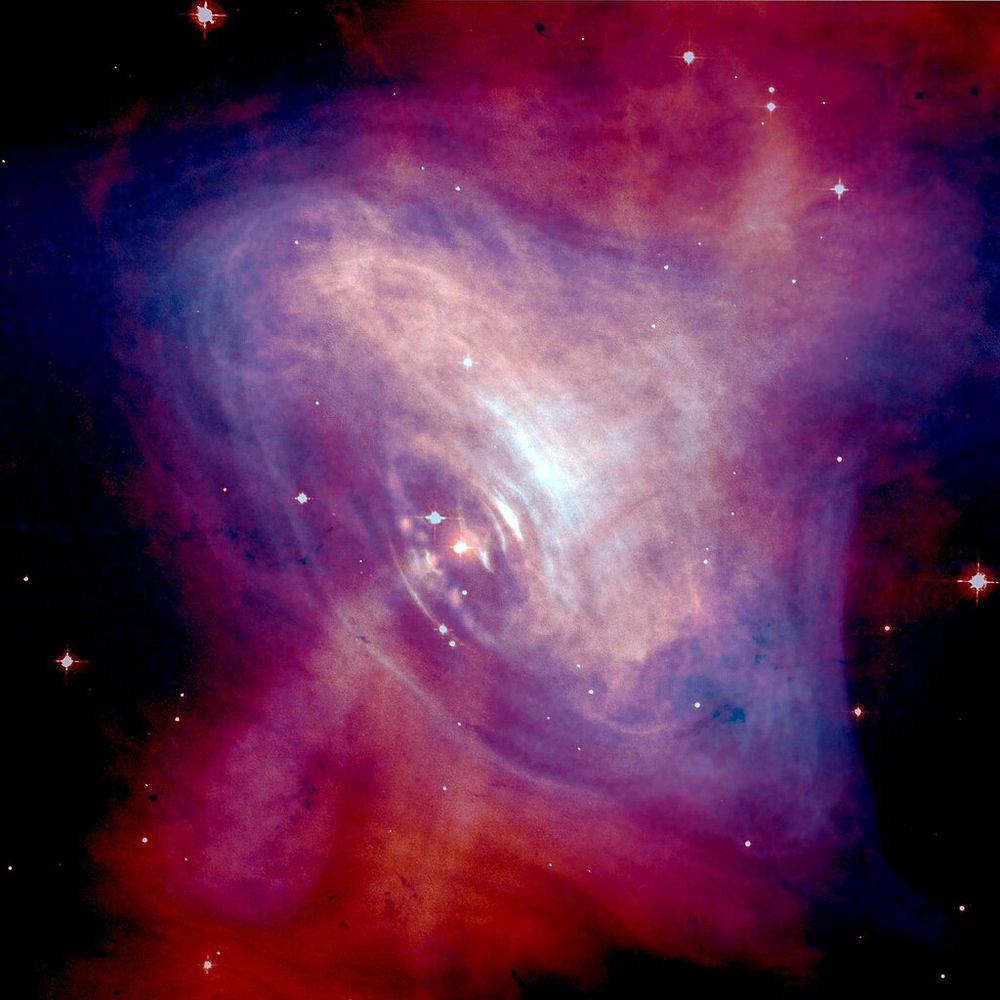
The Crab Nebula is active due to the high energy release of the pulsar, and its interior can change over a few days. The equatorial winds impact the surrounding area, forming a changing shock wave that eventually dissipates into the nebula.
March 10, 2025 at 3:26 PM
The Crab Nebula is active due to the high energy release of the pulsar, and its interior can change over a few days. The equatorial winds impact the surrounding area, forming a changing shock wave that eventually dissipates into the nebula.
To understand the supernova remnant, almost all telescopes are pointed at the Crab Nebula. Only NASA's IXPE studies X-ray polarization, a measure of the electromagnetic field. The Crab Nebula is bright in X-rays, and polarization reveals the direction and order of the magnetic field.

March 10, 2025 at 2:18 AM
To understand the supernova remnant, almost all telescopes are pointed at the Crab Nebula. Only NASA's IXPE studies X-ray polarization, a measure of the electromagnetic field. The Crab Nebula is bright in X-rays, and polarization reveals the direction and order of the magnetic field.
JWST captured the Milky Way satellite LMC and exposed the H II region "N79", whose chemical composition is similar to the universe billions of years ago, which may help study the early universe and distant galaxies.

March 9, 2025 at 5:25 PM
JWST captured the Milky Way satellite LMC and exposed the H II region "N79", whose chemical composition is similar to the universe billions of years ago, which may help study the early universe and distant galaxies.
The M74 Phantom Galaxy is known for its bizarre spiral arms and is located 32 million light-years away in the constellation Pisces, facing Earth. The Janeway Telescope is perfectly positioned to capture its structure and is adept at capturing traces of cosmic gas and dust.

March 9, 2025 at 2:06 AM
The M74 Phantom Galaxy is known for its bizarre spiral arms and is located 32 million light-years away in the constellation Pisces, facing Earth. The Janeway Telescope is perfectly positioned to capture its structure and is adept at capturing traces of cosmic gas and dust.
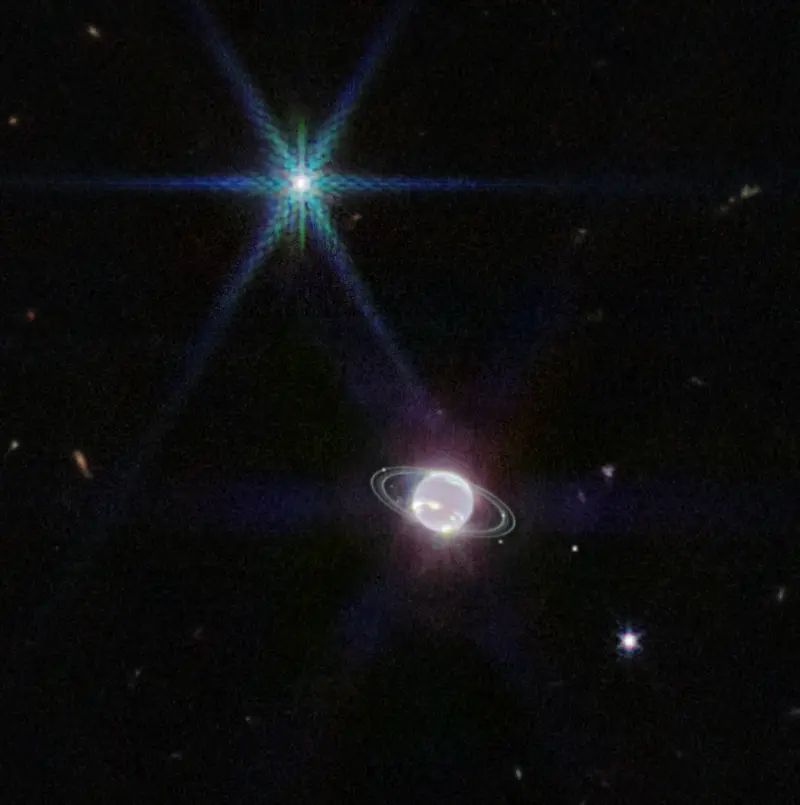
The Janeway Telescope explores the universe and observes planets. The precious photos include Neptune and its rings. The small white dots are its satellites, and the light shines on the largest satellite Triton. The light comes from the telescope's reflective system.
March 8, 2025 at 5:35 PM
The Janeway Telescope explores the universe and observes planets. The precious photos include Neptune and its rings. The small white dots are its satellites, and the light shines on the largest satellite Triton. The light comes from the telescope's reflective system.
Reposted by adela Shevchenko

“Multiple people familiar with the White House proposal said cuts to NASA's ‘Science Mission Directorate’ could be as high as 50 percent.”
arstechnica.com/space/2025/0...
arstechnica.com/space/2025/0...

White House may seek to slash NASA’s science budget by 50 percent
“It would be nothing short of an extinction-level event for space science.”…
arstechnica.com
March 8, 2025 at 1:42 AM
“Multiple people familiar with the White House proposal said cuts to NASA's ‘Science Mission Directorate’ could be as high as 50 percent.”
arstechnica.com/space/2025/0...
arstechnica.com/space/2025/0...
Not only can you see the faint rings around Jupiter, but you can also see two of Jupiter's satellites, Adrastea and Amalthea, on the far left of the rings. The fuzzy spots at the bottom of the photo are actually luminous galaxies in the distance.

March 8, 2025 at 1:07 AM
Not only can you see the faint rings around Jupiter, but you can also see two of Jupiter's satellites, Adrastea and Amalthea, on the far left of the rings. The fuzzy spots at the bottom of the photo are actually luminous galaxies in the distance.