


New video! Memorable for its delightfully absurd name, the Hairy Ball Theorem is extremely beautiful and has some surprising applications: youtu.be/BHdbsHFs2P0
January 31, 2026 at 3:36 PM
New video! Memorable for its delightfully absurd name, the Hairy Ball Theorem is extremely beautiful and has some surprising applications: youtu.be/BHdbsHFs2P0
The Ladybug Clock puzzle
January 20, 2026 at 3:20 PM
The Ladybug Clock puzzle
I had fun joining @peterrowlett.net and @steckl.es recently on their mathematical objects podcast, talking about my wood puzzle collection. Most of the time was spent struggling desperately to describe a highly visual topic in an audio-only context.
open.spotify.com/episode/0rRM...
open.spotify.com/episode/0rRM...
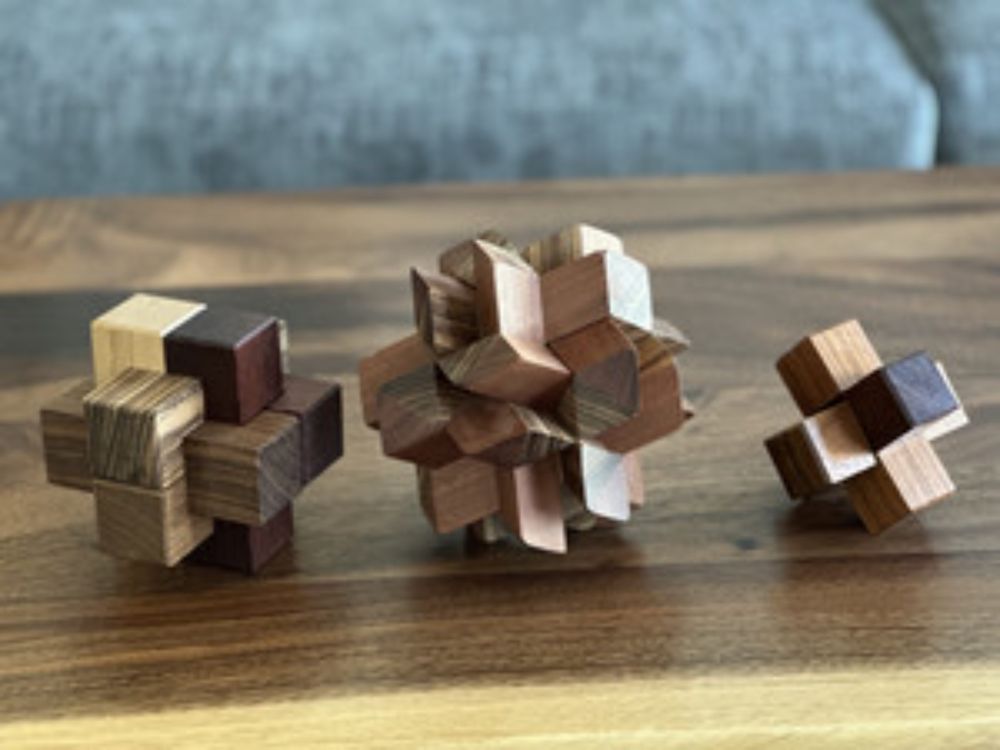
Mathematical Objects: 3D wooden puzzle with Grant Sanderson
open.spotify.com
November 7, 2025 at 2:23 PM
I had fun joining @peterrowlett.net and @steckl.es recently on their mathematical objects podcast, talking about my wood puzzle collection. Most of the time was spent struggling desperately to describe a highly visual topic in an audio-only context.
open.spotify.com/episode/0rRM...
open.spotify.com/episode/0rRM...
The next video in the Laplace Transform sequence is up!
youtu.be/FE-hM1kRK4Y
Here, we dig into a concrete example, the forced oscillator. Some of you may remember that this was relevant for studying why light slows down in a medium.
youtu.be/FE-hM1kRK4Y
Here, we dig into a concrete example, the forced oscillator. Some of you may remember that this was relevant for studying why light slows down in a medium.
November 5, 2025 at 1:37 PM
The next video in the Laplace Transform sequence is up!
youtu.be/FE-hM1kRK4Y
Here, we dig into a concrete example, the forced oscillator. Some of you may remember that this was relevant for studying why light slows down in a medium.
youtu.be/FE-hM1kRK4Y
Here, we dig into a concrete example, the forced oscillator. Some of you may remember that this was relevant for studying why light slows down in a medium.
Ever since I made a video about Fourier Transforms, one of the most requested topics on the channel has been its close cousin, the Laplace Transform.
I've been having a lot of fun animating a mini-series about this topic, and the main part is now out.
youtu.be/j0wJBEZdwLs
I've been having a lot of fun animating a mini-series about this topic, and the main part is now out.
youtu.be/j0wJBEZdwLs

But what is a Laplace Transform?
YouTube video by 3Blue1Brown
youtu.be
October 12, 2025 at 12:49 PM
Ever since I made a video about Fourier Transforms, one of the most requested topics on the channel has been its close cousin, the Laplace Transform.
I've been having a lot of fun animating a mini-series about this topic, and the main part is now out.
youtu.be/j0wJBEZdwLs
I've been having a lot of fun animating a mini-series about this topic, and the main part is now out.
youtu.be/j0wJBEZdwLs
In the fifth and final of a series of guest videos I've been posting, @BenSyversen delves into a question anybody who has had to do ruler and compass constructions in a geometry class may have wondered: What's the point?
September 18, 2025 at 2:24 PM
In the fifth and final of a series of guest videos I've been posting, @BenSyversen delves into a question anybody who has had to do ruler and compass constructions in a geometry class may have wondered: What's the point?
Much of Euclid’s Elements is easily misunderstood. Some proofs seem to have logical gaps. Some constructions seem pointless, others seem needlessly convoluted.
Each of these provides a window into how the ancient Greeks thought about math and the philosophical role that geometry played.
Each of these provides a window into how the ancient Greeks thought about math and the philosophical role that geometry played.

Why ruler and compass? | Guest video by @bensyversen
YouTube video by 3Blue1Brown
youtu.be
September 18, 2025 at 2:24 PM
Much of Euclid’s Elements is easily misunderstood. Some proofs seem to have logical gaps. Some constructions seem pointless, others seem needlessly convoluted.
Each of these provides a window into how the ancient Greeks thought about math and the philosophical role that geometry played.
Each of these provides a window into how the ancient Greeks thought about math and the philosophical role that geometry played.
New video about a piece by the modern artist Sol LeWitt, and the group theory behind it.
youtu.be/_BrFKp-U8GI
youtu.be/_BrFKp-U8GI
September 7, 2025 at 12:39 PM
New video about a piece by the modern artist Sol LeWitt, and the group theory behind it.
youtu.be/_BrFKp-U8GI
youtu.be/_BrFKp-U8GI
Guest video 3/5 while I'm on leave is now up! It's by a former SoME winner, covering key ideas in statistical mechanics to create a simple and discrete model mirroring the behavior of a fluid transitioning between a liquid and gaseous state. Enjoy!
youtu.be/itRV2jEtV8Q
youtu.be/itRV2jEtV8Q

Simulating Phase Change | Guest video by Vilas Winstein
YouTube video by 3Blue1Brown
youtu.be
August 28, 2025 at 2:21 PM
Guest video 3/5 while I'm on leave is now up! It's by a former SoME winner, covering key ideas in statistical mechanics to create a simple and discrete model mirroring the behavior of a fluid transitioning between a liquid and gaseous state. Enjoy!
youtu.be/itRV2jEtV8Q
youtu.be/itRV2jEtV8Q
Hey, psst, you can find early views for two upcoming guest videos on Patreon, one about statistical mechanics and another covering a story of modern art and group theory.
Notes on early releases are always helpful before finalizing a video.
www.patreon.com/posts/explor...
Notes on early releases are always helpful before finalizing a video.
www.patreon.com/posts/explor...

Exploration & Epiphany (Early view) | 3Blue1Brown
Get more from 3Blue1Brown on Patreon
www.patreon.com
August 23, 2025 at 6:01 PM
Hey, psst, you can find early views for two upcoming guest videos on Patreon, one about statistical mechanics and another covering a story of modern art and group theory.
Notes on early releases are always helpful before finalizing a video.
www.patreon.com/posts/explor...
Notes on early releases are always helpful before finalizing a video.
www.patreon.com/posts/explor...
For context, I knew I'd want to take some time away this year (paternity leave!), so I reached out to a few other creators whose work I respect and asked if they'd be interested in me commissioning a guest video during my absence. It's a pretty good lineup coming!
July 25, 2025 at 12:27 PM
For context, I knew I'd want to take some time away this year (paternity leave!), so I reached out to a few other creators whose work I respect and asked if they'd be interested in me commissioning a guest video during my absence. It's a pretty good lineup coming!
New video on the details of diffusion models: youtu.be/iv-5mZ_9CPY
Produced by Welch Labs, this is the first in a short series of 3b1b this summer. I enjoyed providing editorial feedback throughout the last several months, and couldn't be happier with the result.
Produced by Welch Labs, this is the first in a short series of 3b1b this summer. I enjoyed providing editorial feedback throughout the last several months, and couldn't be happier with the result.
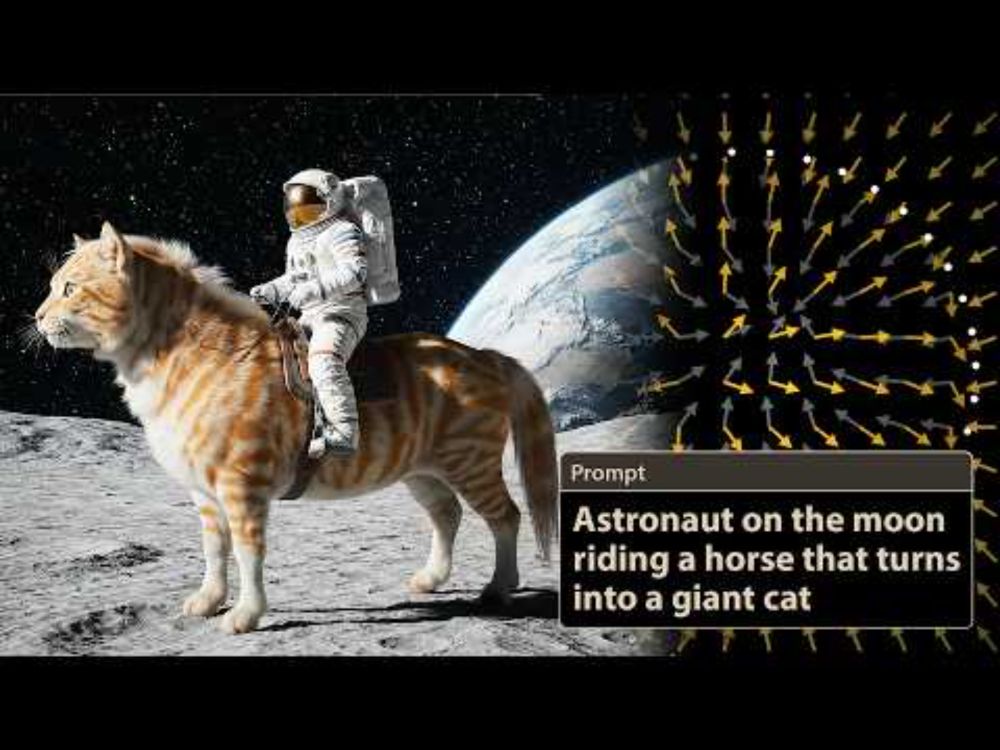
But how do AI videos actually work? | Guest video by @WelchLabsVideo
YouTube video by 3Blue1Brown
youtu.be
July 25, 2025 at 12:27 PM
New video on the details of diffusion models: youtu.be/iv-5mZ_9CPY
Produced by Welch Labs, this is the first in a short series of 3b1b this summer. I enjoyed providing editorial feedback throughout the last several months, and couldn't be happier with the result.
Produced by Welch Labs, this is the first in a short series of 3b1b this summer. I enjoyed providing editorial feedback throughout the last several months, and couldn't be happier with the result.
In the most recent video about quantum computing, I saw many comments expressing a similar point of confusion regarding Grover's algorithm.
I made a follow-up to (hopefully) clarify some of the issues and to address a few other under-emphasized points.
youtu.be/Dlsa9EBKDGI
I made a follow-up to (hopefully) clarify some of the issues and to address a few other under-emphasized points.
youtu.be/Dlsa9EBKDGI

Where my explanation of Grover’s algorithm failed
YouTube video by 3Blue1Brown
youtu.be
May 4, 2025 at 11:57 AM
In the most recent video about quantum computing, I saw many comments expressing a similar point of confusion regarding Grover's algorithm.
I made a follow-up to (hopefully) clarify some of the issues and to address a few other under-emphasized points.
youtu.be/Dlsa9EBKDGI
I made a follow-up to (hopefully) clarify some of the issues and to address a few other under-emphasized points.
youtu.be/Dlsa9EBKDGI
To get around the question P=NP, and whether some clever analysis of the gates could also reveal the answer, the framing here is to assume the only thing you can do with the function is try it out on inputs.
April 30, 2025 at 6:46 PM
To get around the question P=NP, and whether some clever analysis of the gates could also reveal the answer, the framing here is to assume the only thing you can do with the function is try it out on inputs.
That part of the video could have been better phrased. For any problem you'd want to use this for, you would know the gates, so it's not a black-box in that sense. But to have a catch-all stand-in example, I want to presume there's no insight you gain about the answer by analyzing those gates.
April 30, 2025 at 6:46 PM
That part of the video could have been better phrased. For any problem you'd want to use this for, you would know the gates, so it's not a black-box in that sense. But to have a catch-all stand-in example, I want to presume there's no insight you gain about the answer by analyzing those gates.
It's known you cannot do better than O(√N), which is certainly not as earth-shattering as an exponential speed-up would be, and questionably useful given the enormous overheads of quantum computing. Nonetheless, it's thought-provoking that such a thing is possible!
April 30, 2025 at 12:51 PM
It's known you cannot do better than O(√N), which is certainly not as earth-shattering as an exponential speed-up would be, and questionably useful given the enormous overheads of quantum computing. Nonetheless, it's thought-provoking that such a thing is possible!
If you translate this setup into a quantum computer (explained in the video), Grover's algorithm offers a "faster" way to do this, in that it's O(√N).
April 30, 2025 at 12:51 PM
If you translate this setup into a quantum computer (explained in the video), Grover's algorithm offers a "faster" way to do this, in that it's O(√N).
As a generic stand-in for the kind of problem it solves, suppose you have a function acting on {1, ..., N} which returns True on one and only one value in this set. If all you can do with this function is try it out on numbers, then it takes an average of (1/2)N steps to find the answer.
April 30, 2025 at 12:51 PM
As a generic stand-in for the kind of problem it solves, suppose you have a function acting on {1, ..., N} which returns True on one and only one value in this set. If all you can do with this function is try it out on numbers, then it takes an average of (1/2)N steps to find the answer.
What do they do then? This video builds up to Grover’s algorithm, a general method in quantum computing for finding solutions to any NP problem, i.e., anything where you have a quick way to verify solutions, even if finding them in the first place may be hard.
April 30, 2025 at 12:51 PM
What do they do then? This video builds up to Grover’s algorithm, a general method in quantum computing for finding solutions to any NP problem, i.e., anything where you have a quick way to verify solutions, even if finding them in the first place may be hard.
A common misconception about quantum computers is that they would solve hard problems by trying all possible solutions in parallel. This vaguely gestures at something true, but the reality is more subtle.
April 30, 2025 at 12:51 PM
A common misconception about quantum computers is that they would solve hard problems by trying all possible solutions in parallel. This vaguely gestures at something true, but the reality is more subtle.
New video! This covers the fundamentals of quantum computing and builds up to a step-by-step walk-through of an important algorithm in the field.
youtu.be/RQWpF2Gb-gU
youtu.be/RQWpF2Gb-gU
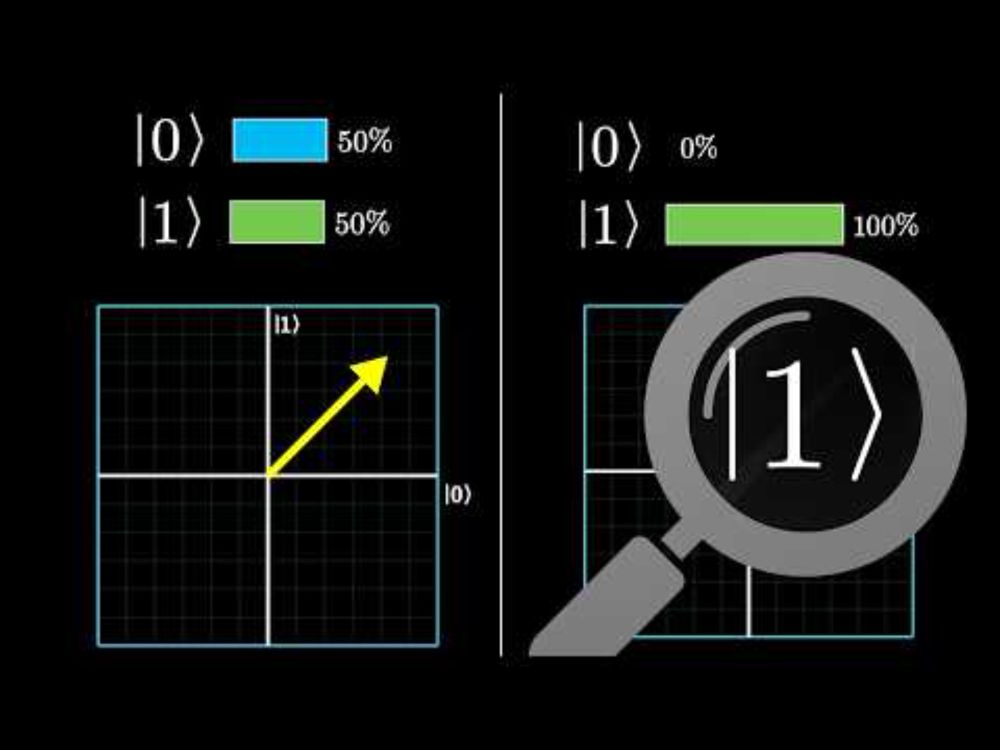
But what is Quantum Computing? (Grover's Algorithm)
YouTube video by 3Blue1Brown
youtu.be
April 30, 2025 at 12:51 PM
New video! This covers the fundamentals of quantum computing and builds up to a step-by-step walk-through of an important algorithm in the field.
youtu.be/RQWpF2Gb-gU
youtu.be/RQWpF2Gb-gU
I hope so too, the thought of a high school teacher using this idea for a lesson was a key motivator in the back of my mind.
March 13, 2025 at 5:53 PM
I hope so too, the thought of a high school teacher using this idea for a lesson was a key motivator in the back of my mind.
The most viewed thing I've ever made is a short about two colliding blocks computing π. I just made a new edition of the explanation for why π shows up there, setting things up for a (coming soon) follow-on connecting it to quantum computing.
youtu.be/6dTyOl1fmDo
youtu.be/6dTyOl1fmDo
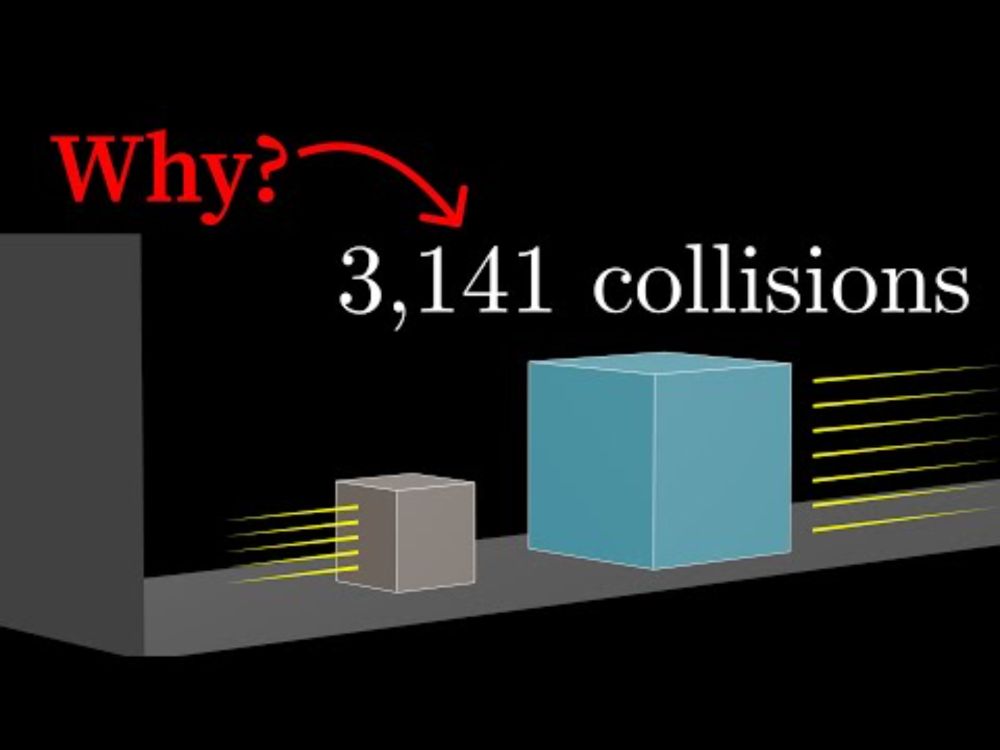
There's more to those colliding blocks computing pi
YouTube video by 3Blue1Brown
youtu.be
March 13, 2025 at 3:46 PM
The most viewed thing I've ever made is a short about two colliding blocks computing π. I just made a new edition of the explanation for why π shows up there, setting things up for a (coming soon) follow-on connecting it to quantum computing.
youtu.be/6dTyOl1fmDo
youtu.be/6dTyOl1fmDo
If you do this, you can reach out to the channel via this page. 3blue1brown.com/contact
Be sure to have a link to footage of the experiment. If anyone can get it to work with 100-to-1, I'd be happy, and if anyone can do it for 10,000-to-1, I'd be both delighted and amazed.
Be sure to have a link to footage of the experiment. If anyone can get it to work with 100-to-1, I'd be happy, and if anyone can do it for 10,000-to-1, I'd be both delighted and amazed.
February 26, 2025 at 5:30 PM
If you do this, you can reach out to the channel via this page. 3blue1brown.com/contact
Be sure to have a link to footage of the experiment. If anyone can get it to work with 100-to-1, I'd be happy, and if anyone can do it for 10,000-to-1, I'd be both delighted and amazed.
Be sure to have a link to footage of the experiment. If anyone can get it to work with 100-to-1, I'd be happy, and if anyone can do it for 10,000-to-1, I'd be both delighted and amazed.
More generally, with a mass ratio of N-to-1, the number of collisions is around π / arctan(1 / sqrt(N)). So any big mass ratio gives you an approximation of pi by multiplying the number of collisions by arctan(1/sqrt(N))
February 26, 2025 at 5:30 PM
More generally, with a mass ratio of N-to-1, the number of collisions is around π / arctan(1 / sqrt(N)). So any big mass ratio gives you an approximation of pi by multiplying the number of collisions by arctan(1/sqrt(N))