



@youngsuko9.bsky.social
PhD student at UCSD, biochemistry and molecular biophysics, working on bio+ml
Do you have any thoughts on ipsae_min/max when using Boltz? This figure was interesting bc for boltz, ipsae_max is better. I think min makes more intuitive sense but not sure what to make of the results here.
I would love to use AF3 ipsae_min, but the AF3 daily limits make it impractical.
I would love to use AF3 ipsae_min, but the AF3 daily limits make it impractical.

September 16, 2025 at 8:42 PM
Do you have any thoughts on ipsae_min/max when using Boltz? This figure was interesting bc for boltz, ipsae_max is better. I think min makes more intuitive sense but not sure what to make of the results here.
I would love to use AF3 ipsae_min, but the AF3 daily limits make it impractical.
I would love to use AF3 ipsae_min, but the AF3 daily limits make it impractical.
November 30, 2024 at 4:10 AM
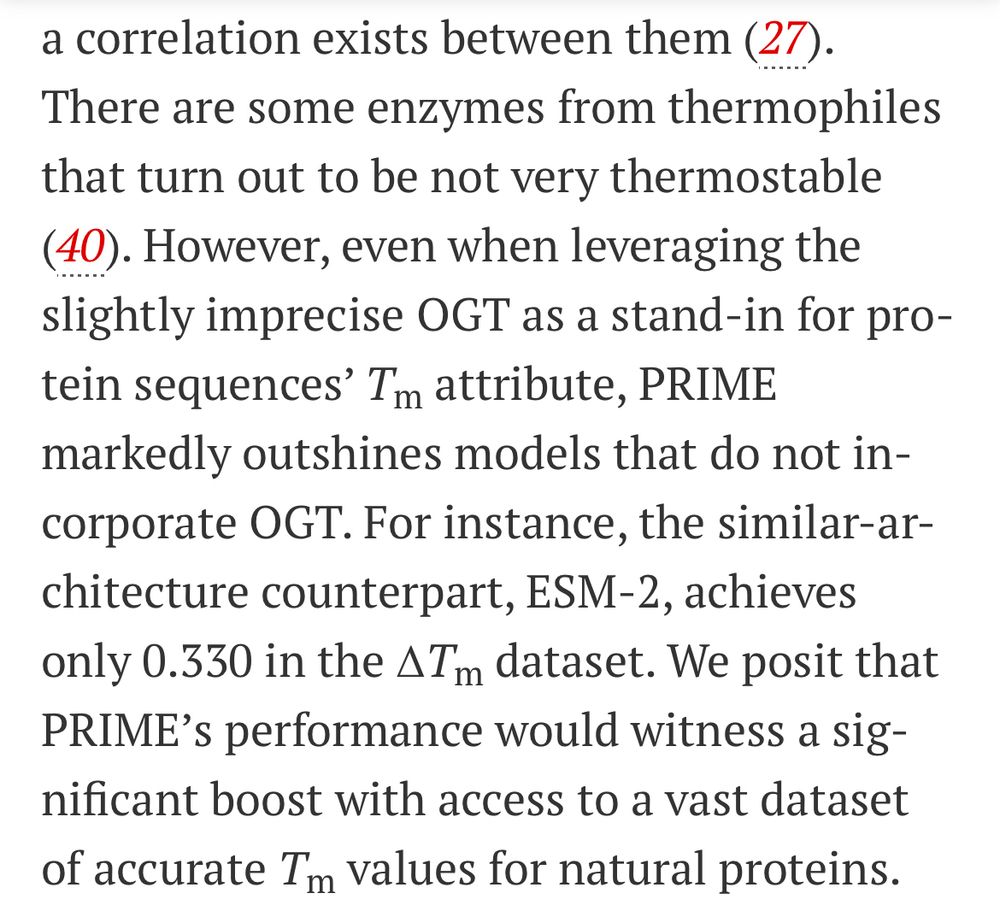
So OGT can act as a proxy for thermostability. I feel like there’s a lot of potential in trying to find viable proxies for other important properties. But finding these proxies seems non-trivial.
November 29, 2024 at 11:13 AM
So OGT can act as a proxy for thermostability. I feel like there’s a lot of potential in trying to find viable proxies for other important properties. But finding these proxies seems non-trivial.
I prefer mean-pooling bc saves a lot of disk space and felt faster to train. But I realized I mean-pool partially because I noticed that was the status-quo, without really asking why.
So, I have just been trying to figure out when and how using the [seq, dim] shaped embeddings can be good.
So, I have just been trying to figure out when and how using the [seq, dim] shaped embeddings can be good.
November 26, 2024 at 1:02 AM
I prefer mean-pooling bc saves a lot of disk space and felt faster to train. But I realized I mean-pool partially because I noticed that was the status-quo, without really asking why.
So, I have just been trying to figure out when and how using the [seq, dim] shaped embeddings can be good.
So, I have just been trying to figure out when and how using the [seq, dim] shaped embeddings can be good.
Does that still apply if you don't flatten the representation from the start? Like in this paper where the authors use [dim, seq len] embeddings as inputs to a model using 1d conv and attention mechanisms, and argue it can extract more info than mean-pool.
academic.oup.com/bioinformati...
academic.oup.com/bioinformati...

Light attention predicts protein location from the language of life
AbstractSummary. Although knowing where a protein functions in a cell is important to characterize biological processes, this information remains unavailab
academic.oup.com
November 26, 2024 at 1:01 AM
Does that still apply if you don't flatten the representation from the start? Like in this paper where the authors use [dim, seq len] embeddings as inputs to a model using 1d conv and attention mechanisms, and argue it can extract more info than mean-pool.
academic.oup.com/bioinformati...
academic.oup.com/bioinformati...
The paper mentions that embeddings need to be compressed for most downstream tasks.
If you aren’t concerned about the computational requirements, would you expect using the uncompressed embeddings as input to a model to be better than using compressed?
If you aren’t concerned about the computational requirements, would you expect using the uncompressed embeddings as input to a model to be better than using compressed?
November 26, 2024 at 12:22 AM
The paper mentions that embeddings need to be compressed for most downstream tasks.
If you aren’t concerned about the computational requirements, would you expect using the uncompressed embeddings as input to a model to be better than using compressed?
If you aren’t concerned about the computational requirements, would you expect using the uncompressed embeddings as input to a model to be better than using compressed?