



Yannan Zhu
@yannanzhu.bsky.social
studying memory, learning, and neuromodulation
phd student @duke
previously postbac researcher @yale
phd student @duke
previously postbac researcher @yale
Reposted by Yannan Zhu
🚨 New #Blueprint🚨 Ever wondered how the HPC supports learning across different contexts? My newest, a combo of experimental and comp neuro, w @SaraASolla & @DisterhoftLab, uncovers a 'universal' memory code in the HPC—consistent across animals and environments! 🧵👇
www.biorxiv.org/content/10.1...
www.biorxiv.org/content/10.1...

A universal hippocampal memory code across animals and environments
How learning is affected by context is a fundamental question of neuroscience, as the ability to generalize learning to different contexts is necessary for navigating the world. An example of swift co...
www.biorxiv.org
November 24, 2024 at 1:03 AM
🚨 New #Blueprint🚨 Ever wondered how the HPC supports learning across different contexts? My newest, a combo of experimental and comp neuro, w @SaraASolla & @DisterhoftLab, uncovers a 'universal' memory code in the HPC—consistent across animals and environments! 🧵👇
www.biorxiv.org/content/10.1...
www.biorxiv.org/content/10.1...
Reposted by Yannan Zhu
So excited to share my *first* first-author paper, out now in @cp-trendscognsci.bsky.social!! In this review, we argue that even if you don’t remember being a baby, evidence that infants form episodic-like memories is actually all around us: authors.elsevier.com/c/1l82g4sIRv...
authors.elsevier.com
May 21, 2025 at 10:33 PM
So excited to share my *first* first-author paper, out now in @cp-trendscognsci.bsky.social!! In this review, we argue that even if you don’t remember being a baby, evidence that infants form episodic-like memories is actually all around us: authors.elsevier.com/c/1l82g4sIRv...
Reposted by Yannan Zhu
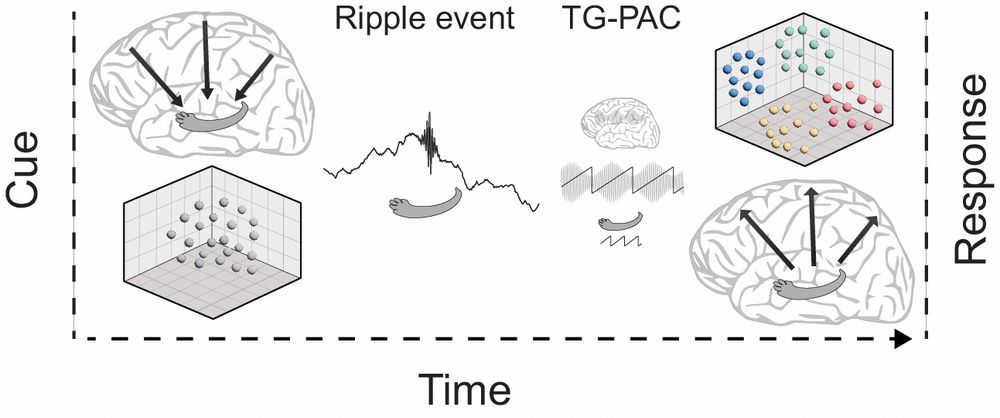
🧠✨How do we rebuild our memories? In our new study, we show that hippocampal ripples kickstart a coordinated expansion of cortical activity that helps reconstruct past experiences.
We recorded iEEG from patients during memory retrieval... and found something really cool 👇(thread)
We recorded iEEG from patients during memory retrieval... and found something really cool 👇(thread)
April 29, 2025 at 6:00 AM
🧠✨How do we rebuild our memories? In our new study, we show that hippocampal ripples kickstart a coordinated expansion of cortical activity that helps reconstruct past experiences.
We recorded iEEG from patients during memory retrieval... and found something really cool 👇(thread)
We recorded iEEG from patients during memory retrieval... and found something really cool 👇(thread)
Reposted by Yannan Zhu
Now out in Plos Computational Biology! We identified a generalizable neural signature of emotional arousal across contexts and individuals during movie watching.
work with the best team: @hayoungsong.bsky.social @Zihan Bai @monicarosenb.bsky.social @ycleong.bsky.social
dx.plos.org/10.1371/jour...
work with the best team: @hayoungsong.bsky.social @Zihan Bai @monicarosenb.bsky.social @ycleong.bsky.social
dx.plos.org/10.1371/jour...
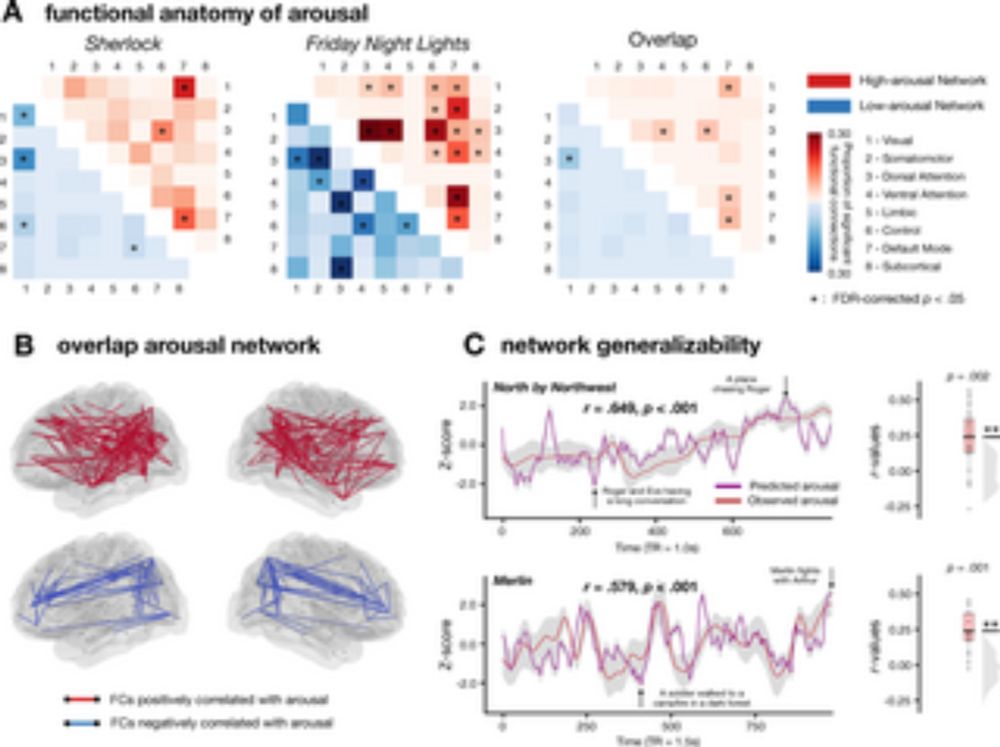
Dynamic brain connectivity predicts emotional arousal during naturalistic movie-watching
Author summary This study explores how the brain represents two key dimensions of emotional experience: valence (how positive or negative an experience feels) and arousal (the level of emotional activ...
dx.plos.org
April 17, 2025 at 3:41 PM
Now out in Plos Computational Biology! We identified a generalizable neural signature of emotional arousal across contexts and individuals during movie watching.
work with the best team: @hayoungsong.bsky.social @Zihan Bai @monicarosenb.bsky.social @ycleong.bsky.social
dx.plos.org/10.1371/jour...
work with the best team: @hayoungsong.bsky.social @Zihan Bai @monicarosenb.bsky.social @ycleong.bsky.social
dx.plos.org/10.1371/jour...
Reposted by Yannan Zhu
New preprint! Excited to share our latest work “Accelerated learning of a noninvasive human brain-computer interface via manifold geometry” ft. outstanding former undergraduate Chandra Fincke, @glajoie.bsky.social, @krishnaswamylab.bsky.social, and @wutsaiyale.bsky.social's Nick Turk-Browne 1/8

Accelerated learning of a noninvasive human brain-computer interface via manifold geometry
Brain-computer interfaces (BCIs) promise to restore and enhance a wide range of human capabilities. However, a barrier to the adoption of BCIs is how long it can take users to learn to control them. W...
doi.org
April 3, 2025 at 11:04 PM
New preprint! Excited to share our latest work “Accelerated learning of a noninvasive human brain-computer interface via manifold geometry” ft. outstanding former undergraduate Chandra Fincke, @glajoie.bsky.social, @krishnaswamylab.bsky.social, and @wutsaiyale.bsky.social's Nick Turk-Browne 1/8
Reposted by Yannan Zhu
Why do we not remember being a baby? One idea is that the hippocampus, which is essential for episodic memory in adults, is too immature to form individual memories in infancy. We tested this using awake infant fMRI, new in @science.org #ScienceResearch www.science.org/doi/10.1126/...
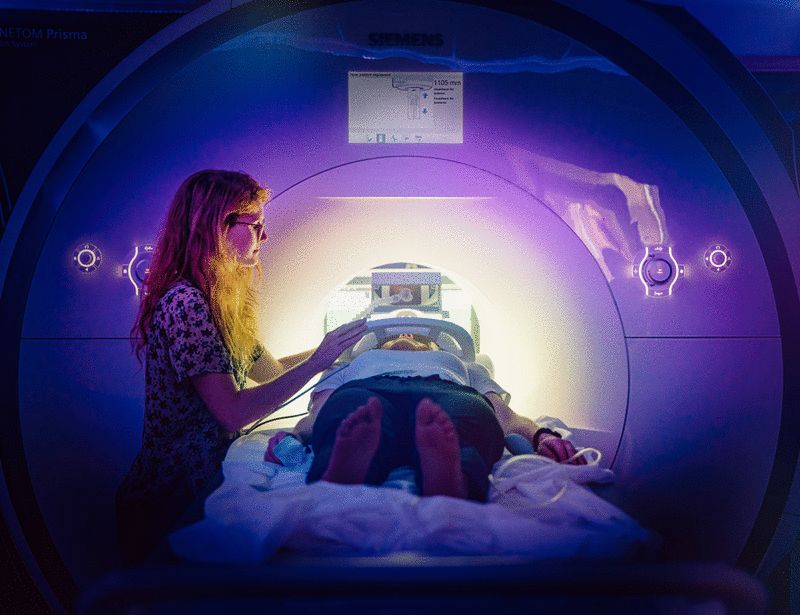
Hippocampal encoding of memories in human infants
Humans lack memories for specific events from the first few years of life. We investigated the mechanistic basis of this infantile amnesia by scanning the brains of awake infants with functional magne...
www.science.org
March 20, 2025 at 6:37 PM
Why do we not remember being a baby? One idea is that the hippocampus, which is essential for episodic memory in adults, is too immature to form individual memories in infancy. We tested this using awake infant fMRI, new in @science.org #ScienceResearch www.science.org/doi/10.1126/...
Reposted by Yannan Zhu
What factors impact the success of an awake infant fMRI scan? What can be done to maximize the data we collect from each infant?
In our new preprint, the Turk-Browne Lab and Saxe Lab combine our data from over 750 attempted scans to try to answer these questions:
www.biorxiv.org/content/10.1...
In our new preprint, the Turk-Browne Lab and Saxe Lab combine our data from over 750 attempted scans to try to answer these questions:
www.biorxiv.org/content/10.1...

Data retention in awake infant fMRI: Lessons from more than 750 scanning sessions
Functional magnetic resonance imaging (fMRI) in awake infants has the potential to reveal how the early developing brain gives rise to cognition and behavior. However, awake infant fMRI poses signific...
www.biorxiv.org
February 26, 2025 at 5:09 PM
What factors impact the success of an awake infant fMRI scan? What can be done to maximize the data we collect from each infant?
In our new preprint, the Turk-Browne Lab and Saxe Lab combine our data from over 750 attempted scans to try to answer these questions:
www.biorxiv.org/content/10.1...
In our new preprint, the Turk-Browne Lab and Saxe Lab combine our data from over 750 attempted scans to try to answer these questions:
www.biorxiv.org/content/10.1...