



Will Misener
@willmisener.bsky.social
Carnegie Postdoctoral Fellow at the Earth and Planets Lab in DC. PhD from UCLA EPSS. Researching exoplanet atmospheres 🪐. Also into baseball ⚾️ and trains 🚇. He/him
I am a professional astronomy researcher
August 7, 2025 at 12:33 PM
I am a professional astronomy researcher
It looks like Rutgers is sorted into NJ-12 (I'm not local, but from a map it looks like the district boundary goes through campus)
June 2, 2025 at 12:33 PM
It looks like Rutgers is sorted into NJ-12 (I'm not local, but from a map it looks like the district boundary goes through campus)
Lastly: this research, and in fact most of my PhD salary and tuition, was funded by federal NASA grants. I'm deeply grateful for the opportunity these funds have provided me to advance our knowledge of the universe. I hope dearly we will continue to give aspiring scientists that same chance. 10/10
February 27, 2025 at 11:20 PM
Lastly: this research, and in fact most of my PhD salary and tuition, was funded by federal NASA grants. I'm deeply grateful for the opportunity these funds have provided me to advance our knowledge of the universe. I hope dearly we will continue to give aspiring scientists that same chance. 10/10
I'm looking forward to thinking about what prospective compositions lead to what escape rates, and how this effect interacts with photoevaporation, the other mechanism thought to play a role in shaping sub-Neptunes. Thoughts welcome! 9/10
February 27, 2025 at 11:20 PM
I'm looking forward to thinking about what prospective compositions lead to what escape rates, and how this effect interacts with photoevaporation, the other mechanism thought to play a role in shaping sub-Neptunes. Thoughts welcome! 9/10
That means that sub-Neptunes will evolve differently depending on the exact upper atmosphere composition, even if they're always hydrogen-dominated. We find that the opacity ratios can make a difference between very little atmosphere being retained under core-powered mass loss, or nearly all. 8/10

February 27, 2025 at 11:20 PM
That means that sub-Neptunes will evolve differently depending on the exact upper atmosphere composition, even if they're always hydrogen-dominated. We find that the opacity ratios can make a difference between very little atmosphere being retained under core-powered mass loss, or nearly all. 8/10
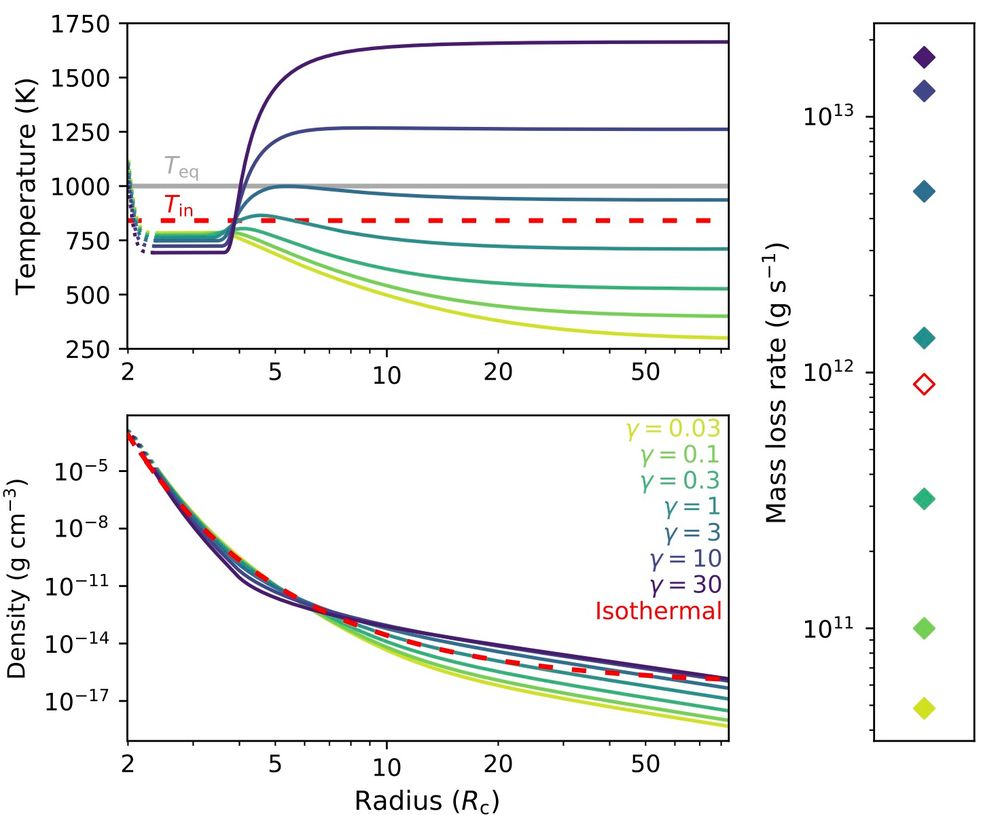
The difference in mass loss rates for different opacity ratios is biggest when the atmospheres are most contracted, with up to a factor of 10^10 in mass loss rate separating cold upper atmospheres from hot ones! We provide tabulated rates in case you'd like to use these numbers yourself. 7/10

February 27, 2025 at 11:20 PM
The difference in mass loss rates for different opacity ratios is biggest when the atmospheres are most contracted, with up to a factor of 10^10 in mass loss rate separating cold upper atmospheres from hot ones! We provide tabulated rates in case you'd like to use these numbers yourself. 7/10
What we found is that the opacities have big implications for escape from sub-Neptunes: hotter temperature profiles lead to more mass loss! The most important reason why is that the density falls off more slowly if the temperatures are higher, leading to higher escape rates. 6/10
February 27, 2025 at 11:20 PM
What we found is that the opacities have big implications for escape from sub-Neptunes: hotter temperature profiles lead to more mass loss! The most important reason why is that the density falls off more slowly if the temperatures are higher, leading to higher escape rates. 6/10
To account for this, we implemented core-powered mass loss in aiolos, a 1D hydrodynamic radiative transfer code, for the first time. This allowed us to calculate the escape rates and profiles self-consistently, and in doing so test the analytic approximations previous work had used. 5/10
February 27, 2025 at 11:20 PM
To account for this, we implemented core-powered mass loss in aiolos, a 1D hydrodynamic radiative transfer code, for the first time. This allowed us to calculate the escape rates and profiles self-consistently, and in doing so test the analytic approximations previous work had used. 5/10
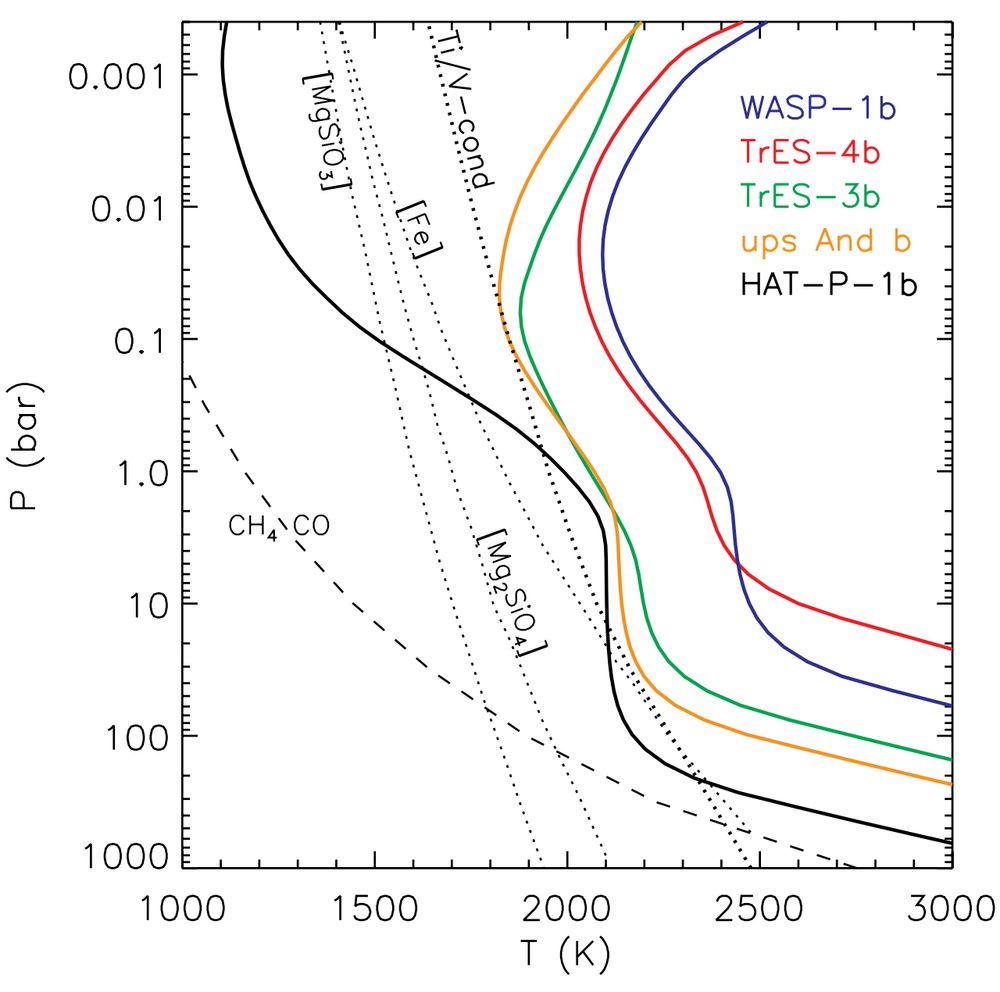
If the ratio (termed gamma) is near 1, then the atmosphere is roughly isothermal, but if it's not, you can get cool stratospheres or thermal inversions. This won't come as news to a lot of exoplaneteers, as we've long seen evidence for the phenomenon in atmospheric spectra! 4/10
February 27, 2025 at 11:20 PM
If the ratio (termed gamma) is near 1, then the atmosphere is roughly isothermal, but if it's not, you can get cool stratospheres or thermal inversions. This won't come as news to a lot of exoplaneteers, as we've long seen evidence for the phenomenon in atmospheric spectra! 4/10
But whether the outer atmosphere actually is isothermal depends on the actual opacities. More specifically, it depends on whether the atmosphere is more opaque to incident stellar light or to outgoing thermal infrared. These in turn depend on the actual composition of the atmosphere. 3/10
February 27, 2025 at 11:20 PM
But whether the outer atmosphere actually is isothermal depends on the actual opacities. More specifically, it depends on whether the atmosphere is more opaque to incident stellar light or to outgoing thermal infrared. These in turn depend on the actual composition of the atmosphere. 3/10
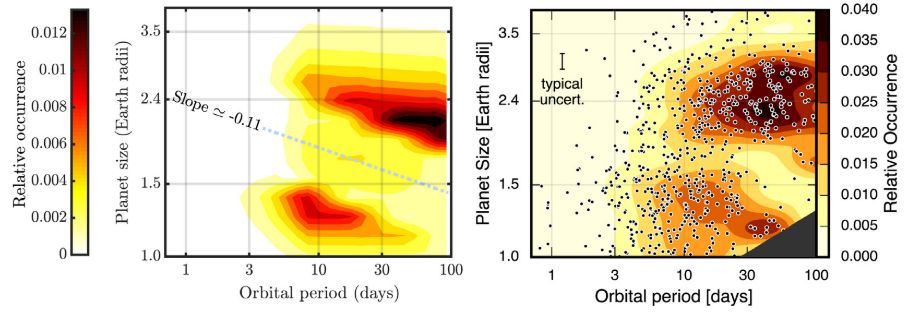
Core-powered mass loss, one of the mechanisms that can explain the radius valley separating the super-Earths and sub-Neptunes, has always been modeled using an analytic escape rate calculation, called a Parker wind, that assumed the outer atmosphere was isothermal at the equilibrium temperature 2/10
February 27, 2025 at 11:20 PM
Core-powered mass loss, one of the mechanisms that can explain the radius valley separating the super-Earths and sub-Neptunes, has always been modeled using an analytic escape rate calculation, called a Parker wind, that assumed the outer atmosphere was isothermal at the equilibrium temperature 2/10
Makes sense! It seems like the numbers might get really big quickly if there are a lot of false positives though (which I suppose doesn't really matter except for aesthetics lol).
October 1, 2023 at 5:58 AM
Makes sense! It seems like the numbers might get really big quickly if there are a lot of false positives though (which I suppose doesn't really matter except for aesthetics lol).
What's been confusing/bothering me is, how come when the planets get confirmed, they stay as TOIs and don't become TESS-1 b or whatever, like how KOI-157.01 -> Kepler-11 c? Was there a reason for this? I guess it's fewer numbers to keep track of...
September 28, 2023 at 10:52 PM
What's been confusing/bothering me is, how come when the planets get confirmed, they stay as TOIs and don't become TESS-1 b or whatever, like how KOI-157.01 -> Kepler-11 c? Was there a reason for this? I guess it's fewer numbers to keep track of...