




Tim Viney
@vineytj.bsky.social
Associate Professor of Neuroscience @ Dept. Pharmacology, University of Oxford.
Spatial memory, cell types, amyloids, dementia, brain rhythms.
https://scholar.google.com/citations?hl=en&user=tgCeCVwAAAAJ&view_op=list_works&sortby=pubdate
Spatial memory, cell types, amyloids, dementia, brain rhythms.
https://scholar.google.com/citations?hl=en&user=tgCeCVwAAAAJ&view_op=list_works&sortby=pubdate
We conclude that selective accumulation of ptau in the anterodorsal thalamic nucleus disrupts head direction signaling, leading a change in orienting behaviour during initial spatial learning.
Dysfunction of thalamic head direction cells may be a 'preclinical' cognitive biomarker of dementia
Dysfunction of thalamic head direction cells may be a 'preclinical' cognitive biomarker of dementia

November 21, 2025 at 11:59 PM
We conclude that selective accumulation of ptau in the anterodorsal thalamic nucleus disrupts head direction signaling, leading a change in orienting behaviour during initial spatial learning.
Dysfunction of thalamic head direction cells may be a 'preclinical' cognitive biomarker of dementia
Dysfunction of thalamic head direction cells may be a 'preclinical' cognitive biomarker of dementia
***Publication alert***
"Pathological tau alters head direction signaling and induces spatial orientation"
www.cell.com/cell-reports...
"Pathological tau alters head direction signaling and induces spatial orientation"
www.cell.com/cell-reports...

November 21, 2025 at 11:59 PM
***Publication alert***
"Pathological tau alters head direction signaling and induces spatial orientation"
www.cell.com/cell-reports...
"Pathological tau alters head direction signaling and induces spatial orientation"
www.cell.com/cell-reports...
Type III HD cells were highly unusual as they avoided the TRN and projected ventrally to the cortex. These cells had distinctive twisted dendrites, were CR+, and were located in the dorsomedial ADn.
10/11
10/11

September 15, 2025 at 3:13 PM
Type III HD cells were highly unusual as they avoided the TRN and projected ventrally to the cortex. These cells had distinctive twisted dendrites, were CR+, and were located in the dorsomedial ADn.
10/11
10/11
We found 3 types of projection patterns: type I HD cells formed collaterals in the thalamic reticular nucleus (TRN) and cortex, projecting via the striatum and cingulum bundle. Type II HD cells additionally innervated the dorsomedial striatum.
9/11
9/11

September 15, 2025 at 3:13 PM
We found 3 types of projection patterns: type I HD cells formed collaterals in the thalamic reticular nucleus (TRN) and cortex, projecting via the striatum and cingulum bundle. Type II HD cells additionally innervated the dorsomedial striatum.
9/11
9/11
We found a mediolateral gradient of calretinin (CR)-expressing HD cells, with CR+ cells tending to have narrower HD tuning widths, lower firing rates, and produced fewer spikes during rebound bursts compared to CR- cells.
8/11
8/11

September 15, 2025 at 3:13 PM
We found a mediolateral gradient of calretinin (CR)-expressing HD cells, with CR+ cells tending to have narrower HD tuning widths, lower firing rates, and produced fewer spikes during rebound bursts compared to CR- cells.
8/11
8/11
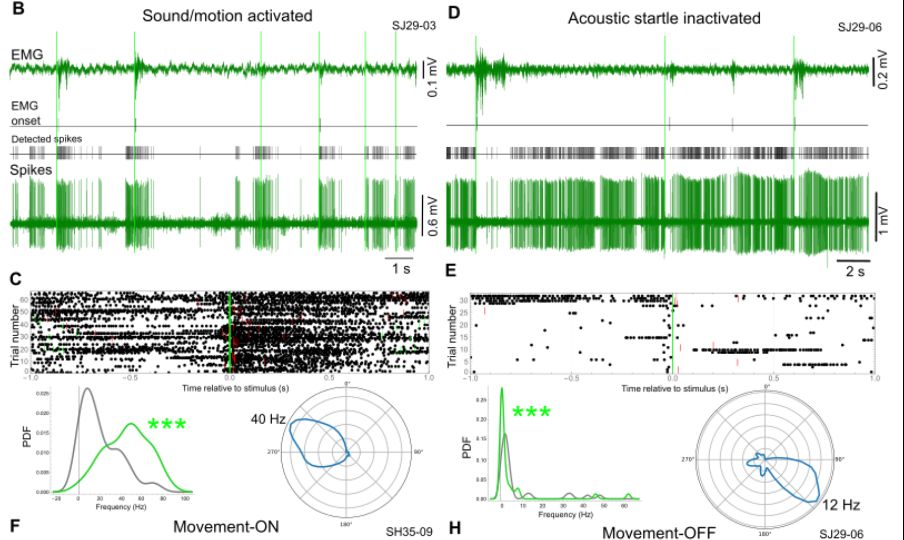
We confirmed that HD cells could respond to sound stimuli, but found that not all cells were responsive, suggesting cell-type-specificity. Also, some sound-responsive cells were ‘boosted’ by muscle twitches. Other HD cells strongly increased or decreased firing during running periods.
7/11
7/11
September 15, 2025 at 3:13 PM
We confirmed that HD cells could respond to sound stimuli, but found that not all cells were responsive, suggesting cell-type-specificity. Also, some sound-responsive cells were ‘boosted’ by muscle twitches. Other HD cells strongly increased or decreased firing during running periods.
7/11
7/11
We recorded HD cells with a range of short-latency responses to light pulses e.g. ‘ON inhibition OFF excitation’, or ‘ON excitation’. We suggest these patterns could help anchor various allocentric cues.
6/11
6/11

September 15, 2025 at 3:13 PM
We recorded HD cells with a range of short-latency responses to light pulses e.g. ‘ON inhibition OFF excitation’, or ‘ON excitation’. We suggest these patterns could help anchor various allocentric cues.
6/11
6/11
We used single neuron extracellular recordings and juxtacellular labelling to define the firing patterns, neurochemical profiles, and connectivity of individual HD cells in the ADn of awake mice.
5/11
5/11

September 15, 2025 at 3:13 PM
We used single neuron extracellular recordings and juxtacellular labelling to define the firing patterns, neurochemical profiles, and connectivity of individual HD cells in the ADn of awake mice.
5/11
5/11
Have you ever wondered how you know which direction you are facing? This is to do with specialised neurons in the brain known as head direction (HD) cells, which are fundamental for spatial navigation.
(Image from Taube 2024 doi.org/10.1002/hipo...)
2/11
(Image from Taube 2024 doi.org/10.1002/hipo...)
2/11

September 15, 2025 at 3:13 PM
Have you ever wondered how you know which direction you are facing? This is to do with specialised neurons in the brain known as head direction (HD) cells, which are fundamental for spatial navigation.
(Image from Taube 2024 doi.org/10.1002/hipo...)
2/11
(Image from Taube 2024 doi.org/10.1002/hipo...)
2/11
One of my favourite markers: vimentin (tested in post-mortem human cortex)

April 4, 2025 at 9:58 AM
One of my favourite markers: vimentin (tested in post-mortem human cortex)
Congratulations to all authors on this extensive and detailed dataset - especially to Peter Somogyi, Istvan Lukacs and Emily Hunter who rigorously defined each cell - see the paper for their beautiful reconstructions (including an axo-axonic cell that lacked CB1 receptor - see image)

January 15, 2025 at 12:47 PM
Congratulations to all authors on this extensive and detailed dataset - especially to Peter Somogyi, Istvan Lukacs and Emily Hunter who rigorously defined each cell - see the paper for their beautiful reconstructions (including an axo-axonic cell that lacked CB1 receptor - see image)
One quarter of GABAergic CB1 immunopositive nerve terminals also express the type 3 vesicular glutamate transporter (VGLUT3). VGLUT3 is present in a subpopulation of VGLUT1 expressing glutamatergic nerve terminals of unknown origin innervating dendritic spines.

January 15, 2025 at 12:43 PM
One quarter of GABAergic CB1 immunopositive nerve terminals also express the type 3 vesicular glutamate transporter (VGLUT3). VGLUT3 is present in a subpopulation of VGLUT1 expressing glutamatergic nerve terminals of unknown origin innervating dendritic spines.
In the human cerebral cortex, GABAergic boutons originating from diverse presynaptic cell types, some expressing CB1 cannabinoid receptor, make synapses mainly with dendritic shafts and spines.

January 15, 2025 at 12:43 PM
In the human cerebral cortex, GABAergic boutons originating from diverse presynaptic cell types, some expressing CB1 cannabinoid receptor, make synapses mainly with dendritic shafts and spines.
Synaptic Targets and Cellular Sources of CB1 Receptor and VGLUT3 Expressing Nerve Terminals in Relation to GABAergic Neurons in the Human Cerebral Cortex
doi.org/10.1111/ejn....
Delighted that this paper is out - includes n=120 tested interneurons that were recorded and labelled in human cortex
doi.org/10.1111/ejn....
Delighted that this paper is out - includes n=120 tested interneurons that were recorded and labelled in human cortex

January 15, 2025 at 12:43 PM
Synaptic Targets and Cellular Sources of CB1 Receptor and VGLUT3 Expressing Nerve Terminals in Relation to GABAergic Neurons in the Human Cerebral Cortex
doi.org/10.1111/ejn....
Delighted that this paper is out - includes n=120 tested interneurons that were recorded and labelled in human cortex
doi.org/10.1111/ejn....
Delighted that this paper is out - includes n=120 tested interneurons that were recorded and labelled in human cortex
A striking example of similar patterns but at massively different scales. Left, a star orbited by exoplanets taken by ESO’s Very Large Telescope (Bohn et al. www.eso.org/public/irela...). Right, β-amyloid42 immunoreactivity in human cerebral cortex (B. Sarkany and T. Viney, University of Oxford)

December 18, 2024 at 11:27 AM
A striking example of similar patterns but at massively different scales. Left, a star orbited by exoplanets taken by ESO’s Very Large Telescope (Bohn et al. www.eso.org/public/irela...). Right, β-amyloid42 immunoreactivity in human cerebral cortex (B. Sarkany and T. Viney, University of Oxford)
Neurobiotin, drawn by Dr Lizzie Burns. This synthetic #molecule is a derivative of biotin (vitamin B7). It can be delivered into single #brain cells in order to study their architecture and trace the fine processes within and across brain regions, revealing hidden details of the nervous system.

December 14, 2024 at 10:49 PM
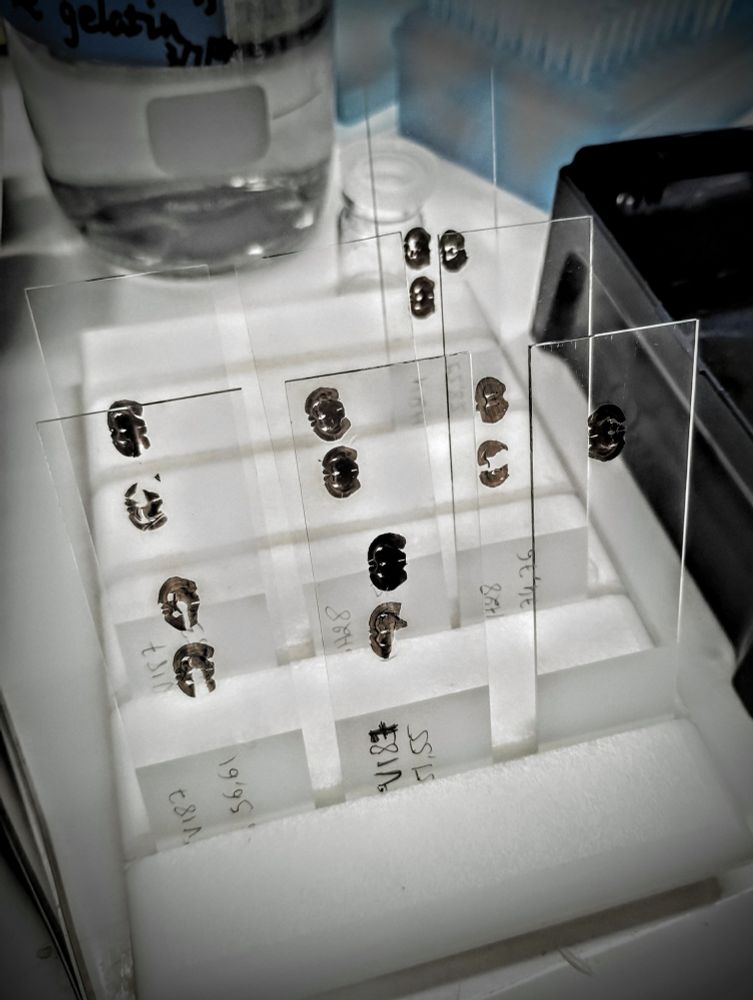
Some precious mouse brain sections currently being processed with diaminobenzidine to follow axons of juxtacellularly labelled cells.
November 27, 2024 at 1:28 PM
Some precious mouse brain sections currently being processed with diaminobenzidine to follow axons of juxtacellularly labelled cells.