




Valeh Valiollah Pour Amiri
@valehamiri.bsky.social
PhD student Genetics+CS @Stanford w/ @anshulkundaje.bsky.social | Prev CS @telecomparis @Columbia @Microsoft | I'm interested in using AI/ML to model biological systems 👩🏻💻🧬☕ | valehamiri.com
Reposted by Valeh Valiollah Pour Amiri
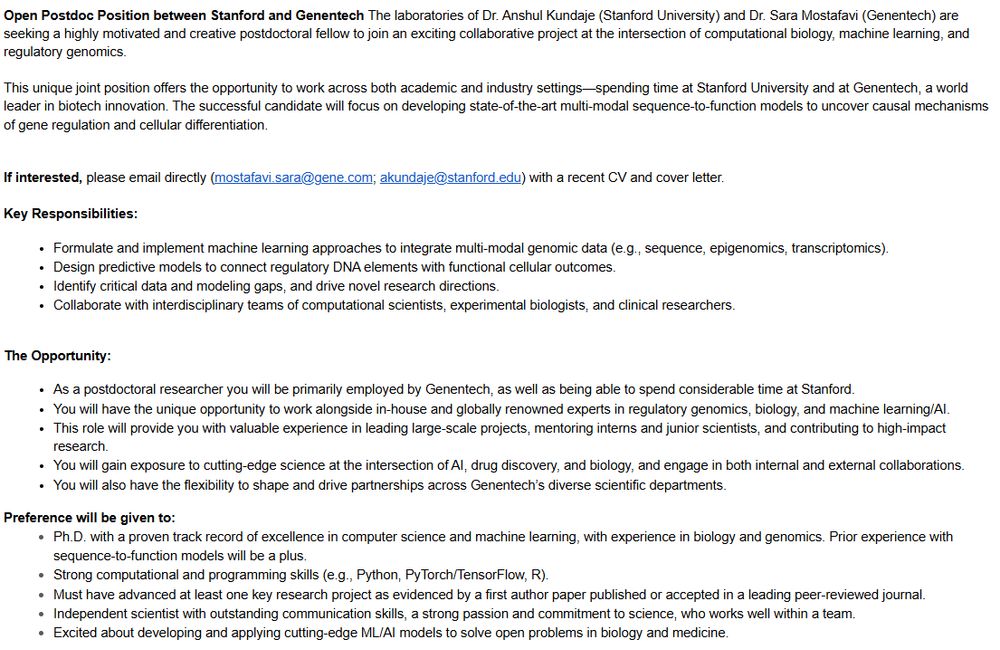
@saramostafavi.bsky.social (@Genentech) & I (@Stanford) r excited to announce co-advised postdoc positions for candidates with deep expertise in ML for bio (especially sequence to function models, causal perturbational models & single cell models). See details below. Pls RT 1/
June 19, 2025 at 8:55 PM
@saramostafavi.bsky.social (@Genentech) & I (@Stanford) r excited to announce co-advised postdoc positions for candidates with deep expertise in ML for bio (especially sequence to function models, causal perturbational models & single cell models). See details below. Pls RT 1/
Reposted by Valeh Valiollah Pour Amiri
Disease diagnostics using machine learning of B cell and T cell receptor sequences
www.science.org/doi/10.1126/...
TL;DR: BCRs ARE ALL YOU NEED!
(Well actually .... keep reading) 1/
www.science.org/doi/10.1126/...
TL;DR: BCRs ARE ALL YOU NEED!
(Well actually .... keep reading) 1/

Disease diagnostics using machine learning of B cell and T cell receptor sequences
Clinical diagnosis typically incorporates physical examination, patient history, various laboratory tests, and imaging studies but makes limited use of the human immune system’s own record of antigen ...
www.science.org
February 21, 2025 at 1:12 AM
Disease diagnostics using machine learning of B cell and T cell receptor sequences
www.science.org/doi/10.1126/...
TL;DR: BCRs ARE ALL YOU NEED!
(Well actually .... keep reading) 1/
www.science.org/doi/10.1126/...
TL;DR: BCRs ARE ALL YOU NEED!
(Well actually .... keep reading) 1/
Reposted by Valeh Valiollah Pour Amiri

This was a really fun collaboration with @amarderstein.bsky.social where we explored some of the interesting relationships between context-specific non-coding variant effects, disease, and evolution using deep learning models of chromatin accessibility in the brain and heart.
New preprint w/ @soumyakundu.bsky.social @sbmontgom.bsky.social @anshulkundaje.bsky.social !
Using deep learning & scATAC-seq, we studied context-specific variants in disease & evolution, and introduce FLARE for de novo mutations—w/ application to autism-affected families.
doi.org/10.1101/2025...
Using deep learning & scATAC-seq, we studied context-specific variants in disease & evolution, and introduce FLARE for de novo mutations—w/ application to autism-affected families.
doi.org/10.1101/2025...
Mapping the regulatory effects of common and rare non-coding variants across cellular and developmental contexts in the brain and heart
Whole genome sequencing has identified over a billion non-coding variants in humans, while GWAS has revealed the non-coding genome as a significant contributor to disease. However, prioritizing causal...
www.biorxiv.org
February 19, 2025 at 7:11 PM
This was a really fun collaboration with @amarderstein.bsky.social where we explored some of the interesting relationships between context-specific non-coding variant effects, disease, and evolution using deep learning models of chromatin accessibility in the brain and heart.
Truly upsetting. That this is considered “usual”, as most comments indicate, is all the more disappointing. What will it take to reverse the trend? When will it be considered UNusual when women are not credited for their work?

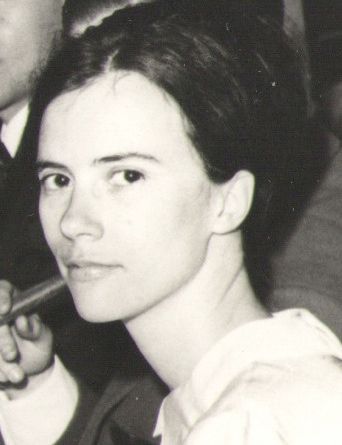
Do you know Daisy Roulland-Dussoix? She is one of the discoverers of restriction enzymes, who’s findings paved the way for the development of recombinant DNA and cloning technologies. Accordingly, the finding was rewarded with a #NobelPrize. But the prize didn’t go to her.
🧵👇
🧵👇
February 3, 2025 at 3:41 AM
Truly upsetting. That this is considered “usual”, as most comments indicate, is all the more disappointing. What will it take to reverse the trend? When will it be considered UNusual when women are not credited for their work?
Reposted by Valeh Valiollah Pour Amiri

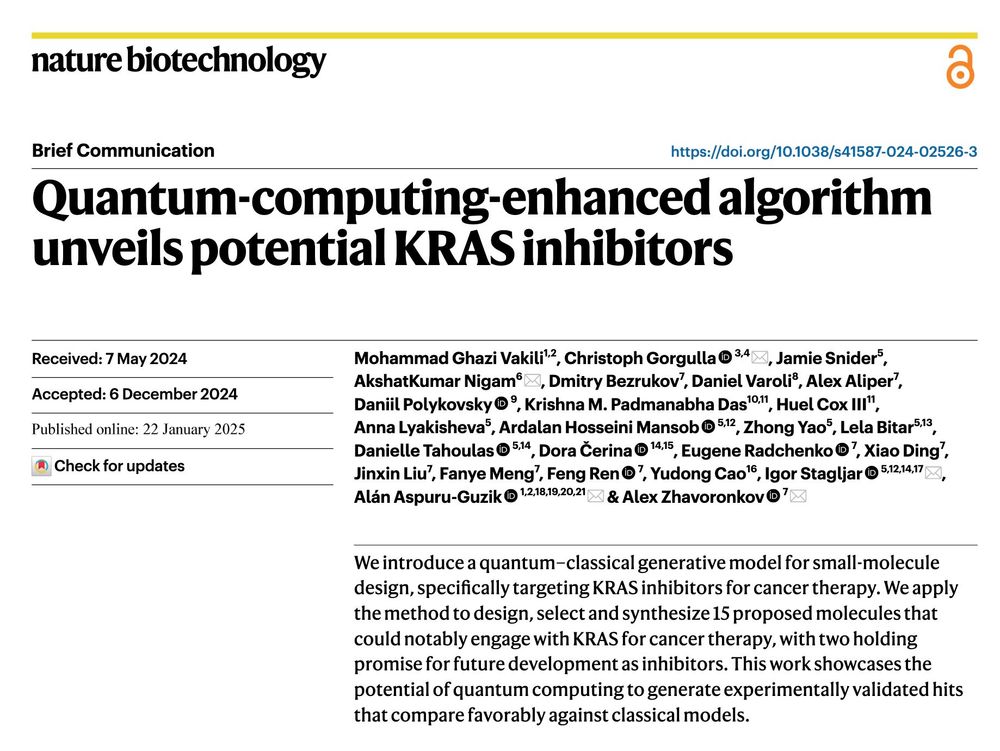
Excited to share our latest work, published this morning in Nature Biotechnology! 🎉 We developed a hybrid quantum computing-enhanced generative model to design KRAS inhibitors. Check it out here: rdcu.be/d68Fs.
Some fascinating insights along the way:
Some fascinating insights along the way:
January 22, 2025 at 8:17 PM
Excited to share our latest work, published this morning in Nature Biotechnology! 🎉 We developed a hybrid quantum computing-enhanced generative model to design KRAS inhibitors. Check it out here: rdcu.be/d68Fs.
Some fascinating insights along the way:
Some fascinating insights along the way:
Reposted by Valeh Valiollah Pour Amiri
@anusri.bsky.social first author & developer of ChromBPNet is looking for opportunities in industry in ML for bio/genomics. She is an excellent rigorous scientist (as u can see from the paper). Very strongly recommend her. Plz reach out to her if u have openings. Plz forward.
Our original biorxiv submission of the ChromBPNet preprint had issues with supp. methods & file links not working (even though we they were uploaded). This updated version has fixed those issues. Everything shud be available now. Thanks for your patience.
www.biorxiv.org/content/10.1...
www.biorxiv.org/content/10.1...
January 13, 2025 at 6:23 PM
@anusri.bsky.social first author & developer of ChromBPNet is looking for opportunities in industry in ML for bio/genomics. She is an excellent rigorous scientist (as u can see from the paper). Very strongly recommend her. Plz reach out to her if u have openings. Plz forward.
Reposted by Valeh Valiollah Pour Amiri
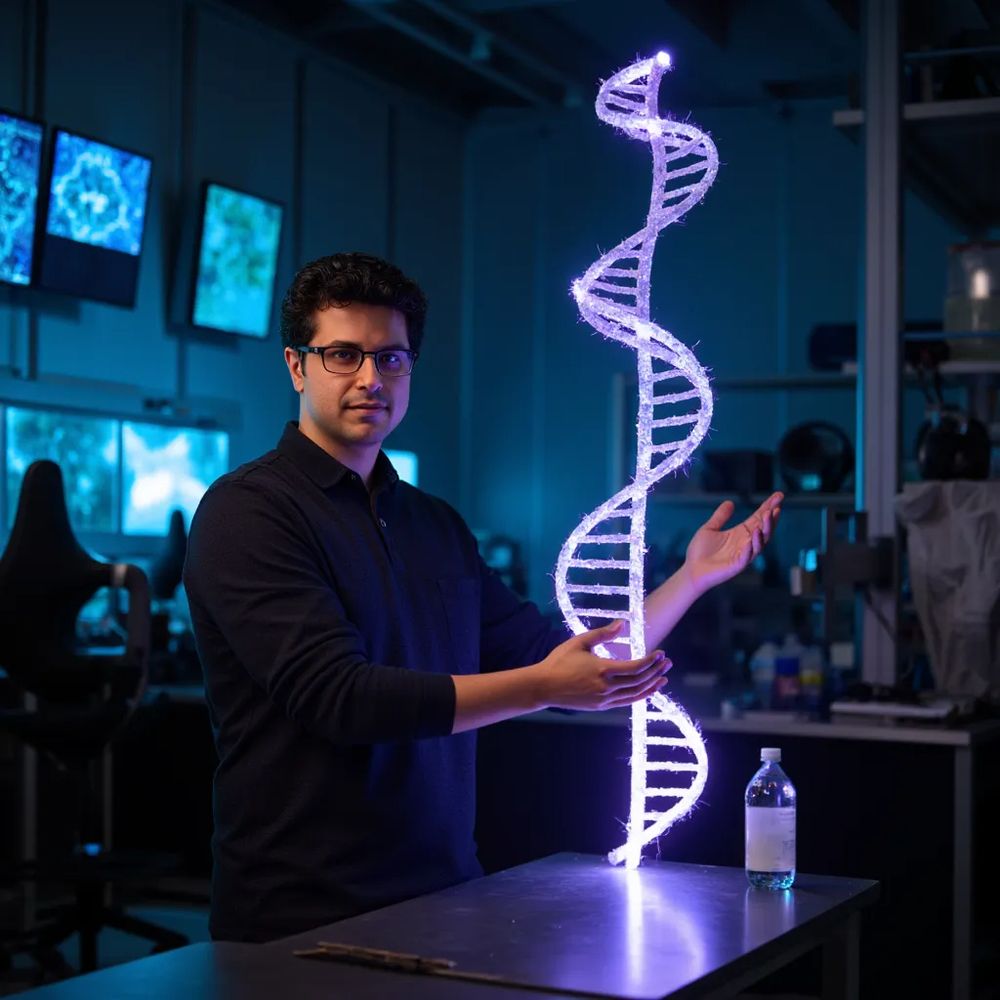
A month ago we @vevotherapeutics.bsky.social announced that we have generated the largest single-cell perturbation atlas in history, Tahoe-100M. Today, we announce that we will fully open-source Tahoe-100M in Feb, as part of a collaboration with NVidia health to train cell state models.
January 13, 2025 at 4:23 PM
A month ago we @vevotherapeutics.bsky.social announced that we have generated the largest single-cell perturbation atlas in history, Tahoe-100M. Today, we announce that we will fully open-source Tahoe-100M in Feb, as part of a collaboration with NVidia health to train cell state models.
Reposted by Valeh Valiollah Pour Amiri
Very excited to announce that the single cell/nuc. RNA/ATAC/multi-ome resource from ENCODE4 is now officially public. This includes raw data, processed data, annotations and pseudobulk products. Covers many human & mouse tissues. 1/
www.encodeproject.org/single-cell/...
www.encodeproject.org/single-cell/...
Single cell – ENCODEHomo sapiens clickable body map
www.encodeproject.org
January 7, 2025 at 9:29 PM
Very excited to announce that the single cell/nuc. RNA/ATAC/multi-ome resource from ENCODE4 is now officially public. This includes raw data, processed data, annotations and pseudobulk products. Covers many human & mouse tissues. 1/
www.encodeproject.org/single-cell/...
www.encodeproject.org/single-cell/...
Reposted by Valeh Valiollah Pour Amiri
The first preprint of 2025! Together with Matvei, @halfacrocodile.bsky.social, & our amazing team, we are excited to share PARADE: an AI framework for designing mRNA UTRs with enhanced cell-type specificity & stability. www.biorxiv.org/content/10.1...
A generative framework for enhanced cell-type specificity in rationally designed mRNAs
mRNA delivery offers new opportunities for disease treatment by directing cells to produce therapeutic proteins. However, designing highly stable mRNAs with programmable cell type-specificity remains ...
www.biorxiv.org
January 2, 2025 at 1:10 PM
The first preprint of 2025! Together with Matvei, @halfacrocodile.bsky.social, & our amazing team, we are excited to share PARADE: an AI framework for designing mRNA UTRs with enhanced cell-type specificity & stability. www.biorxiv.org/content/10.1...
Reposted by Valeh Valiollah Pour Amiri
Good papers lead to more questions than they answer. That's because (as Blaise Pascal wrote) knowledge is like a sphere: the larger it gets the larger also its surface, which is its interface with the unknown.

January 2, 2025 at 11:23 PM
Good papers lead to more questions than they answer. That's because (as Blaise Pascal wrote) knowledge is like a sphere: the larger it gets the larger also its surface, which is its interface with the unknown.
Reposted by Valeh Valiollah Pour Amiri
This is a monumental amount of work and absolutely worth a read if you do anything in genomics. Not only does the underlying modeling idea make sense but the benchmarking is truly next level.
Very happy to see the preprint is out and that the hype of calling it a foundation model was avoided.
Very happy to see the preprint is out and that the hype of calling it a foundation model was avoided.
Our ChromBPNet preprint out!
www.biorxiv.org/content/10.1...
Huge congrats to Anusri! This was quite a slog (for both of us) but we r very proud of this one! It is a long read but worth it IMHO. Methods r in the supp. materials. Bluetorial coming soon below 1/
www.biorxiv.org/content/10.1...
Huge congrats to Anusri! This was quite a slog (for both of us) but we r very proud of this one! It is a long read but worth it IMHO. Methods r in the supp. materials. Bluetorial coming soon below 1/
December 26, 2024 at 8:15 PM
This is a monumental amount of work and absolutely worth a read if you do anything in genomics. Not only does the underlying modeling idea make sense but the benchmarking is truly next level.
Very happy to see the preprint is out and that the hype of calling it a foundation model was avoided.
Very happy to see the preprint is out and that the hype of calling it a foundation model was avoided.
Reposted by Valeh Valiollah Pour Amiri
Our ChromBPNet preprint out!
www.biorxiv.org/content/10.1...
Huge congrats to Anusri! This was quite a slog (for both of us) but we r very proud of this one! It is a long read but worth it IMHO. Methods r in the supp. materials. Bluetorial coming soon below 1/
www.biorxiv.org/content/10.1...
Huge congrats to Anusri! This was quite a slog (for both of us) but we r very proud of this one! It is a long read but worth it IMHO. Methods r in the supp. materials. Bluetorial coming soon below 1/
December 25, 2024 at 11:48 PM
Our ChromBPNet preprint out!
www.biorxiv.org/content/10.1...
Huge congrats to Anusri! This was quite a slog (for both of us) but we r very proud of this one! It is a long read but worth it IMHO. Methods r in the supp. materials. Bluetorial coming soon below 1/
www.biorxiv.org/content/10.1...
Huge congrats to Anusri! This was quite a slog (for both of us) but we r very proud of this one! It is a long read but worth it IMHO. Methods r in the supp. materials. Bluetorial coming soon below 1/
Reposted by Valeh Valiollah Pour Amiri
Our latest from the indefatigable @thejohnnyyu.bsky.social in collaboration with Weissman and Shokat labs. Meet GENEVA, which enables simultaneous phenotyping and profiling of cancer cell drug responses at scale; both in vitro and in vivo across a variety of models: www.biorxiv.org/content/10.1...
Multiplexed mosaic tumor models reveal natural phenotypic variations in drug response within and between populations
Many agents that show promise in preclinical cancer models lack efficacy in patients due to patient heterogeneity that is not captured in traditional assays. To address this problem, we have developed...
www.biorxiv.org
December 17, 2024 at 8:16 PM
Our latest from the indefatigable @thejohnnyyu.bsky.social in collaboration with Weissman and Shokat labs. Meet GENEVA, which enables simultaneous phenotyping and profiling of cancer cell drug responses at scale; both in vitro and in vivo across a variety of models: www.biorxiv.org/content/10.1...
Reposted by Valeh Valiollah Pour Amiri
Have a genomics ML model and want to use it to design regulatory elements? tangermeme v0.4.3 is out with a focus on design. Check it out!
- faster (3-10x usually)
- extended documentation
- evolutionary design
- new construct-centric design paradigm
- QOL improvements
github.com/jmschrei/tan...
- faster (3-10x usually)
- extended documentation
- evolutionary design
- new construct-centric design paradigm
- QOL improvements
github.com/jmschrei/tan...
GitHub - jmschrei/tangermeme: Biological sequence analysis for the modern age.
Biological sequence analysis for the modern age. Contribute to jmschrei/tangermeme development by creating an account on GitHub.
github.com
December 17, 2024 at 6:10 PM
Have a genomics ML model and want to use it to design regulatory elements? tangermeme v0.4.3 is out with a focus on design. Check it out!
- faster (3-10x usually)
- extended documentation
- evolutionary design
- new construct-centric design paradigm
- QOL improvements
github.com/jmschrei/tan...
- faster (3-10x usually)
- extended documentation
- evolutionary design
- new construct-centric design paradigm
- QOL improvements
github.com/jmschrei/tan...
Reposted by Valeh Valiollah Pour Amiri
Check out this systematic benchmark of genome-wide, annotation agnostic DNALMs & strong baseline ab-initio models for biologically meaningful tasks in regulatory genomics 1/
(1/10) Excited to announce our latest work! @arpita-s.bsky.social, @amanpatel100.bsky.social , and I will be presenting DART-Eval, a rigorous suite of evals for DNA Language Models on transcriptional regulatory DNA at #NeurIPS2024. Check it out! arxiv.org/abs/2412.05430
DART-Eval: A Comprehensive DNA Language Model Evaluation Benchmark on Regulatory DNA
Recent advances in self-supervised models for natural language, vision, and protein sequences have inspired the development of large genomic DNA language models (DNALMs). These models aim to learn gen...
arxiv.org
December 11, 2024 at 2:54 AM
Check out this systematic benchmark of genome-wide, annotation agnostic DNALMs & strong baseline ab-initio models for biologically meaningful tasks in regulatory genomics 1/
Reposted by Valeh Valiollah Pour Amiri

(1/10) Excited to announce our latest work! @arpita-s.bsky.social, @amanpatel100.bsky.social , and I will be presenting DART-Eval, a rigorous suite of evals for DNA Language Models on transcriptional regulatory DNA at #NeurIPS2024. Check it out! arxiv.org/abs/2412.05430
DART-Eval: A Comprehensive DNA Language Model Evaluation Benchmark on Regulatory DNA
Recent advances in self-supervised models for natural language, vision, and protein sequences have inspired the development of large genomic DNA language models (DNALMs). These models aim to learn gen...
arxiv.org
December 11, 2024 at 2:30 AM
(1/10) Excited to announce our latest work! @arpita-s.bsky.social, @amanpatel100.bsky.social , and I will be presenting DART-Eval, a rigorous suite of evals for DNA Language Models on transcriptional regulatory DNA at #NeurIPS2024. Check it out! arxiv.org/abs/2412.05430
Reposted by Valeh Valiollah Pour Amiri
To build disease-relevant models of the cell, we need perturbative data at scale + AI that can efficiently learn from that data. @vevotherapeutics.bsky.social may be the only team that is pushing the boundaries of both. This recognition from DataBricke is a testament to that dbricks.co/3DbIULQ

Innovators Unveiled: Announcing the Databricks Generative AI Startup Challenge Winners!
Vevo Therapeutics has been selected as the Grand Prize Winner of the Databricks Generative AI Startup Challenge has selected.
dbricks.co
December 11, 2024 at 7:00 PM
To build disease-relevant models of the cell, we need perturbative data at scale + AI that can efficiently learn from that data. @vevotherapeutics.bsky.social may be the only team that is pushing the boundaries of both. This recognition from DataBricke is a testament to that dbricks.co/3DbIULQ