




Lau Møller Andersen
@ualsbombe.bsky.social
Cognitive Neuroscience researcher specialising in magnetoencephalography and the cerebellum.
PI: (Re-)integration of the cerebellum
PI: (Re-)integration of the cerebellum
Had a great time at the MEG Nord conference in Aarhus, Denmark presenting the latest work of @pandonaude.bsky.social and myself on the cerebellum in Parkinson's disease, which is more than just basal ganglia.
Poster: laumollerandersen.org/poster.pdf
Preprint: www.biorxiv.org/content/10.1...
🧠📈
Poster: laumollerandersen.org/poster.pdf
Preprint: www.biorxiv.org/content/10.1...
🧠📈

November 28, 2025 at 7:49 PM
Had a great time at the MEG Nord conference in Aarhus, Denmark presenting the latest work of @pandonaude.bsky.social and myself on the cerebellum in Parkinson's disease, which is more than just basal ganglia.
Poster: laumollerandersen.org/poster.pdf
Preprint: www.biorxiv.org/content/10.1...
🧠📈
Poster: laumollerandersen.org/poster.pdf
Preprint: www.biorxiv.org/content/10.1...
🧠📈
In conclusion, investigating PD-participants can reveal both underlying facts of our timing and action networks, while also shedding light on the disease itself.
May 19, 2025 at 8:49 AM
In conclusion, investigating PD-participants can reveal both underlying facts of our timing and action networks, while also shedding light on the disease itself.
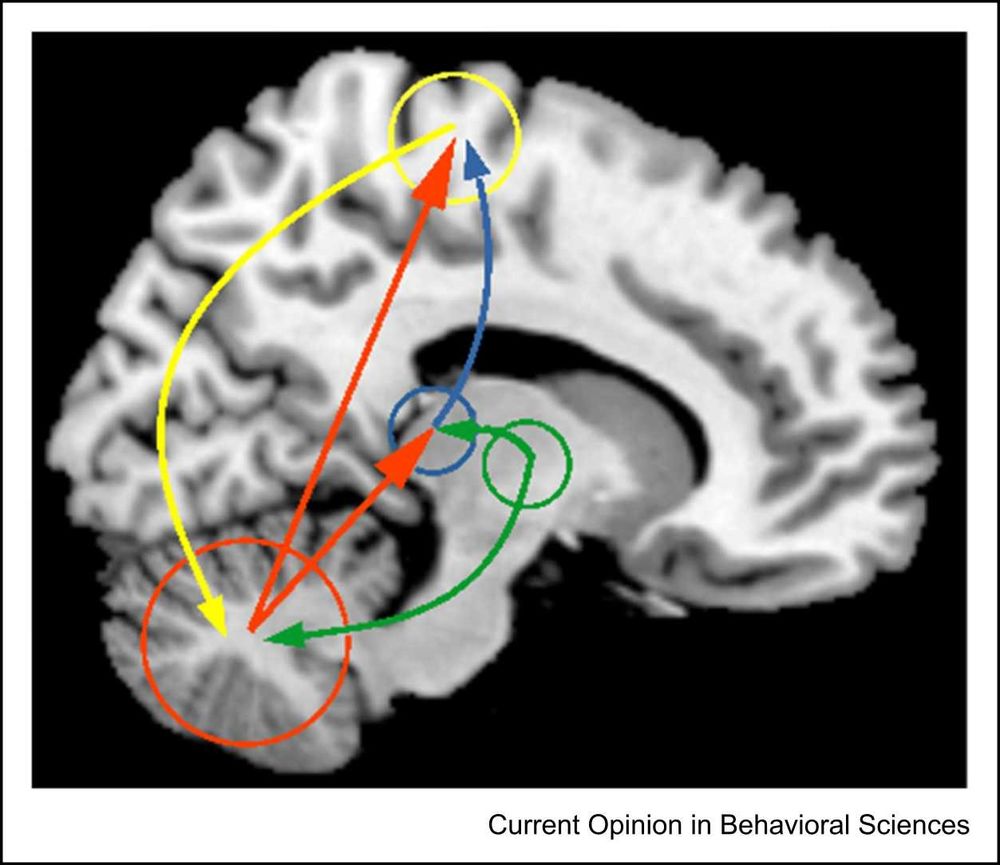
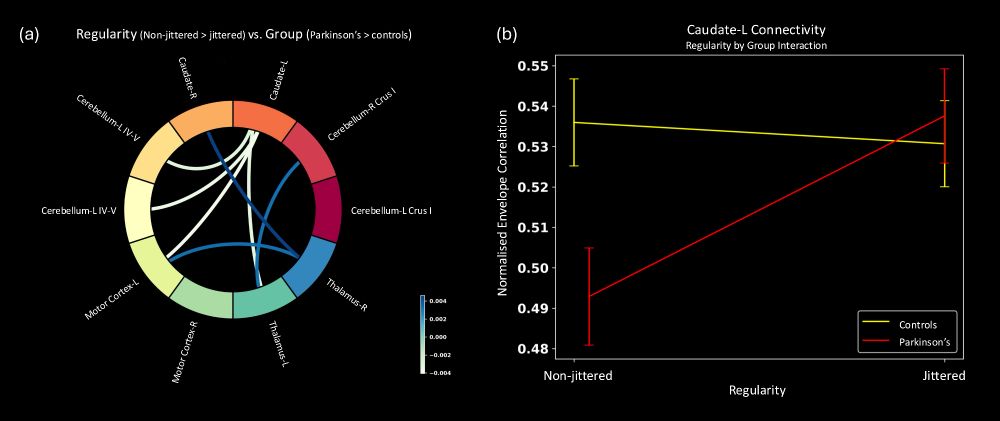
As an exploratory endeavour, we investigated the cerebello-thalamo-ganglion network we, proposed in bit.ly/42Yh4NE, and found that PD-patients showed altered activity for the jittered condition.
May 19, 2025 at 8:49 AM
As an exploratory endeavour, we investigated the cerebello-thalamo-ganglion network we, proposed in bit.ly/42Yh4NE, and found that PD-patients showed altered activity for the jittered condition.
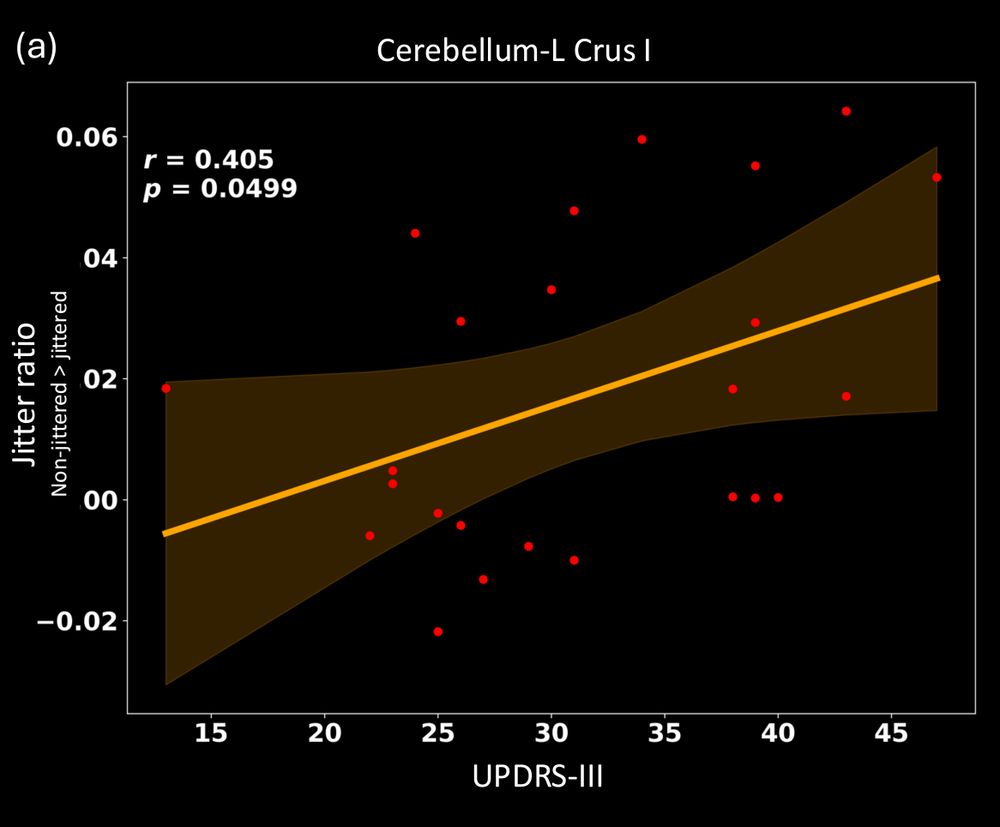
The differences in the cerebellum correlated with PD-symptoms as measured by UPDRS.
May 19, 2025 at 8:49 AM
The differences in the cerebellum correlated with PD-symptoms as measured by UPDRS.
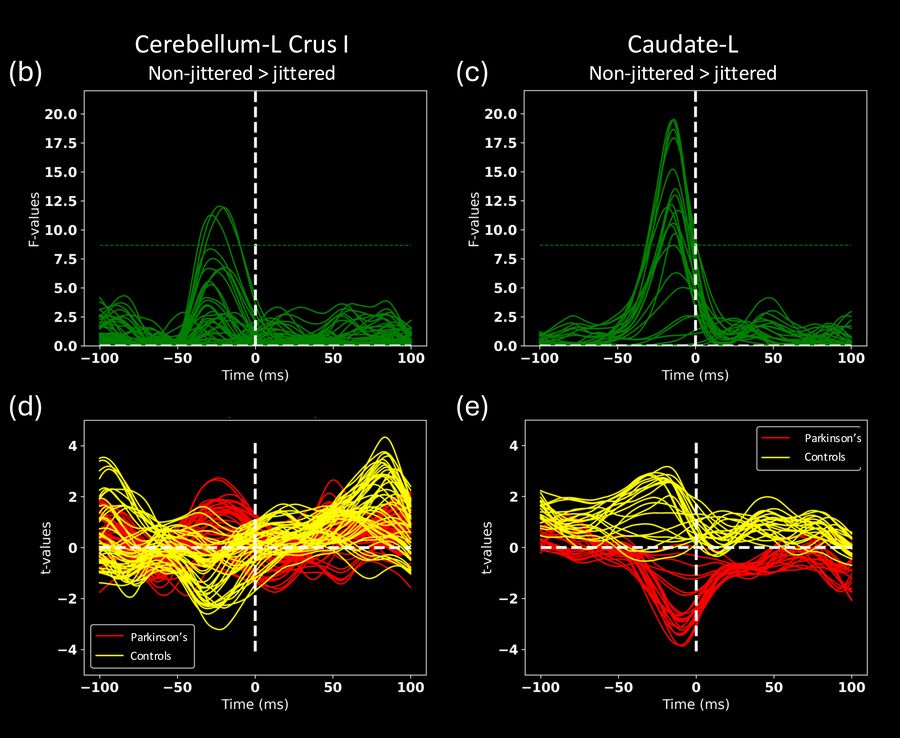
Before the onset of the expected, but omitted stimulation, we found differences in the beta band (14-30 Hz) between groups in the cerebellum and the caudate nucleus.
May 19, 2025 at 8:49 AM
Before the onset of the expected, but omitted stimulation, we found differences in the beta band (14-30 Hz) between groups in the cerebellum and the caudate nucleus.
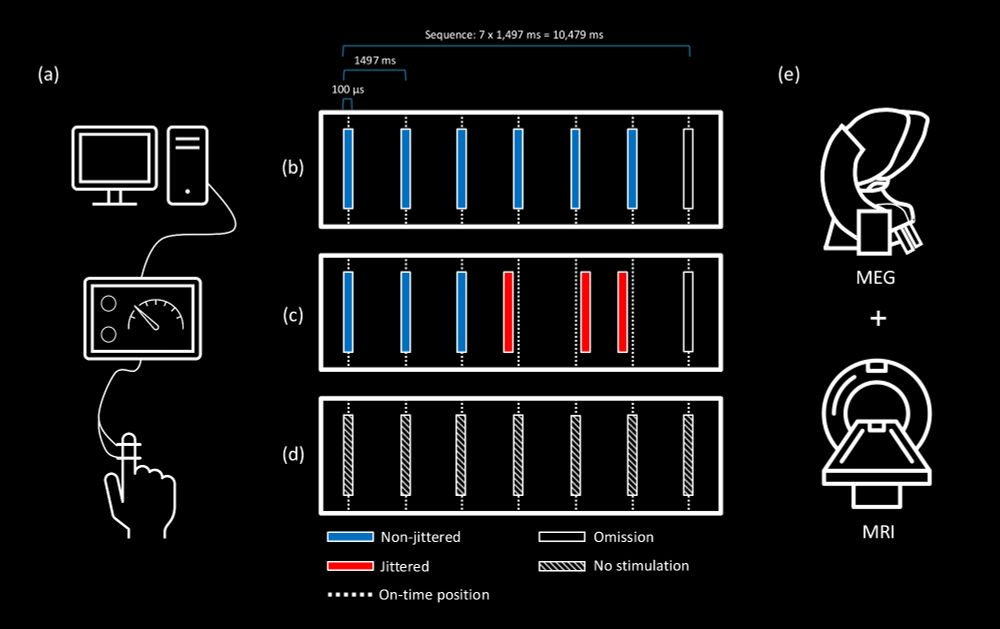
We had PD-participants and controls participate in a passive paradigm. Jittered and non-jittered trains of stimulation were followed by omissions.
May 19, 2025 at 8:49 AM
We had PD-participants and controls participate in a passive paradigm. Jittered and non-jittered trains of stimulation were followed by omissions.
The differences in the cerebellum correlated with PD-symptoms as measured by UPDRS
May 19, 2025 at 8:44 AM
The differences in the cerebellum correlated with PD-symptoms as measured by UPDRS
Before the onset of the expected, but omitted stimulation, we found differences in the beta band (14-30 Hz) between groups in the cerebellum and the caudate nucleus
May 19, 2025 at 8:44 AM
Before the onset of the expected, but omitted stimulation, we found differences in the beta band (14-30 Hz) between groups in the cerebellum and the caudate nucleus
We had PD-participants and controls participate in a passive paradigm. Jittered and non-jittered trains of stimulation were followed by omissions.
May 19, 2025 at 8:44 AM
We had PD-participants and controls participate in a passive paradigm. Jittered and non-jittered trains of stimulation were followed by omissions.
This fits with our second paper, short review where we forward the hypothesis that the cerebellum is not a time-keeper per se, but an integrator of spatial and temporal information that can inform predictions about future sensory events, and allowing for informed behaviour bit.ly/4bcQd31. 🧠📈
March 7, 2025 at 9:39 AM
This fits with our second paper, short review where we forward the hypothesis that the cerebellum is not a time-keeper per se, but an integrator of spatial and temporal information that can inform predictions about future sensory events, and allowing for informed behaviour bit.ly/4bcQd31. 🧠📈
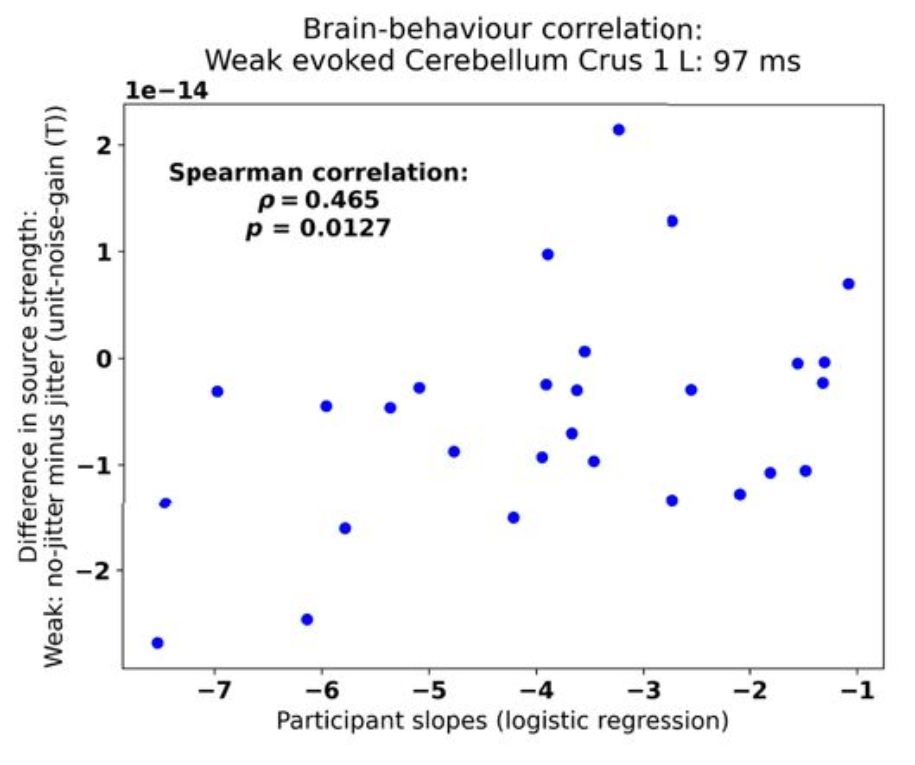
Thus, we find a cerebellum-behaviour correlation that we interpret as: the more surprising the stimulus is to the cerebellum, the less likely one is to detect it. We also find evidence of connectivity between cerebellum and thalamus which we interpret as the cerebellum informing one’s action plans🧠📈
March 7, 2025 at 9:39 AM
Thus, we find a cerebellum-behaviour correlation that we interpret as: the more surprising the stimulus is to the cerebellum, the less likely one is to detect it. We also find evidence of connectivity between cerebellum and thalamus which we interpret as the cerebellum informing one’s action plans🧠📈
n Detection of ..., we (
@sarangnemo.bsky.social
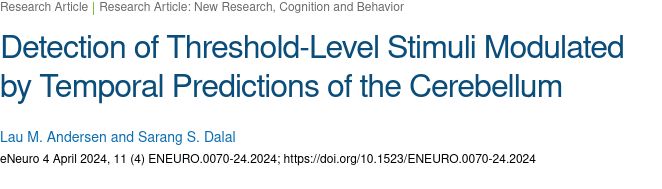
) find cerebellar evoked responses to threshold-level stimuli. We find that accuracy in detection correlates with the magnitude of the cerebellar response, which is in turn dependent on the temporal regularity of preceding stimuli bit.ly/3D2AlTR 🧠📈
@sarangnemo.bsky.social
) find cerebellar evoked responses to threshold-level stimuli. We find that accuracy in detection correlates with the magnitude of the cerebellar response, which is in turn dependent on the temporal regularity of preceding stimuli bit.ly/3D2AlTR 🧠📈
March 7, 2025 at 9:39 AM
n Detection of ..., we (
@sarangnemo.bsky.social
) find cerebellar evoked responses to threshold-level stimuli. We find that accuracy in detection correlates with the magnitude of the cerebellar response, which is in turn dependent on the temporal regularity of preceding stimuli bit.ly/3D2AlTR 🧠📈
@sarangnemo.bsky.social
) find cerebellar evoked responses to threshold-level stimuli. We find that accuracy in detection correlates with the magnitude of the cerebellar response, which is in turn dependent on the temporal regularity of preceding stimuli bit.ly/3D2AlTR 🧠📈
(NOW with) 🧠📈
Background: when going off X/Twitter, I got out of habit of promoting my articles online. I’d like to highlight two articles on the cerebellum that I published in 2024, which also provides some context to my current call. I’m excited about revealing a cerebellum-behavioural correlation
Background: when going off X/Twitter, I got out of habit of promoting my articles online. I’d like to highlight two articles on the cerebellum that I published in 2024, which also provides some context to my current call. I’m excited about revealing a cerebellum-behavioural correlation

March 7, 2025 at 9:39 AM
(NOW with) 🧠📈
Background: when going off X/Twitter, I got out of habit of promoting my articles online. I’d like to highlight two articles on the cerebellum that I published in 2024, which also provides some context to my current call. I’m excited about revealing a cerebellum-behavioural correlation
Background: when going off X/Twitter, I got out of habit of promoting my articles online. I’d like to highlight two articles on the cerebellum that I published in 2024, which also provides some context to my current call. I’m excited about revealing a cerebellum-behavioural correlation
This fits with our second paper, short review where we forward the hypothesis that the cerebellum is not a time-keeper per se, but an integrator of spatial and temporal information that can inform predictions about future sensory events, and allowing for informed behaviour bit.ly/4bcQd31. 🧠
March 5, 2025 at 4:34 PM
This fits with our second paper, short review where we forward the hypothesis that the cerebellum is not a time-keeper per se, but an integrator of spatial and temporal information that can inform predictions about future sensory events, and allowing for informed behaviour bit.ly/4bcQd31. 🧠
Thus, we find a cerebellum-behaviour correlation that we interpret as: the more surprising the stimulus is to the cerebellum, the less likely one is to detect it. We also find evidence of connectivity between cerebellum and thalamus, which we interpret as the cerebellum informing one’s action plans🧠
March 5, 2025 at 4:34 PM
Thus, we find a cerebellum-behaviour correlation that we interpret as: the more surprising the stimulus is to the cerebellum, the less likely one is to detect it. We also find evidence of connectivity between cerebellum and thalamus, which we interpret as the cerebellum informing one’s action plans🧠
In Detection of ..., we (
@sarangnemo.bsky.social
) find cerebellar evoked responses to threshold-level stimuli. We find that accuracy in detection correlates with the magnitude of the cerebellar response, which is in turn dependent on the temporal regularity of preceding stimuli bit.ly/3D2AlTR 🧠
@sarangnemo.bsky.social
) find cerebellar evoked responses to threshold-level stimuli. We find that accuracy in detection correlates with the magnitude of the cerebellar response, which is in turn dependent on the temporal regularity of preceding stimuli bit.ly/3D2AlTR 🧠
March 5, 2025 at 4:34 PM
In Detection of ..., we (
@sarangnemo.bsky.social
) find cerebellar evoked responses to threshold-level stimuli. We find that accuracy in detection correlates with the magnitude of the cerebellar response, which is in turn dependent on the temporal regularity of preceding stimuli bit.ly/3D2AlTR 🧠
@sarangnemo.bsky.social
) find cerebellar evoked responses to threshold-level stimuli. We find that accuracy in detection correlates with the magnitude of the cerebellar response, which is in turn dependent on the temporal regularity of preceding stimuli bit.ly/3D2AlTR 🧠
(NOW with) 🧠
Background: when going off X/Twitter, I got out of habit of promoting my articles online. I’d like to highlight two articles on the cerebellum that I published in 2024, which also provides some context to my current call. I’m excited about revealing a cerebellum-behavioural correlation.
Background: when going off X/Twitter, I got out of habit of promoting my articles online. I’d like to highlight two articles on the cerebellum that I published in 2024, which also provides some context to my current call. I’m excited about revealing a cerebellum-behavioural correlation.
March 5, 2025 at 4:34 PM
(NOW with) 🧠
Background: when going off X/Twitter, I got out of habit of promoting my articles online. I’d like to highlight two articles on the cerebellum that I published in 2024, which also provides some context to my current call. I’m excited about revealing a cerebellum-behavioural correlation.
Background: when going off X/Twitter, I got out of habit of promoting my articles online. I’d like to highlight two articles on the cerebellum that I published in 2024, which also provides some context to my current call. I’m excited about revealing a cerebellum-behavioural correlation.
This fits with our second paper, short review where we forward the hypothesis that the cerebellum is not a time-keeper per se, but an integrator of spatial and temporal information that can inform predictions about future sensory events, and allowing for informed behaviour bit.ly/4bcQd31. 🧪
March 4, 2025 at 9:05 AM
This fits with our second paper, short review where we forward the hypothesis that the cerebellum is not a time-keeper per se, but an integrator of spatial and temporal information that can inform predictions about future sensory events, and allowing for informed behaviour bit.ly/4bcQd31. 🧪
Thus, we find a cerebellum-behaviour correlation that we interpret as: the more surprising the stimulus is to the cerebellum, the less likely one is to detect it. We also find evidence of connectivity between cerebellum and thalamus, which we interpret as the cerebellum informing one’s action plans🧪
March 4, 2025 at 9:05 AM
Thus, we find a cerebellum-behaviour correlation that we interpret as: the more surprising the stimulus is to the cerebellum, the less likely one is to detect it. We also find evidence of connectivity between cerebellum and thalamus, which we interpret as the cerebellum informing one’s action plans🧪
In Detection of ..., we (
@sarangnemo.bsky.social
) find cerebellar evoked responses to threshold-level stimuli. We find that accuracy in detection correlates with the magnitude of the cerebellar response, which is in turn dependent on the temporal regularity of preceding stimuli bit.ly/3D2AlTR 🧪
@sarangnemo.bsky.social
) find cerebellar evoked responses to threshold-level stimuli. We find that accuracy in detection correlates with the magnitude of the cerebellar response, which is in turn dependent on the temporal regularity of preceding stimuli bit.ly/3D2AlTR 🧪
March 4, 2025 at 9:05 AM
In Detection of ..., we (
@sarangnemo.bsky.social
) find cerebellar evoked responses to threshold-level stimuli. We find that accuracy in detection correlates with the magnitude of the cerebellar response, which is in turn dependent on the temporal regularity of preceding stimuli bit.ly/3D2AlTR 🧪
@sarangnemo.bsky.social
) find cerebellar evoked responses to threshold-level stimuli. We find that accuracy in detection correlates with the magnitude of the cerebellar response, which is in turn dependent on the temporal regularity of preceding stimuli bit.ly/3D2AlTR 🧪
(NOW with)🧪
Background: when going off X/Twitter, I got out of habit of promoting my articles online. I’d like to highlight two articles on the cerebellum that I published in 2024, which also provides some context to my current call. I’m excited about revealing a cerebellum-behavioural correlation.
Background: when going off X/Twitter, I got out of habit of promoting my articles online. I’d like to highlight two articles on the cerebellum that I published in 2024, which also provides some context to my current call. I’m excited about revealing a cerebellum-behavioural correlation.
March 4, 2025 at 9:05 AM
(NOW with)🧪
Background: when going off X/Twitter, I got out of habit of promoting my articles online. I’d like to highlight two articles on the cerebellum that I published in 2024, which also provides some context to my current call. I’m excited about revealing a cerebellum-behavioural correlation.
Background: when going off X/Twitter, I got out of habit of promoting my articles online. I’d like to highlight two articles on the cerebellum that I published in 2024, which also provides some context to my current call. I’m excited about revealing a cerebellum-behavioural correlation.
This fits together with our second paper, short review where we forward the hypothesis that the cerebellum is not a time-keeper per se, but an integrator of spatial and temporal information that can inform predictions about future sensory events, and allowing for informed behaviour bit.ly/4bcQd31.
February 21, 2025 at 2:13 PM
This fits together with our second paper, short review where we forward the hypothesis that the cerebellum is not a time-keeper per se, but an integrator of spatial and temporal information that can inform predictions about future sensory events, and allowing for informed behaviour bit.ly/4bcQd31.
Thus, we find a cerebellum-behaviour correlation that we interpret as: the more surprising the stimulus is to the cerebellum, the less likely one is to detect it. We also find evidence of connectivity between cerebellum and thalamus, which we interpret as the cerebellum informing one’s action plans.
February 21, 2025 at 2:13 PM
Thus, we find a cerebellum-behaviour correlation that we interpret as: the more surprising the stimulus is to the cerebellum, the less likely one is to detect it. We also find evidence of connectivity between cerebellum and thalamus, which we interpret as the cerebellum informing one’s action plans.
In Detection of ..., we (@sarangnemo.bsky.social) find cerebellar evoked responses to threshold-level stimuli. We find that accuracy in detecting them correlates with the magnitude of the cerebellar response, which is in turn dependent on the temporal regularity of preceding stimuli bit.ly/3D2AlTR
February 21, 2025 at 2:13 PM
In Detection of ..., we (@sarangnemo.bsky.social) find cerebellar evoked responses to threshold-level stimuli. We find that accuracy in detecting them correlates with the magnitude of the cerebellar response, which is in turn dependent on the temporal regularity of preceding stimuli bit.ly/3D2AlTR
Background: when going off X/Twitter, I got out of habit of promoting my articles online. I’d like to highlight two articles on the cerebellum that I published in 2024, which also provides some context to my current call. I’m excited about revealing a cerebellum-behavioural correlation.
February 21, 2025 at 2:13 PM
Background: when going off X/Twitter, I got out of habit of promoting my articles online. I’d like to highlight two articles on the cerebellum that I published in 2024, which also provides some context to my current call. I’m excited about revealing a cerebellum-behavioural correlation.