




@townsendj.bsky.social
Neuroscientist, fMRI, emotion, AI; evidence-based, patient-centered integrative medicine 🌱🍄🟫 🍎🌊☀️🎶
Reposted
This recent ✨ Early Career Commentary ✨ makes the case that interoception - the sensing & interpretation of internal bodily signals - should be studied within a Bayesian multisensory framework

Moving from isolation to integration: a Bayesian multisensory perspective of interoception and psychosis
Neuropsychopharmacology - Moving from isolation to integration: a Bayesian multisensory perspective of interoception and psychosis
www.nature.com
December 3, 2025 at 3:31 PM
This recent ✨ Early Career Commentary ✨ makes the case that interoception - the sensing & interpretation of internal bodily signals - should be studied within a Bayesian multisensory framework
Reposted

New today in @Nature: your visual cortex contains touch-based body maps. bit.ly/VisualBodyMaps
Your brain transforms what you see into first-person, body-referenced codes: A previously unknown bridge between vision and touch.
Your brain transforms what you see into first-person, body-referenced codes: A previously unknown bridge between vision and touch.

November 26, 2025 at 4:01 PM
New today in @Nature: your visual cortex contains touch-based body maps. bit.ly/VisualBodyMaps
Your brain transforms what you see into first-person, body-referenced codes: A previously unknown bridge between vision and touch.
Your brain transforms what you see into first-person, body-referenced codes: A previously unknown bridge between vision and touch.
www.science.org/doi/10.1126/... @hkt52.bsky.social Wonderful work again!

Mind captioning: Evolving descriptive text of mental content from human brain activity
Nonverbal thoughts can be translated into verbal descriptions by aligning semantic representations between text and the brain.
www.science.org
November 6, 2025 at 1:32 AM
www.science.org/doi/10.1126/... @hkt52.bsky.social Wonderful work again!
Reposted

Cortical and subcortical mapping of the human allostatic–interoceptive system using 7 Tesla fMRI
www.nature.com/articles/s41...
www.nature.com/articles/s41...

Cortical and subcortical mapping of the human allostatic–interoceptive system using 7 Tesla fMRI - Nature Neuroscience
The brain is constantly monitoring the systems in the body. Here the authors use 7 Tesla functional magnetic resonance imaging to map a large-scale brain system for body regulation in humans, includin...
www.nature.com
November 4, 2025 at 7:04 PM
Cortical and subcortical mapping of the human allostatic–interoceptive system using 7 Tesla fMRI
www.nature.com/articles/s41...
www.nature.com/articles/s41...
Reposted

A spatially resolved transcriptomic atlas of the primate amygdala (human, macaque, and baboon) now out in Science Advances (www.science.org/doi/10.1126/...). The amygdala contains 32 types of neurons with many neuron types specific to particular subdivisions.
Lots of updates from the preprint!
Lots of updates from the preprint!

Transcriptomic diversity of amygdalar subdivisions across humans and nonhuman primates
Specialized cell types and links to psychiatric disorders are revealed by genetic mapping of primate amygdala neurons.
www.science.org
September 17, 2025 at 7:31 PM
A spatially resolved transcriptomic atlas of the primate amygdala (human, macaque, and baboon) now out in Science Advances (www.science.org/doi/10.1126/...). The amygdala contains 32 types of neurons with many neuron types specific to particular subdivisions.
Lots of updates from the preprint!
Lots of updates from the preprint!
Reposted

Nature research paper: Amygdala–liver signalling orchestrates glycaemic responses to stress
go.nature.com/4m2rH8t
go.nature.com/4m2rH8t

Amygdala–liver signalling orchestrates glycaemic responses to stress - Nature
Studies in mice show that acute stress activates hyperglycaemia via activation of a medial amygdala–ventral hypothalamic circuit that controls glucose metabolic responses in the liver, independently of adrenal and pancreatic hormones.
go.nature.com
September 8, 2025 at 10:40 AM
Nature research paper: Amygdala–liver signalling orchestrates glycaemic responses to stress
go.nature.com/4m2rH8t
go.nature.com/4m2rH8t
www.frontiersin.org/journals/neu... Bringing Joy to the neuroimaging world: our paper is out today demonstrating proof of concept novel spin-echo based fMRI technique gSlider-SWAT for imaging whole brain at 1mm³ 3T, including amygdala and OFC. Looking forward to continued innovations in the field!

Frontiers | Imaging joy with generalized slice dithered enhanced resolution and SWAT reconstruction: 3T high spatial–temporal resolution fMRI
To facilitate high spatial–temporal resolution fMRI (≦1mm3) at more broadly available field strengths (3T) and to better understand the neural underpinnings ...
www.frontiersin.org
June 3, 2025 at 1:54 PM
www.frontiersin.org/journals/neu... Bringing Joy to the neuroimaging world: our paper is out today demonstrating proof of concept novel spin-echo based fMRI technique gSlider-SWAT for imaging whole brain at 1mm³ 3T, including amygdala and OFC. Looking forward to continued innovations in the field!
Reposted
Pathogen fighters can act as surveillance forces that ferry information from the gut and fat deposits to the brain
https://go.nature.com/4kip5mR
https://go.nature.com/4kip5mR

How the brain spies on the gut: with help from newfound immune cells
The body’s pathogen fighters can act as surveillance forces that ferry information from the gut and fat deposits to the brain.
go.nature.com
May 28, 2025 at 4:19 PM
Pathogen fighters can act as surveillance forces that ferry information from the gut and fat deposits to the brain
https://go.nature.com/4kip5mR
https://go.nature.com/4kip5mR
Reposted

An epithelial cell videoed through a microscope. #CellBiology
May 1, 2025 at 2:16 AM
An epithelial cell videoed through a microscope. #CellBiology
Reposted
A heart muscle cell (cardiac myocyte) photographed through a microscope. Actin filaments are shown. #CellBiology

March 10, 2025 at 12:32 AM
A heart muscle cell (cardiac myocyte) photographed through a microscope. Actin filaments are shown. #CellBiology
Reposted

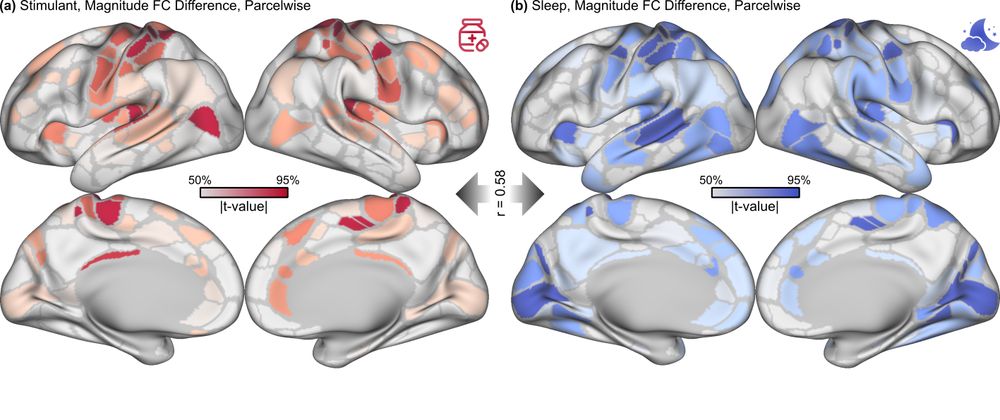
My med school textbook says stimulants like Ritalin treat hyperactivity by “stimulating” the brain’s attention and cognitive control systems. We studied children taking stimulants in the ABCD Study, and the largest differences were actually in arousal and reward networks! Check out our preprint!
May 22, 2025 at 9:33 PM
My med school textbook says stimulants like Ritalin treat hyperactivity by “stimulating” the brain’s attention and cognitive control systems. We studied children taking stimulants in the ABCD Study, and the largest differences were actually in arousal and reward networks! Check out our preprint!
Reposted

Very important point raised by @petersalib.bsky.social and Simon Goldstein regarding AI risk and alignment:
www.ai-frontiers.org/articles/tod...
www.ai-frontiers.org/articles/tod...

May 21, 2025 at 4:33 PM
Very important point raised by @petersalib.bsky.social and Simon Goldstein regarding AI risk and alignment:
www.ai-frontiers.org/articles/tod...
www.ai-frontiers.org/articles/tod...
Reposted

Its a long weekend here in Canada, which seems appropriate to mourn our recent @npp-journal.bsky.social paper, in which we find that FAAH inhibition does NOT improve symptoms in PTSD🙁
A heroic effort w/ @cannabrain.bsky.social @connorhaggarty.bsky.social @ryanntansey.bsky.social & many more 🧵⬇️
A heroic effort w/ @cannabrain.bsky.social @connorhaggarty.bsky.social @ryanntansey.bsky.social & many more 🧵⬇️
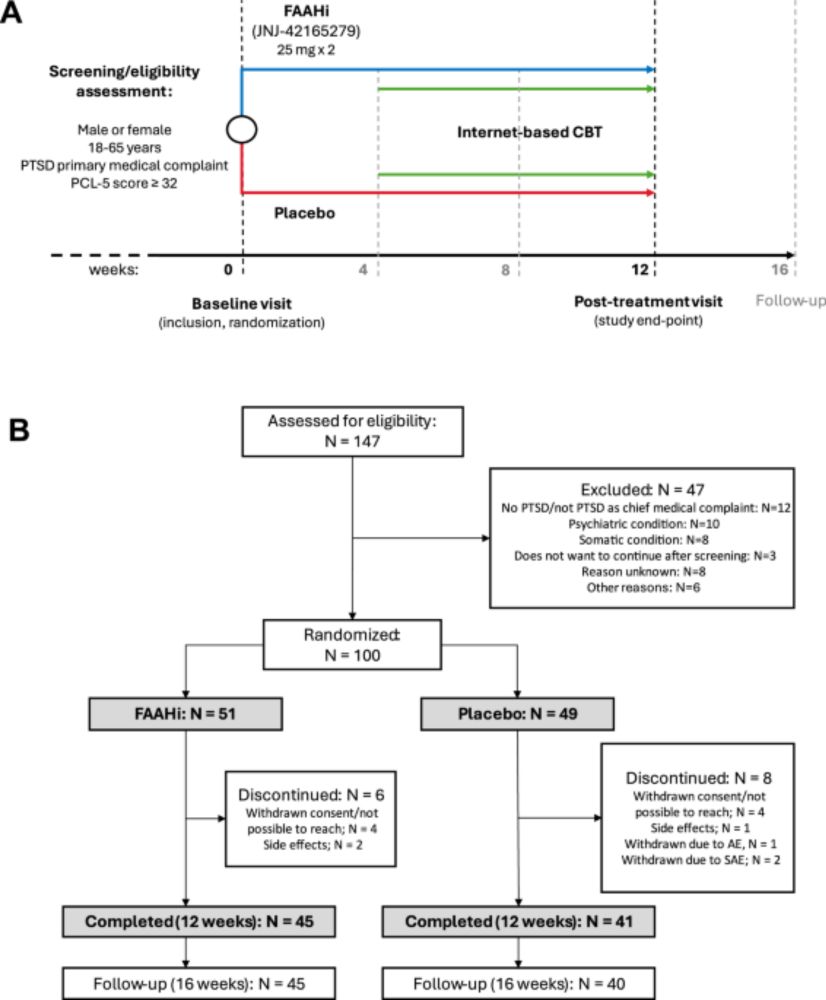
The efficacy of elevating anandamide via inhibition of fatty acid amide hydrolase (FAAH) combined with internet-delivered cognitive behavioral therapy in the treatment of post-traumatic stress disorde...
Neuropsychopharmacology - The efficacy of elevating anandamide via inhibition of fatty acid amide hydrolase (FAAH) combined with internet-delivered cognitive behavioral therapy in the treatment of...
www.nature.com
May 17, 2025 at 5:48 PM
Its a long weekend here in Canada, which seems appropriate to mourn our recent @npp-journal.bsky.social paper, in which we find that FAAH inhibition does NOT improve symptoms in PTSD🙁
A heroic effort w/ @cannabrain.bsky.social @connorhaggarty.bsky.social @ryanntansey.bsky.social & many more 🧵⬇️
A heroic effort w/ @cannabrain.bsky.social @connorhaggarty.bsky.social @ryanntansey.bsky.social & many more 🧵⬇️
Reposted
The leading edge of a crawling cell videoed through a microscope. Watch the actin cytoskeleton in motion as it drives membrane protrusion and cell movement. It’s like watching the cell think with its feet. #CellBiology
May 19, 2025 at 8:53 PM
The leading edge of a crawling cell videoed through a microscope. Watch the actin cytoskeleton in motion as it drives membrane protrusion and cell movement. It’s like watching the cell think with its feet. #CellBiology
Reposted
Nature research paper: Prefrontal encoding of an internal model for emotional inference
https://go.nature.com/4j1zQbK
https://go.nature.com/4j1zQbK

Prefrontal encoding of an internal model for emotional inference - Nature
Neurons in the rodent dorsomedial prefrontal cortex encode a flexible internal model of emotion by linking directly experienced and inferred associations with aversive experiences.
go.nature.com
May 16, 2025 at 12:24 PM
Nature research paper: Prefrontal encoding of an internal model for emotional inference
https://go.nature.com/4j1zQbK
https://go.nature.com/4j1zQbK
Reposted
Whether it's punk rock or Puccini, everyone has music that they love. Why is music so compelling? And what’s going on in your brain when you’re jamming to your favorite song?
Lisa Wooldridge explores your brain on music: pennneuroknow.com/2025/05/13/m...
#neuroskyence #PsychSciSky #SciComm 🧪
Lisa Wooldridge explores your brain on music: pennneuroknow.com/2025/05/13/m...
#neuroskyence #PsychSciSky #SciComm 🧪

Music on the brain
Whether punk rock or Puccini, everyone has music that they love. Why is music so compelling? And what’s going on in your brain when you’re jamming to your favorite song?
pennneuroknow.com
May 13, 2025 at 1:55 PM
Whether it's punk rock or Puccini, everyone has music that they love. Why is music so compelling? And what’s going on in your brain when you’re jamming to your favorite song?
Lisa Wooldridge explores your brain on music: pennneuroknow.com/2025/05/13/m...
#neuroskyence #PsychSciSky #SciComm 🧪
Lisa Wooldridge explores your brain on music: pennneuroknow.com/2025/05/13/m...
#neuroskyence #PsychSciSky #SciComm 🧪
Reposted
#ThisWeekInNPP
🧠 Six months post-trauma, reduced reactivity and connectivity in the basolateral amygdala (BLA) predicted greater PTSD severity.
📉 This challenges the idea of fixed amygdala hyperreactivity, suggesting dynamic BLA changes may shape PTSD development.
🔗 www.nature.com/articles/s41...
🧠 Six months post-trauma, reduced reactivity and connectivity in the basolateral amygdala (BLA) predicted greater PTSD severity.
📉 This challenges the idea of fixed amygdala hyperreactivity, suggesting dynamic BLA changes may shape PTSD development.
🔗 www.nature.com/articles/s41...

Sequential decreases in basolateral amygdala response to threat predict failure to recover from PTSD - Neuropsychopharmacology
Neuropsychopharmacology - Sequential decreases in basolateral amygdala response to threat predict failure to recover from PTSD
www.nature.com
May 13, 2025 at 4:46 PM
#ThisWeekInNPP
🧠 Six months post-trauma, reduced reactivity and connectivity in the basolateral amygdala (BLA) predicted greater PTSD severity.
📉 This challenges the idea of fixed amygdala hyperreactivity, suggesting dynamic BLA changes may shape PTSD development.
🔗 www.nature.com/articles/s41...
🧠 Six months post-trauma, reduced reactivity and connectivity in the basolateral amygdala (BLA) predicted greater PTSD severity.
📉 This challenges the idea of fixed amygdala hyperreactivity, suggesting dynamic BLA changes may shape PTSD development.
🔗 www.nature.com/articles/s41...
Reposted

(4/11)
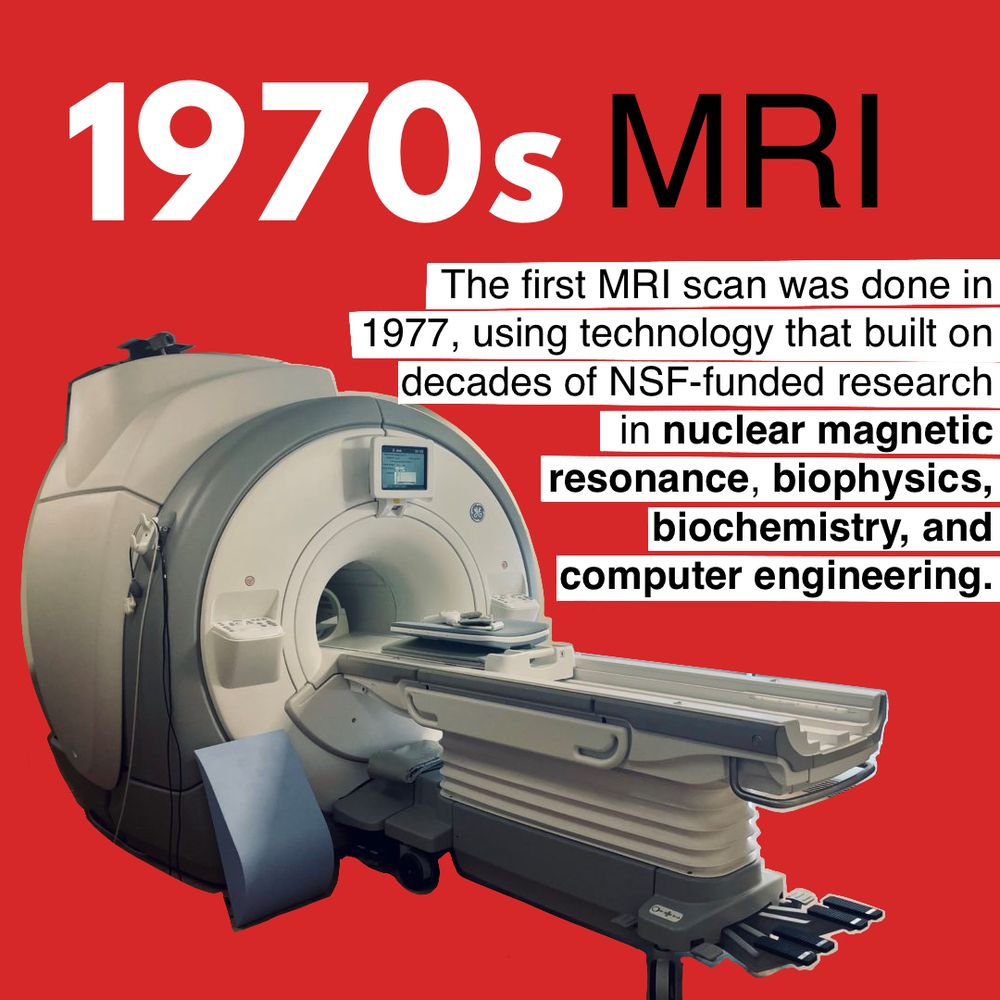
The first MRI scan in 1977 changed medicine forever—but it didn’t come out of nowhere. It was built on years of NSF-funded breakthroughs in nuclear magnetic resonance, biophysics, biochemistry, and computer engineering.
www.nsf.gov/impacts/mri
The first MRI scan in 1977 changed medicine forever—but it didn’t come out of nowhere. It was built on years of NSF-funded breakthroughs in nuclear magnetic resonance, biophysics, biochemistry, and computer engineering.
www.nsf.gov/impacts/mri
May 10, 2025 at 8:25 PM
(4/11)
The first MRI scan in 1977 changed medicine forever—but it didn’t come out of nowhere. It was built on years of NSF-funded breakthroughs in nuclear magnetic resonance, biophysics, biochemistry, and computer engineering.
www.nsf.gov/impacts/mri
The first MRI scan in 1977 changed medicine forever—but it didn’t come out of nowhere. It was built on years of NSF-funded breakthroughs in nuclear magnetic resonance, biophysics, biochemistry, and computer engineering.
www.nsf.gov/impacts/mri
Reposted

🚨🚨New psychedelics paper out today! 🚨🚨
"Reduced Brain Responsiveness to Emotional Stimuli With Escitalopram But Not Psilocybin Therapy for Depression."
psychiatryonline.org/doi/10.1176/...
🧵⬇️
"Reduced Brain Responsiveness to Emotional Stimuli With Escitalopram But Not Psilocybin Therapy for Depression."
psychiatryonline.org/doi/10.1176/...
🧵⬇️

Reduced Brain Responsiveness to Emotional Stimuli With Escitalopram But Not Psilocybin Therapy for Depression | American Journal of Psychiatry
Objective: Psilocybin is an emerging intervention for depression that may be at least as effective as selective serotonin reuptake inhibitors (SSRIs), but effects of the two treatments on the neural c...
psychiatryonline.org
May 7, 2025 at 7:15 PM
🚨🚨New psychedelics paper out today! 🚨🚨
"Reduced Brain Responsiveness to Emotional Stimuli With Escitalopram But Not Psilocybin Therapy for Depression."
psychiatryonline.org/doi/10.1176/...
🧵⬇️
"Reduced Brain Responsiveness to Emotional Stimuli With Escitalopram But Not Psilocybin Therapy for Depression."
psychiatryonline.org/doi/10.1176/...
🧵⬇️
Reposted

First post on an exciting new manuscript online today @natneuro.nature.com - in collab with @lucinauddin.bsky.social and Catie Chang. We take a fresh look at the physiological dynamics associated with the global signal 🧠 ...
www.nature.com/articles/s41...
Read here:
rdcu.be/ek01F
www.nature.com/articles/s41...
Read here:
rdcu.be/ek01F
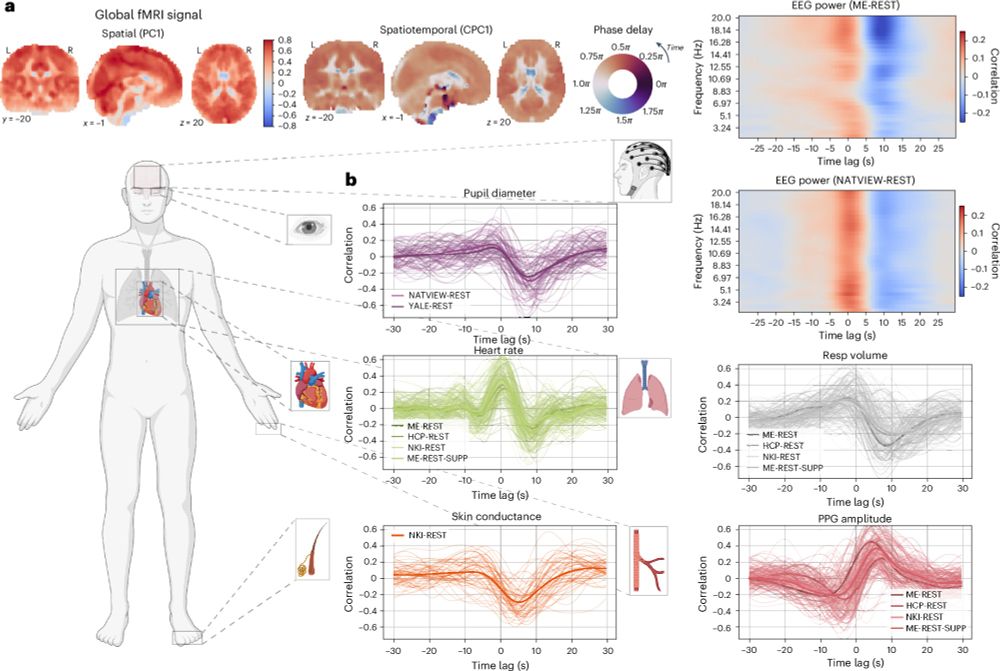
Autonomic physiological coupling of the global fMRI signal
Nature Neuroscience - The brain and body are necessarily connected. Here the authors show that brain blood flow and electrical activity are coupled with systemic physiological changes in the body.
rdcu.be
May 7, 2025 at 1:42 PM
First post on an exciting new manuscript online today @natneuro.nature.com - in collab with @lucinauddin.bsky.social and Catie Chang. We take a fresh look at the physiological dynamics associated with the global signal 🧠 ...
www.nature.com/articles/s41...
Read here:
rdcu.be/ek01F
www.nature.com/articles/s41...
Read here:
rdcu.be/ek01F
Reposted

You might find this interesting link.springer.com/article/10.1...

AI research assistants, intrinsic values, and the science we want - AI & SOCIETY
AI & SOCIETY -
link.springer.com
May 3, 2025 at 9:12 PM
You might find this interesting link.springer.com/article/10.1...
Reposted
Nature research paper: Serotonin and neurotensin inputs in the vCA1 dictate opposing social valence.
https://go.nature.com/3EWC2TL
https://go.nature.com/3EWC2TL

Serotonin and neurotensin inputs in the vCA1 dictate opposing social valence - Nature
Aversive and rewarding social experiences are linked to conspecific identity through converging dorsal raphe 5-HT and paraventricular nucleus of the thalamus neurotensin signals in the vCA1 that instruct opposing valence, representing a synaptic switch for flexible social valence computation.
go.nature.com
May 1, 2025 at 7:22 PM
Nature research paper: Serotonin and neurotensin inputs in the vCA1 dictate opposing social valence.
https://go.nature.com/3EWC2TL
https://go.nature.com/3EWC2TL
Reposted
Immune cells boost stress-linked fear responses by communicating with brain cells.
Psychedelics can modulate this interaction, lessening such fear
https://go.nature.com/4ixzclU
Psychedelics can modulate this interaction, lessening such fear
https://go.nature.com/4ixzclU
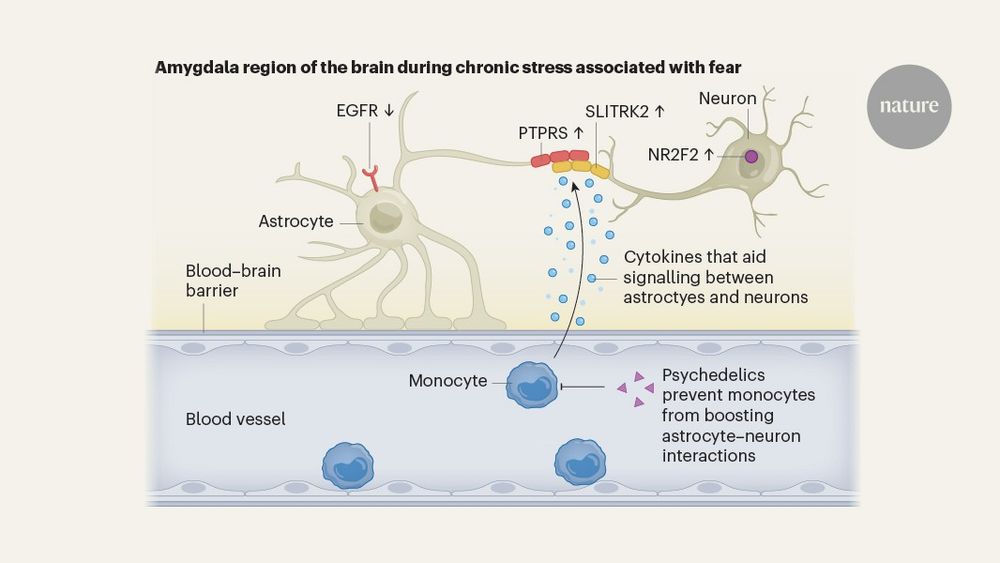
Psychedelics reduce fear by targeting immune cells that modulate brain cells
Immune cells boost stress-linked fear responses by communicating with brain cells. One way that psychedelics lessen such fear is by modulating this interaction.
go.nature.com
April 28, 2025 at 12:44 PM
Immune cells boost stress-linked fear responses by communicating with brain cells.
Psychedelics can modulate this interaction, lessening such fear
https://go.nature.com/4ixzclU
Psychedelics can modulate this interaction, lessening such fear
https://go.nature.com/4ixzclU
“…She wants to study whole mushrooms to investigate whether the diverse chemicals in them provide health benefits.”
“If you want to study drugs that have been criminalized by our government, you must be fearless”
https://go.nature.com/42vvEvR
https://go.nature.com/42vvEvR
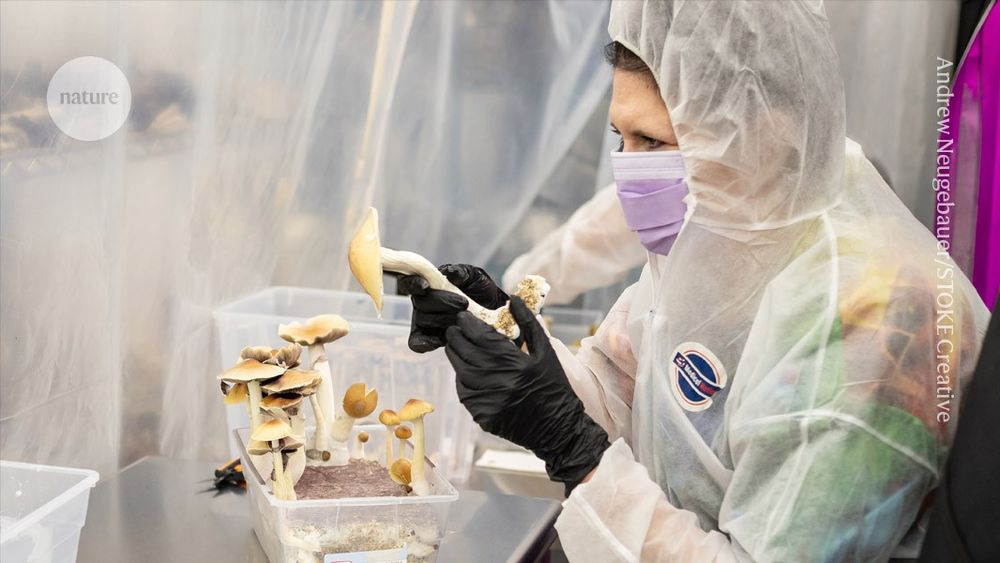
My fight to unlock cannabis and psychedelic drugs for use in medical research
Physician Sue Sisley battles to study cannabis and psilocybin mushrooms for pain, addiction and PTSD.
go.nature.com
April 28, 2025 at 8:58 PM
“…She wants to study whole mushrooms to investigate whether the diverse chemicals in them provide health benefits.”
Reposted
A putative neural correlate of mood!
One big (scandalous?) idea, simple analyses, and the STRONGEST brain/behavior correlation I've EVER seen (which is shocking, given that it's mood).
Work with: You-Ping Yang, @catrinahacker.bsky.social and Veit Stuphorn.
www.biorxiv.org/content/10.1...
One big (scandalous?) idea, simple analyses, and the STRONGEST brain/behavior correlation I've EVER seen (which is shocking, given that it's mood).
Work with: You-Ping Yang, @catrinahacker.bsky.social and Veit Stuphorn.
www.biorxiv.org/content/10.1...

The representation of mood in primate anterior insular cortex
Understanding how the brain reflects and shapes mood requires resolving the disconnect between behavioral measures of mood that can only be made in humans (typically based on subjective reports of hap...
www.biorxiv.org
April 25, 2025 at 1:49 PM
A putative neural correlate of mood!
One big (scandalous?) idea, simple analyses, and the STRONGEST brain/behavior correlation I've EVER seen (which is shocking, given that it's mood).
Work with: You-Ping Yang, @catrinahacker.bsky.social and Veit Stuphorn.
www.biorxiv.org/content/10.1...
One big (scandalous?) idea, simple analyses, and the STRONGEST brain/behavior correlation I've EVER seen (which is shocking, given that it's mood).
Work with: You-Ping Yang, @catrinahacker.bsky.social and Veit Stuphorn.
www.biorxiv.org/content/10.1...