



Tien Phan
@tienphan.bsky.social
Postdoc at Texas A&M University | Computational Biophysics | Molecular Dynamics Simulations | Machine Learning and AI
Reposted by Tien Phan
Explainable GNNs in Chemistry: Combining Attribution and Uncertainty Quantification | ChemRxiv - doi.org/10.26434/che... #compchem

Explainable GNNs in Chemistry: Combining Attribution and Uncertainty Quantification
Graph Neural Networks (GNNs) are powerful tools for predicting chemical properties, but their black-box nature can limit trust and utility. Explainability through feature attribution and awareness of ...
doi.org
April 30, 2025 at 5:59 AM
Explainable GNNs in Chemistry: Combining Attribution and Uncertainty Quantification | ChemRxiv - doi.org/10.26434/che... #compchem
Reposted by Tien Phan
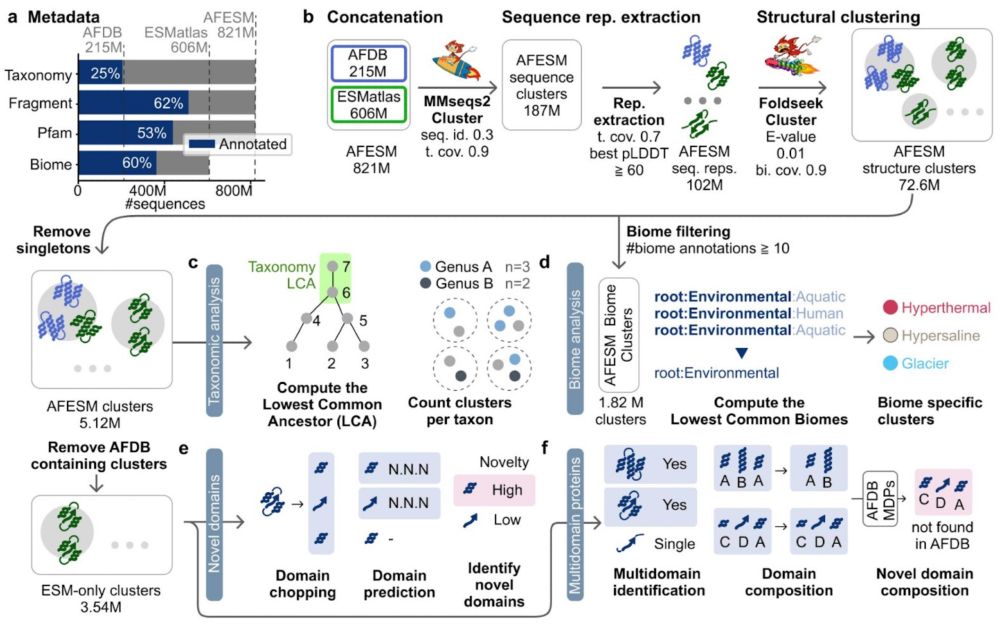
AFESM: a metagenomic guide through the protein structure universe! We clustered 821M structures (AFDB&ESMatlas) into 5.12M groups; revealing biome-specific groups, only 1 new fold even after AlphaFold2 re-prediction & many novel domain combos. 🧵
🌐 afesm.foldseek.com
📄 www.biorxiv.org/content/10.1...
🌐 afesm.foldseek.com
📄 www.biorxiv.org/content/10.1...
April 27, 2025 at 12:13 AM
AFESM: a metagenomic guide through the protein structure universe! We clustered 821M structures (AFDB&ESMatlas) into 5.12M groups; revealing biome-specific groups, only 1 new fold even after AlphaFold2 re-prediction & many novel domain combos. 🧵
🌐 afesm.foldseek.com
📄 www.biorxiv.org/content/10.1...
🌐 afesm.foldseek.com
📄 www.biorxiv.org/content/10.1...
Reposted by Tien Phan

AlphaFold is amazing but gives you static structures 🧊
In a fantastic teamwork, @mcagiada.bsky.social and @emilthomasen.bsky.social developed AF2χ to generate conformational ensembles representing side-chain dynamics using AF2 💃
Code: github.com/KULL-Centre/...
Colab: github.com/matteo-cagia...
In a fantastic teamwork, @mcagiada.bsky.social and @emilthomasen.bsky.social developed AF2χ to generate conformational ensembles representing side-chain dynamics using AF2 💃
Code: github.com/KULL-Centre/...
Colab: github.com/matteo-cagia...

April 17, 2025 at 7:11 PM
AlphaFold is amazing but gives you static structures 🧊
In a fantastic teamwork, @mcagiada.bsky.social and @emilthomasen.bsky.social developed AF2χ to generate conformational ensembles representing side-chain dynamics using AF2 💃
Code: github.com/KULL-Centre/...
Colab: github.com/matteo-cagia...
In a fantastic teamwork, @mcagiada.bsky.social and @emilthomasen.bsky.social developed AF2χ to generate conformational ensembles representing side-chain dynamics using AF2 💃
Code: github.com/KULL-Centre/...
Colab: github.com/matteo-cagia...
Reposted by Tien Phan
In this wonderful collaboration with K Maeshima and M Shimazoe we show that H1 in living cells acts as a liquid-like glue not a driver of stiff zigzag fibers 🔥🔥🔥 Each H1 bridges multiple nucleosomes and exchanges nucleosomes frequently: boosting both compaction and dynamical behaviour of chromatin
Our new preprint is out@bioRxiv: www.biorxiv.org/content/10.1...
@masaashimazoe.bsky.social et al. reveal that linker histone H1 acts as a liquid-like glue to organize chromatin in living cells. 🎉 Fantastic collab with @rcollepardo.bsky.social @janhuemar.bsky.social and others—huge thanks! 🙌 1/
@masaashimazoe.bsky.social et al. reveal that linker histone H1 acts as a liquid-like glue to organize chromatin in living cells. 🎉 Fantastic collab with @rcollepardo.bsky.social @janhuemar.bsky.social and others—huge thanks! 🙌 1/
March 7, 2025 at 11:09 AM
In this wonderful collaboration with K Maeshima and M Shimazoe we show that H1 in living cells acts as a liquid-like glue not a driver of stiff zigzag fibers 🔥🔥🔥 Each H1 bridges multiple nucleosomes and exchanges nucleosomes frequently: boosting both compaction and dynamical behaviour of chromatin
Reposted by Tien Phan

🚀 First Bluesky Post! 🎉 VMD 2.0 Alpha is here! Released today at BPS 2025, this is the biggest update in 30 years—new UI, real-time ray tracing, fast surfaces, UHD & touchscreen support. Monthly updates coming in 2025! Try it now! #VMD #BPS2025 #MolecularVisualization
www.ks.uiuc.edu/Research/vmd...
www.ks.uiuc.edu/Research/vmd...

February 17, 2025 at 6:56 AM
🚀 First Bluesky Post! 🎉 VMD 2.0 Alpha is here! Released today at BPS 2025, this is the biggest update in 30 years—new UI, real-time ray tracing, fast surfaces, UHD & touchscreen support. Monthly updates coming in 2025! Try it now! #VMD #BPS2025 #MolecularVisualization
www.ks.uiuc.edu/Research/vmd...
www.ks.uiuc.edu/Research/vmd...
Reposted by Tien Phan
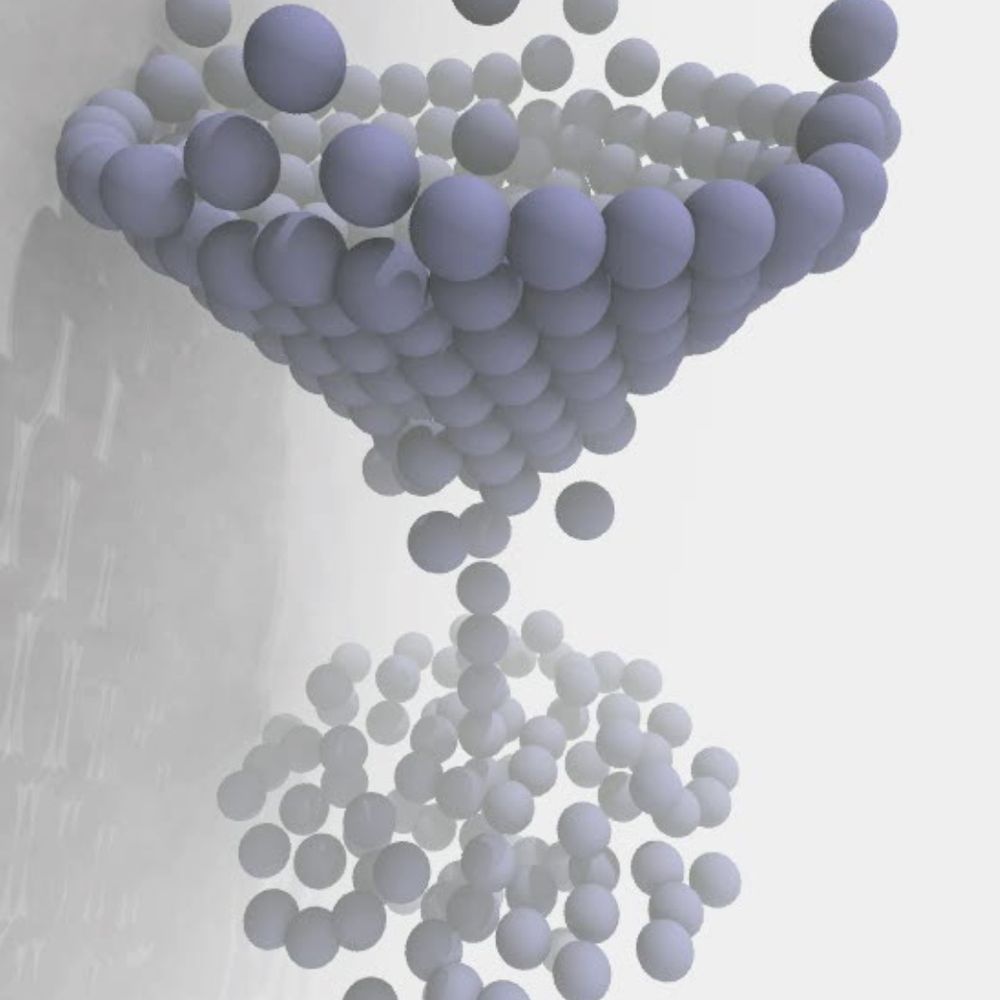
Excellent review including a comprehensive section on what Martini can do in this field: "Computational Methods for Modeling Lipid-Mediated Active Pharmaceutical Ingredient Delivery | Molecular Pharmaceutics" pubs.acs.org/doi/10.1021/...
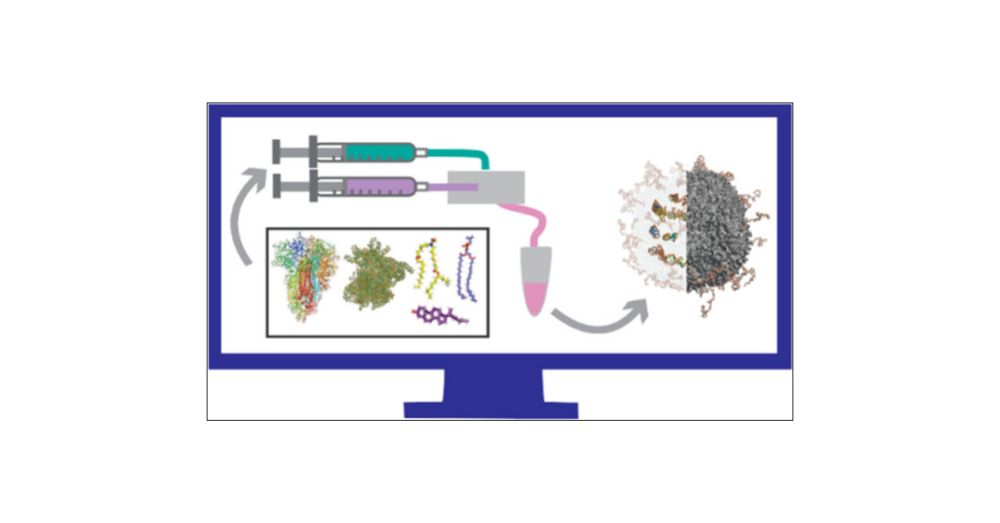
Computational Methods for Modeling Lipid-Mediated Active Pharmaceutical Ingredient Delivery
Lipid-mediated delivery of active pharmaceutical ingredients (API) opened new possibilities in advanced therapies. By encapsulating an API into a lipid nanocarrier (LNC), one can safely deliver APIs n...
pubs.acs.org
February 1, 2025 at 11:25 AM
Excellent review including a comprehensive section on what Martini can do in this field: "Computational Methods for Modeling Lipid-Mediated Active Pharmaceutical Ingredient Delivery | Molecular Pharmaceutics" pubs.acs.org/doi/10.1021/...
Reposted by Tien Phan
Ten simple rules for developing good reading habits during graduate school and beyond
To me, the most important are:
Read often, read broadly (incl. older papers and outside your field), and learn to read some papers in detail and others more superficially (and quickly)
To me, the most important are:
Read often, read broadly (incl. older papers and outside your field), and learn to read some papers in detail and others more superficially (and quickly)

January 26, 2025 at 10:15 AM
Ten simple rules for developing good reading habits during graduate school and beyond
To me, the most important are:
Read often, read broadly (incl. older papers and outside your field), and learn to read some papers in detail and others more superficially (and quickly)
To me, the most important are:
Read often, read broadly (incl. older papers and outside your field), and learn to read some papers in detail and others more superficially (and quickly)
Reposted by Tien Phan

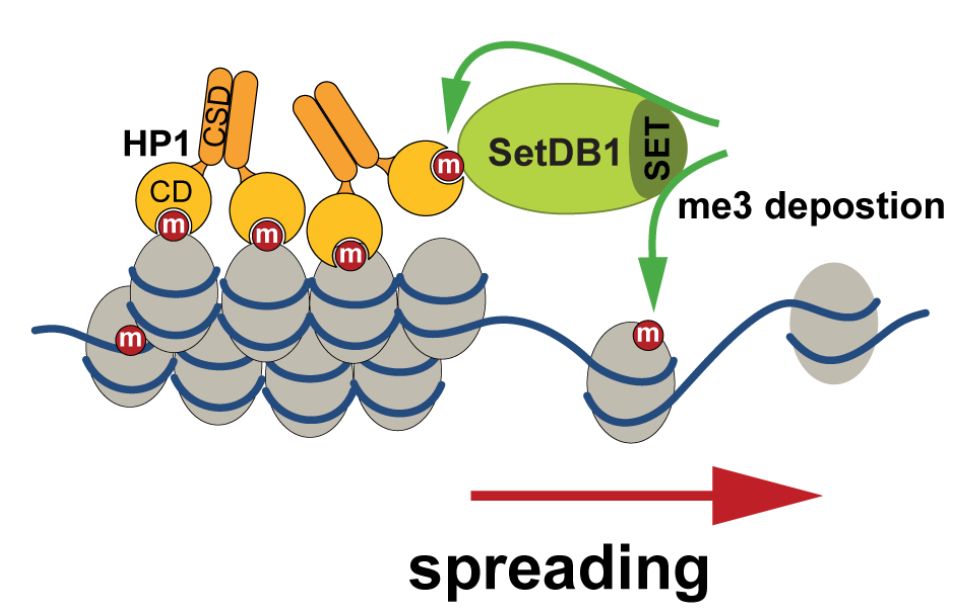
A mechanism for maintaining and spreading H3K9me3 in heterochromatin from the Fejes Toth and Aravin labs that depends on the local H3K9me3 density: HP1 dimers recruit SetDB1 to chromatin by simultaneously binding H3K9me3 on histone H3 and auto-methylated SetDB1. www.biorxiv.org/content/10.1...
January 25, 2025 at 9:17 AM
A mechanism for maintaining and spreading H3K9me3 in heterochromatin from the Fejes Toth and Aravin labs that depends on the local H3K9me3 density: HP1 dimers recruit SetDB1 to chromatin by simultaneously binding H3K9me3 on histone H3 and auto-methylated SetDB1. www.biorxiv.org/content/10.1...
Reposted by Tien Phan
What is the multiscale structure of chromatin condensates? How does it shape thermodynamic and material properties?
We address this at near-atomistic resolution🔥🔥🔥 using cryoET (Rosen & Villa labs, led by H Zhou), a new multiscale model (K Russell) and cryoET-guided sims (J Huertas & J Maristany)
We address this at near-atomistic resolution🔥🔥🔥 using cryoET (Rosen & Villa labs, led by H Zhou), a new multiscale model (K Russell) and cryoET-guided sims (J Huertas & J Maristany)
January 23, 2025 at 9:32 AM
What is the multiscale structure of chromatin condensates? How does it shape thermodynamic and material properties?
We address this at near-atomistic resolution🔥🔥🔥 using cryoET (Rosen & Villa labs, led by H Zhou), a new multiscale model (K Russell) and cryoET-guided sims (J Huertas & J Maristany)
We address this at near-atomistic resolution🔥🔥🔥 using cryoET (Rosen & Villa labs, led by H Zhou), a new multiscale model (K Russell) and cryoET-guided sims (J Huertas & J Maristany)
Reposted by Tien Phan

Feng et al. propose a two-stage sampling to train electron density ML models using under 0.015% of grid points, yet achieving ∼0.001 e/ų error for broad systems (e.g., QM9, H₂O/Pt). The approach also captures field-driven charge transfers in metals with minimal cost. pubs.acs.org/doi/full/10....

Efficient Sampling for Machine Learning Electron Density and Its Response in Real Space
Electron density is a fundamental quantity that can in principle determine all ground state electronic properties of a given system. Although machine learning (ML) models for electron density based on either an atom-centered basis or a real-space grid have been proposed, the demand for a number of high-order basis functions or grid points is enormous. In this work, we propose an efficient grid-point sampling strategy that combines targeted sampling favoring a large density and a screening of grid points associated with linearly independent atomic features. This new sampling strategy is integrated with a field-induced recursively embedded atom neural network model to develop a real-space grid-based ML model for the electron density and its response to an electric field. This approach is applied to a QM9 molecular data set, a H2O/Pt(111) interfacial system, an Au(100) electrode, and an Au nanoparticle under an electric field. The number of training points is found to be much smaller than previous models, while yielding comparably accurate predictions for the electron density of the entire grid. The resultant machine-learned electron density model enables us to properly partition partial charge onto each atom and analyze the charge variation upon proton transfer in the H2O/Pt(111) system. The machine-learning electronic response model allows us to predict charge transfer and the electrostatic potential change induced by an electric field applied to an Au(100) electrode or an Au nanoparticle.
pubs.acs.org
January 4, 2025 at 5:13 PM
Feng et al. propose a two-stage sampling to train electron density ML models using under 0.015% of grid points, yet achieving ∼0.001 e/ų error for broad systems (e.g., QM9, H₂O/Pt). The approach also captures field-driven charge transfers in metals with minimal cost. pubs.acs.org/doi/full/10....
Reposted by Tien Phan
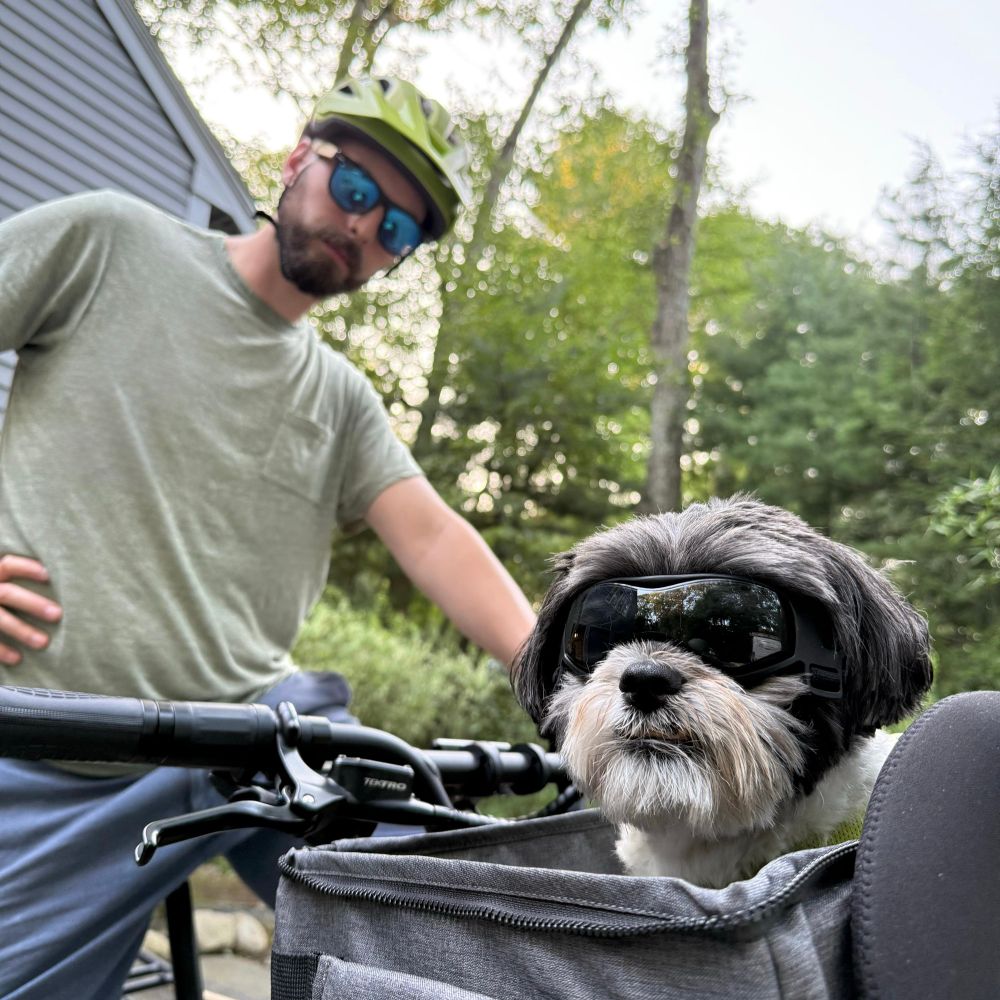
A method for integrating externally calculated potentials from any Python package of interest into OpenMM, courtesy of ByteDance, which I must stress again is the parent company of TikTok
January 1, 2025 at 9:50 PM
A method for integrating externally calculated potentials from any Python package of interest into OpenMM, courtesy of ByteDance, which I must stress again is the parent company of TikTok
Reposted by Tien Phan

Here is the link to our new collaborative paper with Sijbren Otto and his team: "Departure from randomness: Evolution of self-replicators that can self-sort through steric zipper formation": www.sciencedirect.com/science/arti.... #Amyloid principles in self assembly

Departure from randomness: Evolution of self-replicators that can self-sort through steric zipper formation
Darwinian evolution of self-replicating entities most likely played a key role in the emergence of life from inanimate matter. For evolution to occur,…
www.sciencedirect.com
December 28, 2024 at 8:59 AM
Here is the link to our new collaborative paper with Sijbren Otto and his team: "Departure from randomness: Evolution of self-replicators that can self-sort through steric zipper formation": www.sciencedirect.com/science/arti.... #Amyloid principles in self assembly
Reposted by Tien Phan

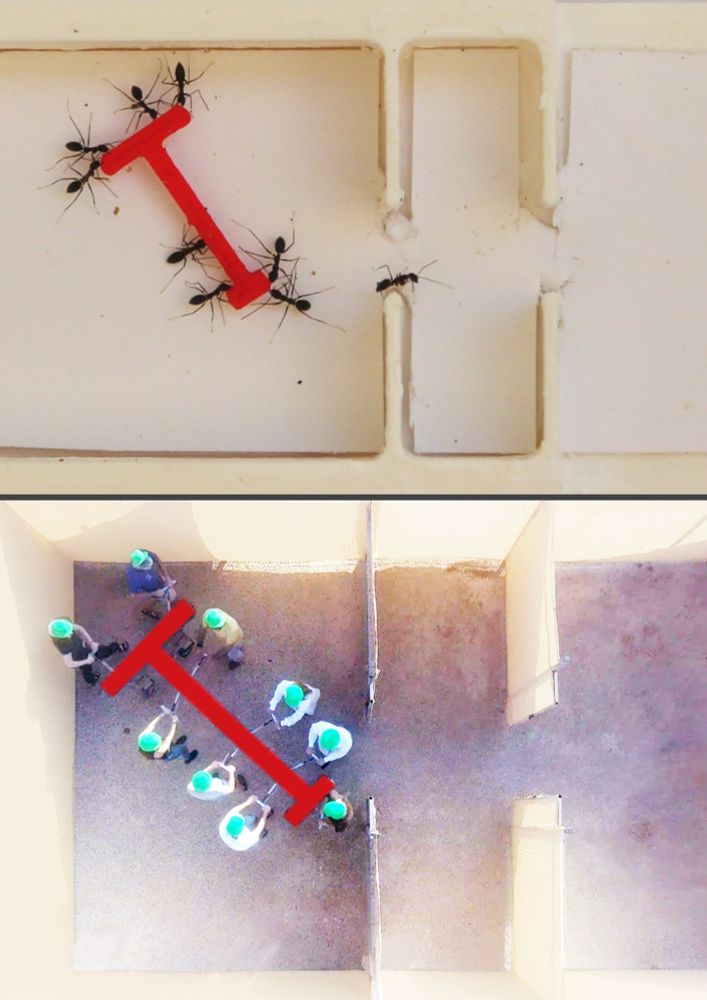
Researchers challenged longhorn crazy ants and humans with the same task: maneuvering a T-shaped object through two consecutive open doorways. Single humans always outperformed single ants, but ant groups could beat human groups. In PNAS: www.pnas.org/doi/10.1073/...
December 27, 2024 at 9:03 PM
Researchers challenged longhorn crazy ants and humans with the same task: maneuvering a T-shaped object through two consecutive open doorways. Single humans always outperformed single ants, but ant groups could beat human groups. In PNAS: www.pnas.org/doi/10.1073/...
Reposted by Tien Phan

Deep learning for proteins tutorial: github.com/Graylab/DL4P...
GitHub - Graylab/DL4Proteins-notebooks: Colab Notebooks covering deep learning tools for biomolecular structure prediction and design
Colab Notebooks covering deep learning tools for biomolecular structure prediction and design - Graylab/DL4Proteins-notebooks
github.com
December 28, 2024 at 3:15 AM
Deep learning for proteins tutorial: github.com/Graylab/DL4P...
Reposted by Tien Phan
Super excited to preprint our work on developing a Biomolecular Emulator (BioEmu): Scalable emulation of protein equilibrium ensembles with generative deep learning from @msftresearch.bsky.social ch AI for Science.
www.biorxiv.org/content/10.1...
www.biorxiv.org/content/10.1...
December 6, 2024 at 8:39 AM
Super excited to preprint our work on developing a Biomolecular Emulator (BioEmu): Scalable emulation of protein equilibrium ensembles with generative deep learning from @msftresearch.bsky.social ch AI for Science.
www.biorxiv.org/content/10.1...
www.biorxiv.org/content/10.1...
Reposted by Tien Phan

#compchem Good read: PLUMED Tutorials: a collaborative, community-driven learning ecosystem #compchemsky arxiv.org/abs/2412.03595

PLUMED Tutorials: a collaborative, community-driven learning ecosystem
In computational physics, chemistry, and biology, the implementation of new techniques in a shared and open source software lowers barriers to entry and promotes rapid scientific progress. However, ef...
arxiv.org
December 8, 2024 at 6:48 AM
#compchem Good read: PLUMED Tutorials: a collaborative, community-driven learning ecosystem #compchemsky arxiv.org/abs/2412.03595
Reposted by Tien Phan
"Are there at least 3 simulations per simulation condition with statistical analysis?"
From @commsbio.bsky.social's "Reliability and reproducibility checklist for molecular dynamics simulations" (doi.org/10.1038/s420...)
IMO the number 3 is meaningless and could equally well be 1 or 1000
From @commsbio.bsky.social's "Reliability and reproducibility checklist for molecular dynamics simulations" (doi.org/10.1038/s420...)
IMO the number 3 is meaningless and could equally well be 1 or 1000
December 7, 2024 at 6:33 PM
"Are there at least 3 simulations per simulation condition with statistical analysis?"
From @commsbio.bsky.social's "Reliability and reproducibility checklist for molecular dynamics simulations" (doi.org/10.1038/s420...)
IMO the number 3 is meaningless and could equally well be 1 or 1000
From @commsbio.bsky.social's "Reliability and reproducibility checklist for molecular dynamics simulations" (doi.org/10.1038/s420...)
IMO the number 3 is meaningless and could equally well be 1 or 1000
Reposted by Tien Phan

Good news everyone! A new version of graph-tool is just out! @graph-tool.skewed.de
graph-tool.skewed.de
Graph-tool is a comprehensive and efficient Python library to work with networks, including structural, dynamical, and statistical algorithms, as well as visualization. 1/N
#networkscience
graph-tool.skewed.de
Graph-tool is a comprehensive and efficient Python library to work with networks, including structural, dynamical, and statistical algorithms, as well as visualization. 1/N
#networkscience
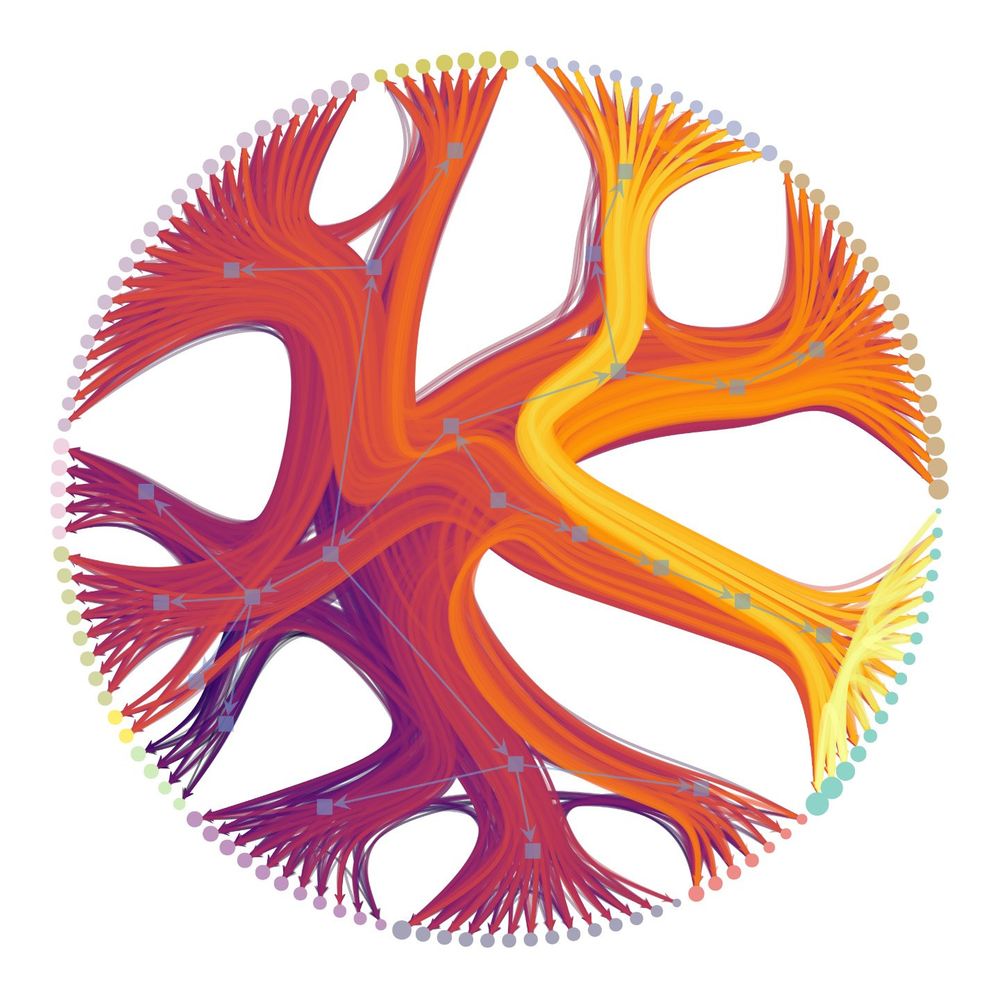
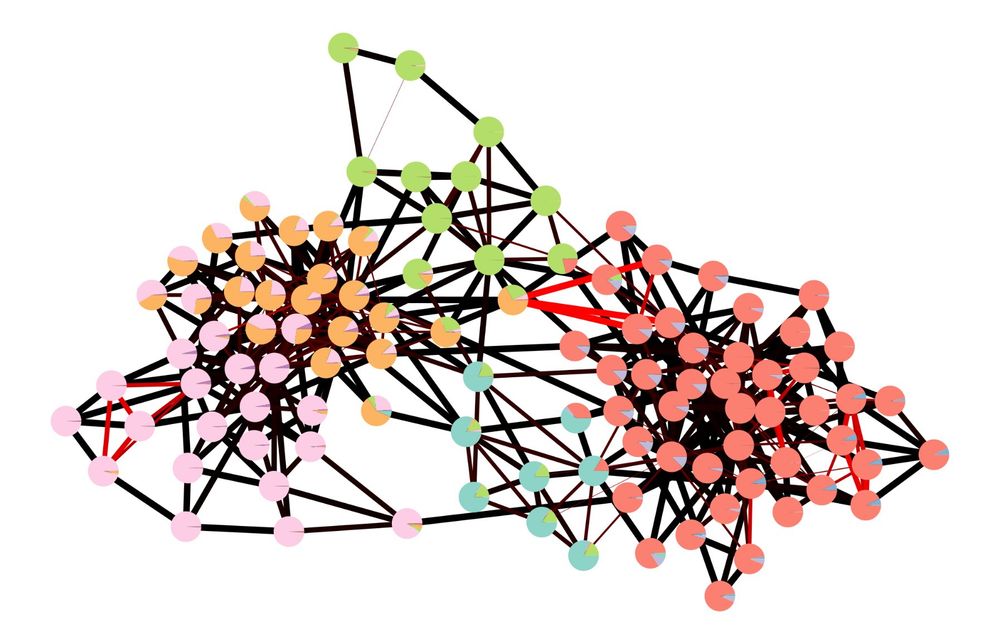
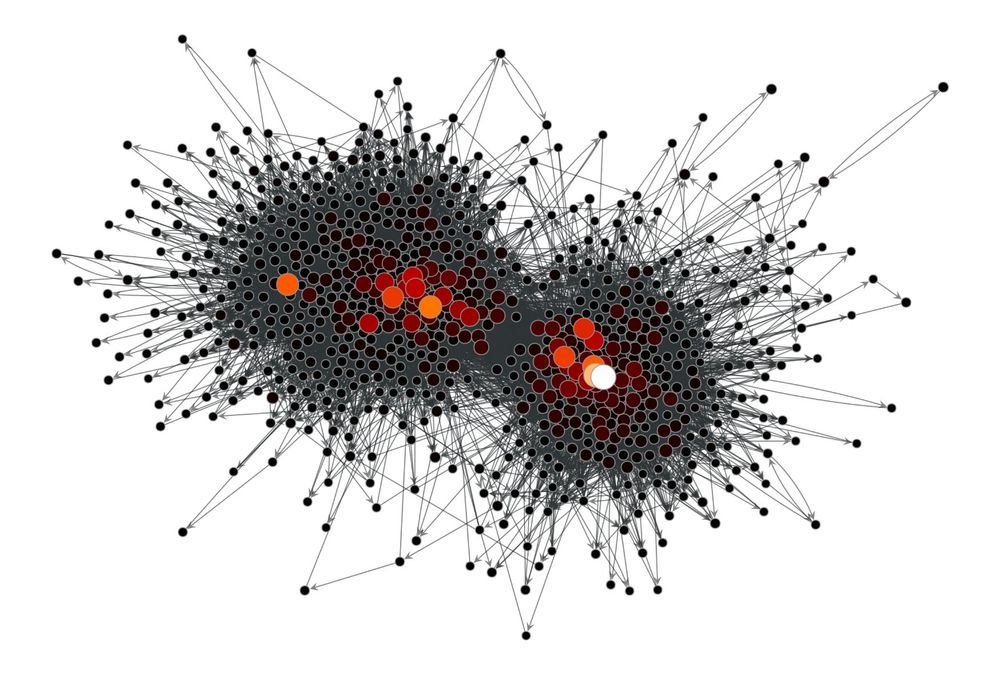
December 2, 2024 at 12:55 PM
Good news everyone! A new version of graph-tool is just out! @graph-tool.skewed.de
graph-tool.skewed.de
Graph-tool is a comprehensive and efficient Python library to work with networks, including structural, dynamical, and statistical algorithms, as well as visualization. 1/N
#networkscience
graph-tool.skewed.de
Graph-tool is a comprehensive and efficient Python library to work with networks, including structural, dynamical, and statistical algorithms, as well as visualization. 1/N
#networkscience
Reposted by Tien Phan
If you're interested in reading about how I got into biophysics and protein science and what I enjoy about the field, I'm profiled this month by the Biophysical Society:
www.biophysics.org/profiles/kre...
www.biophysics.org/profiles/kre...

Kresten Lindorff-Larsen
Kresten Lindorff-Larsen, Professor at the Linderstrøm-Lang Centre for Protein Science in the Department of Biology, University of Copenhagen, studied biochemistry, leading him to...
www.biophysics.org
May 6, 2024 at 1:02 PM
If you're interested in reading about how I got into biophysics and protein science and what I enjoy about the field, I'm profiled this month by the Biophysical Society:
www.biophysics.org/profiles/kre...
www.biophysics.org/profiles/kre...
Reposted by Tien Phan

A project 10 years in the making w/ Terry Sejnowski, led by
@philosophaki.bsky.social
Insights into ryanodine receptor activation & calcium-induced Ca2+ release from a stochastic explicit-particle 3D simulation of cardiac dyad w/ realistic TEM geometry 🧪
www.sciencedirect.com/science/arti...
@philosophaki.bsky.social
Insights into ryanodine receptor activation & calcium-induced Ca2+ release from a stochastic explicit-particle 3D simulation of cardiac dyad w/ realistic TEM geometry 🧪
www.sciencedirect.com/science/arti...
November 26, 2024 at 2:39 PM
A project 10 years in the making w/ Terry Sejnowski, led by
@philosophaki.bsky.social
Insights into ryanodine receptor activation & calcium-induced Ca2+ release from a stochastic explicit-particle 3D simulation of cardiac dyad w/ realistic TEM geometry 🧪
www.sciencedirect.com/science/arti...
@philosophaki.bsky.social
Insights into ryanodine receptor activation & calcium-induced Ca2+ release from a stochastic explicit-particle 3D simulation of cardiac dyad w/ realistic TEM geometry 🧪
www.sciencedirect.com/science/arti...
Reposted by Tien Phan
Some fun with Boltz-1 (www.biorxiv.org/content/10.1...). I generated 1000 samples profilin (green) and compare them to the NMR structures (cyan). Samples were generated by docking 1000 random ligands. NMR structures show more conformational diversity.
November 21, 2024 at 9:40 PM
Some fun with Boltz-1 (www.biorxiv.org/content/10.1...). I generated 1000 samples profilin (green) and compare them to the NMR structures (cyan). Samples were generated by docking 1000 random ligands. NMR structures show more conformational diversity.
Reposted by Tien Phan
Here is how Boltz-1 (green), DynamicBind (magenta), and GNINA (blue) dock a collection of random molecules. GNINA, using a classical sampling algorithm (MCMC) hits all concave regions while the ML samplers have distinct preferences. Boltz is the most likely to induce a fit.
November 22, 2024 at 6:27 PM
Here is how Boltz-1 (green), DynamicBind (magenta), and GNINA (blue) dock a collection of random molecules. GNINA, using a classical sampling algorithm (MCMC) hits all concave regions while the ML samplers have distinct preferences. Boltz is the most likely to induce a fit.
Reposted by Tien Phan
🚨Announcing NetSci: a super fast tool to compute correlated motion in biomolecules
pubs.acs.org/doi/10.1021/...
@pabloarantes.bsky.social & team also made it into a Colab notebook:
colab.research.google.com/drive/1GGJKr...
Give it a try & send feedback!
pubs.acs.org/doi/10.1021/...
@pabloarantes.bsky.social & team also made it into a Colab notebook:
colab.research.google.com/drive/1GGJKr...
Give it a try & send feedback!

NetSci: A Library for High Performance Biomolecular Simulation Network Analysis Computation
We present the NetSci program–an open-source scientific software package designed for estimating mutual information (MI) between data sets using GPU acceleration and a k-nearest-neighbor algorithm. This approach significantly enhances calculation speed, achieving improvements of several orders of magnitude over traditional CPU-based methods, with data set size limits dictated only by available hardware. To validate NetSci, we accurately compute MI for an analytically verifiable two-dimensional Gaussian distribution and replicate the generalized correlation (GC) analysis previously conducted on the B1 domain of protein G. We also apply NetSci to molecular dynamics simulations of the Sarcoendoplasmic Reticulum Calcium-ATPase (SERCA) pump, exploring the allosteric mechanisms and pathways influenced by ATP and 2′-deoxy-ATP (dATP) binding. Our analysis reveals distinct allosteric effects induced by ATP compared to dATP, with predicted information pathways from the bound nucleotide to the calcium-binding domain differing based on the nucleotide involved. NetSci proves to be a valuable tool for estimating MI and GC in various data sets and is particularly effective for analyzing intraprotein communication and information transfer.
pubs.acs.org
November 18, 2024 at 6:49 PM
🚨Announcing NetSci: a super fast tool to compute correlated motion in biomolecules
pubs.acs.org/doi/10.1021/...
@pabloarantes.bsky.social & team also made it into a Colab notebook:
colab.research.google.com/drive/1GGJKr...
Give it a try & send feedback!
pubs.acs.org/doi/10.1021/...
@pabloarantes.bsky.social & team also made it into a Colab notebook:
colab.research.google.com/drive/1GGJKr...
Give it a try & send feedback!