




Brenden Tervo-Clemmens
@tervoclemmensb.bsky.social
Assistant Professor, University of Minnesota
Developmental Neuroscience | Substance Use | Quantitative Methods.
he/him.
Views are my own.
Developmental Neuroscience | Substance Use | Quantitative Methods.
he/him.
Views are my own.

Can’t wait to send this self-serving “AI generated text” to reviewer 2 when they (rightfully) point out my long and winding sentences….
blueskyroast.com/roast/tervoc...
blueskyroast.com/roast/tervoc...

December 1, 2024 at 1:39 PM
Can’t wait to send this self-serving “AI generated text” to reviewer 2 when they (rightfully) point out my long and winding sentences….
blueskyroast.com/roast/tervoc...
blueskyroast.com/roast/tervoc...
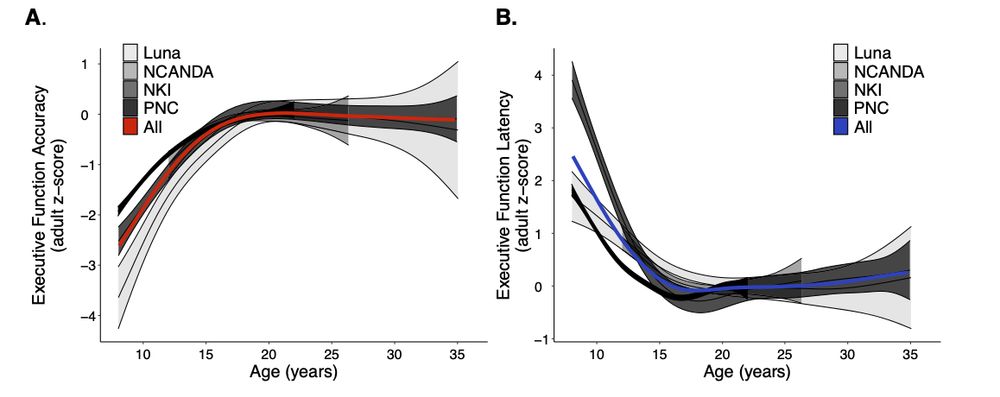
This then clarifies how for example composite metrics constructed from varying EF task batteries align in their shape and timing across datasets.
November 1, 2023 at 9:01 PM
This then clarifies how for example composite metrics constructed from varying EF task batteries align in their shape and timing across datasets.
What explains all this consistency? Note some included datasets had zero overlapping EF measures. Consistent with work in adults, which had not yet been well tested in dev., we found that EF performance was generally well described by a low dimensional, domain general process.

November 1, 2023 at 9:01 PM
What explains all this consistency? Note some included datasets had zero overlapping EF measures. Consistent with work in adults, which had not yet been well tested in dev., we found that EF performance was generally well described by a low dimensional, domain general process.
This would then seem to imply that maturity among EFs (no more change) aligns with notions of adolescence as the second decade of life. A parallel analysis that examined maturational timing via effect size reveals the same pattern.

November 1, 2023 at 9:00 PM
This would then seem to imply that maturity among EFs (no more change) aligns with notions of adolescence as the second decade of life. A parallel analysis that examined maturational timing via effect size reveals the same pattern.
With these models, we explicitly tested ages with local (first deriv.), sig. age-related increases (red) and decreases (blue). Individual measures and aggregates reveal sig. differences from late childhood to mid-adolescence and a stabilization towards adult levels from 15-18-y.o

November 1, 2023 at 9:00 PM
With these models, we explicitly tested ages with local (first deriv.), sig. age-related increases (red) and decreases (blue). Individual measures and aggregates reveal sig. differences from late childhood to mid-adolescence and a stabilization towards adult levels from 15-18-y.o
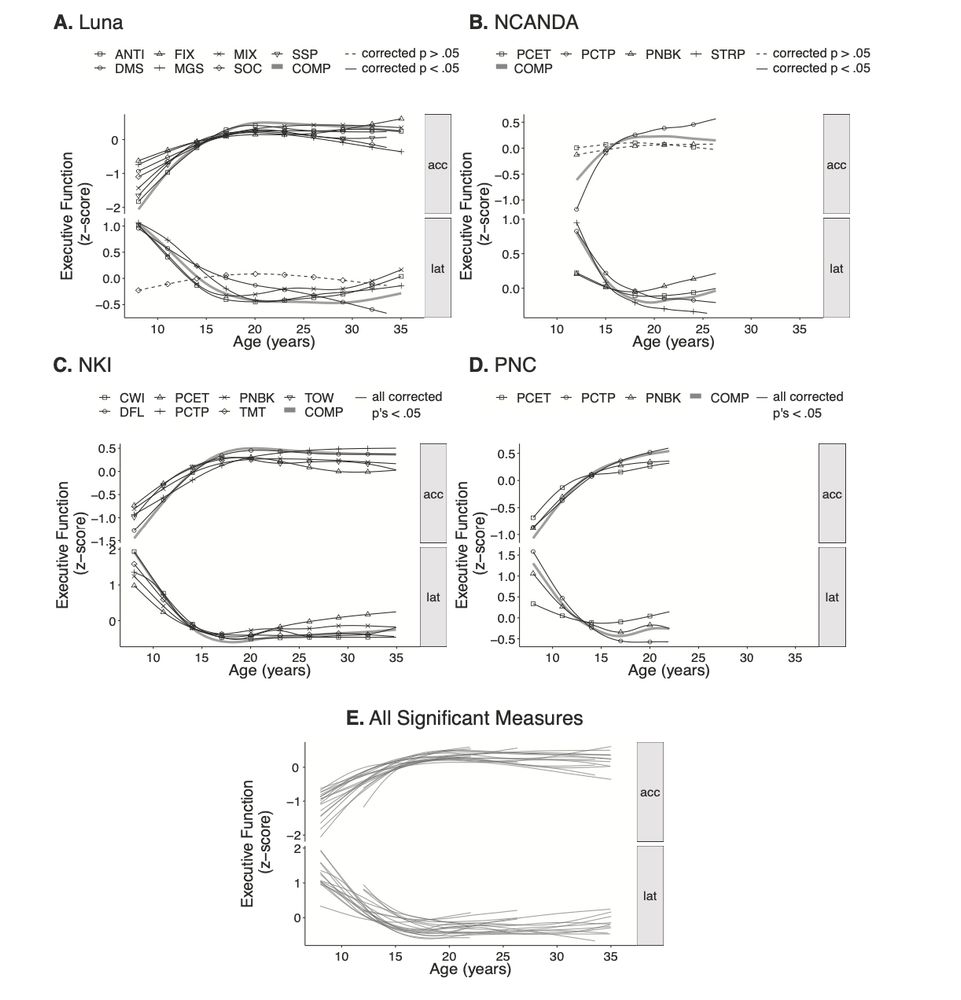
Fit independently (using GAM/GAMM models), performance across executive function tasks and datasets converge onto a common non-linear developmental shape/functional form of age. Nearly all measures show corrected, significant age-related differences.
November 1, 2023 at 8:59 PM
Fit independently (using GAM/GAMM models), performance across executive function tasks and datasets converge onto a common non-linear developmental shape/functional form of age. Nearly all measures show corrected, significant age-related differences.
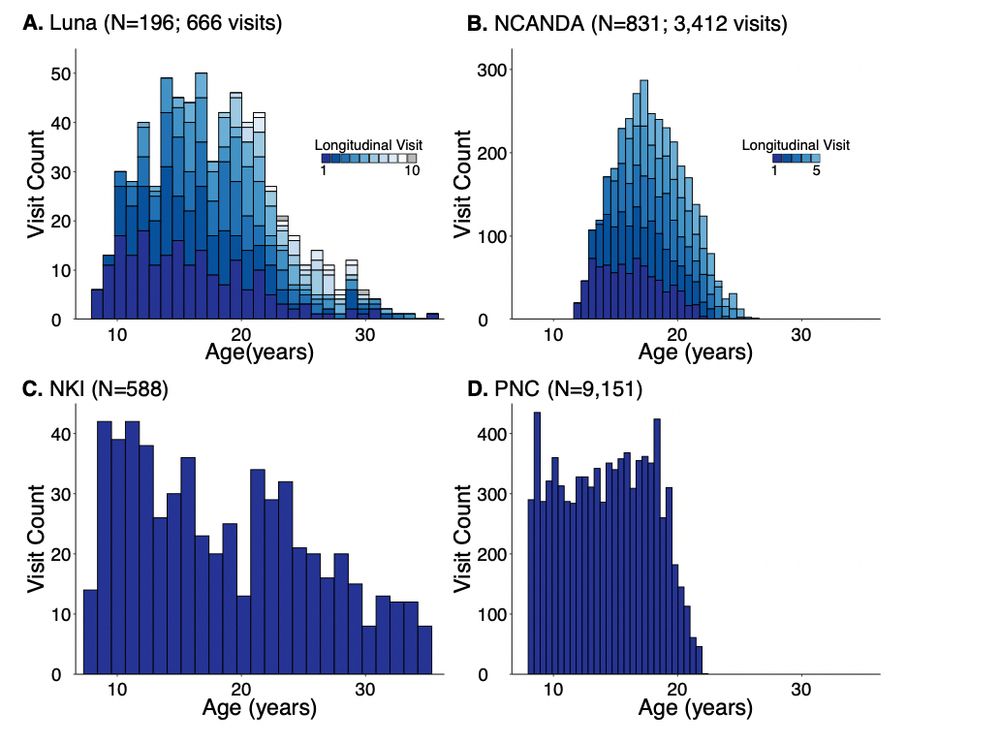
We sought to comprehensively test these ideas using multiple large, independent datasets (two longitudinal: Luna, NCANDA; two cross-sectional: NKI, PNC), each of which included executive function measures across the full adolescent period.
November 1, 2023 at 8:59 PM
We sought to comprehensively test these ideas using multiple large, independent datasets (two longitudinal: Luna, NCANDA; two cross-sectional: NKI, PNC), each of which included executive function measures across the full adolescent period.
Both contemporary and historical theories of neurobehavioral development suggest executive functions (EF) mature through adolescence. These are often used in various contexts to try to demarcate the developmental boundaries of the adolescent period.


November 1, 2023 at 8:58 PM
Both contemporary and historical theories of neurobehavioral development suggest executive functions (EF) mature through adolescence. These are often used in various contexts to try to demarcate the developmental boundaries of the adolescent period.
Now available at Nature Communications!
When do adolescents reach adult levels of executive function? We used FOUR independent datasets (N>10,000), behavioral data from 17 distinct EF tasks, and nonlinear modeling to address this and related questions.
www.nature.com/articles/s41...
When do adolescents reach adult levels of executive function? We used FOUR independent datasets (N>10,000), behavioral data from 17 distinct EF tasks, and nonlinear modeling to address this and related questions.
www.nature.com/articles/s41...
November 1, 2023 at 8:57 PM
Now available at Nature Communications!
When do adolescents reach adult levels of executive function? We used FOUR independent datasets (N>10,000), behavioral data from 17 distinct EF tasks, and nonlinear modeling to address this and related questions.
www.nature.com/articles/s41...
When do adolescents reach adult levels of executive function? We used FOUR independent datasets (N>10,000), behavioral data from 17 distinct EF tasks, and nonlinear modeling to address this and related questions.
www.nature.com/articles/s41...

September 24, 2023 at 11:10 PM
A recurring reflection on questions during talks after a conference this week:
Graduate Student: Methods Question
Junior Faculty: Question on interpretation/implications/missed citations
Senior Faculty: "It's more of a comment than a question"
Graduate Student: Methods Question
Junior Faculty: Question on interpretation/implications/missed citations
Senior Faculty: "It's more of a comment than a question"

September 10, 2023 at 9:43 PM
A recurring reflection on questions during talks after a conference this week:
Graduate Student: Methods Question
Junior Faculty: Question on interpretation/implications/missed citations
Senior Faculty: "It's more of a comment than a question"
Graduate Student: Methods Question
Junior Faculty: Question on interpretation/implications/missed citations
Senior Faculty: "It's more of a comment than a question"