



Tao Chen
@taochen.bsky.social
Lightly seasoned economist 📈
PhD candidate @UCL
Scholar @IFS @theifs.bsky.social
IO / Demand Estimation/ Consumption
PhD candidate @UCL
Scholar @IFS @theifs.bsky.social
IO / Demand Estimation/ Consumption
In the paper, we also address measurement concerns for cost-of-living change interpretations. We provide suggestive evidences pointing to differential pass-through as the driver of cheapflation leveraging on an earlier cost-shock on imports driven by Brexit referendum. #EconSky
November 27, 2024 at 12:03 PM
In the paper, we also address measurement concerns for cost-of-living change interpretations. We provide suggestive evidences pointing to differential pass-through as the driver of cheapflation leveraging on an earlier cost-shock on imports driven by Brexit referendum. #EconSky
6) How does all of this contribute to inflation inequality we observe? Turns out cheaper products see much higher price hikes, a phenomenon termed “Cheapflation”. This is prevalent across categories and novel in the recent history.

November 27, 2024 at 12:03 PM
6) How does all of this contribute to inflation inequality we observe? Turns out cheaper products see much higher price hikes, a phenomenon termed “Cheapflation”. This is prevalent across categories and novel in the recent history.
5/ How households with different spending power systematically differ on their choices within categories? Poorer households favor cheaper products, increasing their exposure to price changes of those products.

November 27, 2024 at 12:03 PM
5/ How households with different spending power systematically differ on their choices within categories? Poorer households favor cheaper products, increasing their exposure to price changes of those products.
4b/ A conventional CPI calculation, which uses data at category level, would mask a substantial degree of inflation inequality.
November 27, 2024 at 12:03 PM
4b/ A conventional CPI calculation, which uses data at category level, would mask a substantial degree of inflation inequality.
4a/Where does this inequality arise? It turns out that most of the differences in inflation rates across households is not because of differences across categories or types, rather it is driven by differences in what exact products they buy *within* categories.

November 27, 2024 at 12:03 PM
4a/Where does this inequality arise? It turns out that most of the differences in inflation rates across households is not because of differences across categories or types, rather it is driven by differences in what exact products they buy *within* categories.
3/ In a break with recent history, the cost of buying the typical grocery baskets of poorer (lower spending) households also rose by more than richer households. Households in the bottom quarter of spending saw inflation rates 5.6ppt higher than those in top quarter.

November 27, 2024 at 12:03 PM
3/ In a break with recent history, the cost of buying the typical grocery baskets of poorer (lower spending) households also rose by more than richer households. Households in the bottom quarter of spending saw inflation rates 5.6ppt higher than those in top quarter.
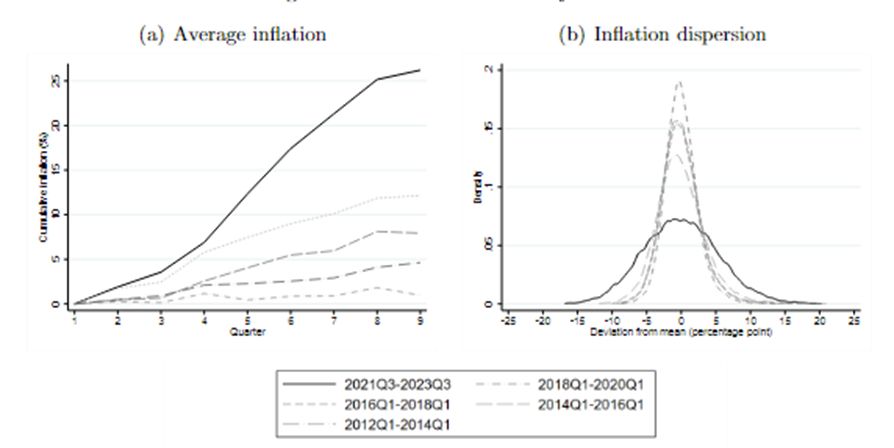
2/ We look at the period September 21 to September 23 using detailed data on grocery purchases. Relative to the past, grocery price inflation was very high. There were also large differences in the inflation different households experienced according to what they bought.
November 27, 2024 at 12:03 PM
2/ We look at the period September 21 to September 23 using detailed data on grocery purchases. Relative to the past, grocery price inflation was very high. There were also large differences in the inflation different households experienced according to what they bought.