



Thom Elston
@t-elston.bsky.social
Assistant Prof. at U.T. Austin
• NHP + Human ephys and cognition
• #Humboldtian
• elstonlab.org
formerly UC Berkeley, Tübingen, and Otago
• NHP + Human ephys and cognition
• #Humboldtian
• elstonlab.org
formerly UC Berkeley, Tübingen, and Otago
any chance the dept. is open to a primate user?
September 24, 2023 at 5:16 PM
any chance the dept. is open to a primate user?
Definitely yes, although it feels like behavior alone needs now to be part of a neuropipeline. I do pure behavior in people to ID tasks/effects which I'll then characterize neurophysiologically in primates. Still, without convincing/cool behavior, it's not worth looking at the brain
September 16, 2023 at 4:45 PM
Definitely yes, although it feels like behavior alone needs now to be part of a neuropipeline. I do pure behavior in people to ID tasks/effects which I'll then characterize neurophysiologically in primates. Still, without convincing/cool behavior, it's not worth looking at the brain
loved the first one, for sure
September 10, 2023 at 7:43 AM
loved the first one, for sure
A similar line of reasoning could be applied to credit-assignment during learning - distinct value sub-circuits for each state could make it easier to understand why an outcome occurred in one scenario without affecting the other. [13/n]
September 10, 2023 at 12:58 AM
A similar line of reasoning could be applied to credit-assignment during learning - distinct value sub-circuits for each state could make it easier to understand why an outcome occurred in one scenario without affecting the other. [13/n]
Why would OFC have state-specific subcircuits for value? I think it's to facilitate cognitive control. In the task, a low value opt in state A is a high value opt in state B. A single subcircuit could have conflict as to which value to assign. Subcircuits side-step that. [12/n]
September 10, 2023 at 12:58 AM
Why would OFC have state-specific subcircuits for value? I think it's to facilitate cognitive control. In the task, a low value opt in state A is a high value opt in state B. A single subcircuit could have conflict as to which value to assign. Subcircuits side-step that. [12/n]
What does this imply? 1: HPC initially constructs/sets the cognitive map; OFC uses the cognitive map to guide choice. 2: There is no "common currency" for value in the OFC (as was widely believed). 3: Cognition arises via rhythmic interactions between brain areas. [11/n]
September 10, 2023 at 12:58 AM
What does this imply? 1: HPC initially constructs/sets the cognitive map; OFC uses the cognitive map to guide choice. 2: There is no "common currency" for value in the OFC (as was widely believed). 3: Cognition arises via rhythmic interactions between brain areas. [11/n]
Taken together, these results suggest that HPC initially encodes state as it becomes available and then relays that to OFC via theta coherence. This has the effect of activating distinct, state-specific subcircuits for value, thus allowing for contextual reasoning in value-based choice. [10/n]
September 10, 2023 at 12:57 AM
Taken together, these results suggest that HPC initially encodes state as it becomes available and then relays that to OFC via theta coherence. This has the effect of activating distinct, state-specific subcircuits for value, thus allowing for contextual reasoning in value-based choice. [10/n]
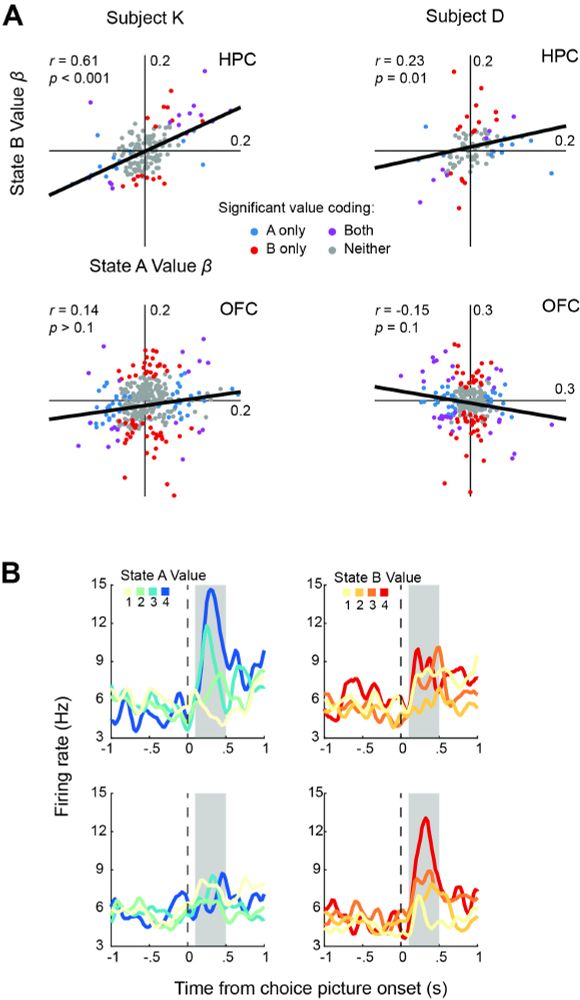
This indicates that distinct subcircuits within the OFC encode value within each task state and suggests OFC value coding is far more flexible than previously thought. Interestingly, HPC neurons generalized their value code across task-states. [9/n]
September 10, 2023 at 12:57 AM
This indicates that distinct subcircuits within the OFC encode value within each task state and suggests OFC value coding is far more flexible than previously thought. Interestingly, HPC neurons generalized their value code across task-states. [9/n]
OFC neurons famously encode value. Does OFC's value code generalize across task-states? Turns out, no! I regressed each neuron's firing rates against value for choices in each state, and then correlated the betas. Most OFC neurons encoded value in only one state! [8/n]
September 10, 2023 at 12:56 AM
OFC neurons famously encode value. Does OFC's value code generalize across task-states? Turns out, no! I regressed each neuron's firing rates against value for choices in each state, and then correlated the betas. Most OFC neurons encoded value in only one state! [8/n]
So far, this suggests that HPC encodes state information as it becomes available and then may relay that information to OFC via theta coherence. But what happens when state information arrives in OFC? [7/n]
September 10, 2023 at 12:56 AM
So far, this suggests that HPC encodes state information as it becomes available and then may relay that information to OFC via theta coherence. But what happens when state information arrives in OFC? [7/n]
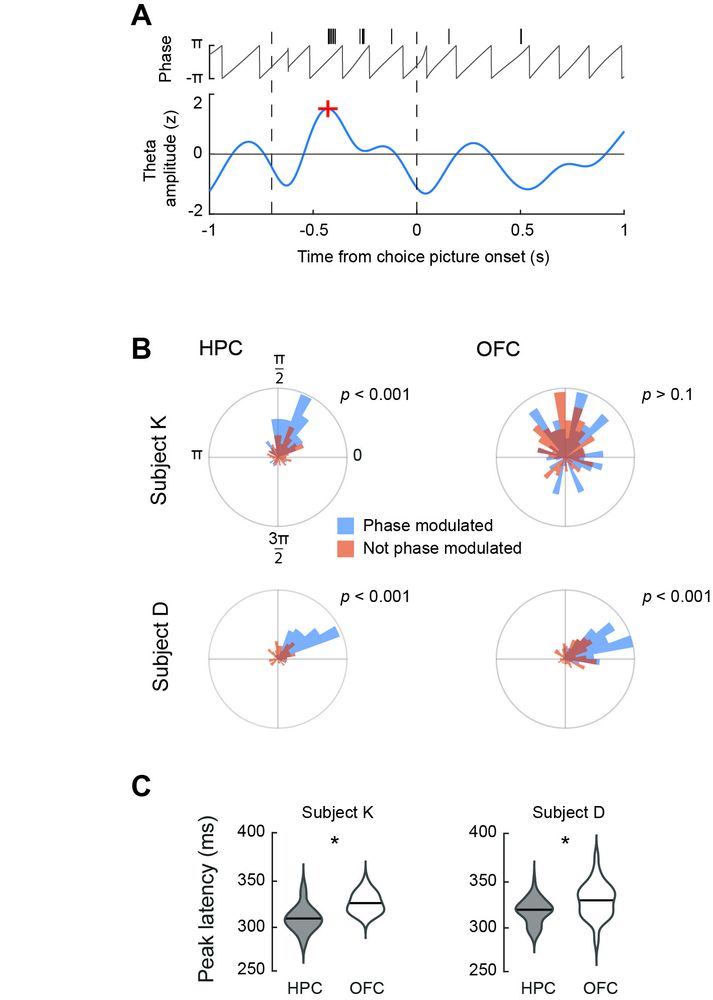
Several lines of evidence suggest HPC is the sender: HPC neurons were phase-locked to the rising phase of theta and single-trial HPC theta amplitude peaks preceded those in OFC. Partial directed coherence models also suggested HPC->OFC directionality. [6/n]
September 10, 2023 at 12:56 AM
Several lines of evidence suggest HPC is the sender: HPC neurons were phase-locked to the rising phase of theta and single-trial HPC theta amplitude peaks preceded those in OFC. Partial directed coherence models also suggested HPC->OFC directionality. [6/n]
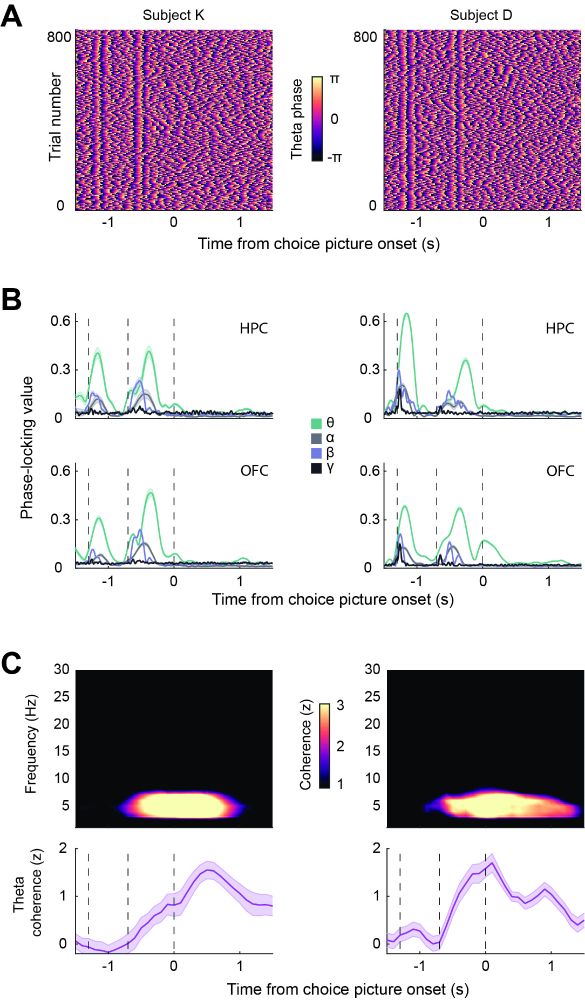
HPC and OFC are strongly connected and next I wanted to see if they communicate. LFP Theta (4-8 Hz) responses were present on every trial and HPC-OFC theta coherence ramps, starting at the state cue and peaking at the choice, suggesting that HPC and OFC are communicating. [5/n]
September 10, 2023 at 12:55 AM
HPC and OFC are strongly connected and next I wanted to see if they communicate. LFP Theta (4-8 Hz) responses were present on every trial and HPC-OFC theta coherence ramps, starting at the state cue and peaking at the choice, suggesting that HPC and OFC are communicating. [5/n]
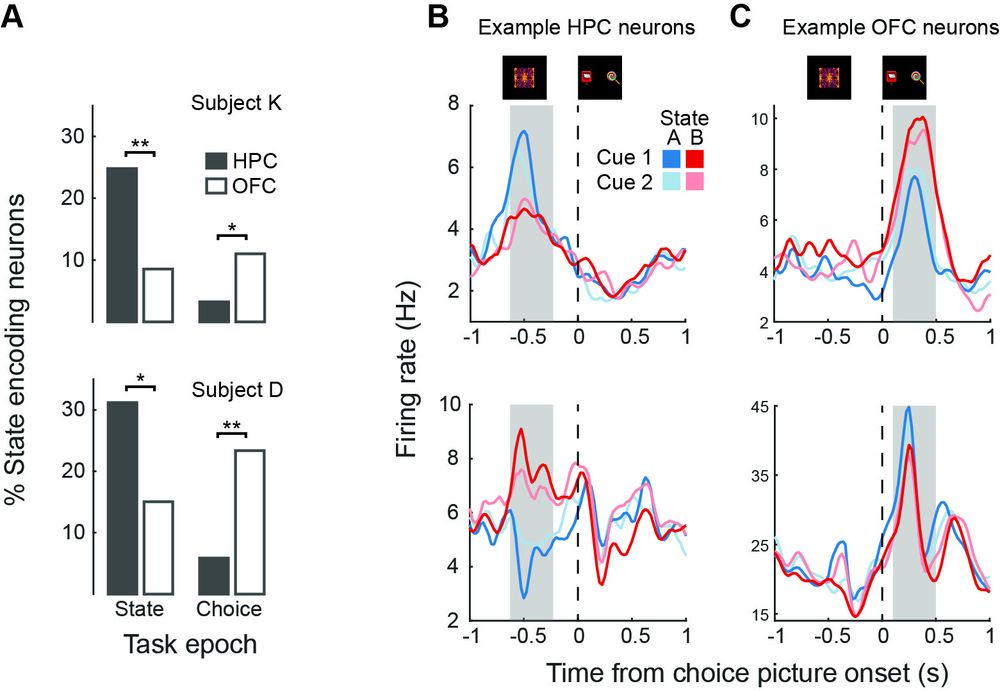
I found a functional double-dissociation between HPC and OFC: HPC (but not OFC) neurons encode state information as it becomes available and, at the choice, OFC (but not HPC) neurons encode state. In other words, HPC sets the system state that OFC then uses to guide choice. [4/n]
September 10, 2023 at 12:55 AM
I found a functional double-dissociation between HPC and OFC: HPC (but not OFC) neurons encode state information as it becomes available and, at the choice, OFC (but not HPC) neurons encode state. In other words, HPC sets the system state that OFC then uses to guide choice. [4/n]
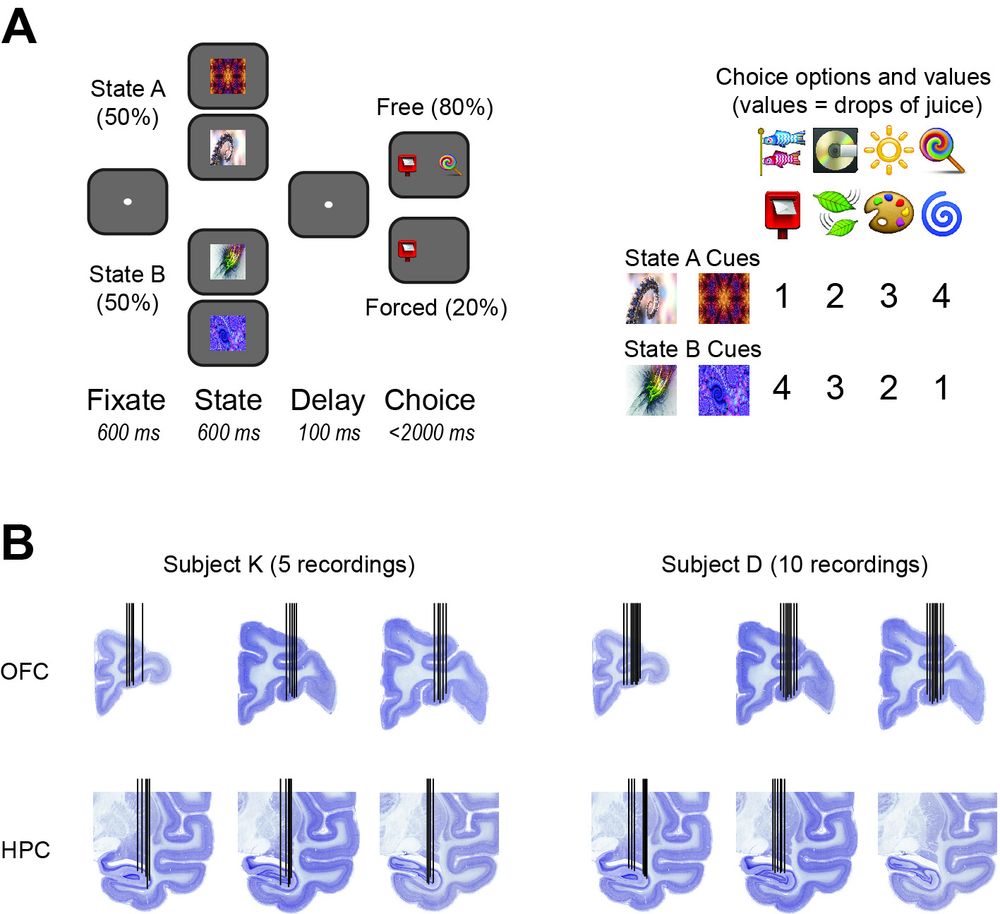
To address this, I recorded from HPC and OFC in two non-human primates (NHPs) performing a state-dependent choice task. On each trial, the NHPs were cued as to which of two value schemes to apply to an array of 8 choice options. The task state changed trial-to-trial. [3/n]
September 10, 2023 at 12:54 AM
To address this, I recorded from HPC and OFC in two non-human primates (NHPs) performing a state-dependent choice task. On each trial, the NHPs were cued as to which of two value schemes to apply to an array of 8 choice options. The task state changed trial-to-trial. [3/n]
Hippocampus (HPC) and orbitofrontal cortex (OFC) have both been proposed to carry cognitive maps but their precise roles in intializing vs utilizing an internal world model is controversial. The goal was to understand how each region contributes to model-driven behavior. [2/n]
September 10, 2023 at 12:54 AM
Hippocampus (HPC) and orbitofrontal cortex (OFC) have both been proposed to carry cognitive maps but their precise roles in intializing vs utilizing an internal world model is controversial. The goal was to understand how each region contributes to model-driven behavior. [2/n]
What seems good in one context might seem bad in another. Although we use contextual reasoning everyday, how the brain does this has remained unclear. Cognitive map theory offers a suggestion: the brain carries flexible, internal models of the world.
September 10, 2023 at 12:51 AM
What seems good in one context might seem bad in another. Although we use contextual reasoning everyday, how the brain does this has remained unclear. Cognitive map theory offers a suggestion: the brain carries flexible, internal models of the world.