



Shing
@szhan.bsky.social
Studying microbial evolution and recombination using computers and genomics | Views my own | https://ecoevo.social/@shzhan | https://scholar.google.ca/citations?user=2nS6Z44AAAAJ&hl=en
Reposted by Shing

www.biorxiv.org/content/10.1...
We finally submitted the earlier preprint to a journal after massive restructuring.
We've expanded the REML section for those interested in the method. We clarify that ARG-LMM estimates mutational variance and not additive variance.
We finally submitted the earlier preprint to a journal after massive restructuring.
We've expanded the REML section for those interested in the method. We clarify that ARG-LMM estimates mutational variance and not additive variance.

Genetic prediction with ARG-powered linear algebra
Ancestral recombination graphs (ARGs) are an attractive means for quantitative genetic analysis of complex traits because they encode the realized genetic relatedness between a sample of individuals i...
www.biorxiv.org
November 30, 2025 at 5:08 PM
www.biorxiv.org/content/10.1...
We finally submitted the earlier preprint to a journal after massive restructuring.
We've expanded the REML section for those interested in the method. We clarify that ARG-LMM estimates mutational variance and not additive variance.
We finally submitted the earlier preprint to a journal after massive restructuring.
We've expanded the REML section for those interested in the method. We clarify that ARG-LMM estimates mutational variance and not additive variance.
Reposted by Shing

With @szhan.bsky.social, @yulinzhang.bsky.social, Chao Zhang and Bingjie Chen, we wrote a Perspective about unifying the tree-based method across phylogenetics, population genetics and cell biology: arxiv.org/abs/2512.05499.
Reposts are greatly appreciated!
Reposts are greatly appreciated!

Tree Thinking in the Genomic Era: Unifying Models Across Cells, Populations, and Species
The ongoing explosion of genome sequence data is transforming how we reconstruct and understand the histories of biological systems. Across biological scales, from individual cells to populations and ...
arxiv.org
December 9, 2025 at 3:26 AM
With @szhan.bsky.social, @yulinzhang.bsky.social, Chao Zhang and Bingjie Chen, we wrote a Perspective about unifying the tree-based method across phylogenetics, population genetics and cell biology: arxiv.org/abs/2512.05499.
Reposts are greatly appreciated!
Reposts are greatly appreciated!
Reposted by Shing

Come one come all! Come get involved in stdpopsim and help us decide where to go from here!

The PopSim Consortium wants you! Please join us on zoom on May 27 at noon Eastern Time (1600 UTC) to tell us you would like to see in the next version of stdpopsim! DM me for meeting link, or just sign up for our email list: lists.uoregon.edu/mailman/list... (1/3)
popgen_benchmark Info Page
lists.uoregon.edu
May 14, 2025 at 4:09 AM
Come one come all! Come get involved in stdpopsim and help us decide where to go from here!
Reposted by Shing

#NatureMicroPicks
Microbial integrons in focus 🦠🧬
Two studies showing microbial integrons encoding phage defense systems
#MicroSky
www.science.org/doi/10.1126/...
www.science.org/doi/10.1126/...
Microbial integrons in focus 🦠🧬
Two studies showing microbial integrons encoding phage defense systems
#MicroSky
www.science.org/doi/10.1126/...
www.science.org/doi/10.1126/...
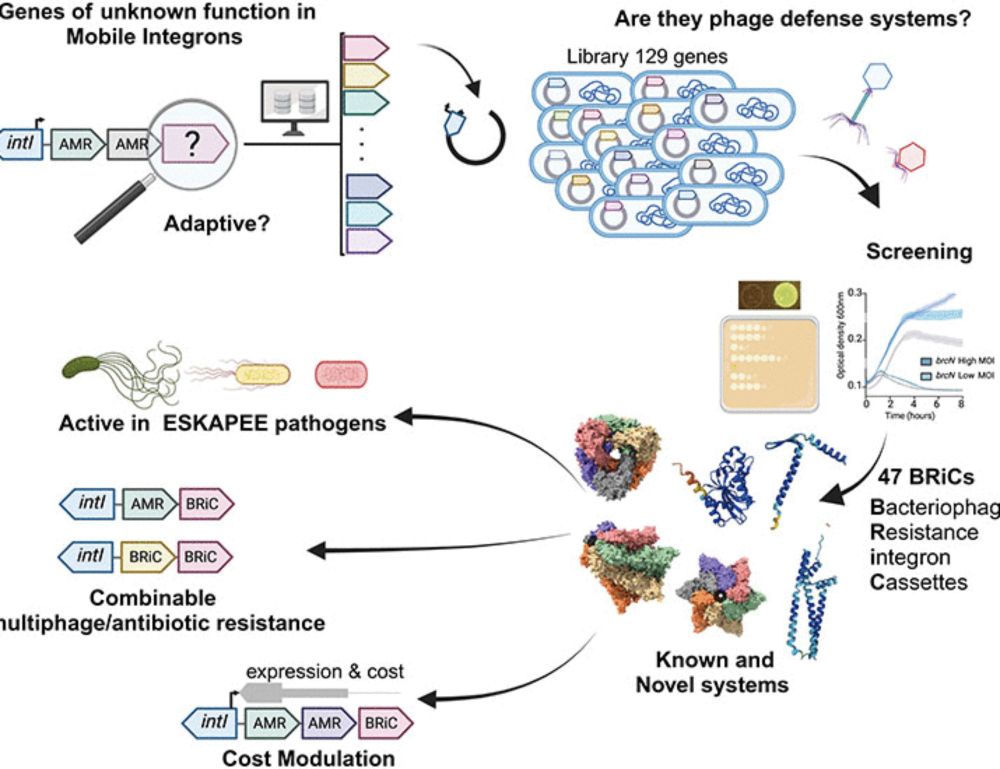
Mobile integrons encode phage defense systems
Integrons are bacterial genetic elements that capture, stockpile, and modulate the expression of genes encoded in integron cassettes. Mobile integrons (MIs) are borne on plasmids, acting as a vehicle ...
www.science.org
May 14, 2025 at 3:55 PM
#NatureMicroPicks
Microbial integrons in focus 🦠🧬
Two studies showing microbial integrons encoding phage defense systems
#MicroSky
www.science.org/doi/10.1126/...
www.science.org/doi/10.1126/...
Microbial integrons in focus 🦠🧬
Two studies showing microbial integrons encoding phage defense systems
#MicroSky
www.science.org/doi/10.1126/...
www.science.org/doi/10.1126/...
Reposted by Shing

Fungi shape genome evolution of bacteria even in the absence of major growth phenotypes
#ISMEJournal from @benwolfe.bsky.social
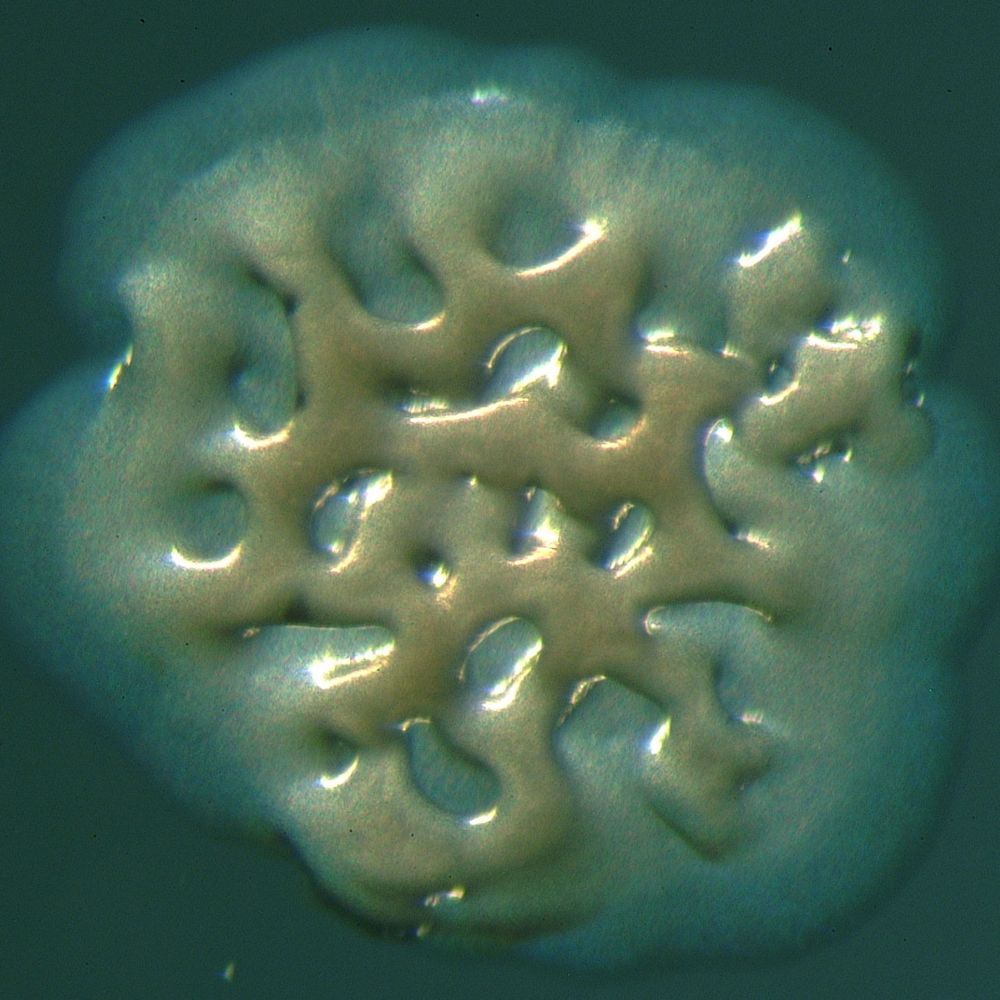
Penicillium camemberti and Geotrichum candidum on Pseudomonas carnis evolution
academic.oup.com/ismej/advanc...
#ISMEJournal from @benwolfe.bsky.social
Penicillium camemberti and Geotrichum candidum on Pseudomonas carnis evolution
academic.oup.com/ismej/advanc...

Fungi shape genome evolution of bacteria even in the absence of major growth phenotypes
Abstract. Studies of microbial interactions often emphasize interactions with large, easily measurable growth differences and short-term ecological outcome
academic.oup.com
May 4, 2025 at 10:47 AM
Fungi shape genome evolution of bacteria even in the absence of major growth phenotypes
#ISMEJournal from @benwolfe.bsky.social
Penicillium camemberti and Geotrichum candidum on Pseudomonas carnis evolution
academic.oup.com/ismej/advanc...
#ISMEJournal from @benwolfe.bsky.social
Penicillium camemberti and Geotrichum candidum on Pseudomonas carnis evolution
academic.oup.com/ismej/advanc...
Reposted by Shing

In the phosphorus-limited Sargasso Sea, microbes partition phosphorus uptake by time of day—bacteria in the morning, phytoplankton by day, and cyanobacteria at dusk—revealing a temporal niche strategy. www.pnas.org/doi/10.1073/...
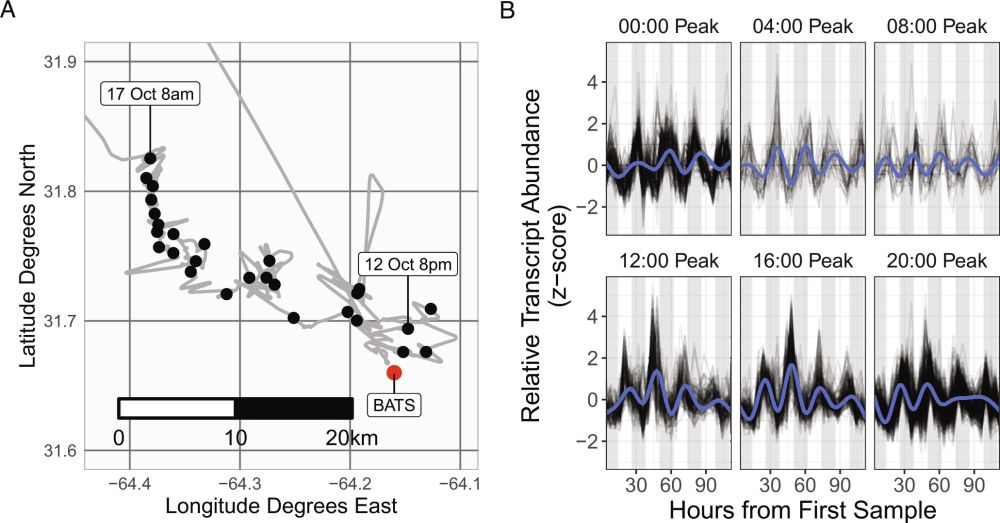
Diel partitioning in microbial phosphorus acquisition in the Sargasso Sea | PNAS
The daily cycle of photosynthetic primary production at the base of marine food webs
is often limited by the availability of scarce nutrients. Micr...
www.pnas.org
May 3, 2025 at 5:44 PM
In the phosphorus-limited Sargasso Sea, microbes partition phosphorus uptake by time of day—bacteria in the morning, phytoplankton by day, and cyanobacteria at dusk—revealing a temporal niche strategy. www.pnas.org/doi/10.1073/...
Reposted by Shing
This meeting will be great!
Abstract submission open now
See you 26-27 Nov in Liverpool
microbiologysociety.org/event/societ...
Abstract submission open now
See you 26-27 Nov in Liverpool
microbiologysociety.org/event/societ...
Understanding and predicting microbial evolutionary dynamics - 2025 meeting
microbiologysociety.org
April 29, 2025 at 5:37 PM
This meeting will be great!
Abstract submission open now
See you 26-27 Nov in Liverpool
microbiologysociety.org/event/societ...
Abstract submission open now
See you 26-27 Nov in Liverpool
microbiologysociety.org/event/societ...
Reposted by Shing
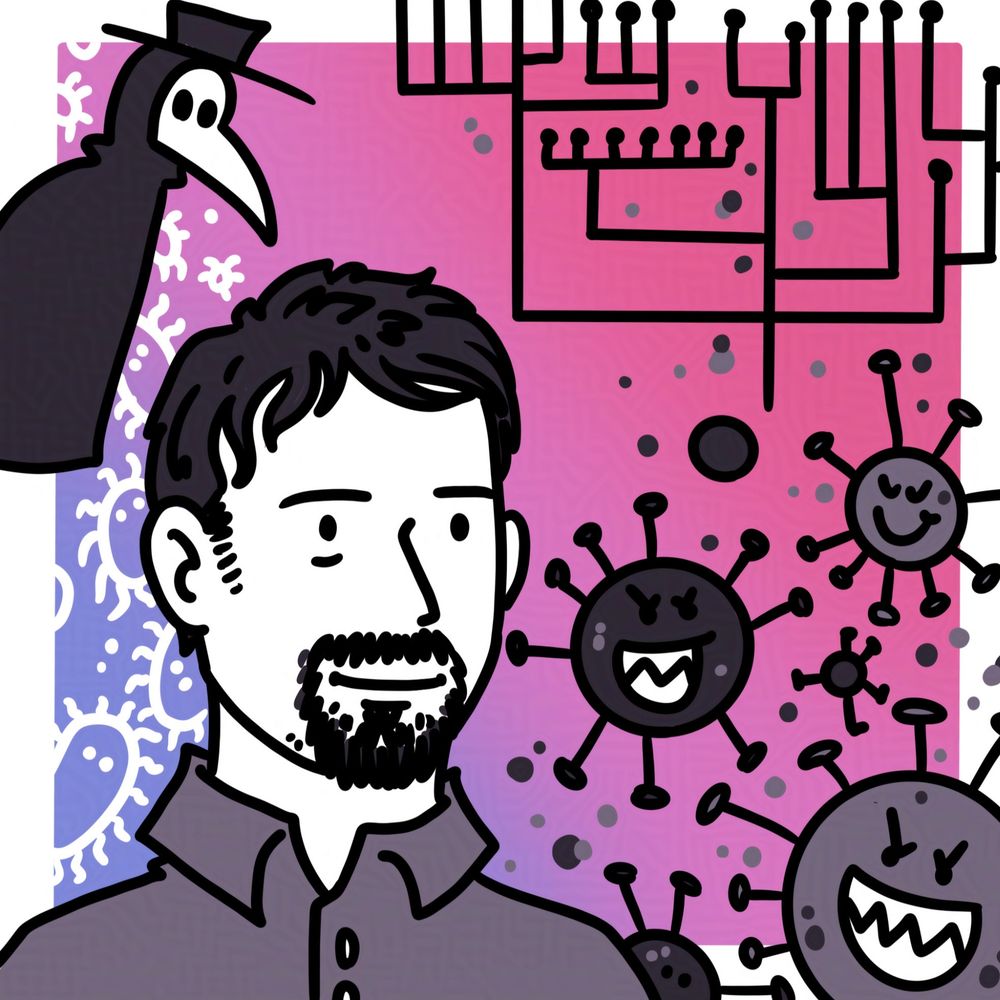
Hey! That's me! Check out my latest where I develop a method for pinpointing where mutation spectra change along phylogenies. Striking, nodes with large changes are significantly enriched for protein changes in the RdRp (catalytic domain of the polymerase) suggesting a causal role.
Using ~8M SARS-CoV-2 genomes, a new phylogenetic algorithm by @russcd.bsky.social detects 10 shifts in mutation patterns, some of them linked to changes in viral polymerase. This provides new perspectives on the evolution of mutational processes.
🔗 doi.org/10.1093/molb...
#molbio #evobio #covid
🔗 doi.org/10.1093/molb...
#molbio #evobio #covid

A Phylogenetic Method Identifies Candidate Drivers of the Evolution of the SARS-CoV-2 Mutation Spectrum
Abstract. The molecular processes that generate new mutations evolve, but the causal mechanisms are largely unknown. In particular, the relative rates of m
doi.org
May 1, 2025 at 3:02 AM
Hey! That's me! Check out my latest where I develop a method for pinpointing where mutation spectra change along phylogenies. Striking, nodes with large changes are significantly enriched for protein changes in the RdRp (catalytic domain of the polymerase) suggesting a causal role.
Reposted by Shing
300 billion years of angiosperm evolution at risk of extinction
doi.org/10.1101/2025...
Evolutionary blocks to anthocyanin accumulation in betalain-pigmented Caryophyllales
doi.org/10.1101/2022...
#Biodiversity #Evolution #PlantSci
doi.org/10.1101/2025...
Evolutionary blocks to anthocyanin accumulation in betalain-pigmented Caryophyllales
doi.org/10.1101/2022...
#Biodiversity #Evolution #PlantSci

300 billion years of angiosperm evolution at risk of extinction
Extinction results in not only loss of species, but also loss of the unique evolutionary history that they represent and the irreplaceable features they exhibit. There is broad consensus regarding the...
doi.org
May 1, 2025 at 4:38 AM
300 billion years of angiosperm evolution at risk of extinction
doi.org/10.1101/2025...
Evolutionary blocks to anthocyanin accumulation in betalain-pigmented Caryophyllales
doi.org/10.1101/2022...
#Biodiversity #Evolution #PlantSci
doi.org/10.1101/2025...
Evolutionary blocks to anthocyanin accumulation in betalain-pigmented Caryophyllales
doi.org/10.1101/2022...
#Biodiversity #Evolution #PlantSci
Reposted by Shing

Ancestral sequence reconstruction often assumes unrealistic homogeneous substitution models; however @rmuniztrejo.bsky.social et al. find that reconstruction accuracy is determined by phylogenetic signal, not model choice.
🔗 doi.org/10.1093/molb...
#evobio #molbio
🔗 doi.org/10.1093/molb...
#evobio #molbio

Robustness of Ancestral Sequence Reconstruction to Among-site and Among-lineage Evolutionary Heterogeneity
Abstract. Ancestral sequence reconstruction is typically performed using homogeneous evolutionary models, which assume that the same substitution propensit
doi.org
April 30, 2025 at 11:29 PM
Ancestral sequence reconstruction often assumes unrealistic homogeneous substitution models; however @rmuniztrejo.bsky.social et al. find that reconstruction accuracy is determined by phylogenetic signal, not model choice.
🔗 doi.org/10.1093/molb...
#evobio #molbio
🔗 doi.org/10.1093/molb...
#evobio #molbio
Reposted by Shing

Code for PopPIPE here: github.com/bacpop/PopPIPE
Thanks to some thorough editing in review we ironed out some errors that can arise, made the installation simpler, and added more automated output from the transmission pipline steps
Thanks to some thorough editing in review we ironed out some errors that can arise, made the installation simpler, and added more automated output from the transmission pipline steps
April 30, 2025 at 4:38 PM
Code for PopPIPE here: github.com/bacpop/PopPIPE
Thanks to some thorough editing in review we ironed out some errors that can arise, made the installation simpler, and added more automated output from the transmission pipline steps
Thanks to some thorough editing in review we ironed out some errors that can arise, made the installation simpler, and added more automated output from the transmission pipline steps
Reposted by Shing

Ancient polyploidy and low rate of chromosome loss explain the high chromosome numbers of homosporous ferns https://www.biorxiv.org/content/10.1101/2024.09.23.614530v1

Ancient polyploidy and low rate of chromosome loss explain the high chromosome numbers of homosporous ferns https://www.biorxiv.org/content/10.1101/2024.09.23.614530v1
A longstanding question in plant evolution is why ferns have many more chromosomes than angiosperms.
www.biorxiv.org
September 25, 2024 at 7:32 PM
Ancient polyploidy and low rate of chromosome loss explain the high chromosome numbers of homosporous ferns https://www.biorxiv.org/content/10.1101/2024.09.23.614530v1
Reposted by Shing
If you're interesting in the #H5N1 outbreak in cattle in the US, please have a look at our preliminary analyses just posted.
Part 1 of 2:
virological.org/t/preliminar...
Part 1 of 2:
virological.org/t/preliminar...

May 3, 2024 at 7:11 PM
If you're interesting in the #H5N1 outbreak in cattle in the US, please have a look at our preliminary analyses just posted.
Part 1 of 2:
virological.org/t/preliminar...
Part 1 of 2:
virological.org/t/preliminar...
Reposted by Shing

As Prof. Priyanga Amarasekare's heartbreaking saga at UCLA drags into another year, I've compiled a thread of articles written about the situation. My sardonic take: Some people didn't like to be accused of racism and decided to destroy her career over their hurt feelings. 1/21
January 10, 2024 at 4:28 PM
As Prof. Priyanga Amarasekare's heartbreaking saga at UCLA drags into another year, I've compiled a thread of articles written about the situation. My sardonic take: Some people didn't like to be accused of racism and decided to destroy her career over their hurt feelings. 1/21