



sylefeb
@sylefeb2.bsky.social
I am a researcher-maker-hacker focusing on Computer Graphics with a #retro, #fpga gaming twist. I am also very much into #3dprinting and #electronics.
These days I enjoy making #graphics hardware on fpga, using a language I developed, #Silice
These days I enjoy making #graphics hardware on fpga, using a language I developed, #Silice
WolFPGA on the icepi-zero! Works great!! ( #Wolfenstein raycaster on #FPGA, no CPU, pure graphics, in #Silice)
It is a very neat board, packed with features. (Silice already has support, check it out!).
Crowd funding still open for a few hours, check it out :
www.crowdsupply.com/icy-electron...
It is a very neat board, packed with features. (Silice already has support, check it out!).
Crowd funding still open for a few hours, check it out :
www.crowdsupply.com/icy-electron...
October 2, 2025 at 7:12 PM
WolFPGA on the icepi-zero! Works great!! ( #Wolfenstein raycaster on #FPGA, no CPU, pure graphics, in #Silice)
It is a very neat board, packed with features. (Silice already has support, check it out!).
Crowd funding still open for a few hours, check it out :
www.crowdsupply.com/icy-electron...
It is a very neat board, packed with features. (Silice already has support, check it out!).
Crowd funding still open for a few hours, check it out :
www.crowdsupply.com/icy-electron...
This is as simple as it gets:
- clone the Silice repo
- run ./get_started_yowasp.sh
- go to projects/blinky
- make yowasp-ulx3s
- open localhost:8000
- program your board from a browser (locally)!
- clone the Silice repo
- run ./get_started_yowasp.sh
- go to projects/blinky
- make yowasp-ulx3s
- open localhost:8000
- program your board from a browser (locally)!

March 21, 2025 at 6:54 PM
This is as simple as it gets:
- clone the Silice repo
- run ./get_started_yowasp.sh
- go to projects/blinky
- make yowasp-ulx3s
- open localhost:8000
- program your board from a browser (locally)!
- clone the Silice repo
- run ./get_started_yowasp.sh
- go to projects/blinky
- make yowasp-ulx3s
- open localhost:8000
- program your board from a browser (locally)!
Nearing a #Silice main branch update, testing a5k and it still just works! This is a complete hardware implementation of Another World's VM on #FPGA, here running on the mighty #mch2022 badge.
a5k repo + write up: github.com/sylefeb/a5k
Silice: github.com/sylefeb/Sili...
a5k repo + write up: github.com/sylefeb/a5k
Silice: github.com/sylefeb/Sili...

February 24, 2025 at 6:49 PM
Nearing a #Silice main branch update, testing a5k and it still just works! This is a complete hardware implementation of Another World's VM on #FPGA, here running on the mighty #mch2022 badge.
a5k repo + write up: github.com/sylefeb/a5k
Silice: github.com/sylefeb/Sili...
a5k repo + write up: github.com/sylefeb/a5k
Silice: github.com/sylefeb/Sili...
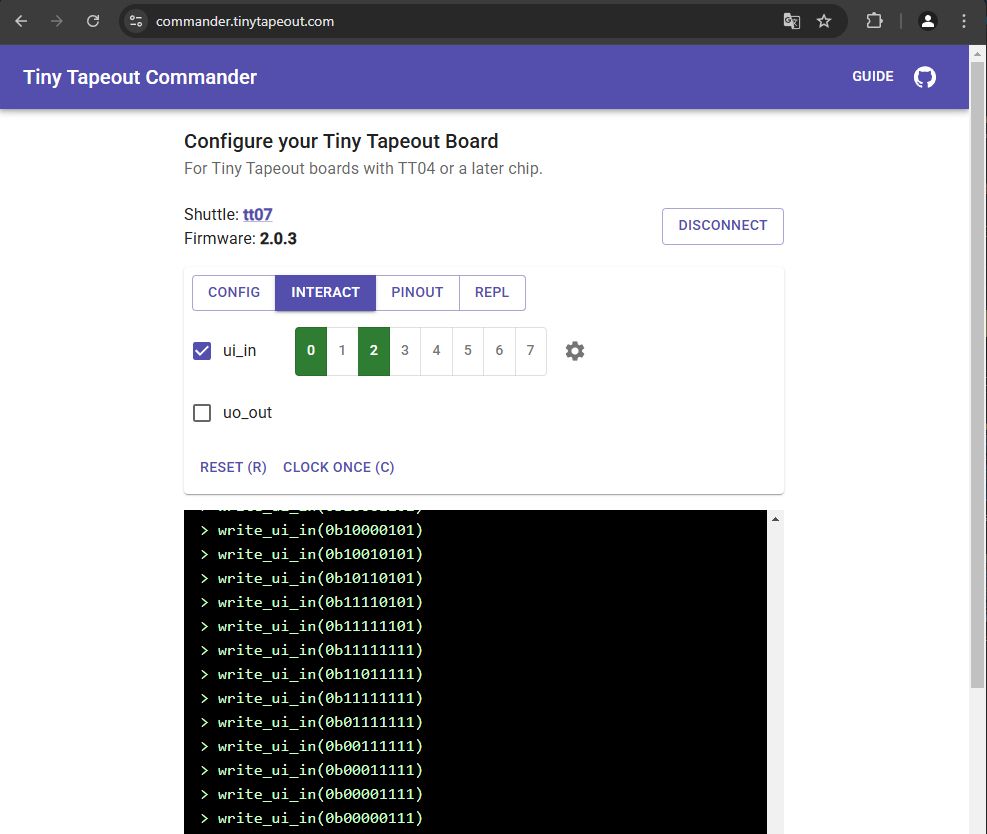
14/ Using the design is quite simple, after loading data in the pmod, I select my design, change the clock frequency (currently runs at 17MHz max, I'll have to investigate, more on this later!), and hit reset.

February 1, 2025 at 10:04 AM
14/ Using the design is quite simple, after loading data in the pmod, I select my design, change the clock frequency (currently runs at 17MHz max, I'll have to investigate, more on this later!), and hit reset.
12/ How do I put data in memory in the first place? #TinyTapeout is an amazing project with amazing tool, and the demo board has a RP2040 onboard with micropython on it. So you can use that to initialize ('flash') data in the PSRAM pmod before statrting your design.

February 1, 2025 at 10:04 AM
12/ How do I put data in memory in the first place? #TinyTapeout is an amazing project with amazing tool, and the demo board has a RP2040 onboard with micropython on it. So you can use that to initialize ('flash') data in the PSRAM pmod before statrting your design.
11/ I store all of that in memory (in the PSRAM pmod): for each step, 1/z and x,y offsets along the ray. The terrain texture (height and color) is also fetched from memory.

February 1, 2025 at 10:04 AM
11/ I store all of that in memory (in the PSRAM pmod): for each step, 1/z and x,y offsets along the ray. The terrain texture (height and color) is also fetched from memory.
10/ However, I pre-compute many things in RAM to reduce the design size. The algorithm draws the screen column by column, left to right, and then steps along the ray in depth. Each step it draws small segments if they are visible. This requires 1/z, as well as stepping in x,y along the ray.

February 1, 2025 at 10:04 AM
10/ However, I pre-compute many things in RAM to reduce the design size. The algorithm draws the screen column by column, left to right, and then steps along the ray in depth. Each step it draws small segments if they are visible. This requires 1/z, as well as stepping in x,y along the ray.
7/ Now for some technical details! This renderer fits in two tiles of the TinyTapeout chip. That's 161x225 μm (130nm process), and roughly 3000 gates.

February 1, 2025 at 10:04 AM
7/ Now for some technical details! This renderer fits in two tiles of the TinyTapeout chip. That's 161x225 μm (130nm process), and roughly 3000 gates.

4/ POWER UP 🚀🚀🚀
More news asap!
More news asap!

January 31, 2025 at 4:13 PM
4/ POWER UP 🚀🚀🚀
More news asap!
More news asap!
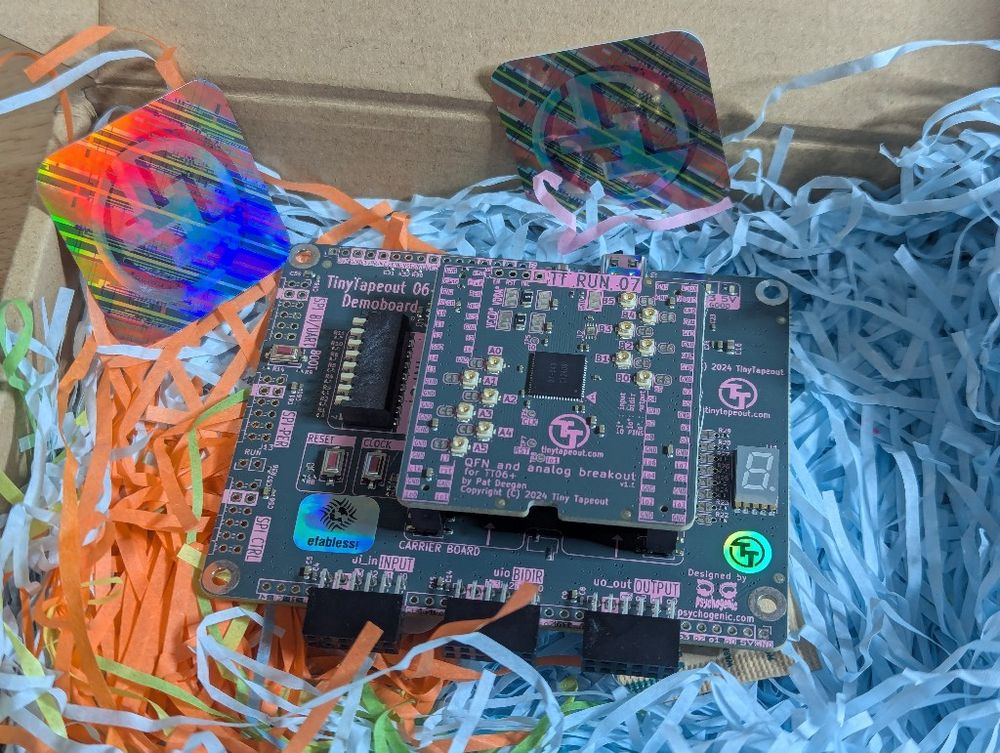
2/ Wow!!! It arrived!! @tinytapeout.com 🤩

January 31, 2025 at 4:13 PM
2/ Wow!!! It arrived!! @tinytapeout.com 🤩
