
Saurab Sharma, PhD
@saurabsharma.bsky.social
Pain researcher interested in developing and testing equitable interventions for chronic pain.
Making Underrepresented Pain Visible: Chronic Pain Disparities Among Immigrant Adolescents in 30 European Countries
www.jpain.org/article/S152...
www.jpain.org/article/S152...

Making Underrepresented Pain Visible: Chronic Pain Disparities Among Immigrant Adolescents in 30 European Countries
Chronic pain is prevalent among adolescents and is associated with significant impairments
in physical, emotional, social, and academic functioning. Despite advances in pediatric
pain research, includ...
www.jpain.org
August 14, 2025 at 11:21 AM
Making Underrepresented Pain Visible: Chronic Pain Disparities Among Immigrant Adolescents in 30 European Countries
www.jpain.org/article/S152...
www.jpain.org/article/S152...
🔥
Prevalence of low back pain in Nepal: Results from a nationally representative WHO STEPS survey - The Journal of Pain www.jpain.org/article/S152...
Prevalence of low back pain in Nepal: Results from a nationally representative WHO STEPS survey - The Journal of Pain www.jpain.org/article/S152...
Prevalence of low back pain in Nepal: Results from a nationally representative WHO STEPS survey
Low back pain is the leading cause of disability globally. Most prevalence data for
low back pain come from high-income countries. Data from low-and middle-income countries
such as Nepal are currently...
www.jpain.org
August 13, 2025 at 10:38 AM
🔥
Prevalence of low back pain in Nepal: Results from a nationally representative WHO STEPS survey - The Journal of Pain www.jpain.org/article/S152...
Prevalence of low back pain in Nepal: Results from a nationally representative WHO STEPS survey - The Journal of Pain www.jpain.org/article/S152...
🔥
Assessing pain intensity in people from non-western countries: A multicenter study comparing four pain scales in adults with musculoskeletal pain in Bhutan - The Journal of Pain www.jpain.org/article/S152...
Assessing pain intensity in people from non-western countries: A multicenter study comparing four pain scales in adults with musculoskeletal pain in Bhutan - The Journal of Pain www.jpain.org/article/S152...

Assessing pain intensity in people from non-western countries: A multicenter study comparing four pain scales in adults with musculoskeletal pain in Bhutan
Although the Numerical Rating Scale (NRS) is commonly recommended for use in research
and clinical practice internationally, recent research in non-western countries questions
its utility in some coun...
www.jpain.org
August 13, 2025 at 10:36 AM
🔥
Assessing pain intensity in people from non-western countries: A multicenter study comparing four pain scales in adults with musculoskeletal pain in Bhutan - The Journal of Pain www.jpain.org/article/S152...
Assessing pain intensity in people from non-western countries: A multicenter study comparing four pain scales in adults with musculoskeletal pain in Bhutan - The Journal of Pain www.jpain.org/article/S152...
Reposted by Saurab Sharma, PhD
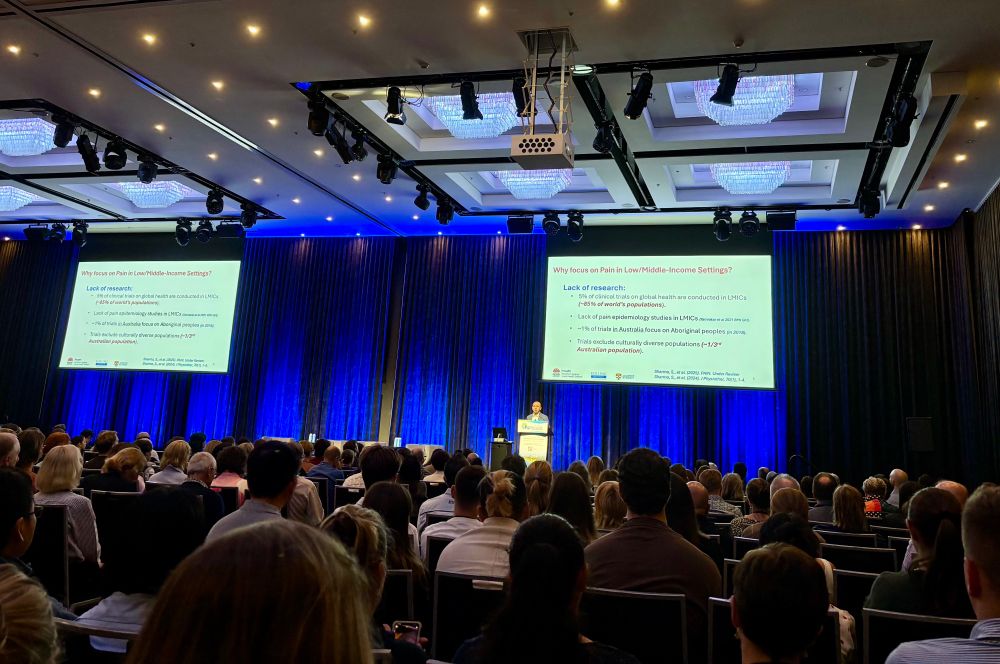
Staggering fact: Only 5% of clinical trials on global health are conducted in LMICs - even though they’re home to around 85% of the world’s population.
Fantastic presentation by @saurabsharma.bsky.social at #AusPainSoc!
#LMIC #ResearchEquity #APS
Fantastic presentation by @saurabsharma.bsky.social at #AusPainSoc!
#LMIC #ResearchEquity #APS
April 13, 2025 at 11:14 PM
Staggering fact: Only 5% of clinical trials on global health are conducted in LMICs - even though they’re home to around 85% of the world’s population.
Fantastic presentation by @saurabsharma.bsky.social at #AusPainSoc!
#LMIC #ResearchEquity #APS
Fantastic presentation by @saurabsharma.bsky.social at #AusPainSoc!
#LMIC #ResearchEquity #APS
Reposted by Saurab Sharma, PhD
@saurabsharma.bsky.social and Tie Yamato kicking off #APS2025 and the @iasp.bsky.social Global Year for pain management in low and middle income settings.
A call to action to improve pain management in these settings
@auspainsoc.bsky.social
A call to action to improve pain management in these settings
@auspainsoc.bsky.social


April 13, 2025 at 11:23 PM
@saurabsharma.bsky.social and Tie Yamato kicking off #APS2025 and the @iasp.bsky.social Global Year for pain management in low and middle income settings.
A call to action to improve pain management in these settings
@auspainsoc.bsky.social
A call to action to improve pain management in these settings
@auspainsoc.bsky.social
🔥
Read our new Cochrane overview on Non‐pharmacological and non‐surgical treatments for low back pain in adults
www.cochranelibrary.com/cdsr/doi/10....
Read our new Cochrane overview on Non‐pharmacological and non‐surgical treatments for low back pain in adults
www.cochranelibrary.com/cdsr/doi/10....

Non‐pharmacological and non‐surgical treatments for low back pain in adults: an overview of Cochrane reviews - Rizzo, RRN - 2025 | Cochrane Library
Select your preferred language for Cochrane reviews and other content. Sections without translation will be in English.
www.cochranelibrary.com
March 28, 2025 at 11:07 AM
🔥
Read our new Cochrane overview on Non‐pharmacological and non‐surgical treatments for low back pain in adults
www.cochranelibrary.com/cdsr/doi/10....
Read our new Cochrane overview on Non‐pharmacological and non‐surgical treatments for low back pain in adults
www.cochranelibrary.com/cdsr/doi/10....
I am excited to share that I was awarded the National Health and Medical Research Council (NHMRC) Investigator Grant.
After three near misses, this fourth attempt has finally paid off.
I am deeply grateful to my mentors, collaborators, and supporters for your encouragement and guidance.
After three near misses, this fourth attempt has finally paid off.
I am deeply grateful to my mentors, collaborators, and supporters for your encouragement and guidance.

February 26, 2025 at 1:08 AM
I am excited to share that I was awarded the National Health and Medical Research Council (NHMRC) Investigator Grant.
After three near misses, this fourth attempt has finally paid off.
I am deeply grateful to my mentors, collaborators, and supporters for your encouragement and guidance.
After three near misses, this fourth attempt has finally paid off.
I am deeply grateful to my mentors, collaborators, and supporters for your encouragement and guidance.