



Sanjana Joshi
@sanjanajoshi.bsky.social
(she/her)
Previously MPIBR Naked mole-rat 🎶🗣️| Neuroethology 🧠| M.Sc. Biotechnology 👩🔬🦠🧪
Previously MPIBR Naked mole-rat 🎶🗣️| Neuroethology 🧠| M.Sc. Biotechnology 👩🔬🦠🧪
Reposted by Sanjana Joshi

'Foraging as an ethological framework for neuroscience'
by @LauraGrima.bsky.social, @Hannah-Haberkern.bsky.social, Rishika Mohanta, @MaimMorimoto.bsky.social @adiraj95.bsky.social @EmmavScholey.bsky.social
www.cell.com/trends/neuro...
by @LauraGrima.bsky.social, @Hannah-Haberkern.bsky.social, Rishika Mohanta, @MaimMorimoto.bsky.social @adiraj95.bsky.social @EmmavScholey.bsky.social
www.cell.com/trends/neuro...


October 13, 2025 at 1:53 PM
'Foraging as an ethological framework for neuroscience'
by @LauraGrima.bsky.social, @Hannah-Haberkern.bsky.social, Rishika Mohanta, @MaimMorimoto.bsky.social @adiraj95.bsky.social @EmmavScholey.bsky.social
www.cell.com/trends/neuro...
by @LauraGrima.bsky.social, @Hannah-Haberkern.bsky.social, Rishika Mohanta, @MaimMorimoto.bsky.social @adiraj95.bsky.social @EmmavScholey.bsky.social
www.cell.com/trends/neuro...
Reposted by Sanjana Joshi

New preprint! 🪶
We analysed 60 years of data on 83,000+ great tits to show how extreme climate impacts on nestling growth and survival are stage-specific and context-dependent 🐣 🌍🔥❄️
With @davididiaquez.bsky.social @iremsepil.bsky.social @sheldonbirds.bsky.social
www.biorxiv.org/content/10.1...
We analysed 60 years of data on 83,000+ great tits to show how extreme climate impacts on nestling growth and survival are stage-specific and context-dependent 🐣 🌍🔥❄️
With @davididiaquez.bsky.social @iremsepil.bsky.social @sheldonbirds.bsky.social
www.biorxiv.org/content/10.1...


October 14, 2025 at 2:35 PM
New preprint! 🪶
We analysed 60 years of data on 83,000+ great tits to show how extreme climate impacts on nestling growth and survival are stage-specific and context-dependent 🐣 🌍🔥❄️
With @davididiaquez.bsky.social @iremsepil.bsky.social @sheldonbirds.bsky.social
www.biorxiv.org/content/10.1...
We analysed 60 years of data on 83,000+ great tits to show how extreme climate impacts on nestling growth and survival are stage-specific and context-dependent 🐣 🌍🔥❄️
With @davididiaquez.bsky.social @iremsepil.bsky.social @sheldonbirds.bsky.social
www.biorxiv.org/content/10.1...
Reposted by Sanjana Joshi
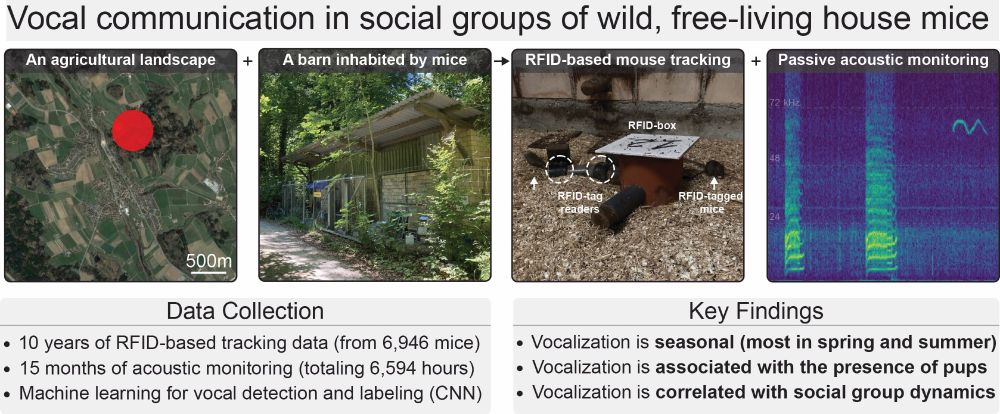
Very happy to share the latest from my postdoc!
10 yrs of mouse social networks + 1.25 yrs of acoustic data ➡️ insight into vocalization & sociality in a wild population of your favorite lab model 🐁
paper: bit.ly/4n93yyD
data: bit.ly/4lfFBEk
code: bit.ly/4kNnMwx
#bioacoustics #neuroskyence
1/8
10 yrs of mouse social networks + 1.25 yrs of acoustic data ➡️ insight into vocalization & sociality in a wild population of your favorite lab model 🐁
paper: bit.ly/4n93yyD
data: bit.ly/4lfFBEk
code: bit.ly/4kNnMwx
#bioacoustics #neuroskyence
1/8
June 18, 2025 at 6:26 PM
Very happy to share the latest from my postdoc!
10 yrs of mouse social networks + 1.25 yrs of acoustic data ➡️ insight into vocalization & sociality in a wild population of your favorite lab model 🐁
paper: bit.ly/4n93yyD
data: bit.ly/4lfFBEk
code: bit.ly/4kNnMwx
#bioacoustics #neuroskyence
1/8
10 yrs of mouse social networks + 1.25 yrs of acoustic data ➡️ insight into vocalization & sociality in a wild population of your favorite lab model 🐁
paper: bit.ly/4n93yyD
data: bit.ly/4lfFBEk
code: bit.ly/4kNnMwx
#bioacoustics #neuroskyence
1/8
Reposted by Sanjana Joshi

Birdsong, brains & sunshine! More than 70 brilliant minds from across the globe flocked to Seewiesen to get inspired by cutting-edge research. From finches to singing mice, vocal research flew high at the European Birdsong Meeting hosted at our Institute.

June 13, 2025 at 5:37 PM
Birdsong, brains & sunshine! More than 70 brilliant minds from across the globe flocked to Seewiesen to get inspired by cutting-edge research. From finches to singing mice, vocal research flew high at the European Birdsong Meeting hosted at our Institute.
Reposted by Sanjana Joshi
📢 New Bridging Brains and Bioacoustics seminar next week!
We are lucky to have both @nicolasmathevon.bsky.social and @annmclemens.bsky.social
to speak about vocal communication during infancy and early life 👶🐁
🗓️ May 27th @ 10:00 EST
✅ Register here: braincoustics.com
We are lucky to have both @nicolasmathevon.bsky.social and @annmclemens.bsky.social
to speak about vocal communication during infancy and early life 👶🐁
🗓️ May 27th @ 10:00 EST
✅ Register here: braincoustics.com
HOME | Braincoustics
braincoustics.com
May 20, 2025 at 3:45 PM
📢 New Bridging Brains and Bioacoustics seminar next week!
We are lucky to have both @nicolasmathevon.bsky.social and @annmclemens.bsky.social
to speak about vocal communication during infancy and early life 👶🐁
🗓️ May 27th @ 10:00 EST
✅ Register here: braincoustics.com
We are lucky to have both @nicolasmathevon.bsky.social and @annmclemens.bsky.social
to speak about vocal communication during infancy and early life 👶🐁
🗓️ May 27th @ 10:00 EST
✅ Register here: braincoustics.com
Reposted by Sanjana Joshi

Longitudinal monitoring of developmental plasticity in the mouse auditory cortex https://www.biorxiv.org/content/10.1101/2025.05.12.653595v1
May 13, 2025 at 2:15 PM
Longitudinal monitoring of developmental plasticity in the mouse auditory cortex https://www.biorxiv.org/content/10.1101/2025.05.12.653595v1
Reposted by Sanjana Joshi
Registration is open!
gutenberg-workshops.uni-mainz.de/flexibility-...
gutenberg-workshops.uni-mainz.de/flexibility-...
Flexibility and Robustness of Nervous System Function | Gutenberg Workshops in the Life Sciences
gutenberg-workshops.uni-mainz.de
April 24, 2025 at 5:25 PM
Registration is open!
gutenberg-workshops.uni-mainz.de/flexibility-...
gutenberg-workshops.uni-mainz.de/flexibility-...
Reposted by Sanjana Joshi

In this fascinating paper by the Long lab, activity was recorded from the vocal production region of the budgerigar. These neurons form a map of phonetic features just like in humans. This, however, was not the case in the homologous region of the zebra finch 🧠! www.nature.com/articles/s41... 🦜🗣️
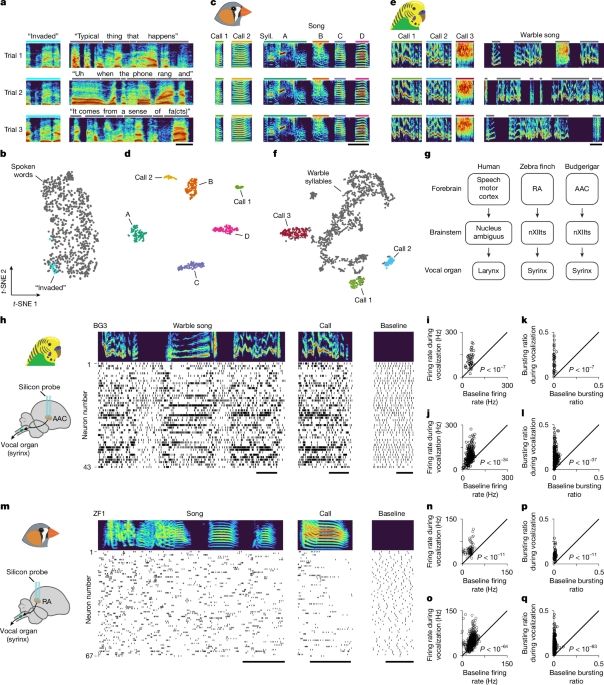
Convergent vocal representations in parrot and human forebrain motor networks - Nature
Using advanced brain-recording techniques, parrots were found to have a brain organization for vocal control similar to humans, making them an important model for studying speech and for developing po...
www.nature.com
April 14, 2025 at 7:32 PM
In this fascinating paper by the Long lab, activity was recorded from the vocal production region of the budgerigar. These neurons form a map of phonetic features just like in humans. This, however, was not the case in the homologous region of the zebra finch 🧠! www.nature.com/articles/s41... 🦜🗣️
Reposted by Sanjana Joshi

Why do some deer mice stick around to raise their young while others don’t?
New research shows that differences in brain cell types and gene expression may shape their wildly different parenting instincts.
New research shows that differences in brain cell types and gene expression may shape their wildly different parenting instincts.

The parenting styles of deer mice
Single-nuclei RNA-sequencing sheds new light on how two closely related species of deer behave differently when mating and caring for young.
buff.ly
April 12, 2025 at 8:01 PM
Why do some deer mice stick around to raise their young while others don’t?
New research shows that differences in brain cell types and gene expression may shape their wildly different parenting instincts.
New research shows that differences in brain cell types and gene expression may shape their wildly different parenting instincts.
Reposted by Sanjana Joshi
Attuning to song duels facilitates song-matching in nightingales https://www.biorxiv.org/content/10.1101/2025.04.12.648496v1
April 13, 2025 at 6:15 PM
Attuning to song duels facilitates song-matching in nightingales https://www.biorxiv.org/content/10.1101/2025.04.12.648496v1
Reposted by Sanjana Joshi
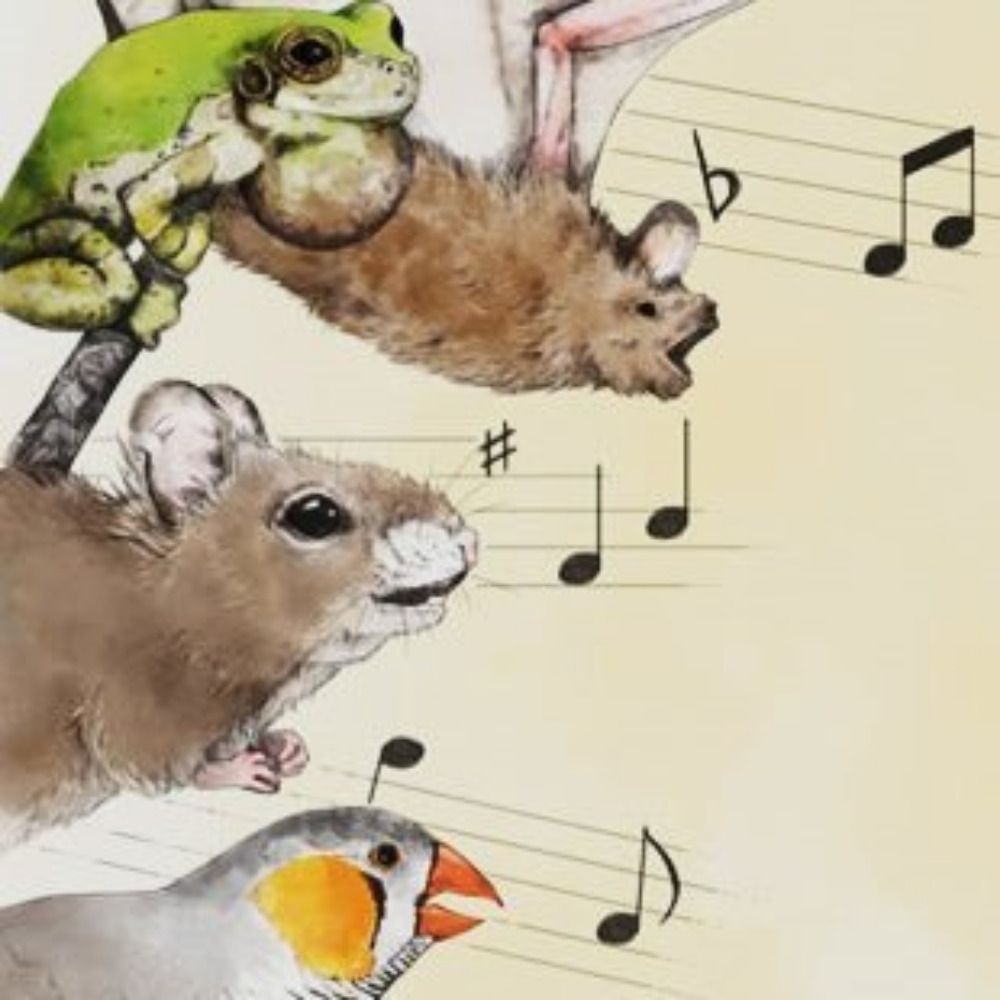
Important study here from @katietschida.bsky.social et al
on the transition from neonatal isolation calls to social vocalization in lab mice
“juvenile mice begin producing social USVs earlier than previously reported, at ages P20-P24”
#bioacoustics #prattle💬
on the transition from neonatal isolation calls to social vocalization in lab mice
“juvenile mice begin producing social USVs earlier than previously reported, at ages P20-P24”
#bioacoustics #prattle💬

Vocal ontogeny in Mus musculus https://www.biorxiv.org/content/10.1101/2025.03.24.644972v1
March 25, 2025 at 11:32 AM
Important study here from @katietschida.bsky.social et al
on the transition from neonatal isolation calls to social vocalization in lab mice
“juvenile mice begin producing social USVs earlier than previously reported, at ages P20-P24”
#bioacoustics #prattle💬
on the transition from neonatal isolation calls to social vocalization in lab mice
“juvenile mice begin producing social USVs earlier than previously reported, at ages P20-P24”
#bioacoustics #prattle💬
Reposted by Sanjana Joshi

Our first look at midbrain PAG’s role in singing mouse vocal control. When near each other, these mice produce two divergent vocal modes. Same circuits for USVs and Songs—or different ones? Bets were made..some of us bought beers for others! Led by @xmikezheng20.bsky.social & Clifford Harpole. 👇🏽
Important new work from @xmikezheng20.bsky.social @arkarupbanerjee.bsky.social et al
bit.ly/42dWcQN
ethology+modeling+targeted neural manipulation —> new textbook example of how evolutionary tinkering can generate multiple behavioral modes with a single neural circuit
#bioacoustics
#prattle 💬
bit.ly/42dWcQN
ethology+modeling+targeted neural manipulation —> new textbook example of how evolutionary tinkering can generate multiple behavioral modes with a single neural circuit
#bioacoustics
#prattle 💬

Parametric Modulation of a Shared Midbrain Circuit Drives Distinct Vocal Modes in a Singing Mouse
Neural circuits capable of generating multiple outputs are essential for behavioral flexibility, yet their organizational principles remain poorly understood. Using vocal communication in singing mice...
bit.ly
April 6, 2025 at 2:08 AM
Our first look at midbrain PAG’s role in singing mouse vocal control. When near each other, these mice produce two divergent vocal modes. Same circuits for USVs and Songs—or different ones? Bets were made..some of us bought beers for others! Led by @xmikezheng20.bsky.social & Clifford Harpole. 👇🏽