



Alessandro Ruggieri
@ruggieriale.bsky.social
Macroeconomist. Assistant Professor @cunef.bsky.social, previously @uniofnottingham.bsky.social. PhD @ UAB & BSE. #FirstGen from #Abruzzo. www.alessandroruggieri.com
We test our theory using Portuguese administrative data. Completing insurance markets would increase aggregate productivity and income by 64% and 97%, respectively. (n/n)
March 3, 2025 at 9:59 AM
We test our theory using Portuguese administrative data. Completing insurance markets would increase aggregate productivity and income by 64% and 97%, respectively. (n/n)
Specifically, incomplete markets operate as correlated distortions, leading to a reallocation of capital from more to less productive firms relative to the complete markets benchmark. (4/n)
March 3, 2025 at 9:59 AM
Specifically, incomplete markets operate as correlated distortions, leading to a reallocation of capital from more to less productive firms relative to the complete markets benchmark. (4/n)
Incomplete markets tie entrepreneurs’ consumption to the profits generated by their enterprises, making them willing to forgo expected profits to reduce volatility. As a result, the expected MPK are not equalized across firms, i.e. capital is misallocated. (3/n)
March 3, 2025 at 9:59 AM
Incomplete markets tie entrepreneurs’ consumption to the profits generated by their enterprises, making them willing to forgo expected profits to reduce volatility. As a result, the expected MPK are not equalized across firms, i.e. capital is misallocated. (3/n)
In a recent working paper (papers.ssrn.com/sol3/papers....) we build a GE model where risk-averse entrepreneurs with heterogeneous productivity face uninsurable idiosyncratic output shocks and choose how much capital to rent before uncertainty unfolds. (2/n)
Incomplete markets as correlated distortions
We argue that capital misallocation arises endogenously due to incomplete consumption insurance. We model risk-averse entrepreneurs with heterogeneous productiv
papers.ssrn.com
March 3, 2025 at 9:59 AM
In a recent working paper (papers.ssrn.com/sol3/papers....) we build a GE model where risk-averse entrepreneurs with heterogeneous productivity face uninsurable idiosyncratic output shocks and choose how much capital to rent before uncertainty unfolds. (2/n)
Quantitatively, differences in the degree of monopsony account for 42% of observed variation in GDP per capita across countries. At least one-third of the losses are attributable to distorted entrepreneurial decisions and lack of innovation.
November 24, 2024 at 2:25 PM
Quantitatively, differences in the degree of monopsony account for 42% of observed variation in GDP per capita across countries. At least one-third of the losses are attributable to distorted entrepreneurial decisions and lack of innovation.
Because it penalises high-productivity employers, labor market power acts as a skill-biased force, similar to what has been shown for a wide array of size-dependent policies and correlated distortions.
November 24, 2024 at 2:25 PM
Because it penalises high-productivity employers, labor market power acts as a skill-biased force, similar to what has been shown for a wide array of size-dependent policies and correlated distortions.
Labor market power leads to aggregate output losses by 1) reallocating employment towards less-productive, lower-paying employers; 2) allowing low-productivity individuals to reap high benefits from entrepreneurship; and 3) lowering the returns from climbing the productivity ladder for employers.
November 24, 2024 at 2:25 PM
Labor market power leads to aggregate output losses by 1) reallocating employment towards less-productive, lower-paying employers; 2) allowing low-productivity individuals to reap high benefits from entrepreneurship; and 3) lowering the returns from climbing the productivity ladder for employers.
The paper extends our paper with Nezih Guner (aeaweb.org/articles?id=...) to a dynamic setting with occupational choice, firm growth, and productivity-enhancing investment.
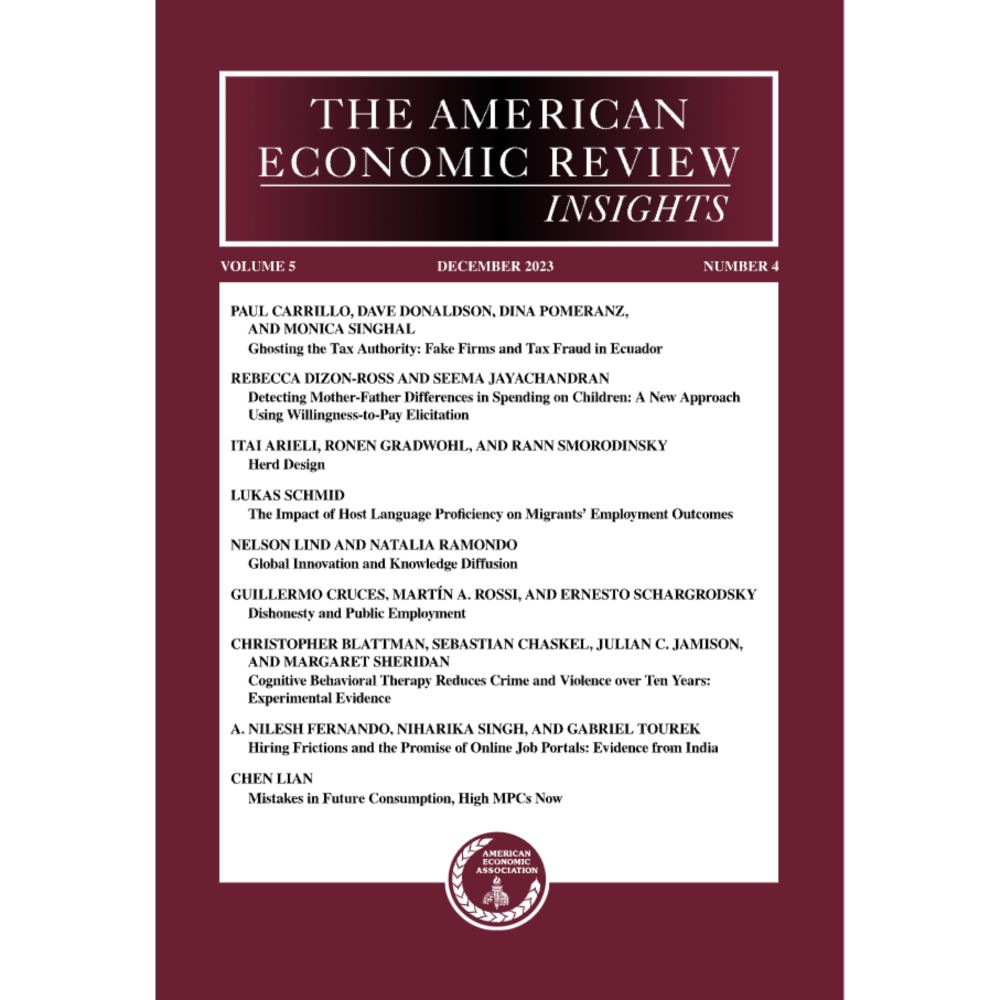
Labor Market Power and Development
(Forthcoming Article) - Imperfect competition in labor markets can lead to efficiency losses and
lower aggregate output. This paper examines how variations in labor
market competitiveness may account ...
aeaweb.org
November 24, 2024 at 2:21 PM
The paper extends our paper with Nezih Guner (aeaweb.org/articles?id=...) to a dynamic setting with occupational choice, firm growth, and productivity-enhancing investment.