




Roderik Rekker
@roderikrekker.bsky.social
Political Scientist/Psychologist • Assistant Professor at Radboud University 🇳🇱 • Research Fellow at Leibniz University Hannover 🇩🇪 • Generational differences in vote choice (Veni) • Political polarization over facts and science (Vidi, Horizon Europe)
(9/10) Descriptively, young men in the 2020s were substantially more progressive and slightly more left-leaning than both older men in the same period and young men in previous decades. Voting for the far right is not – and has never been – correlated with being young among either men or women.

November 16, 2025 at 2:27 PM
(9/10) Descriptively, young men in the 2020s were substantially more progressive and slightly more left-leaning than both older men in the same period and young men in previous decades. Voting for the far right is not – and has never been – correlated with being young among either men or women.
(8/10) The results also revealed that the youth gender gap already existed in the early 2000s and that it has not widened over time. This, again, is precisely what should be expected if the youth gender gap is rooted in the psychosocial development that has always characterized adolescence.

November 16, 2025 at 2:26 PM
(8/10) The results also revealed that the youth gender gap already existed in the early 2000s and that it has not widened over time. This, again, is precisely what should be expected if the youth gender gap is rooted in the psychosocial development that has always characterized adolescence.
(5/10) Analyses on 22 years of ESS data from 30 countries provided clear and consistent support for this gender intensification explanation, by demonstrating that the youth gender gap peaks in middle adolescence, narrows during late adolescence, and mostly disappears in early adulthood.

November 16, 2025 at 2:25 PM
(5/10) Analyses on 22 years of ESS data from 30 countries provided clear and consistent support for this gender intensification explanation, by demonstrating that the youth gender gap peaks in middle adolescence, narrows during late adolescence, and mostly disappears in early adulthood.
@jvanslageren.bsky.social Dat vind ik dus ook niet. Zie ook deze grafiek. Rechte lijn zijn jongeren onder de 25. Gestreepte lijn is 25 en ouder.

November 12, 2025 at 10:44 AM
@jvanslageren.bsky.social Dat vind ik dus ook niet. Zie ook deze grafiek. Rechte lijn zijn jongeren onder de 25. Gestreepte lijn is 25 en ouder.
(1/5) Because this thread got a lot of attention yesterday (thank you so much @casmudde.bsky.social!), I decided to present some data to back up my claims.

November 4, 2025 at 12:33 PM
(1/5) Because this thread got a lot of attention yesterday (thank you so much @casmudde.bsky.social!), I decided to present some data to back up my claims.
De 'nieuwe breuklijn' is toch een beetje de waspoeder van de politicologie. Al decennia nieuw!

October 7, 2025 at 7:40 PM
De 'nieuwe breuklijn' is toch een beetje de waspoeder van de politicologie. Al decennia nieuw!
(1/3) I’m very grateful and excited to officially start my Vidi project today on “Factual Belief Polarization and its Attitudinal Consequences” — and even happier to announce that two incredibly talented young scholars will join my team as postdocs.

September 1, 2025 at 10:32 AM
(1/3) I’m very grateful and excited to officially start my Vidi project today on “Factual Belief Polarization and its Attitudinal Consequences” — and even happier to announce that two incredibly talented young scholars will join my team as postdocs.
(1/2) Zeer interessante bevinding van het Rathenau Instituut: Zo'n 80% van de Nederlanders met een laag vertrouwen in de wetenschap stemde op een populistische partij of helemaal niet. Sluit aan bij mijn recente artikelen over populisme en de politisering van wetenschap.

July 18, 2025 at 2:42 PM
(1/2) Zeer interessante bevinding van het Rathenau Instituut: Zo'n 80% van de Nederlanders met een laag vertrouwen in de wetenschap stemde op een populistische partij of helemaal niet. Sluit aan bij mijn recente artikelen over populisme en de politisering van wetenschap.
It's easy to see why Labour would want to lower the voting age. There are few places in the world where generations are as politically divided as in the UK.
www.frontiersin.org/journals/pol...
www.frontiersin.org/journals/pol...

July 17, 2025 at 2:18 PM
It's easy to see why Labour would want to lower the voting age. There are few places in the world where generations are as politically divided as in the UK.
www.frontiersin.org/journals/pol...
www.frontiersin.org/journals/pol...
(3/5) This study provides three mutually reinforcing explanations for this politicization of science. First, citizens who distrust political and scientific elites have increasingly sought refuge with populist parties that express their dissatisfaction.

July 3, 2025 at 5:51 PM
(3/5) This study provides three mutually reinforcing explanations for this politicization of science. First, citizens who distrust political and scientific elites have increasingly sought refuge with populist parties that express their dissatisfaction.
(2/5) First, the results reveal a surging correlation between science skepticism and populist voting, especially during the COVID-19 pandemic. Much like political trust, trust in science has not so much been characterized by a structural decline, but rather by a process of politicization.

July 3, 2025 at 5:49 PM
(2/5) First, the results reveal a surging correlation between science skepticism and populist voting, especially during the COVID-19 pandemic. Much like political trust, trust in science has not so much been characterized by a structural decline, but rather by a process of politicization.
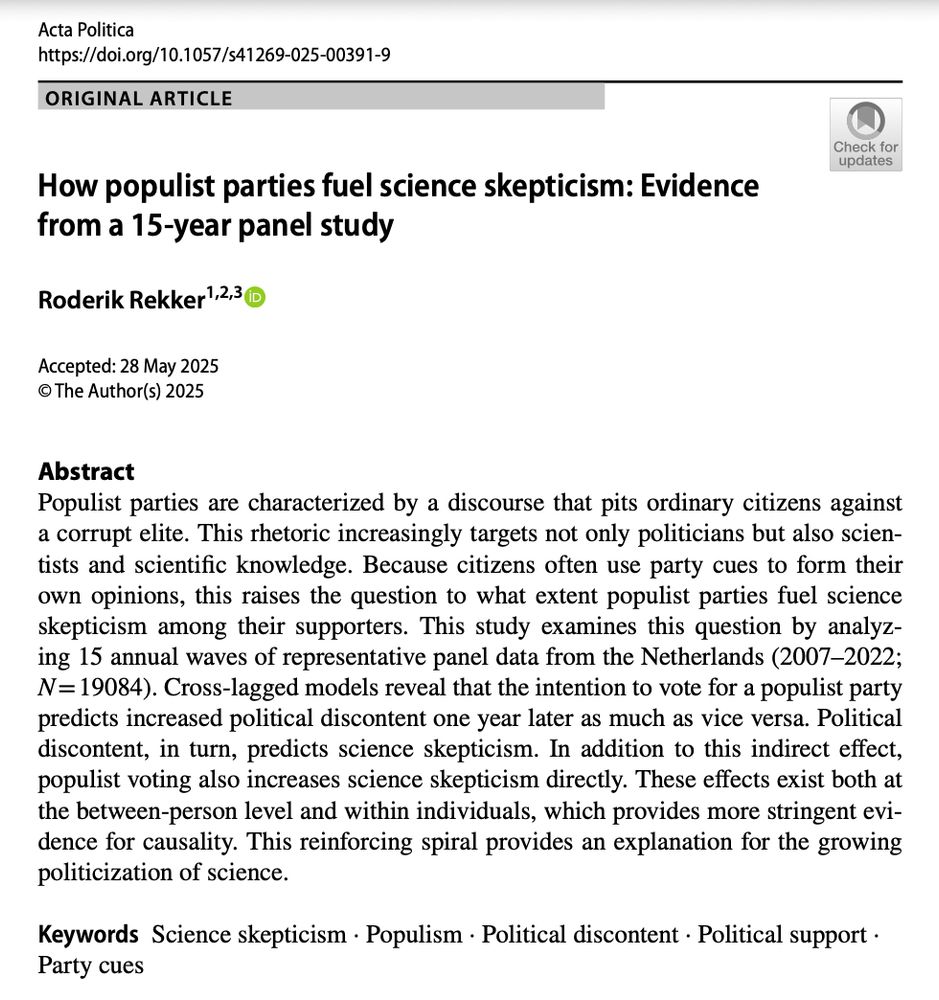
(1/5) Out now in Acta Politica: Populist parties increasingly target scientists and scientific knowledge. By analyzing 15 annual waves of representative panel data from the Netherlands (2007–2022), I examine to what extent populist parties fuel science skepticism among their supporters.
July 3, 2025 at 5:48 PM
(1/5) Out now in Acta Politica: Populist parties increasingly target scientists and scientific knowledge. By analyzing 15 annual waves of representative panel data from the Netherlands (2007–2022), I examine to what extent populist parties fuel science skepticism among their supporters.
Contrary to common misconception, the German youth vote is in line with all research on this issue: support for the radical right is NOT stronger among youth. It is, and always has been, roughly similar among all age groups, except the oldest generation which remained more loyal to cleavage parties.

February 23, 2025 at 6:14 PM
Contrary to common misconception, the German youth vote is in line with all research on this issue: support for the radical right is NOT stronger among youth. It is, and always has been, roughly similar among all age groups, except the oldest generation which remained more loyal to cleavage parties.
(5/8) Moreover, the science polarization between populist and non-populist voters seems to have fundamentally different roots than the effect of left-right ideology. For populist voters, science rejection seems mostly a byproduct of their general distrust in elite institutions.

January 18, 2025 at 11:07 AM
(5/8) Moreover, the science polarization between populist and non-populist voters seems to have fundamentally different roots than the effect of left-right ideology. For populist voters, science rejection seems mostly a byproduct of their general distrust in elite institutions.
(4/8) The results reveal that the hypothesized four-level model fits the data, indicating that it provides a reasonably accurate and parsimonious representation of how a variety of trust indicators relate to each other and to citizens’ political leaning.

January 18, 2025 at 11:07 AM
(4/8) The results reveal that the hypothesized four-level model fits the data, indicating that it provides a reasonably accurate and parsimonious representation of how a variety of trust indicators relate to each other and to citizens’ political leaning.
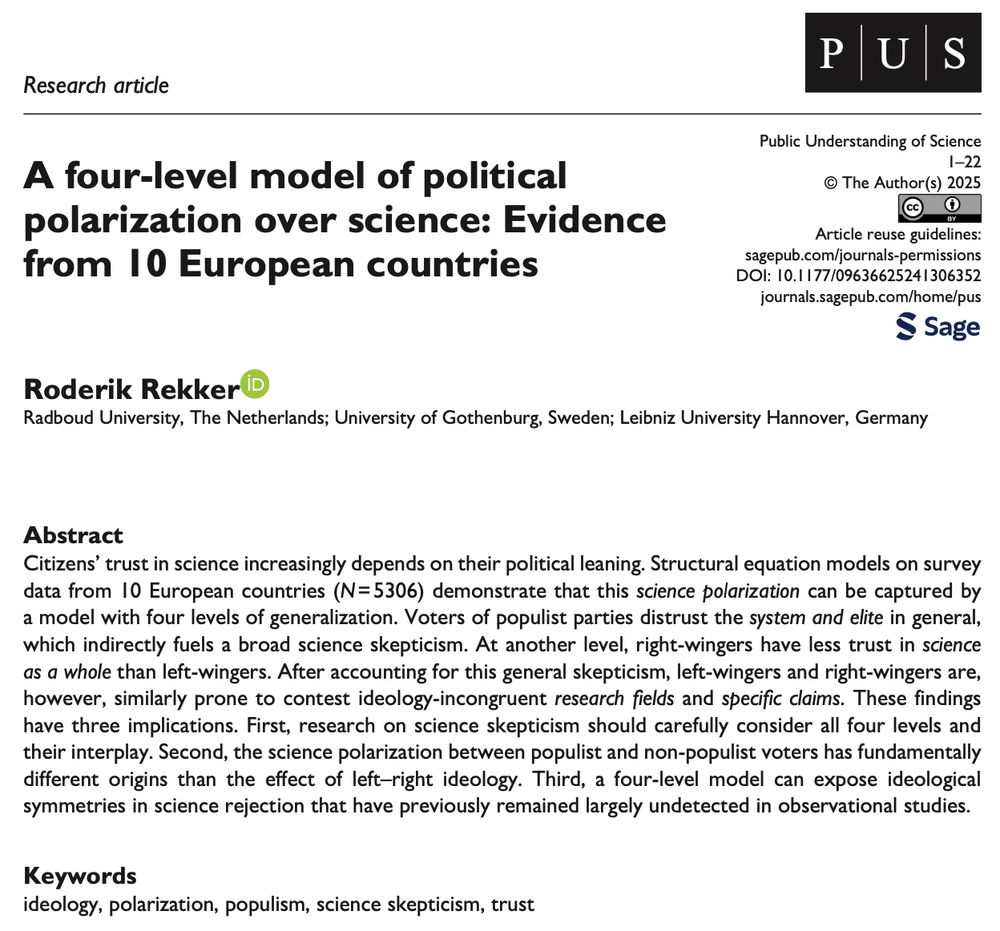
(2/8) This model distinguishes science polarization on four interconnected levels of generalization: (1) scientific claims, (2) research fields, (3) science as a whole, and (4) the system and the elite.

January 18, 2025 at 11:04 AM
(2/8) This model distinguishes science polarization on four interconnected levels of generalization: (1) scientific claims, (2) research fields, (3) science as a whole, and (4) the system and the elite.
(1/8) I’m very excited to share this new publication in Public Understanding of Science. Citizens’ trust in science increasingly depends on their political leaning. In a theoretical article published in 2021, I proposed a four-level model for this ‘science polarization.'
doi.org/10.1177/0963...
doi.org/10.1177/0963...
January 18, 2025 at 11:04 AM
(1/8) I’m very excited to share this new publication in Public Understanding of Science. Citizens’ trust in science increasingly depends on their political leaning. In a theoretical article published in 2021, I proposed a four-level model for this ‘science polarization.'
doi.org/10.1177/0963...
doi.org/10.1177/0963...