




Rob Barber
@ra-barber.bsky.social
Data-y ecologist researching tradeoffs between biodiversity and climate change at Kew Gardens. Mostly work on fungi + birds / but also anything + everything nature-y.
He/Him.
He/Him.
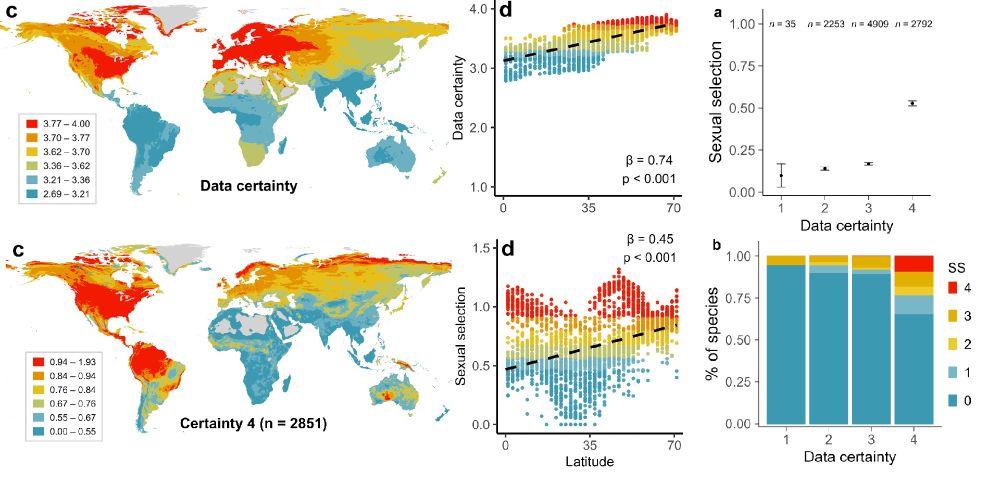
While historical biases dominate data quality, our analyses confirm the gradient still holds for the fraction of best-known species. Moreover, because of a multitude of reasons, sexually selected species (especially tropical) are better known, which can also dampen global trends
December 13, 2024 at 5:09 PM
While historical biases dominate data quality, our analyses confirm the gradient still holds for the fraction of best-known species. Moreover, because of a multitude of reasons, sexually selected species (especially tropical) are better known, which can also dampen global trends
Diet also matters:
Frugivores show weaker sexual selection at higher latitudes (a reversed trend).
In comparison, Insectivores show the strongest positive gradient.
This divergence highlights how ecology can shape the relevance of sexual traits across of species. 🦟🍇
Frugivores show weaker sexual selection at higher latitudes (a reversed trend).
In comparison, Insectivores show the strongest positive gradient.
This divergence highlights how ecology can shape the relevance of sexual traits across of species. 🦟🍇

December 13, 2024 at 5:09 PM
Diet also matters:
Frugivores show weaker sexual selection at higher latitudes (a reversed trend).
In comparison, Insectivores show the strongest positive gradient.
This divergence highlights how ecology can shape the relevance of sexual traits across of species. 🦟🍇
Frugivores show weaker sexual selection at higher latitudes (a reversed trend).
In comparison, Insectivores show the strongest positive gradient.
This divergence highlights how ecology can shape the relevance of sexual traits across of species. 🦟🍇
Ecology and climate provide the answers. Species in seasonal environments (common at higher latitudes) experience greater sexual selection, perhaps due to restricted breeding seasons and greater competition for mates.

December 13, 2024 at 5:09 PM
Ecology and climate provide the answers. Species in seasonal environments (common at higher latitudes) experience greater sexual selection, perhaps due to restricted breeding seasons and greater competition for mates.
Key result: Sexual selection intensity follows a striking latitudinal gradient, increasing toward higher latitudes! 🗺️ Birds in temperate zones exhibit more intense sexual selection compared to their tropical counterparts. But what drives this pattern? 🤔

December 13, 2024 at 5:09 PM
Key result: Sexual selection intensity follows a striking latitudinal gradient, increasing toward higher latitudes! 🗺️ Birds in temperate zones exhibit more intense sexual selection compared to their tropical counterparts. But what drives this pattern? 🤔
We first combed studies, books, databases, encyclopedias, and expert advice to score sexual selection across thousands of species, validating information on mating systems and courtship behavior against established metrics (e.g., Bateman gradients).

December 13, 2024 at 5:09 PM
We first combed studies, books, databases, encyclopedias, and expert advice to score sexual selection across thousands of species, validating information on mating systems and courtship behavior against established metrics (e.g., Bateman gradients).
Sexual selection shapes incredible diversity in bird traits, from extravagant plumage to complex displays. Yet, why it varies across species and regions remains a big question in biology. We set out to explore this using data from >10,000 bird species globally. 🌎🐦

December 13, 2024 at 5:09 PM
Sexual selection shapes incredible diversity in bird traits, from extravagant plumage to complex displays. Yet, why it varies across species and regions remains a big question in biology. We set out to explore this using data from >10,000 bird species globally. 🌎🐦
Big news! 🎉 My first PhD chapter has been published in @PLOSBiology, and it just made the cover! 🐦🌍 Perfect time to dive into the key findings from our global study on sexual selection in birds. 🧵👇
📖 Read the paper: doi.org/10.1371/jour...
📖 Read the paper: doi.org/10.1371/jour...

December 13, 2024 at 5:09 PM
Big news! 🎉 My first PhD chapter has been published in @PLOSBiology, and it just made the cover! 🐦🌍 Perfect time to dive into the key findings from our global study on sexual selection in birds. 🧵👇
📖 Read the paper: doi.org/10.1371/jour...
📖 Read the paper: doi.org/10.1371/jour...