



Christopher Dean
@princessquatris.bsky.social
Palaeontology person. My interests include music, science, justice, animals, shapes and feelings. (he/him)
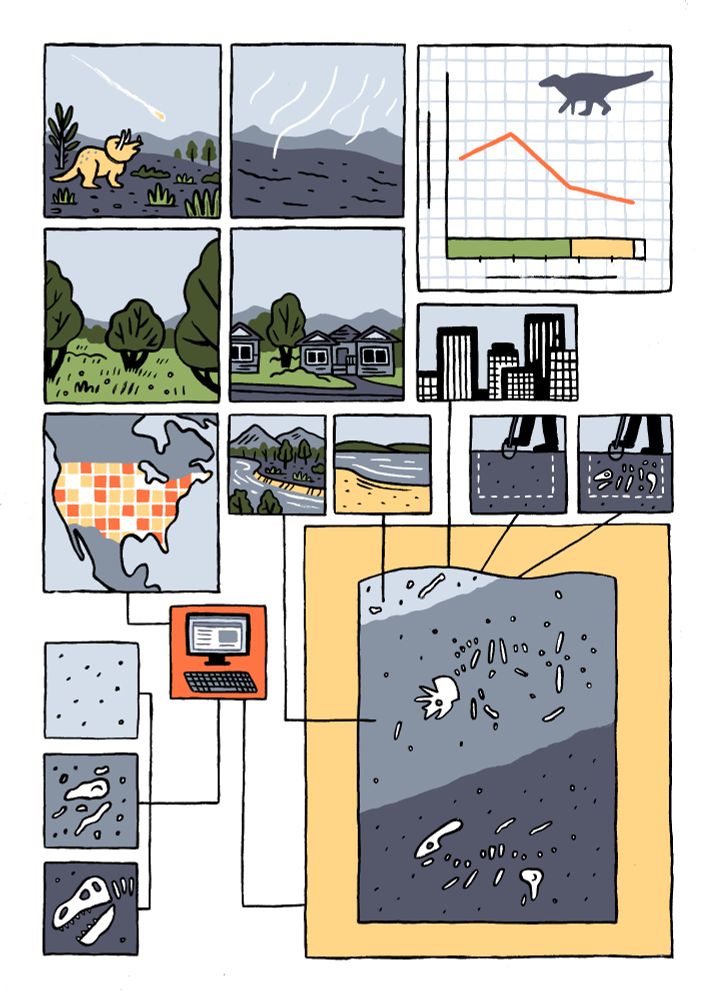
🦖📉 In case anyone missed it, our new paper on using occupancy modelling to resolve the structure of the end-Cretaceous dinosaur fossil record came out yesterday! 🪨⛰️
You can find it here ⬇️
www.cell.com/current-biol...
It's also accompanied by this incredible illustration by @tim-bird.bsky.social!
You can find it here ⬇️
www.cell.com/current-biol...
It's also accompanied by this incredible illustration by @tim-bird.bsky.social!
April 9, 2025 at 10:55 AM
🦖📉 In case anyone missed it, our new paper on using occupancy modelling to resolve the structure of the end-Cretaceous dinosaur fossil record came out yesterday! 🪨⛰️
You can find it here ⬇️
www.cell.com/current-biol...
It's also accompanied by this incredible illustration by @tim-bird.bsky.social!
You can find it here ⬇️
www.cell.com/current-biol...
It's also accompanied by this incredible illustration by @tim-bird.bsky.social!
I'd also like to say a huge thanks to @tim-bird.bsky.social for producing a stunning piece of art to accompany the research. I've been a fan of Tim's graphic novels for many years now, so it was amazing to collaborate with him on this illustration! I love it so much.
April 8, 2025 at 3:58 PM
I'd also like to say a huge thanks to @tim-bird.bsky.social for producing a stunning piece of art to accompany the research. I've been a fan of Tim's graphic novels for many years now, so it was amazing to collaborate with him on this illustration! I love it so much.
We also found that this appears to be unrelated to sampling intensity, i.e. how many dinosaur collections there are during the latest Cretaceous. This suggests that physical changes in environment and preservation are exerting a strong control on the terminal dinosaur fossil record!

April 8, 2025 at 3:55 PM
We also found that this appears to be unrelated to sampling intensity, i.e. how many dinosaur collections there are during the latest Cretaceous. This suggests that physical changes in environment and preservation are exerting a strong control on the terminal dinosaur fossil record!
📉 We found that the probability of detecting various dinosaur families decreases as we approach the K/Pg boundary, indicating that spatial and geological biases likely exert the largest control on their observable fossil record in North America 📉

April 8, 2025 at 3:50 PM
📉 We found that the probability of detecting various dinosaur families decreases as we approach the K/Pg boundary, indicating that spatial and geological biases likely exert the largest control on their observable fossil record in North America 📉
That being said, poor old echinoids show extremely low comparative rates of 'parachute science' (when scientists ‘drop in’ to other countries to conduct research, often without including local researchers), mostly because no one wants to collect or study them! Sorry guys :'(

February 26, 2025 at 3:27 PM
That being said, poor old echinoids show extremely low comparative rates of 'parachute science' (when scientists ‘drop in’ to other countries to conduct research, often without including local researchers), mostly because no one wants to collect or study them! Sorry guys :'(
Finally, we also have indications that museum collections are subject to the same historical collection biases as the broader published fossil record, mostly as a result of colonial legacy (see @mauritiantales.bsky.social et al's excellent 2022 paper for more details).

February 26, 2025 at 3:22 PM
Finally, we also have indications that museum collections are subject to the same historical collection biases as the broader published fossil record, mostly as a result of colonial legacy (see @mauritiantales.bsky.social et al's excellent 2022 paper for more details).
Thankfully, other analyses show more limited impacts. 'Dark Data' doesn't really seem to have an effect on diversity estimates, temporal ranges or sediment associations of echinoids. Which makes sense; new species exist from publications, so unpublished specimens aren't going to impact that much!


February 26, 2025 at 3:19 PM
Thankfully, other analyses show more limited impacts. 'Dark Data' doesn't really seem to have an effect on diversity estimates, temporal ranges or sediment associations of echinoids. Which makes sense; new species exist from publications, so unpublished specimens aren't going to impact that much!
Firstly, we found that geographic patterns are strongly affected by the addition of museum ‘dark data’. Mean geographic and latitudinal ranges for genera increased by ~30% on average when these ‘dark data’ were included alongside the published record.


February 26, 2025 at 3:12 PM
Firstly, we found that geographic patterns are strongly affected by the addition of museum ‘dark data’. Mean geographic and latitudinal ranges for genera increased by ~30% on average when these ‘dark data’ were included alongside the published record.
Well, a paper by Marshall et al. in 2018 found that museum collections across California contained 23 times more geographic localities than the PBDB. That’s a lot of extra data! But there’s still the question of impact; what does this additional data actually mean for individual fossil groups?

February 26, 2025 at 3:07 PM
Well, a paper by Marshall et al. in 2018 found that museum collections across California contained 23 times more geographic localities than the PBDB. That’s a lot of extra data! But there’s still the question of impact; what does this additional data actually mean for individual fossil groups?
Now what is ‘dark data’ you ask? You might be thinking it’s something a bit like this...

February 26, 2025 at 2:59 PM
Now what is ‘dark data’ you ask? You might be thinking it’s something a bit like this...