



Femke de Jong
@plantenzo.bsky.social
Plant scientist turned science journalist, writing among other things about plants. I am based in the Netherlands, so next to English post maybe in Dutch. You can visit my website on http://plantenzo.net/en-2/

After some hard work and testing to remove the remaining bugs can I now say: My new website www.femkedejongsciencejournalist.com is online.
All services new and old that I am offering as part of my portfolio career you can find now in one place.
All services new and old that I am offering as part of my portfolio career you can find now in one place.

October 17, 2025 at 7:26 AM
After some hard work and testing to remove the remaining bugs can I now say: My new website www.femkedejongsciencejournalist.com is online.
All services new and old that I am offering as part of my portfolio career you can find now in one place.
All services new and old that I am offering as part of my portfolio career you can find now in one place.
When running the other day, I spotted a bright pink flower on which I had up till that moment assumed was just another bramble bush. Coming back later to have a proper look, it turned out to be a rose, a beach rose, Rosa rugosa, to be precise. 1/2

August 27, 2025 at 3:17 PM
When running the other day, I spotted a bright pink flower on which I had up till that moment assumed was just another bramble bush. Coming back later to have a proper look, it turned out to be a rose, a beach rose, Rosa rugosa, to be precise. 1/2
These thistles belong to the spear thistle, Cirsium vulgare. It likes to grow on places with enough nitrogen. It basically slurps it up. Making the ground nitrogen poor. So, on one hand it is a bad sign that I spotted these thistles on the moor. 1/2

August 26, 2025 at 2:50 PM
These thistles belong to the spear thistle, Cirsium vulgare. It likes to grow on places with enough nitrogen. It basically slurps it up. Making the ground nitrogen poor. So, on one hand it is a bad sign that I spotted these thistles on the moor. 1/2
These red berries belong to the rowan tree , Sorbus aucuparia. I found this particular specimen growing nearby the Tienhovenskanaal. When ripe its berries are eaten by many birds. 🧵1/3

August 20, 2025 at 2:52 PM
These red berries belong to the rowan tree , Sorbus aucuparia. I found this particular specimen growing nearby the Tienhovenskanaal. When ripe its berries are eaten by many birds. 🧵1/3
While cycling along the Tienhovens kanaal I spotted these little pink flowers. They belong to the hairy willowherb, Epilobium hirsutum. Hairy willowherb grows on moist places, like nearby water edges. 🧵1/2

August 19, 2025 at 2:38 PM
While cycling along the Tienhovens kanaal I spotted these little pink flowers. They belong to the hairy willowherb, Epilobium hirsutum. Hairy willowherb grows on moist places, like nearby water edges. 🧵1/2
Those pretty purple balls belong to the field thistle, Cirsium arvense, belongs like the false mayweed to the aster family. Each of those purple balls is made up of multiple flowers. 🧵1/3

August 18, 2025 at 3:34 PM
Those pretty purple balls belong to the field thistle, Cirsium arvense, belongs like the false mayweed to the aster family. Each of those purple balls is made up of multiple flowers. 🧵1/3
These flowers belong to the common hogweed, Heracleum sphondylium. They do look a bit like the flowers of carrots, which is not that strange as they are family. Although the common hogweed is a fair bit bigger. Its flowers produce lots of nectar and are pollinated by beetles, wasps and flies. 🧵1/3

August 17, 2025 at 7:03 PM
These flowers belong to the common hogweed, Heracleum sphondylium. They do look a bit like the flowers of carrots, which is not that strange as they are family. Although the common hogweed is a fair bit bigger. Its flowers produce lots of nectar and are pollinated by beetles, wasps and flies. 🧵1/3
The false mayweed, Tripleurospermum maritimum, stands out – or maybe I should say doesn’t stand out – because its lack of smell.
Like all other members of the of the aster family, its flowers are composite flowers. The flower head is composed of multiple tiny flowers.
Like all other members of the of the aster family, its flowers are composite flowers. The flower head is composed of multiple tiny flowers.

August 16, 2025 at 2:54 PM
The false mayweed, Tripleurospermum maritimum, stands out – or maybe I should say doesn’t stand out – because its lack of smell.
Like all other members of the of the aster family, its flowers are composite flowers. The flower head is composed of multiple tiny flowers.
Like all other members of the of the aster family, its flowers are composite flowers. The flower head is composed of multiple tiny flowers.
You might not think common reed, Phragmites australis, as that interesting. But there you are wrong. Did you ever noticed that the leaves in a patch of reeds are al facing the same way? And that this is in the opposite direction the wind blew last from? 1/2

August 15, 2025 at 3:31 PM
You might not think common reed, Phragmites australis, as that interesting. But there you are wrong. Did you ever noticed that the leaves in a patch of reeds are al facing the same way? And that this is in the opposite direction the wind blew last from? 1/2
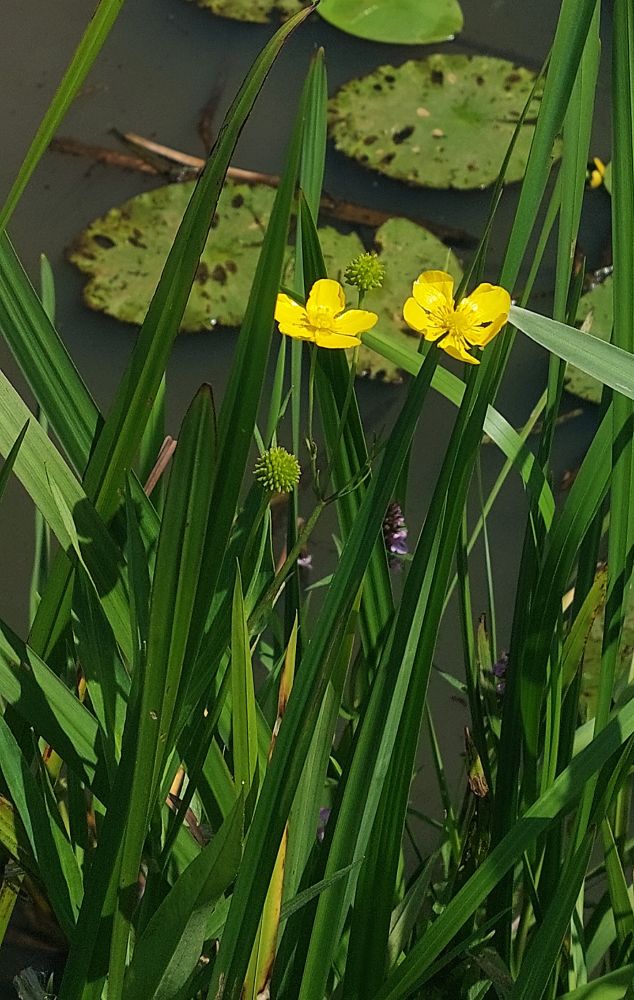
It is not often that you see shiny flowers but these water-buttercup, Ranunculus lingua, are definitely shiny. They thank this to a unique and rare combination of traits. 🧵1/3
August 13, 2025 at 1:49 PM
It is not often that you see shiny flowers but these water-buttercup, Ranunculus lingua, are definitely shiny. They thank this to a unique and rare combination of traits. 🧵1/3
Like many plants in the Westbroekse Zodden, the yellow loosestrife, Lysimachia vulgaris, likes to grow in moist places. Which makes sense considering the amount of water available. 🧵1/3

August 9, 2025 at 3:05 PM
Like many plants in the Westbroekse Zodden, the yellow loosestrife, Lysimachia vulgaris, likes to grow in moist places. Which makes sense considering the amount of water available. 🧵1/3
These striking white flowers belong to the hedge bindweed, Calystegia sepium. A plant that climes around other plants. In this way they can get up to 3 meters high. It likes slightly moist places. And that is just where I spotted these, nearby water. 🧵1/3

August 8, 2025 at 3:03 PM
These striking white flowers belong to the hedge bindweed, Calystegia sepium. A plant that climes around other plants. In this way they can get up to 3 meters high. It likes slightly moist places. And that is just where I spotted these, nearby water. 🧵1/3
Today’s plant hiding between the reed is a look-a-like to the curly dock. It is its close relative, bitter dock, Rumex obtusifolius.
It is considered by farmers and others to be an injurious weed. As eating to much of it as poisonous.
It is considered by farmers and others to be an injurious weed. As eating to much of it as poisonous.

August 7, 2025 at 5:49 PM
Today’s plant hiding between the reed is a look-a-like to the curly dock. It is its close relative, bitter dock, Rumex obtusifolius.
It is considered by farmers and others to be an injurious weed. As eating to much of it as poisonous.
It is considered by farmers and others to be an injurious weed. As eating to much of it as poisonous.
This particular flower is known as meadowsweet, Filipendula ulmaria. It likes a moist environment. No surprise here as I found it at the waters edge. 🧵1/3

August 6, 2025 at 5:09 PM
This particular flower is known as meadowsweet, Filipendula ulmaria. It likes a moist environment. No surprise here as I found it at the waters edge. 🧵1/3
These two plumes belong to Timothy-grass, Phleum pratense. It is commonly grown to feed domestic animals.
Fun fact, its pollen is used to treat hay fever.
Fun fact, its pollen is used to treat hay fever.

August 5, 2025 at 3:54 PM
These two plumes belong to Timothy-grass, Phleum pratense. It is commonly grown to feed domestic animals.
Fun fact, its pollen is used to treat hay fever.
Fun fact, its pollen is used to treat hay fever.
More plants from my walk through the Westbroekse Zodden. These stunning yellow flowers belong to the common bird's-foot trefoil, Lotus corniculatus. This legume is loved by butterflies and bees along. 1/2

August 4, 2025 at 6:18 PM
More plants from my walk through the Westbroekse Zodden. These stunning yellow flowers belong to the common bird's-foot trefoil, Lotus corniculatus. This legume is loved by butterflies and bees along. 1/2
These flower laden plumes are from the purple-loosestrife, Lythrum salicaria. It gets its Latin epithet from its leaves. They look a lot like those found on willows (Salix). Like many plants found in the Westbroekse Zodden, it likes a moist environment. 1/2

August 3, 2025 at 6:00 PM
These flower laden plumes are from the purple-loosestrife, Lythrum salicaria. It gets its Latin epithet from its leaves. They look a lot like those found on willows (Salix). Like many plants found in the Westbroekse Zodden, it likes a moist environment. 1/2
This is hemp-agrimony, Eupatorium cannabinum. It is extremely attractive to butterflies. Like many other plants it has medicinal uses. It works as an anti-inflammatory.

August 2, 2025 at 5:22 PM
This is hemp-agrimony, Eupatorium cannabinum. It is extremely attractive to butterflies. Like many other plants it has medicinal uses. It works as an anti-inflammatory.
These little purple flowers standing out between all that green belong to the marsh woundwort, Stachys palustris. 🧵1/3

August 1, 2025 at 5:35 PM
These little purple flowers standing out between all that green belong to the marsh woundwort, Stachys palustris. 🧵1/3
This tall thistle is the marsh thistle, Cirsium palustre. It doesn’t grow that tall all at ones. It does takes its time. In the first year it only grows a rosette, from which in the subsequent years a tall stem grows which only branches at the top. 1/2

July 31, 2025 at 3:11 PM
This tall thistle is the marsh thistle, Cirsium palustre. It doesn’t grow that tall all at ones. It does takes its time. In the first year it only grows a rosette, from which in the subsequent years a tall stem grows which only branches at the top. 1/2
Looking closely at this yellow flower I was surprised to see purple thong sticking out. These are so-called teeth of the petals. They belong to the greater yellow-rattle, Rhinanthus angustifolius. They are called rattles as the seeds in their casing rattle when you shake the plant. 1/2

July 29, 2025 at 5:12 PM
Looking closely at this yellow flower I was surprised to see purple thong sticking out. These are so-called teeth of the petals. They belong to the greater yellow-rattle, Rhinanthus angustifolius. They are called rattles as the seeds in their casing rattle when you shake the plant. 1/2
These plants made me think, maybe naively, about quinoa. It is actually curly dock, Rumex crispus. And not in the faintest part related to quinoa. 🧵1/4

July 28, 2025 at 2:28 PM
These plants made me think, maybe naively, about quinoa. It is actually curly dock, Rumex crispus. And not in the faintest part related to quinoa. 🧵1/4
When looking for a spot to park my bike when visiting the Westbroekse Zodden I was greeted by the purple flowers of the birth vetch, Vicia cracca. This purple beauty is related to beans and peas, and likewise a legume. 🧵1/3

July 27, 2025 at 3:40 PM
When looking for a spot to park my bike when visiting the Westbroekse Zodden I was greeted by the purple flowers of the birth vetch, Vicia cracca. This purple beauty is related to beans and peas, and likewise a legume. 🧵1/3
Carrot is not one of the plants you expect to come across outside an agricultural setting. But like all or fruit or veggies carrot has wild relatives, who as the name suggests grow out in the wild nature.

July 26, 2025 at 3:32 PM
Carrot is not one of the plants you expect to come across outside an agricultural setting. But like all or fruit or veggies carrot has wild relatives, who as the name suggests grow out in the wild nature.