Reposted

“Putin would eat you for lunch.”
Today, exactly that happened.
Today, exactly that happened.
August 15, 2025 at 11:48 PM
“Putin would eat you for lunch.”
Today, exactly that happened.
Today, exactly that happened.
Reposted

Do your outer join queries produce more rows than expected? In this blog post, I show a strange result when using filter predicates in the join clause.
dbLinter can help you sort your join and filter criteria and spot issues like this.
www.salvis.com/blog/2025/07...
dbLinter can help you sort your join and filter criteria and spot issues like this.
www.salvis.com/blog/2025/07...
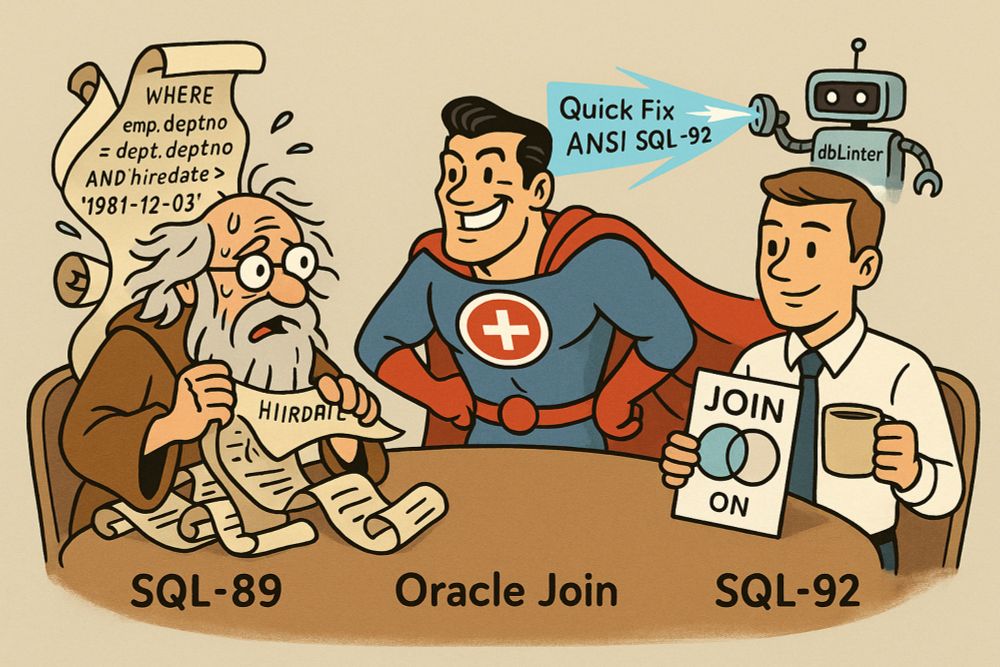
Outer Joining With ANSI SQL-89 and SQL-92
Introduction I recently implemented a quick fix for the rule G-3130 to transform queries to ANSI SQL-92 syntax. One of the challenges was to handle Oracle’s outer-join syntax (+). In ANSI SQL-89, join...
www.salvis.com
July 12, 2025 at 3:52 PM
Do your outer join queries produce more rows than expected? In this blog post, I show a strange result when using filter predicates in the join clause.
dbLinter can help you sort your join and filter criteria and spot issues like this.
www.salvis.com/blog/2025/07...
dbLinter can help you sort your join and filter criteria and spot issues like this.
www.salvis.com/blog/2025/07...
Reposted

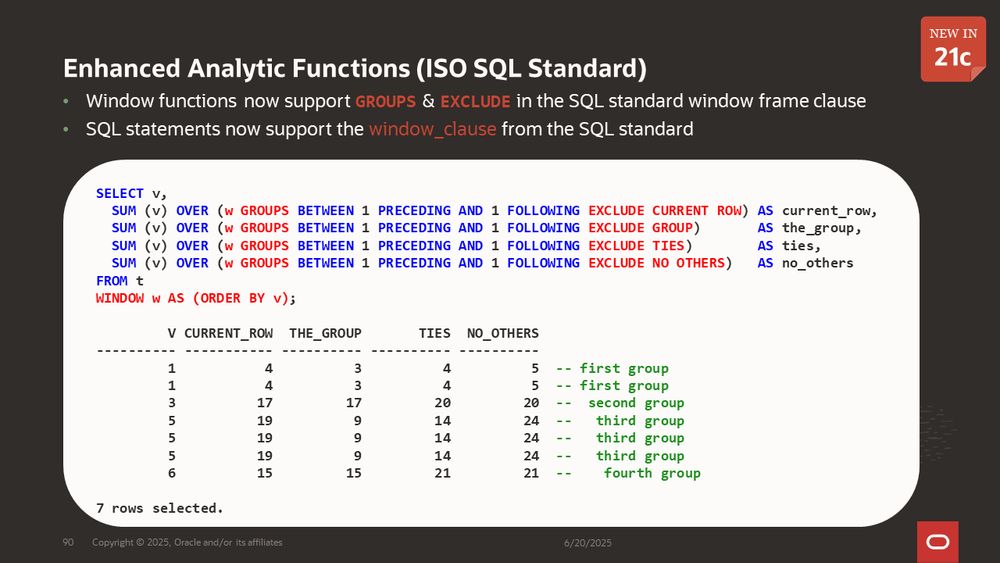
Oracle Database 21c enhanced analytic functions to support GROUPS, EXCLUDE, & the WINDOW clause:
fn ( ... ) OVER ( <w> GROUPS ... EXCLUDE ... )
...
WINDOW <w> AS ( ... )
GROUPS => rows with the same sort key are in the same group
EXCLUDE => omit the current or adjacent rows
fn ( ... ) OVER ( <w> GROUPS ... EXCLUDE ... )
...
WINDOW <w> AS ( ... )
GROUPS => rows with the same sort key are in the same group
EXCLUDE => omit the current or adjacent rows
July 3, 2025 at 11:03 AM
Oracle Database 21c enhanced analytic functions to support GROUPS, EXCLUDE, & the WINDOW clause:
fn ( ... ) OVER ( <w> GROUPS ... EXCLUDE ... )
...
WINDOW <w> AS ( ... )
GROUPS => rows with the same sort key are in the same group
EXCLUDE => omit the current or adjacent rows
fn ( ... ) OVER ( <w> GROUPS ... EXCLUDE ... )
...
WINDOW <w> AS ( ... )
GROUPS => rows with the same sort key are in the same group
EXCLUDE => omit the current or adjacent rows
Reposted

Looking forward to the first low-code conference in Germany! All information, tickets and sponsoring can be found here: low-code.doag.org/en/
We even accept some more abstracts, if you would like to present technical aspects of your low-code platform.
#lowcode @doagev.bsky.social
We even accept some more abstracts, if you would like to present technical aspects of your low-code platform.
#lowcode @doagev.bsky.social

June 12, 2025 at 12:58 PM
Looking forward to the first low-code conference in Germany! All information, tickets and sponsoring can be found here: low-code.doag.org/en/
We even accept some more abstracts, if you would like to present technical aspects of your low-code platform.
#lowcode @doagev.bsky.social
We even accept some more abstracts, if you would like to present technical aspects of your low-code platform.
#lowcode @doagev.bsky.social
Reposted

Everything that is happening in Los Angeles could've been avoided if folks had listened and voted for the sane and qualified black lady.

June 9, 2025 at 11:40 AM
Everything that is happening in Los Angeles could've been avoided if folks had listened and voted for the sane and qualified black lady.
Reposted


Reposted


Reposted


Reposted


Reposted
Group ordered rows into batches up to a given size (bin packing) in Oracle #SQL with
SELECT ... FROM ... MATCH_RECGONIZE (
ORDER BY ...
MEASURES ...
PATTERN ( total+ )
DEFINE total AS SUM ( ... ) <= ...
)
e.g. to group sales by date into batches with value <= X
SELECT ... FROM ... MATCH_RECGONIZE (
ORDER BY ...
MEASURES ...
PATTERN ( total+ )
DEFINE total AS SUM ( ... ) <= ...
)
e.g. to group sales by date into batches with value <= X
April 14, 2025 at 11:03 AM
Group ordered rows into batches up to a given size (bin packing) in Oracle #SQL with
SELECT ... FROM ... MATCH_RECGONIZE (
ORDER BY ...
MEASURES ...
PATTERN ( total+ )
DEFINE total AS SUM ( ... ) <= ...
)
e.g. to group sales by date into batches with value <= X
SELECT ... FROM ... MATCH_RECGONIZE (
ORDER BY ...
MEASURES ...
PATTERN ( total+ )
DEFINE total AS SUM ( ... ) <= ...
)
e.g. to group sales by date into batches with value <= X
Awesome
This is clever. Thank you

New Video!
Load large Excel spreadsheets like a Pro using some cool features in the Oracle Database!
youtu.be/BzpCaMcGTVo
Load large Excel spreadsheets like a Pro using some cool features in the Oracle Database!
youtu.be/BzpCaMcGTVo
April 9, 2025 at 7:10 PM
Awesome
Reposted
You can diff two tables to find the rows only in one with:
SELECT * FROM ( SELECT 't1' t1, t1.* FROM t1) t1
NATURAL FULL JOIN ( SELECT 't2' t2, t2.* FROM t2 ) t2
WHERE t1 IS NULL OR t2 IS NULL
For this to work the columns must
Have the same names in each table
Contain no NULLs
SELECT * FROM ( SELECT 't1' t1, t1.* FROM t1) t1
NATURAL FULL JOIN ( SELECT 't2' t2, t2.* FROM t2 ) t2
WHERE t1 IS NULL OR t2 IS NULL
For this to work the columns must
Have the same names in each table
Contain no NULLs
March 31, 2025 at 11:01 AM
You can diff two tables to find the rows only in one with:
SELECT * FROM ( SELECT 't1' t1, t1.* FROM t1) t1
NATURAL FULL JOIN ( SELECT 't2' t2, t2.* FROM t2 ) t2
WHERE t1 IS NULL OR t2 IS NULL
For this to work the columns must
Have the same names in each table
Contain no NULLs
SELECT * FROM ( SELECT 't1' t1, t1.* FROM t1) t1
NATURAL FULL JOIN ( SELECT 't2' t2, t2.* FROM t2 ) t2
WHERE t1 IS NULL OR t2 IS NULL
For this to work the columns must
Have the same names in each table
Contain no NULLs
Reposted
Turn rows into columns in Oracle #SQL with
PIVOT ( fn FOR col IN ( 'v1', 'v2', ... ) )
This adds a column for each value in the IN list with the fn result
You can have many fns but must alias each:
PIVOT ( fn1 a1, fn2 a2 ... )
Any table columns not in the PIVOT clause form an implicit group by
PIVOT ( fn FOR col IN ( 'v1', 'v2', ... ) )
This adds a column for each value in the IN list with the fn result
You can have many fns but must alias each:
PIVOT ( fn1 a1, fn2 a2 ... )
Any table columns not in the PIVOT clause form an implicit group by
March 3, 2025 at 12:00 PM
Turn rows into columns in Oracle #SQL with
PIVOT ( fn FOR col IN ( 'v1', 'v2', ... ) )
This adds a column for each value in the IN list with the fn result
You can have many fns but must alias each:
PIVOT ( fn1 a1, fn2 a2 ... )
Any table columns not in the PIVOT clause form an implicit group by
PIVOT ( fn FOR col IN ( 'v1', 'v2', ... ) )
This adds a column for each value in the IN list with the fn result
You can have many fns but must alias each:
PIVOT ( fn1 a1, fn2 a2 ... )
Any table columns not in the PIVOT clause form an implicit group by
Reposted


March 1, 2025 at 8:44 PM
Reposted


Reposted

Reposted

It’s horrifying that it’s come to this, but as someone with a deep affinity for Europe I feel moved seeing that continent come together to try to save itself in the absence of any meaningful aid from the totalitarian regime that’s in the midst of taking over the United States through an illegal coup

February 28, 2025 at 3:38 AM
It’s horrifying that it’s come to this, but as someone with a deep affinity for Europe I feel moved seeing that continent come together to try to save itself in the absence of any meaningful aid from the totalitarian regime that’s in the midst of taking over the United States through an illegal coup
Reposted
When you create an index on a column, the database stores its values and a pointer to the corresponding row
This means a value can be listed many times in an index - once for each row
Deduplicate entries within a block in Oracle Database with
CREATE INDEX ... COMPRESS
This means a value can be listed many times in an index - once for each row
Deduplicate entries within a block in Oracle Database with
CREATE INDEX ... COMPRESS
February 20, 2025 at 12:00 PM
When you create an index on a column, the database stores its values and a pointer to the corresponding row
This means a value can be listed many times in an index - once for each row
Deduplicate entries within a block in Oracle Database with
CREATE INDEX ... COMPRESS
This means a value can be listed many times in an index - once for each row
Deduplicate entries within a block in Oracle Database with
CREATE INDEX ... COMPRESS
Reposted

Please read my latest post, where I show you how to consolidate and centralize Oracle APEX validation logic with the PL/SQL Error validation type to improve reuse, performance, and maintenance. #orclAPEX
blog.cloudnueva.com/validation-l...
blog.cloudnueva.com/validation-l...

Streamline Validation Logic Using APEX_ERROR
Consolidate and centralize Oracle APEX validation logic with the PL/SQL Error validation type to improve reuse, performance, and maintenance.
blog.cloudnueva.com
February 6, 2025 at 2:06 PM
Please read my latest post, where I show you how to consolidate and centralize Oracle APEX validation logic with the PL/SQL Error validation type to improve reuse, performance, and maintenance. #orclAPEX
blog.cloudnueva.com/validation-l...
blog.cloudnueva.com/validation-l...
Reposted

Join me next Wednesday (12 Feb) to learn about using PL/SQL to build #database APIs
We'll cover Oracle Database 23ai enhancements to help you do this such as:
Better loops
Extended case expressions
JSON integration
The automatic SQL transpiler
Starts 10am UK time
go.oracle.com/LP=146704?el...
We'll cover Oracle Database 23ai enhancements to help you do this such as:
Better loops
Extended case expressions
JSON integration
The automatic SQL transpiler
Starts 10am UK time
go.oracle.com/LP=146704?el...
Developer Coaching: Build Database APIs with PL/SQL in Oracle Database 23ai
Oracle Database 23ai continues to enhance PL/SQL with better loops, extended case expressions, and better JSON integration. Join this session to learn what’s new to help you build data-drive apps.
go.oracle.com
February 5, 2025 at 3:03 PM
Join me next Wednesday (12 Feb) to learn about using PL/SQL to build #database APIs
We'll cover Oracle Database 23ai enhancements to help you do this such as:
Better loops
Extended case expressions
JSON integration
The automatic SQL transpiler
Starts 10am UK time
go.oracle.com/LP=146704?el...
We'll cover Oracle Database 23ai enhancements to help you do this such as:
Better loops
Extended case expressions
JSON integration
The automatic SQL transpiler
Starts 10am UK time
go.oracle.com/LP=146704?el...
Reposted

Reposted

I'll be sharing Oracle Database blogs from our PM team, every working day this month.
💡- Flashback Time Travel -
www.killiansbytes.com/post/flashba...
💡- Flashback Time Travel -
www.killiansbytes.com/post/flashba...

Flashback Time Travel
This blog is part of the overall "10 Oracle Database Features That Fly Under the Radar" and explains what Flashback Time Travel is and gives a small demo example.What it is:Flashback Time Travel is a feature of Oracle Flashback Technology that lets you store and track all changes to the data in your table(s) for a decided amount of time including across DDL changes on tracked tables. This could be useful for a handful of reasons • Compliance - you want to keep a historical record of your data or
www.killiansbytes.com
January 6, 2025 at 1:56 PM
I'll be sharing Oracle Database blogs from our PM team, every working day this month.
💡- Flashback Time Travel -
www.killiansbytes.com/post/flashba...
💡- Flashback Time Travel -
www.killiansbytes.com/post/flashba...
Reposted

How could someone with 34 felonies become president?

January 4, 2025 at 10:46 PM
How could someone with 34 felonies become president?
Reposted


Reposted