



@pardissabeti.bsky.social
Author selfie—but this one feels different. Our newest @sabeti_lab paper came out as conflict escalated between Israel & Iran, our birth countries. A reminder of how fragile the world can be & a reminder of what’s possible: across borders & conflict, individuals can still choose to build together.

June 16, 2025 at 6:53 PM
Author selfie—but this one feels different. Our newest @sabeti_lab paper came out as conflict escalated between Israel & Iran, our birth countries. A reminder of how fragile the world can be & a reminder of what’s possible: across borders & conflict, individuals can still choose to build together.
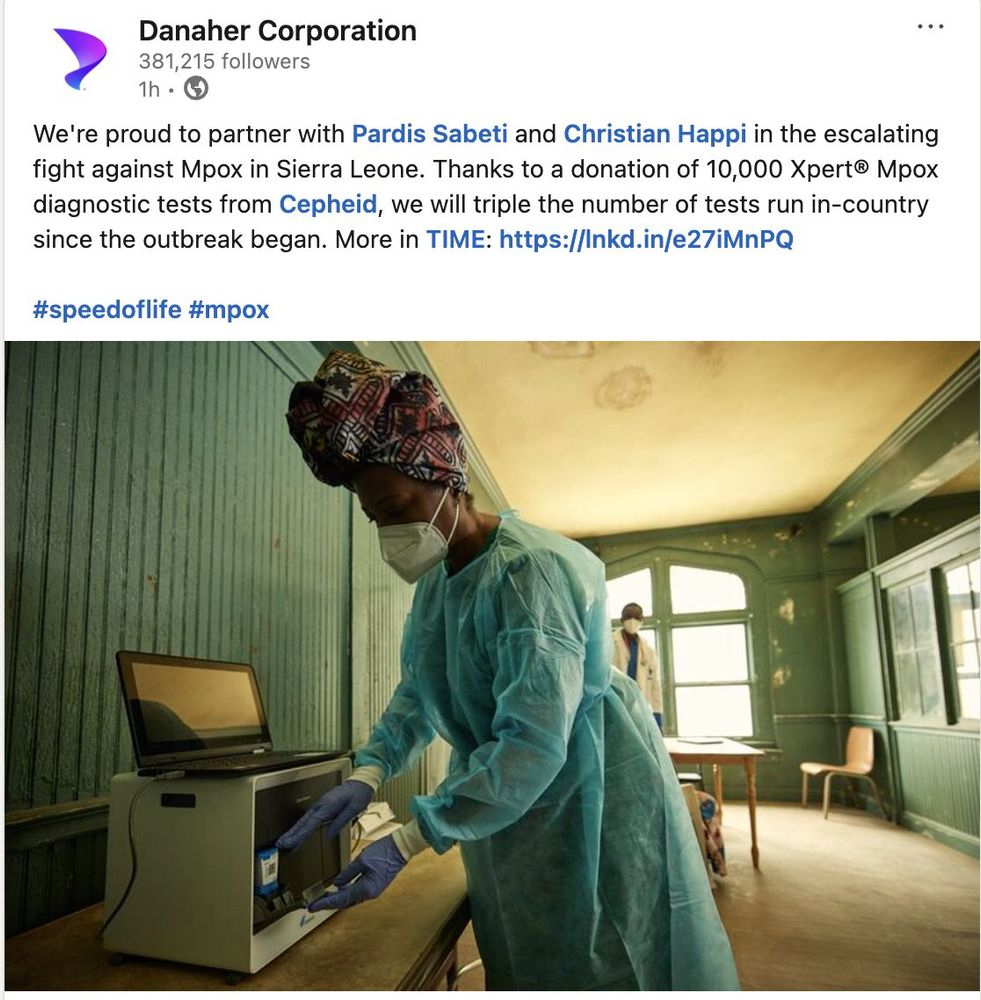
Thank you to Sierra Leone Ministry of Health and National Public Health Agency for their inspired leadership in the #mpox response and to Danaher for supporting them by donating 10,000 Cepheid Xpert diagnostic tests
June 12, 2025 at 7:20 PM
Thank you to Sierra Leone Ministry of Health and National Public Health Agency for their inspired leadership in the #mpox response and to Danaher for supporting them by donating 10,000 Cepheid Xpert diagnostic tests
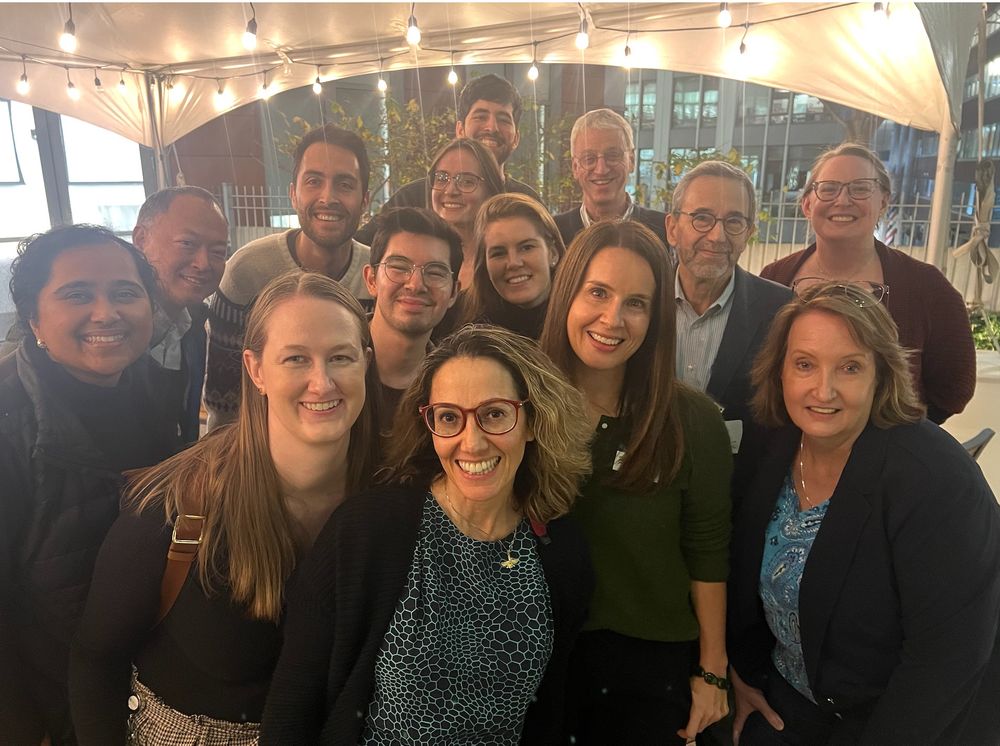
We will keep a close look out, thanks to our academic and public health partnership that makes this possible. Here is a team selfie, including our project lead @drelyse.bsky.social and some of our awesome @sabetilab.bsky.social @broadinstitute.org & the Mass DPH team. (10/10)
April 3, 2025 at 2:12 PM
We will keep a close look out, thanks to our academic and public health partnership that makes this possible. Here is a team selfie, including our project lead @drelyse.bsky.social and some of our awesome @sabetilab.bsky.social @broadinstitute.org & the Mass DPH team. (10/10)
At higher sample concentrations (>500 cp/uL), hybrid-selected RNA-Seq libraries produced the most complete genomes, while an Amp-Seq protocol performed best at lower concentrations. (8/10)

April 3, 2025 at 2:12 PM
At higher sample concentrations (>500 cp/uL), hybrid-selected RNA-Seq libraries produced the most complete genomes, while an Amp-Seq protocol performed best at lower concentrations. (8/10)
Of our 214 commercial milk samples, 55 (26%) tested positive for H5N1 RNA by dPCR, while 48 (22%) tested positive by qPCR. Most positive samples were from processing plants in four states with reported H5N1 outbreaks: Colorado, Idaho, Michigan, and Texas. (6/10)

April 3, 2025 at 2:12 PM
Of our 214 commercial milk samples, 55 (26%) tested positive for H5N1 RNA by dPCR, while 48 (22%) tested positive by qPCR. Most positive samples were from processing plants in four states with reported H5N1 outbreaks: Colorado, Idaho, Michigan, and Texas. (6/10)
We also assessed a variety of pre-processing and extraction protocols for H5N1 detection and sequencing. All three tested extraction kits demonstrated similar recovery, and fat content and pre-centrifugation did not significantly affect detection. (5/10)

April 3, 2025 at 2:12 PM
We also assessed a variety of pre-processing and extraction protocols for H5N1 detection and sequencing. All three tested extraction kits demonstrated similar recovery, and fat content and pre-centrifugation did not significantly affect detection. (5/10)
With 214 store-bought milk samples from 20 states, we evaluated dPCR & qPCR assays for H5N1 w/primers targeting the H5 subtype of HA gene. All assays performed well w/minimal optimization – dPCR was slightly more sensitive – & bovine Ribonuclease P gene served as an effective positive control.(4/10)

April 3, 2025 at 2:12 PM
With 214 store-bought milk samples from 20 states, we evaluated dPCR & qPCR assays for H5N1 w/primers targeting the H5 subtype of HA gene. All assays performed well w/minimal optimization – dPCR was slightly more sensitive – & bovine Ribonuclease P gene served as an effective positive control.(4/10)
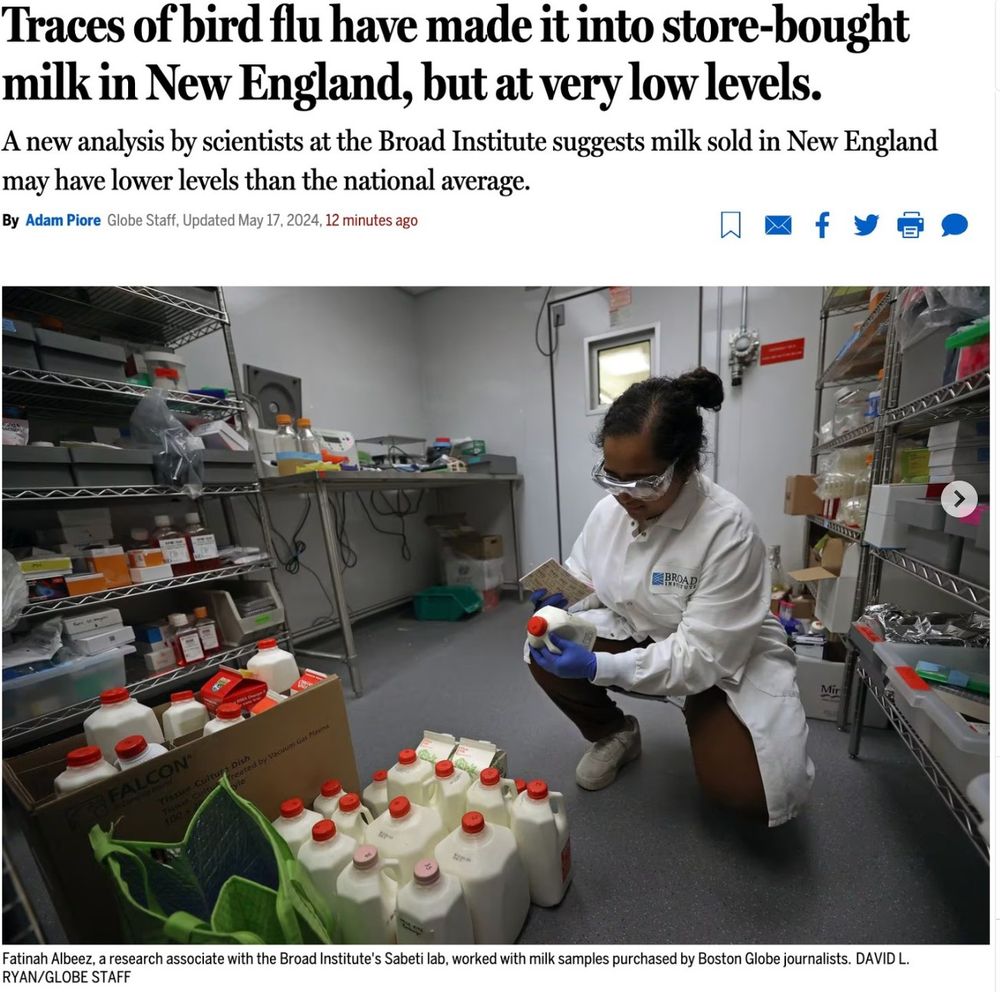
The best time to set up testing is indeed before any cases, but setting up testing requires positive cases for validation. A classic conundrum, that here was solved by ready access to positive samples are our store shelves – commercial milk – and spurred by a collaboration with @BostonGlobe. (3/10)
April 3, 2025 at 2:12 PM
The best time to set up testing is indeed before any cases, but setting up testing requires positive cases for validation. A classic conundrum, that here was solved by ready access to positive samples are our store shelves – commercial milk – and spurred by a collaboration with @BostonGlobe. (3/10)
We tested Delphy’s scalability with simulated outbreaks having 100 to 100K samples over 6 months of growth. Inferred trees and parameters matched ground truth in all but one case. The 100K run finished in <15 hrs (ESS 248)—likely the largest full Bayesian phylo run to date. 🚀
#ScalableTech 12/17
#ScalableTech 12/17

March 31, 2025 at 3:34 PM
We tested Delphy’s scalability with simulated outbreaks having 100 to 100K samples over 6 months of growth. Inferred trees and parameters matched ground truth in all but one case. The 100K run finished in <15 hrs (ESS 248)—likely the largest full Bayesian phylo run to date. 🚀
#ScalableTech 12/17
#ScalableTech 12/17
Stay up to date on the #H5N1 outbreak with Delphy’s daily-updated results 👉 delphy.fathom.info/us-h5n1-latest.
Uses Andersen Lab’s avian flu sequences (1944 as of Mar 22, 2025) and exact dates from GenBank.
Delphy assumes exponential growth—for now.
#OutbreakResponse 11/17
Uses Andersen Lab’s avian flu sequences (1944 as of Mar 22, 2025) and exact dates from GenBank.
Delphy assumes exponential growth—for now.
#OutbreakResponse 11/17

March 31, 2025 at 3:34 PM
Stay up to date on the #H5N1 outbreak with Delphy’s daily-updated results 👉 delphy.fathom.info/us-h5n1-latest.
Uses Andersen Lab’s avian flu sequences (1944 as of Mar 22, 2025) and exact dates from GenBank.
Delphy assumes exponential growth—for now.
#OutbreakResponse 11/17
Uses Andersen Lab’s avian flu sequences (1944 as of Mar 22, 2025) and exact dates from GenBank.
Delphy assumes exponential growth—for now.
#OutbreakResponse 11/17
We’re now applying Delphy to the ongoing H5N1 outbreak in U.S. cattle. It captures key dynamics: 🐄 Initial spillover in TX (early 2024), 🌾 gradual spread across states, 🌄 localized CO outbreaks (spring–summer), 🌉 spread to CA (summer–fall).
#H5N1 #Phylogenetics #OutbreakResponse 10/17
#H5N1 #Phylogenetics #OutbreakResponse 10/17

March 31, 2025 at 3:34 PM
We’re now applying Delphy to the ongoing H5N1 outbreak in U.S. cattle. It captures key dynamics: 🐄 Initial spillover in TX (early 2024), 🌾 gradual spread across states, 🌄 localized CO outbreaks (spring–summer), 🌉 spread to CA (summer–fall).
#H5N1 #Phylogenetics #OutbreakResponse 10/17
#H5N1 #Phylogenetics #OutbreakResponse 10/17
By Feb 8, 2020, Delphy could've detected separate early SARS-CoV-2 introductions into Europe & N. America that exhibited onward transmission. Even as early as Feb 1, key outbreak parameters like mutation rate & tMRCA were already coming into focus.
#SARSCoV2 #Phylogenetics #OutbreakResponse 9/17
#SARSCoV2 #Phylogenetics #OutbreakResponse 9/17

March 31, 2025 at 3:34 PM
By Feb 8, 2020, Delphy could've detected separate early SARS-CoV-2 introductions into Europe & N. America that exhibited onward transmission. Even as early as Feb 1, key outbreak parameters like mutation rate & tMRCA were already coming into focus.
#SARSCoV2 #Phylogenetics #OutbreakResponse 9/17
#SARSCoV2 #Phylogenetics #OutbreakResponse 9/17
To demo Delphy as a frontline tool, we simulated how it could’ve inferred key insights week-by-week during the early SARS-CoV-2 pandemic using GISAID data—applying minimal filtering to reflect the urgency and limited knowledge of a real-time outbreak. 8/17

March 31, 2025 at 3:34 PM
To demo Delphy as a frontline tool, we simulated how it could’ve inferred key insights week-by-week during the early SARS-CoV-2 pandemic using GISAID data—applying minimal filtering to reflect the urgency and limited knowledge of a real-time outbreak. 8/17
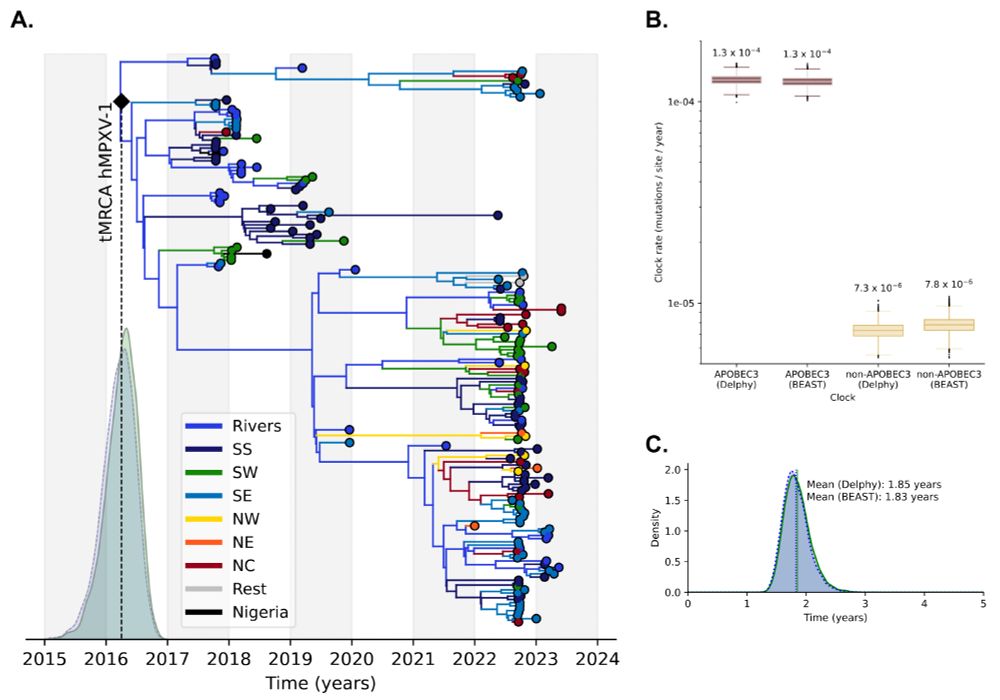
We adapted Delphy for human mpox, accounting for APOBEC3-driven mutations. In minutes, it replicated Parker et al. (2024)’s key findings on the 2022 outbreak’s origin (Rivers State, Nigeria), matching BEAST’s inferences of parameters (restricted to hMPXV-1 samples only). #Phylogenetics #Mpox 7/17
March 31, 2025 at 3:34 PM
We adapted Delphy for human mpox, accounting for APOBEC3-driven mutations. In minutes, it replicated Parker et al. (2024)’s key findings on the 2022 outbreak’s origin (Rivers State, Nigeria), matching BEAST’s inferences of parameters (restricted to hMPXV-1 samples only). #Phylogenetics #Mpox 7/17
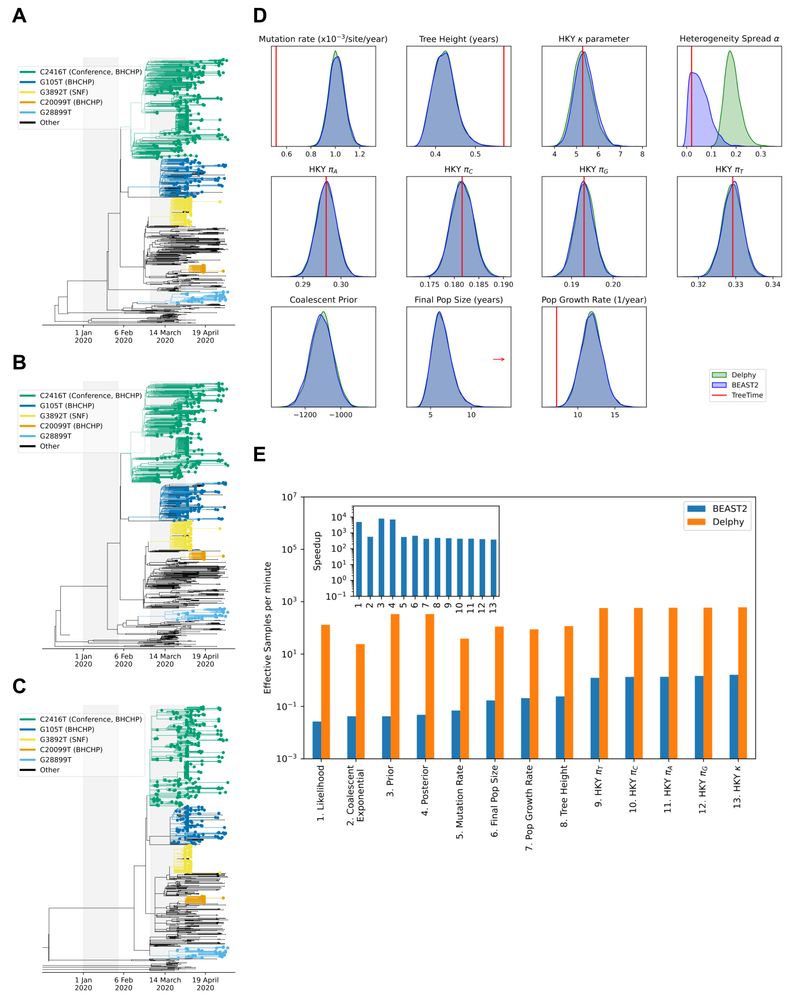
Delphy delivers results consistent with state-of-the-art tools — but up to 1000x faster. 🚀
In our initial whitepaper, we benchmarked it on viral genome sequence datasets:
🧬 757 SARS-CoV-2
🧬 174 Zika
🧬 81 Ebola
General scaling suggests even greater speedups on larger datasets.
5/17
In our initial whitepaper, we benchmarked it on viral genome sequence datasets:
🧬 757 SARS-CoV-2
🧬 174 Zika
🧬 81 Ebola
General scaling suggests even greater speedups on larger datasets.
5/17
March 31, 2025 at 3:34 PM
Delphy delivers results consistent with state-of-the-art tools — but up to 1000x faster. 🚀
In our initial whitepaper, we benchmarked it on viral genome sequence datasets:
🧬 757 SARS-CoV-2
🧬 174 Zika
🧬 81 Ebola
General scaling suggests even greater speedups on larger datasets.
5/17
In our initial whitepaper, we benchmarked it on viral genome sequence datasets:
🧬 757 SARS-CoV-2
🧬 174 Zika
🧬 81 Ebola
General scaling suggests even greater speedups on larger datasets.
5/17
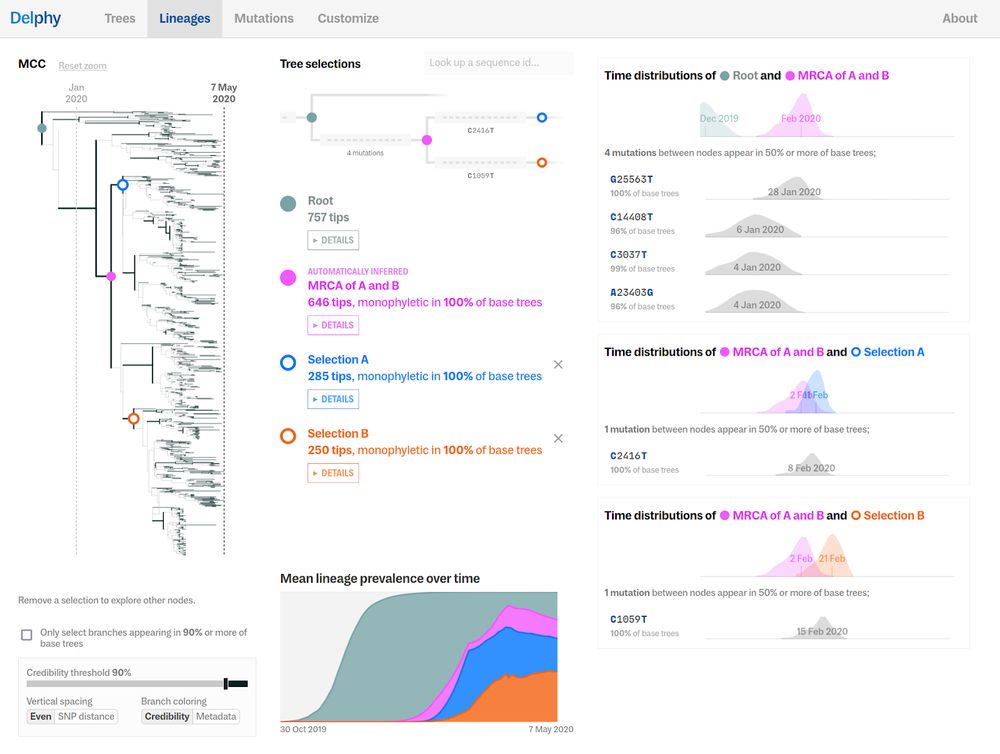
Delphy is a secure, easy-to-use web app 👉 delphy.fathom.info. Analyze your own sequence data locally—no uploads needed. With smart defaults, auto burn-in suggestions, and seamless analysis, you can go from data to publication-ready figures in under an hour. ⏰ 4/17



March 31, 2025 at 3:34 PM
Delphy is a secure, easy-to-use web app 👉 delphy.fathom.info. Analyze your own sequence data locally—no uploads needed. With smart defaults, auto burn-in suggestions, and seamless analysis, you can go from data to publication-ready figures in under an hour. ⏰ 4/17
Delphy reformulates Bayesian phylogenetics exactly using Explicit Mutation-Annotated Trees (EMATs)—an extension of UShER’s MATs—to infer timed trees. With 🔎 efficient local moves & ⚡ scalable parallelization, it delivers 🌍 faster insights for large-scale outbreak data. 3/17

March 31, 2025 at 3:34 PM
Delphy reformulates Bayesian phylogenetics exactly using Explicit Mutation-Annotated Trees (EMATs)—an extension of UShER’s MATs—to infer timed trees. With 🔎 efficient local moves & ⚡ scalable parallelization, it delivers 🌍 faster insights for large-scale outbreak data. 3/17

The SARS-CoV-2 study––the largest transmission reconstruction to our knowledge––revealed a significantly lower transmission rate for vaccinated individuals as compared to unvaccinated ones. This analysis was made possible by JUNIPER’s novel approach to parallelization. 9/12

March 6, 2025 at 3:13 PM
The SARS-CoV-2 study––the largest transmission reconstruction to our knowledge––revealed a significantly lower transmission rate for vaccinated individuals as compared to unvaccinated ones. This analysis was made possible by JUNIPER’s novel approach to parallelization. 9/12
The H5N1 study revealed an elevated transmission rate in California, quantified discrepancies in transmission rates by state, and identified high-probability individual transmission links. 8/12

March 6, 2025 at 3:13 PM
The H5N1 study revealed an elevated transmission rate in California, quantified discrepancies in transmission rates by state, and identified high-probability individual transmission links. 8/12
We further validated JUNIPER on a controlled bovine RSV transmission study (panels A, B) and a rigorously-investigated SARS-CoV-2 outbreak at a hospital (panels C, D). JUNIPER reconstructed the known or likely transmission links with higher accuracy than existing methods. 6/12

March 6, 2025 at 3:13 PM
We further validated JUNIPER on a controlled bovine RSV transmission study (panels A, B) and a rigorously-investigated SARS-CoV-2 outbreak at a hospital (panels C, D). JUNIPER reconstructed the known or likely transmission links with higher accuracy than existing methods. 6/12
We first validated JUNIPER on computer-simulated outbreaks under a variety of different evolutionary and transmission dynamics. JUNIPER inferred transmissions and key parameters, such as the evolution rate and reproductive number, more accurately than existing methods. 5/12

March 6, 2025 at 3:13 PM
We first validated JUNIPER on computer-simulated outbreaks under a variety of different evolutionary and transmission dynamics. JUNIPER inferred transmissions and key parameters, such as the evolution rate and reproductive number, more accurately than existing methods. 5/12
Geranah Nerette is a senior administrative assistant on the team. She helps coordinate travel, HR, leads applicant reviews, and streamlines lab processes overall. No matter how busy things get, Geranah is always there to lend a hand and keep the lab running like a well-oiled machine.🧵7/7


February 27, 2025 at 3:35 PM
Geranah Nerette is a senior administrative assistant on the team. She helps coordinate travel, HR, leads applicant reviews, and streamlines lab processes overall. No matter how busy things get, Geranah is always there to lend a hand and keep the lab running like a well-oiled machine.🧵7/7
Dora Nabatanzi, an RA passionate about public health, works on our respiratory sequencing project, bringing curiosity, energy, & a love for discovery to the lab. Her positivity and kindness uplift everyone around her, making the lab a more vibrant & welcoming place every day. She’s a 🌟 🧵6/7


February 27, 2025 at 3:35 PM
Dora Nabatanzi, an RA passionate about public health, works on our respiratory sequencing project, bringing curiosity, energy, & a love for discovery to the lab. Her positivity and kindness uplift everyone around her, making the lab a more vibrant & welcoming place every day. She’s a 🌟 🧵6/7
@tsionabay.bsky.social joined our lab as a BBS Harvard rotation student & made such an impact we were thrilled to have her join. Now a PhD student, she brings her unique skill set to projects on host-viral interactions & viral diagnostics. Her passion shines through in everything she does! 🧵5/7


February 27, 2025 at 3:35 PM
@tsionabay.bsky.social joined our lab as a BBS Harvard rotation student & made such an impact we were thrilled to have her join. Now a PhD student, she brings her unique skill set to projects on host-viral interactions & viral diagnostics. Her passion shines through in everything she does! 🧵5/7