



Noam Sarna
@noamsarna.bsky.social
PhD student at TAU. Trainee Clinical Psychologist.
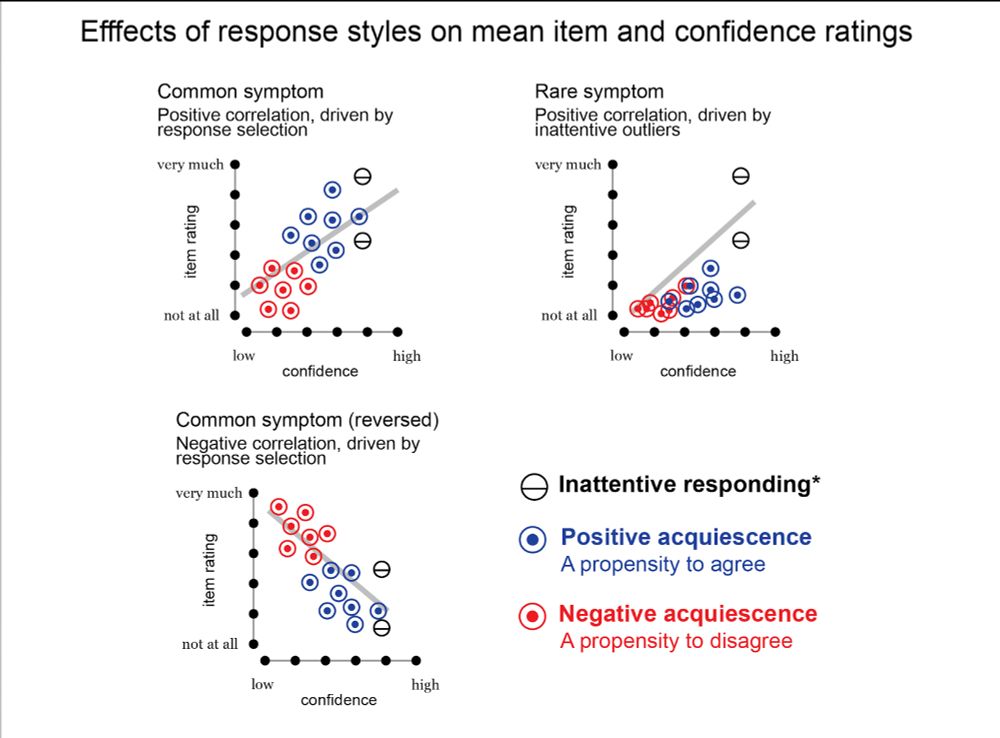
We showed that the AD factor loads highly on reversed items (Figure 6). So, a participant with negative acquiescence will likely score high on the AD factor (as low ratings for reversed items translate to high symptom) and will also tend to endorse low confidence ratings (Figure 1, panel B).
March 22, 2025 at 8:53 AM
We showed that the AD factor loads highly on reversed items (Figure 6). So, a participant with negative acquiescence will likely score high on the AD factor (as low ratings for reversed items translate to high symptom) and will also tend to endorse low confidence ratings (Figure 1, panel B).
I think so, yes. As acquiescence is a tendency to give (high/low) ratings irrespective of content. In our paper we show that acquiescence is correlated with confidence ratings but also with scores on the OCI-R for example.
March 22, 2025 at 8:42 AM
I think so, yes. As acquiescence is a tendency to give (high/low) ratings irrespective of content. In our paper we show that acquiescence is correlated with confidence ratings but also with scores on the OCI-R for example.
Many thanks for sharing this Oliver! It's very interesting and compelling.
March 22, 2025 at 8:32 AM
Many thanks for sharing this Oliver! It's very interesting and compelling.
Thanks so much, Claire! Really appreciate your collaborative spirit.
March 22, 2025 at 8:24 AM
Thanks so much, Claire! Really appreciate your collaborative spirit.
None of this would have been possible without the open data, code sharing, and immensely useful feedback from @smfleming.bsky.social, @clairegillan.bsky.social, Marion Rouault, and @seowxft.bsky.social, which we are grateful for. [end]
March 17, 2025 at 5:17 PM
None of this would have been possible without the open data, code sharing, and immensely useful feedback from @smfleming.bsky.social, @clairegillan.bsky.social, Marion Rouault, and @seowxft.bsky.social, which we are grateful for. [end]
We present some ideas for how future studies may better control for these nuisance effects when testing for correlations between mental health and metacognition. [13/14]
March 17, 2025 at 5:17 PM
We present some ideas for how future studies may better control for these nuisance effects when testing for correlations between mental health and metacognition. [13/14]
Importantly, our claim is *not* that true correlations between mental health and decision confidence do not exist. But more work is needed to tease apart true effects from nuisance correlations of confidence with surface-level properties of questionnaire-filling behaviour. [12/14]
March 17, 2025 at 5:17 PM
Importantly, our claim is *not* that true correlations between mental health and decision confidence do not exist. But more work is needed to tease apart true effects from nuisance correlations of confidence with surface-level properties of questionnaire-filling behaviour. [12/14]
Lastly, we show that the commonly used factor structure of mental health (elifesciences.org/articles/11305) is largely shaped by these two surface-level properties. [11/14]

March 17, 2025 at 5:17 PM
Lastly, we show that the commonly used factor structure of mental health (elifesciences.org/articles/11305) is largely shaped by these two surface-level properties. [11/14]
We provide direct evidence for these two effects in a new experiment, and use simulations to show that our findings cannot be explained by statistical artefacts. [10/14]

March 17, 2025 at 5:17 PM
We provide direct evidence for these two effects in a new experiment, and use simulations to show that our findings cannot be explained by statistical artefacts. [10/14]
We then show that inattentive responders tend to be highly confident in their decisions (we have some ideas for why). Together, items that are rarely endorsed (therefore highly skewed) are more positively correlated with decision confidence. [9/14]

March 17, 2025 at 5:17 PM
We then show that inattentive responders tend to be highly confident in their decisions (we have some ideas for why). Together, items that are rarely endorsed (therefore highly skewed) are more positively correlated with decision confidence. [9/14]
And second, we build on Sam Zorowitz’s work (www.nature.com/articles/s41...) and show that, indeed, inattentive responders appear highly symptomatic in items that are rarely endorsed (like item OCI-R 16) [8/14]

March 17, 2025 at 5:17 PM
And second, we build on Sam Zorowitz’s work (www.nature.com/articles/s41...) and show that, indeed, inattentive responders appear highly symptomatic in items that are rarely endorsed (like item OCI-R 16) [8/14]
In line with this surface-level account, we find that, in two published datasets, correlations between poor mental health and confidence are positive for standard items (where a high rating = poor mental health), but negative for reversed items (where a low rating = poor mental health). [7/14]

March 17, 2025 at 5:17 PM
In line with this surface-level account, we find that, in two published datasets, correlations between poor mental health and confidence are positive for standard items (where a high rating = poor mental health), but negative for reversed items (where a low rating = poor mental health). [7/14]
First, a tendency to give high or low ratings to self-report items translates to confidence ratings. Here is a correlation between endorsement of OCI-R item 16 and participants’ general tendency to give high ratings to neutral items such as “there are relatively few breeds of cats”: [6/14]

March 17, 2025 at 5:17 PM
First, a tendency to give high or low ratings to self-report items translates to confidence ratings. Here is a correlation between endorsement of OCI-R item 16 and participants’ general tendency to give high ratings to neutral items such as “there are relatively few breeds of cats”: [6/14]
We think we now understand what is going on. We show that correlations of confidence with mental health in online studies are largely driven by two surface-level properties of questionnaire-filling behaviour: rating biases and inattentive responding. [5/14]
March 17, 2025 at 5:17 PM
We think we now understand what is going on. We show that correlations of confidence with mental health in online studies are largely driven by two surface-level properties of questionnaire-filling behaviour: rating biases and inattentive responding. [5/14]
As a clinical psychologist in training, this surprised me. In the clinic, obsessive compulsive patients are known to doubt their own cognition. So much so that OCD has been termed “folie du doute” – a madness of doubt. [4/14]
March 17, 2025 at 5:17 PM
As a clinical psychologist in training, this surprised me. In the clinic, obsessive compulsive patients are known to doubt their own cognition. So much so that OCD has been termed “folie du doute” – a madness of doubt. [4/14]
In recent studies, it has been found that endorsement of this item (and other items that measure compulsivity) is associated with high levels of confidence in perceptual decision-making tasks. We replicated this finding. [3/14]

March 17, 2025 at 5:17 PM
In recent studies, it has been found that endorsement of this item (and other items that measure compulsivity) is associated with high levels of confidence in perceptual decision-making tasks. We replicated this finding. [3/14]
Take a moment to read this item: “I feel that there are good and bad numbers”. This is item number 16 from the OCI-R questionnaire: a list of 18 questions that is used to assess obsessive-compulsive tendencies. [2/14]

March 17, 2025 at 5:17 PM
Take a moment to read this item: “I feel that there are good and bad numbers”. This is item number 16 from the OCI-R questionnaire: a list of 18 questions that is used to assess obsessive-compulsive tendencies. [2/14]
Importantly, our claim is *not* that true correlations between mental health and decision confidence do not exist. But more work is needed to tease apart true effects from nuisance correlations of confidence with surface-level properties of questionnaire-filling behaviour. [12/14]
March 17, 2025 at 5:08 PM
Importantly, our claim is *not* that true correlations between mental health and decision confidence do not exist. But more work is needed to tease apart true effects from nuisance correlations of confidence with surface-level properties of questionnaire-filling behaviour. [12/14]
Lastly, we show that the commonly used factor structure of mental health (elifesciences.org/articles/11305) is largely shaped by these two surface-level properties. [11/14]
March 17, 2025 at 5:08 PM
Lastly, we show that the commonly used factor structure of mental health (elifesciences.org/articles/11305) is largely shaped by these two surface-level properties. [11/14]
We provide direct evidence for these two effects in a new experiment, and use simulations to show that our findings cannot be explained by statistical artefacts. [10/14]
March 17, 2025 at 5:08 PM
We provide direct evidence for these two effects in a new experiment, and use simulations to show that our findings cannot be explained by statistical artefacts. [10/14]
We then show that inattentive responders tend to be highly confident in their decisions (we have some ideas for why). Together, items that are rarely endorsed (therefore highly skewed) are more positively correlated with decision confidence. [9/14]
March 17, 2025 at 5:08 PM
We then show that inattentive responders tend to be highly confident in their decisions (we have some ideas for why). Together, items that are rarely endorsed (therefore highly skewed) are more positively correlated with decision confidence. [9/14]
And second, we build on Sam Zorowitz’s work (www.nature.com/articles/s41...) and show that, indeed, inattentive respondes appear highly symptomatic in items that are rarely endorsed (like item OCI-R 16) [8/14]
March 17, 2025 at 5:08 PM
And second, we build on Sam Zorowitz’s work (www.nature.com/articles/s41...) and show that, indeed, inattentive respondes appear highly symptomatic in items that are rarely endorsed (like item OCI-R 16) [8/14]