


Nicolas Bigot
@nicolab.bsky.social
Studying #DNA3R and teaching in #Paris
Reposted by Nicolas Bigot

MISO: a micro isolation method for single-particle cryo-EM grid preparation for extremely small sample amounts.
www.nature.com/articles/s41...
www.nature.com/articles/s41...

MISO: microfluidic protein isolation enables single-particle cryo-EM structure determination from a single cell colony - Nature Methods
The micro isolation (MISO) method combines microfluidics-based protein purification with cryo-EM grid preparation, enabling cryo-EM structure determination of soluble and membrane proteins starting fr...
www.nature.com
November 20, 2025 at 4:46 PM
MISO: a micro isolation method for single-particle cryo-EM grid preparation for extremely small sample amounts.
www.nature.com/articles/s41...
www.nature.com/articles/s41...
Reposted by Nicolas Bigot
Please check our collaborative paper with Marcin Suskiewicz and Sebastien Huet labs on FAM118 proteins – non-canonical sirtuins that form filaments and act as NADases in human and other vertebrate cells.
www.nature.com/articles/s41...
www.nature.com/articles/s41...

Filament formation and NAD processing by noncanonical human FAM118 sirtuins - Nature Structural & Molecular Biology
Baretić and Missoury et al. identify vertebrate proteins FAM118B and FAM118A as sirtuins similar to bacterial antiphage enzymes and show that FAM118A/B processing of NAD involves head-to-tail filament...
www.nature.com
November 17, 2025 at 6:17 PM
Please check our collaborative paper with Marcin Suskiewicz and Sebastien Huet labs on FAM118 proteins – non-canonical sirtuins that form filaments and act as NADases in human and other vertebrate cells.
www.nature.com/articles/s41...
www.nature.com/articles/s41...
Reposted by Nicolas Bigot

Very happy to share our collaborative project on FAM118 proteins - noncanonical sirtuins that form filaments and process NAD in human and other vertebrate cells.

Filament formation and NAD processing by noncanonical human FAM118 sirtuins
Nature Structural & Molecular Biology - Baretić and Missoury et al. identify vertebrate proteins FAM118B and FAM118A as sirtuins similar to bacterial antiphage enzymes and show that...
rdcu.be
November 17, 2025 at 11:37 AM
Very happy to share our collaborative project on FAM118 proteins - noncanonical sirtuins that form filaments and process NAD in human and other vertebrate cells.
Reposted by Nicolas Bigot
Agreed! This review thoughtfully and comprehensively dives into the world of HPF1. The questions at the end are on point!
Beautiful review from J. Rudolph on Histone PARylation factor 1: a review of its role in the DNA damage response url: academic.oup.com/nar/article/...

Histone PARylation factor 1: a review of its role in the DNA damage response
Abstract. Although poly-(ADP ribose) polymerase 1 (PARP1) and PARylation of histones have been known for over 50 years and have been successfully targeted
academic.oup.com
November 11, 2025 at 4:21 PM
Agreed! This review thoughtfully and comprehensively dives into the world of HPF1. The questions at the end are on point!
Reposted by Nicolas Bigot

Beautiful review from J. Rudolph on Histone PARylation factor 1: a review of its role in the DNA damage response url: academic.oup.com/nar/article/...
Histone PARylation factor 1: a review of its role in the DNA damage response
Abstract. Although poly-(ADP ribose) polymerase 1 (PARP1) and PARylation of histones have been known for over 50 years and have been successfully targeted
academic.oup.com
November 11, 2025 at 2:49 PM
Beautiful review from J. Rudolph on Histone PARylation factor 1: a review of its role in the DNA damage response url: academic.oup.com/nar/article/...
Reposted by Nicolas Bigot

#JobOffer
💼 Un poste susceptible d’être vacant de Professeur en stabilité des génomes devrait s’ouvrir pour la rentrée 2026 au sein de l’Institut Jacques Monod
➡️ Informations concernant ce poste et la procédure de candidature 🔗 www.ijm.fr/poste-de-pro...
💼 Un poste susceptible d’être vacant de Professeur en stabilité des génomes devrait s’ouvrir pour la rentrée 2026 au sein de l’Institut Jacques Monod
➡️ Informations concernant ce poste et la procédure de candidature 🔗 www.ijm.fr/poste-de-pro...

October 28, 2025 at 1:41 PM
#JobOffer
💼 Un poste susceptible d’être vacant de Professeur en stabilité des génomes devrait s’ouvrir pour la rentrée 2026 au sein de l’Institut Jacques Monod
➡️ Informations concernant ce poste et la procédure de candidature 🔗 www.ijm.fr/poste-de-pro...
💼 Un poste susceptible d’être vacant de Professeur en stabilité des génomes devrait s’ouvrir pour la rentrée 2026 au sein de l’Institut Jacques Monod
➡️ Informations concernant ce poste et la procédure de candidature 🔗 www.ijm.fr/poste-de-pro...
Reposted by Nicolas Bigot
Finally, someone has solved a real problem with AI! No more having to take a paper in the format for a journal that rejected you, and reformat it for a new journal. Well done!! formatmypaper.com

October 15, 2025 at 6:33 AM
Finally, someone has solved a real problem with AI! No more having to take a paper in the format for a journal that rejected you, and reformat it for a new journal. Well done!! formatmypaper.com
Reposted by Nicolas Bigot
Reposted by Nicolas Bigot
SPT of DNA repair proteins after cell irradiation by Ashli Kobayashi @asaki-kobayashi.bsky.social and Romane Riou. Setup by Abbelight @abbelight.bsky.social and irradiator by Errol Laser @errol-laser.bsky.social. Look at that recruitment!
#Mifobio2025 @gdrimabio.bsky.social
#Mifobio2025 @gdrimabio.bsky.social


October 13, 2025 at 2:32 PM
SPT of DNA repair proteins after cell irradiation by Ashli Kobayashi @asaki-kobayashi.bsky.social and Romane Riou. Setup by Abbelight @abbelight.bsky.social and irradiator by Errol Laser @errol-laser.bsky.social. Look at that recruitment!
#Mifobio2025 @gdrimabio.bsky.social
#Mifobio2025 @gdrimabio.bsky.social
Reposted by Nicolas Bigot

New method paper:
Bennie Lemmens et al @scilifelab.se describe 3D-SPARK, a super-resolution microscopy method that maps changes in DNA replication nanostructures in response to genetic perturbations or drugs, linking spatial cell biology with DNA synthesis dynamics
www.embopress.org/doi/full/10....
Bennie Lemmens et al @scilifelab.se describe 3D-SPARK, a super-resolution microscopy method that maps changes in DNA replication nanostructures in response to genetic perturbations or drugs, linking spatial cell biology with DNA synthesis dynamics
www.embopress.org/doi/full/10....

October 7, 2025 at 1:04 PM
New method paper:
Bennie Lemmens et al @scilifelab.se describe 3D-SPARK, a super-resolution microscopy method that maps changes in DNA replication nanostructures in response to genetic perturbations or drugs, linking spatial cell biology with DNA synthesis dynamics
www.embopress.org/doi/full/10....
Bennie Lemmens et al @scilifelab.se describe 3D-SPARK, a super-resolution microscopy method that maps changes in DNA replication nanostructures in response to genetic perturbations or drugs, linking spatial cell biology with DNA synthesis dynamics
www.embopress.org/doi/full/10....
Reposted by Nicolas Bigot

New pre-print on the role of CCDC103/DNAAF19 in dynein assembly highlighting it's link to PCD.
www.biorxiv.org/content/10.1...
www.biorxiv.org/content/10.1...

CCDC103-mediated assembly of the R2C complex links RUVBL1-RUVBL2 to Primary Ciliary Dyskinesia
Primary ciliary dyskinesia (PCD) is a genetic disorder caused by defective cilia motility, powered by axonemal dynein motors. Assembly of these motors is facilitated by the molecular chaperone HSP90, ...
www.biorxiv.org
September 15, 2025 at 7:56 PM
New pre-print on the role of CCDC103/DNAAF19 in dynein assembly highlighting it's link to PCD.
www.biorxiv.org/content/10.1...
www.biorxiv.org/content/10.1...
Reposted by Nicolas Bigot
Exciting new study from new-PI Mohinder Pal on the role of CCDC103 and it's links to PCD as the most recent dynein assembly factor (DNAAF19). Congratulations to the entire team.
@Mohinder Pal (currently not on Bluesky)
@mike-wieczorek.bsky.social
@laurencepearl.bsky.social
@Mohinder Pal (currently not on Bluesky)
@mike-wieczorek.bsky.social
@laurencepearl.bsky.social
New pre-print on the role of CCDC103/DNAAF19 in dynein assembly highlighting it's link to PCD.
www.biorxiv.org/content/10.1...
www.biorxiv.org/content/10.1...
CCDC103-mediated assembly of the R2C complex links RUVBL1-RUVBL2 to Primary Ciliary Dyskinesia
Primary ciliary dyskinesia (PCD) is a genetic disorder caused by defective cilia motility, powered by axonemal dynein motors. Assembly of these motors is facilitated by the molecular chaperone HSP90, ...
www.biorxiv.org
September 15, 2025 at 8:00 PM
Exciting new study from new-PI Mohinder Pal on the role of CCDC103 and it's links to PCD as the most recent dynein assembly factor (DNAAF19). Congratulations to the entire team.
@Mohinder Pal (currently not on Bluesky)
@mike-wieczorek.bsky.social
@laurencepearl.bsky.social
@Mohinder Pal (currently not on Bluesky)
@mike-wieczorek.bsky.social
@laurencepearl.bsky.social
Reposted by Nicolas Bigot

Academic research generates almost all intellecutal innovation in the life sciences. With big pharma refusing to contribute, maybe it's time to stop giving them our research outputs cheaply, and instead having globally nationalised means of translating innovation?
www.theguardian.com/business/202...
www.theguardian.com/business/202...

US drugmaker Merck scraps £1bn London research centre and cuts 125 science jobs
New blow to UK’s key life science sector as industry body says country is losing ground on investment and research
www.theguardian.com
September 11, 2025 at 7:52 AM
Academic research generates almost all intellecutal innovation in the life sciences. With big pharma refusing to contribute, maybe it's time to stop giving them our research outputs cheaply, and instead having globally nationalised means of translating innovation?
www.theguardian.com/business/202...
www.theguardian.com/business/202...
Reposted by Nicolas Bigot
I supervise an excellent postdoc who's looking for a postdoc or associate position in < 1 yr. Highly skilled in chem biol and biochem (peptide synthesis, native chem ligation, bacterial expression, purification, intein-based splicing, crystallography, interaction assays). Contact me if interested.
September 5, 2025 at 5:41 AM
I supervise an excellent postdoc who's looking for a postdoc or associate position in < 1 yr. Highly skilled in chem biol and biochem (peptide synthesis, native chem ligation, bacterial expression, purification, intein-based splicing, crystallography, interaction assays). Contact me if interested.
Reposted by Nicolas Bigot

#New-Paper Rass laboratory reveal DNA2 to be a gatekeeper to homologous recombination at stalled DNA replication forks, rrequired to stave off cellular senescence. Their findings provide a molecular explanation for the association of DNA2 with primordial dwarfism and cancer.
doi.org/10.1038/s415...
doi.org/10.1038/s415...

DNA2 enables growth by restricting recombination-restarted replication - Nature
DNA2 suppresses recombination-restarted replication and checkpoint activation at stalled forks, and its loss triggers recombination-dependent synthesis, checkpoint signalling and cell-cycle exit, high...
doi.org
September 3, 2025 at 3:13 PM
#New-Paper Rass laboratory reveal DNA2 to be a gatekeeper to homologous recombination at stalled DNA replication forks, rrequired to stave off cellular senescence. Their findings provide a molecular explanation for the association of DNA2 with primordial dwarfism and cancer.
doi.org/10.1038/s415...
doi.org/10.1038/s415...
Reposted by Nicolas Bigot
The application deadline has been extended for a postdoc position in our lab until August 22. Please enquire/apply if you are interested in ADP-ribosylation, ubiquitination, genome stability or immunity.
my.corehr.com/pls/uoxrecru...
my.corehr.com/pls/uoxrecru...
'
my.corehr.com
July 18, 2025 at 6:43 AM
The application deadline has been extended for a postdoc position in our lab until August 22. Please enquire/apply if you are interested in ADP-ribosylation, ubiquitination, genome stability or immunity.
my.corehr.com/pls/uoxrecru...
my.corehr.com/pls/uoxrecru...
Reposted by Nicolas Bigot
Our latest study on ADP-ribosyl-linked serine ubiquitylation in the context of PARP1 signaling and the DNA damage response is out today in Nature Chemical Biology www.nature.com/articles/s41...
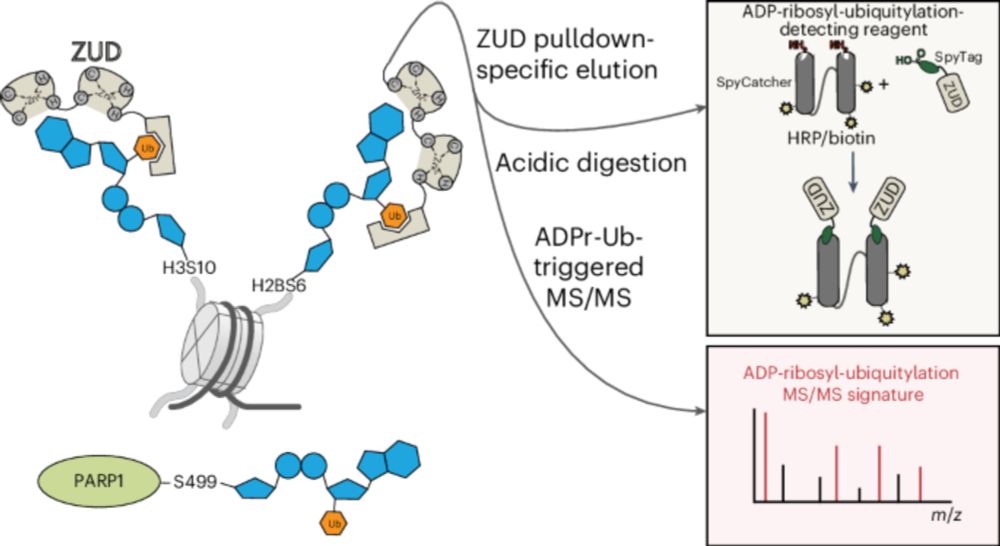
Serine ADPr on histones and PARP1 is a cellular target of ester-linked ubiquitylation - Nature Chemical Biology
RNF114 is an E3 ligase that can recognize ADP-ribose (ADPr) and ubiquitin with separate domains. Using these domains, Kolvenbach and Palumbieri et al. developed a proteomics approach to map ADP-ribosy...
www.nature.com
July 9, 2025 at 12:00 PM
Our latest study on ADP-ribosyl-linked serine ubiquitylation in the context of PARP1 signaling and the DNA damage response is out today in Nature Chemical Biology www.nature.com/articles/s41...
Reposted by Nicolas Bigot

My former lab at the University of Oxford is looking for a postdoc to study ADP-ribosylation and ubiquitination signalling in DNA damage using biochemistry and structural biology.
my.corehr.com/pls/uoxrecru...
Informal inquiries can be sent to Prof Ivan Ahel via email: ivan.ahel@path.ox.ac.uk.
my.corehr.com/pls/uoxrecru...
Informal inquiries can be sent to Prof Ivan Ahel via email: ivan.ahel@path.ox.ac.uk.
'
my.corehr.com
June 4, 2025 at 1:02 PM
My former lab at the University of Oxford is looking for a postdoc to study ADP-ribosylation and ubiquitination signalling in DNA damage using biochemistry and structural biology.
my.corehr.com/pls/uoxrecru...
Informal inquiries can be sent to Prof Ivan Ahel via email: ivan.ahel@path.ox.ac.uk.
my.corehr.com/pls/uoxrecru...
Informal inquiries can be sent to Prof Ivan Ahel via email: ivan.ahel@path.ox.ac.uk.
Reposted by Nicolas Bigot
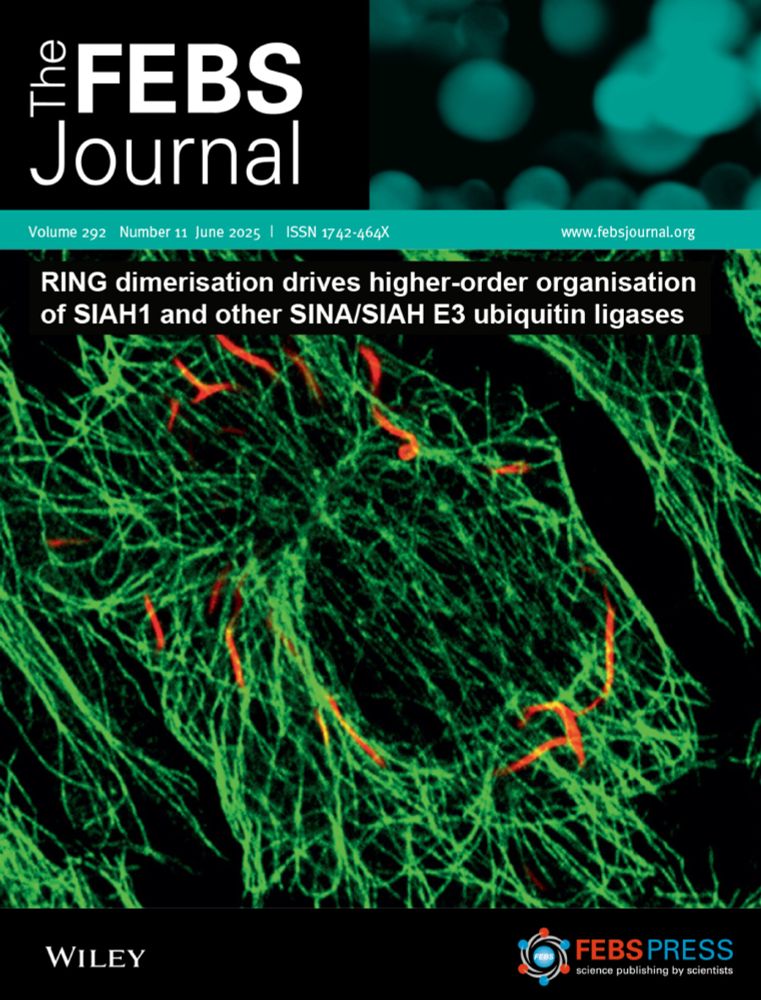
Very happy that our SIAH1 article - published online in February - was now chosen for the cover of the new issue of the @febsj.bsky.social . Thank you @spartelab.bsky.social for the wonderful collaboration and the lovely cellular images. febs.onlinelibrary.wiley.com/toc/17424658...
June 5, 2025 at 5:49 AM
Very happy that our SIAH1 article - published online in February - was now chosen for the cover of the new issue of the @febsj.bsky.social . Thank you @spartelab.bsky.social for the wonderful collaboration and the lovely cellular images. febs.onlinelibrary.wiley.com/toc/17424658...
Reposted by Nicolas Bigot
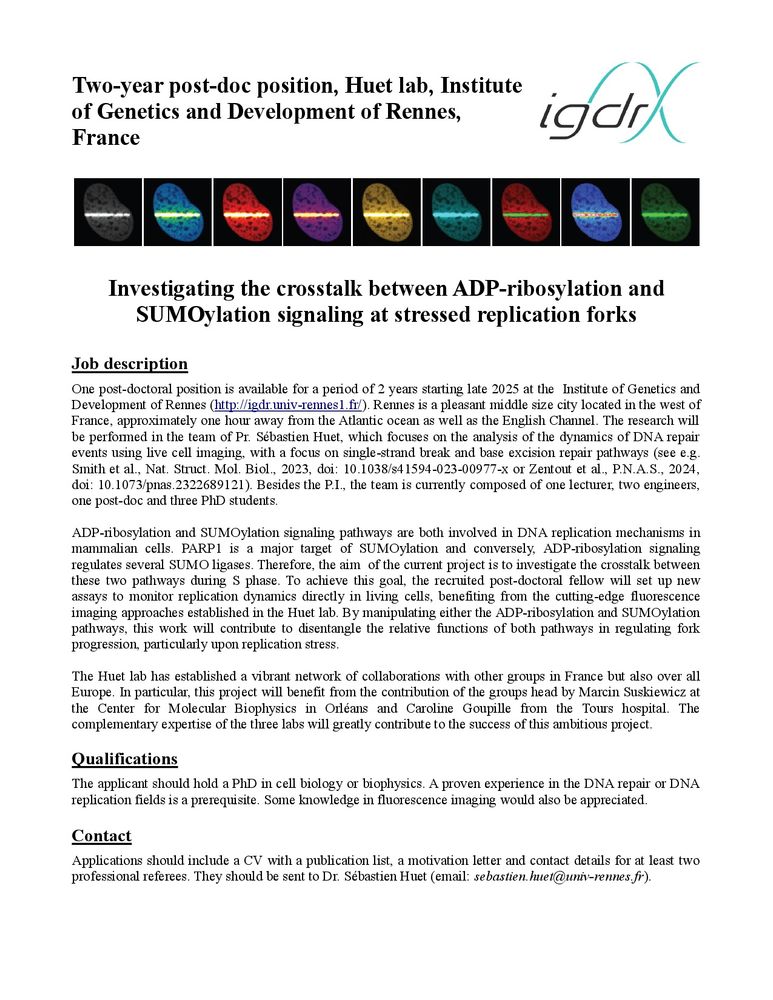
Two year postdoc position available in the Sparte lab at IGDR to investigate the crosstalk between ADP-ribosylation and SUMOylation signaling at stressed replication forks
May 27, 2025 at 2:30 PM
Two year postdoc position available in the Sparte lab at IGDR to investigate the crosstalk between ADP-ribosylation and SUMOylation signaling at stressed replication forks
Reposted by Nicolas Bigot

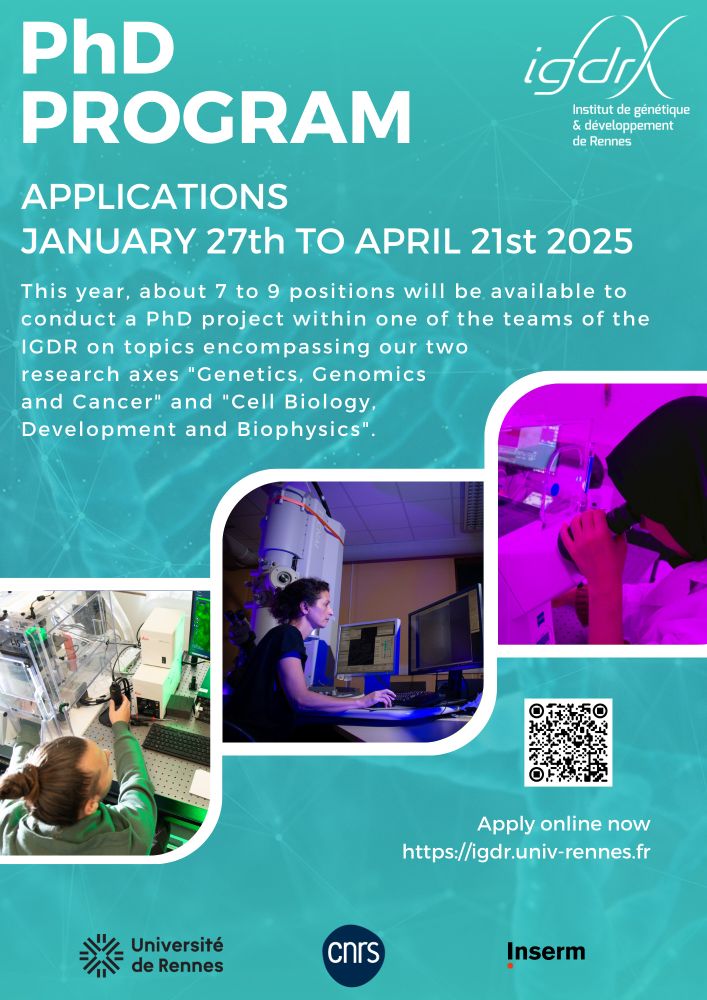
📢Are you planning to do a #PhD in #Biology? There's still a month to apply at #IGDR PhD call!
Apply before April 21st, 1:00 pm
7 to 9 positions
ℹ️https://igdr.univ-rennes.fr/en/application-igdr-phd-program
cc @cnrs-bretagneloire.bsky.social @insermgrandouest.bsky.social @rennesuniv.bsky.social
Apply before April 21st, 1:00 pm
7 to 9 positions
ℹ️https://igdr.univ-rennes.fr/en/application-igdr-phd-program
cc @cnrs-bretagneloire.bsky.social @insermgrandouest.bsky.social @rennesuniv.bsky.social
March 21, 2025 at 11:43 AM
📢Are you planning to do a #PhD in #Biology? There's still a month to apply at #IGDR PhD call!
Apply before April 21st, 1:00 pm
7 to 9 positions
ℹ️https://igdr.univ-rennes.fr/en/application-igdr-phd-program
cc @cnrs-bretagneloire.bsky.social @insermgrandouest.bsky.social @rennesuniv.bsky.social
Apply before April 21st, 1:00 pm
7 to 9 positions
ℹ️https://igdr.univ-rennes.fr/en/application-igdr-phd-program
cc @cnrs-bretagneloire.bsky.social @insermgrandouest.bsky.social @rennesuniv.bsky.social
Reposted by Nicolas Bigot
📢 Vous envisagez de faire un #PhD en #Biologie ? Il vous reste un mois pour candidater à notre appel #IGDR !
Candidatez avant le 21 avril, 13h
ℹ️https://igdr.univ-rennes.fr/concours-doctoral-de-ligdr cc
@cnrs-bretagneloire.bsky.social
@insermgrandouest.bsky.social
@rennesuniv.bsky.social
Candidatez avant le 21 avril, 13h
ℹ️https://igdr.univ-rennes.fr/concours-doctoral-de-ligdr cc
@cnrs-bretagneloire.bsky.social
@insermgrandouest.bsky.social
@rennesuniv.bsky.social

March 21, 2025 at 11:43 AM
📢 Vous envisagez de faire un #PhD en #Biologie ? Il vous reste un mois pour candidater à notre appel #IGDR !
Candidatez avant le 21 avril, 13h
ℹ️https://igdr.univ-rennes.fr/concours-doctoral-de-ligdr cc
@cnrs-bretagneloire.bsky.social
@insermgrandouest.bsky.social
@rennesuniv.bsky.social
Candidatez avant le 21 avril, 13h
ℹ️https://igdr.univ-rennes.fr/concours-doctoral-de-ligdr cc
@cnrs-bretagneloire.bsky.social
@insermgrandouest.bsky.social
@rennesuniv.bsky.social
Reposted by Nicolas Bigot
📢 Vous envisagez de faire un #PhD en #Biologie ? Ne manquez pas notre appel pour le programme doctoral #IGDR !
Candidatez avant le 21 avril, 13h
ℹ️https://igdr.univ-rennes.fr/concours-doctoral-de-ligdr
cc @cnrs-bretagneloire.bsky.social @insermgrandouest.bsky.social @rennesuniv.bsky.social
Candidatez avant le 21 avril, 13h
ℹ️https://igdr.univ-rennes.fr/concours-doctoral-de-ligdr
cc @cnrs-bretagneloire.bsky.social @insermgrandouest.bsky.social @rennesuniv.bsky.social

March 3, 2025 at 3:02 PM
📢 Vous envisagez de faire un #PhD en #Biologie ? Ne manquez pas notre appel pour le programme doctoral #IGDR !
Candidatez avant le 21 avril, 13h
ℹ️https://igdr.univ-rennes.fr/concours-doctoral-de-ligdr
cc @cnrs-bretagneloire.bsky.social @insermgrandouest.bsky.social @rennesuniv.bsky.social
Candidatez avant le 21 avril, 13h
ℹ️https://igdr.univ-rennes.fr/concours-doctoral-de-ligdr
cc @cnrs-bretagneloire.bsky.social @insermgrandouest.bsky.social @rennesuniv.bsky.social
Reposted by Nicolas Bigot
Will these tools further exacerbate biases in the literature: if the opinion of those who write many papers gets fed into their training more than the opinion of those who write sparingly?
Scientists should use their precious time to do good science, not to write many papers...
Scientists should use their precious time to do good science, not to write many papers...

Many scientists who have tried OpenAI's 'deep research' tool are impressed with its ability to write literature reviews or full review papers and even identify gaps in knowledge. But others are less enthusiastic.
https://go.nature.com/4gu9uOo
https://go.nature.com/4gu9uOo

OpenAI’s ‘deep research’ tool: is it useful for scientists?
The model produces cited, pages-long reports that might be helpful for generating literature reviews.
go.nature.com
February 7, 2025 at 7:50 AM
Will these tools further exacerbate biases in the literature: if the opinion of those who write many papers gets fed into their training more than the opinion of those who write sparingly?
Scientists should use their precious time to do good science, not to write many papers...
Scientists should use their precious time to do good science, not to write many papers...
Reposted by Nicolas Bigot
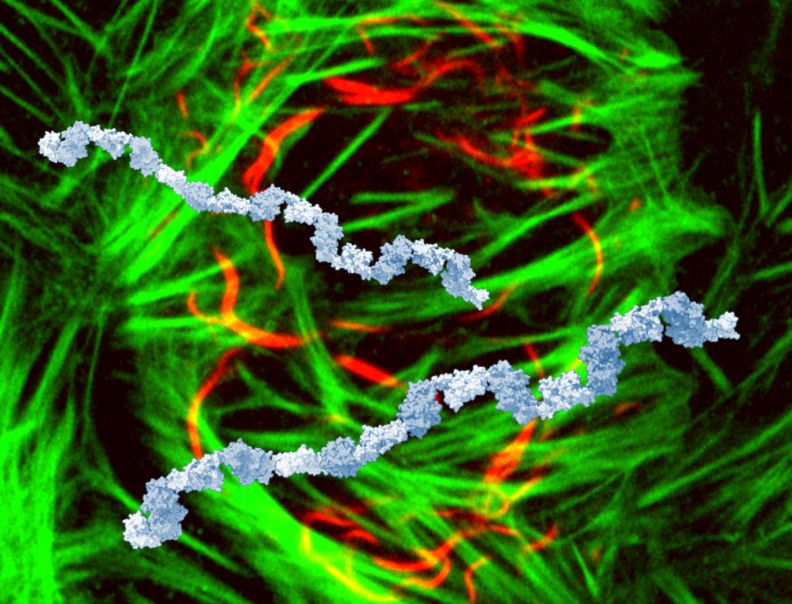
This is a cover design that wasn't accepted, showing SIAH1 multimers on top of cells (SIAH1 red, actin green). We were not able to visualise SIAH1 chains in vitro, as we could only purify N- or C-term halves of SIAH1 separately: the blue chains are made from combined dimeric structures of each half.
February 6, 2025 at 10:17 AM
This is a cover design that wasn't accepted, showing SIAH1 multimers on top of cells (SIAH1 red, actin green). We were not able to visualise SIAH1 chains in vitro, as we could only purify N- or C-term halves of SIAH1 separately: the blue chains are made from combined dimeric structures of each half.