



Nick Jourjine
@nickjourjine.bsky.social
Brains and bioacoustics // postdoc using animal diversity to understand animal behavior // nickjourjine.github.io // he, him
I organize the Bridging Brains and Bioacoustics seminar series: braincoustics.bsky.social // braincoustics.com
I organize the Bridging Brains and Bioacoustics seminar series: braincoustics.bsky.social // braincoustics.com
We began a pilot experiment. Lots of sciencey excitement! Then, (pole)catastrophe. Something weaseled into the barn and started killing mice. It kept coming back until it was caught and ID'd: a polecat with a rude demeanor, an appetite for small mammals, and exceptionally bad scientific timing
8/11
8/11

June 20, 2025 at 7:21 PM
We began a pilot experiment. Lots of sciencey excitement! Then, (pole)catastrophe. Something weaseled into the barn and started killing mice. It kept coming back until it was caught and ID'd: a polecat with a rude demeanor, an appetite for small mammals, and exceptionally bad scientific timing
8/11
8/11
After some troubleshooting, we assembled an ultrasonic speaker for ~$220, and confirmed qualitatively that it plays mouse ultrasonic calls up to at least ~60 kHz (see alt text for a note on the background in the playback). Not dirt cheap, but a lot cheaper than most commercial options.
7/11
7/11

June 20, 2025 at 7:21 PM
After some troubleshooting, we assembled an ultrasonic speaker for ~$220, and confirmed qualitatively that it plays mouse ultrasonic calls up to at least ~60 kHz (see alt text for a note on the background in the playback). Not dirt cheap, but a lot cheaper than most commercial options.
7/11
7/11
Squeaks seemed to be associated with male RFID box use during the spring mating season. We hypothesized that these came from males fighting for box access, and that playback of Caspar's fight squeaks might be sufficient to alter social groups, perhaps by driving subordinate males out of boxes.
4/11
4/11

June 20, 2025 at 7:21 PM
Squeaks seemed to be associated with male RFID box use during the spring mating season. We hypothesized that these came from males fighting for box access, and that playback of Caspar's fight squeaks might be sufficient to alter social groups, perhaps by driving subordinate males out of boxes.
4/11
4/11
Big picture: Vocalization in wild house mice is seasonal, and vocal signals likely shape group dynamics
What's next? Disentangling how exactly they shape group dynamics, and how they are in turn shaped by variables like social context, temperature, and physiology. Stay tuned!
7/8
What's next? Disentangling how exactly they shape group dynamics, and how they are in turn shaped by variables like social context, temperature, and physiology. Stay tuned!
7/8

June 18, 2025 at 6:26 PM
Big picture: Vocalization in wild house mice is seasonal, and vocal signals likely shape group dynamics
What's next? Disentangling how exactly they shape group dynamics, and how they are in turn shaped by variables like social context, temperature, and physiology. Stay tuned!
7/8
What's next? Disentangling how exactly they shape group dynamics, and how they are in turn shaped by variables like social context, temperature, and physiology. Stay tuned!
7/8
What about shorter time scales? Tricky because we didn't record video, but we did align audio to RFID timestamps
Takeaways:
1. Vocalization is associated with box entrances/exits
2. Vocalization during a meeting b/w 2 mice is on average positively correlated with duration of future meetings
6/8
Takeaways:
1. Vocalization is associated with box entrances/exits
2. Vocalization during a meeting b/w 2 mice is on average positively correlated with duration of future meetings
6/8


June 18, 2025 at 6:26 PM
What about shorter time scales? Tricky because we didn't record video, but we did align audio to RFID timestamps
Takeaways:
1. Vocalization is associated with box entrances/exits
2. Vocalization during a meeting b/w 2 mice is on average positively correlated with duration of future meetings
6/8
Takeaways:
1. Vocalization is associated with box entrances/exits
2. Vocalization during a meeting b/w 2 mice is on average positively correlated with duration of future meetings
6/8
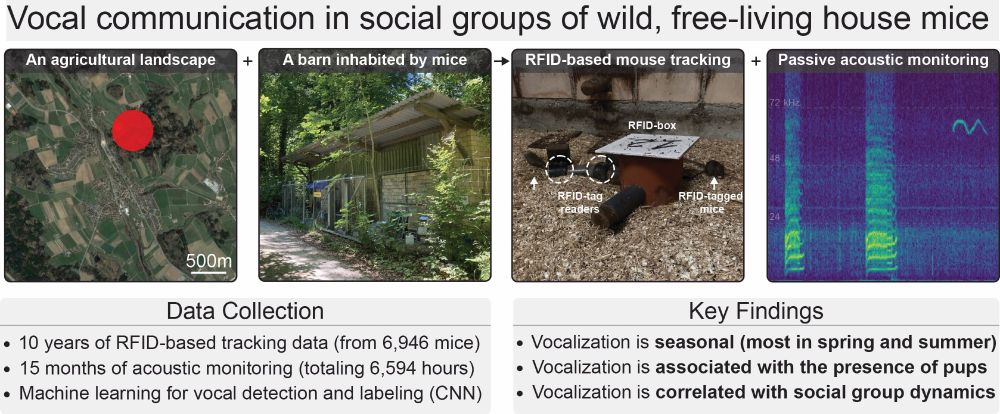
What contributes to these seasonal patterns in vocalization? Pups! The presence of neonates was closely associated with peaks in vocalization in spring and summer
5/8
5/8

June 18, 2025 at 6:26 PM
What contributes to these seasonal patterns in vocalization? Pups! The presence of neonates was closely associated with peaks in vocalization in spring and summer
5/8
5/8
Next we looked at vocalizations w/ 6,000 hrs of RFID box audio (thanks @openacousticdevices.info!) + ML to find vocal events
Takeaways:
1. Vocalization is seasonal: most in spring/summer when social groups are small
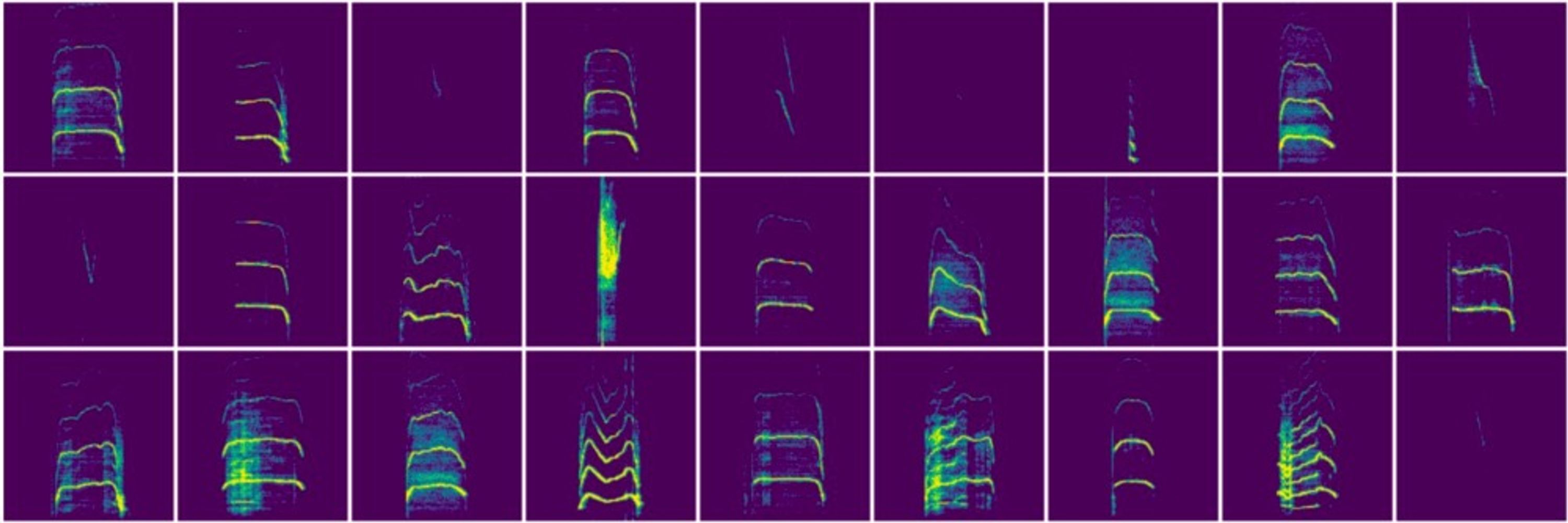
2. Wild mice use both audible squeaks & ultrasonic calls, often close together
4/8
Takeaways:
1. Vocalization is seasonal: most in spring/summer when social groups are small
2. Wild mice use both audible squeaks & ultrasonic calls, often close together
4/8

June 18, 2025 at 6:26 PM
Next we looked at vocalizations w/ 6,000 hrs of RFID box audio (thanks @openacousticdevices.info!) + ML to find vocal events
Takeaways:
1. Vocalization is seasonal: most in spring/summer when social groups are small
2. Wild mice use both audible squeaks & ultrasonic calls, often close together
4/8
Takeaways:
1. Vocalization is seasonal: most in spring/summer when social groups are small
2. Wild mice use both audible squeaks & ultrasonic calls, often close together
4/8
First, we examined social dynamics in 10 years of RFID-based tracking data.
Takeaways:
1. Social groups are seasonal - larger and more stable in winter vs summer
2. Mice occupy larger territories in winter vs summer
3. Females are more central in social networks than males
3/8
Takeaways:
1. Social groups are seasonal - larger and more stable in winter vs summer
2. Mice occupy larger territories in winter vs summer
3. Females are more central in social networks than males
3/8

June 18, 2025 at 6:26 PM
First, we examined social dynamics in 10 years of RFID-based tracking data.
Takeaways:
1. Social groups are seasonal - larger and more stable in winter vs summer
2. Mice occupy larger territories in winter vs summer
3. Females are more central in social networks than males
3/8
Takeaways:
1. Social groups are seasonal - larger and more stable in winter vs summer
2. Mice occupy larger territories in winter vs summer
3. Females are more central in social networks than males
3/8
We studied wild house mice (Mus musculus domesticus) living in a barn in the Swiss countryside. All mice in this population are RFID-tagged and their social interactions have been tracked via RFID reader-equipped boxes for over a decade(!)
Check out the details here: doi.org/10.1186/s403...
2/8
Check out the details here: doi.org/10.1186/s403...
2/8

June 18, 2025 at 6:26 PM
We studied wild house mice (Mus musculus domesticus) living in a barn in the Swiss countryside. All mice in this population are RFID-tagged and their social interactions have been tracked via RFID reader-equipped boxes for over a decade(!)
Check out the details here: doi.org/10.1186/s403...
2/8
Check out the details here: doi.org/10.1186/s403...
2/8
Very happy to share the latest from my postdoc!
10 yrs of mouse social networks + 1.25 yrs of acoustic data ➡️ insight into vocalization & sociality in a wild population of your favorite lab model 🐁
paper: bit.ly/4n93yyD
data: bit.ly/4lfFBEk
code: bit.ly/4kNnMwx
#bioacoustics #neuroskyence
1/8
10 yrs of mouse social networks + 1.25 yrs of acoustic data ➡️ insight into vocalization & sociality in a wild population of your favorite lab model 🐁
paper: bit.ly/4n93yyD
data: bit.ly/4lfFBEk
code: bit.ly/4kNnMwx
#bioacoustics #neuroskyence
1/8
June 18, 2025 at 6:26 PM
Very happy to share the latest from my postdoc!
10 yrs of mouse social networks + 1.25 yrs of acoustic data ➡️ insight into vocalization & sociality in a wild population of your favorite lab model 🐁
paper: bit.ly/4n93yyD
data: bit.ly/4lfFBEk
code: bit.ly/4kNnMwx
#bioacoustics #neuroskyence
1/8
10 yrs of mouse social networks + 1.25 yrs of acoustic data ➡️ insight into vocalization & sociality in a wild population of your favorite lab model 🐁
paper: bit.ly/4n93yyD
data: bit.ly/4lfFBEk
code: bit.ly/4kNnMwx
#bioacoustics #neuroskyence
1/8
Not sure it you already found your answer, but you can add axes=FALSE, ylab="", xlab="" when you do dfreq, like:
dfreq(sample1, f=f, ovlp=0, threshold=13, type="l", col="red", lwd=2, axes=FALSE, ylab="", xlab="")
This is what I get without vs. with these extra plot parameters:
dfreq(sample1, f=f, ovlp=0, threshold=13, type="l", col="red", lwd=2, axes=FALSE, ylab="", xlab="")
This is what I get without vs. with these extra plot parameters:


May 16, 2025 at 1:49 PM
Not sure it you already found your answer, but you can add axes=FALSE, ylab="", xlab="" when you do dfreq, like:
dfreq(sample1, f=f, ovlp=0, threshold=13, type="l", col="red", lwd=2, axes=FALSE, ylab="", xlab="")
This is what I get without vs. with these extra plot parameters:
dfreq(sample1, f=f, ovlp=0, threshold=13, type="l", col="red", lwd=2, axes=FALSE, ylab="", xlab="")
This is what I get without vs. with these extra plot parameters: